How to use AI interview tools without losing human judgment
Automate the parts of screening that humans do badly anyway — consistency, scheduling, identity verification, and rubric application — and protect the parts humans still do better: context, judgment, and read-the-room calls. That is the practical division behind every AI hiring rollout worth running.
If you're a recruiter or hiring manager evaluating AI interview tools — software that conducts, scores, or supports structured candidate interviews using machine learning — the question is rarely whether to adopt them. It's where to draw the line. The mistake we see most often is binary thinking. Teams either bolt an AI interviewer onto the top of their funnel and call it done, or they refuse to use AI-assisted screening at all because "hiring is human." Both positions miss the point.
This guide explains where AI interview tools create value, where human involvement remains essential, and how hiring teams can implement automated interviewing without sacrificing hiring quality.
What are AI interview tools?
AI interview tools are platforms that automate specific parts of the hiring process. Depending on the use case, they can:
- Conduct structured interviews
- Ask standardized questions
- Score responses against predefined rubrics
- Verify candidate identity
- Detect suspicious assessment behavior
- Schedule interviews automatically
Note: some vendors in the broader market also offer note-taking, transcription, and post-interview summary features under the label "AI interview assistants." These are general market capabilities and are not part of every platform, including HackerEarth's. Buyers should verify which features any specific product supports.
What these tools share is the ability to introduce consistency into hiring processes that are often highly variable.
Types of AI interview tools and where each fits
Organizations typically use AI interview tools in several ways. AI screening interviews are used for early-stage candidate evaluation and high-volume hiring — for example, screening 500+ applicants for entry-level software engineering or customer support roles before committing recruiter time. AI technical interviews evaluate technical skills using structured coding exercises and predefined scoring criteria, common for mid-level engineering hiring at companies like Atlassian, Stripe, or similar volume technical employers. AI proctoring tools focus on fraud prevention and identity verification during remote assessments — increasingly important as remote-first hiring becomes standard. AI candidate evaluation platforms help recruiters compare, rank, and shortlist candidates based on structured frameworks, typically integrated into an ATS like Greenhouse or Workday.
Most hiring teams use a combination of these rather than relying on a single solution. HackerEarth's technical assessments and OnScreen interview platform cover screening, technical evaluation, and proctoring in one workflow.
Why AI hiring tools matter for recruiters today
The biggest challenge in hiring is not attracting applicants. It is generating reliable hiring signals.
Human interviewers are naturally inconsistent. Different interviewers ask different questions, evaluate candidates differently, and often rely on intuition rather than structured evidence. For a recruiter managing 40+ open requisitions, that variability means two equally qualified candidates can receive opposite recommendations depending on who interviewed them.
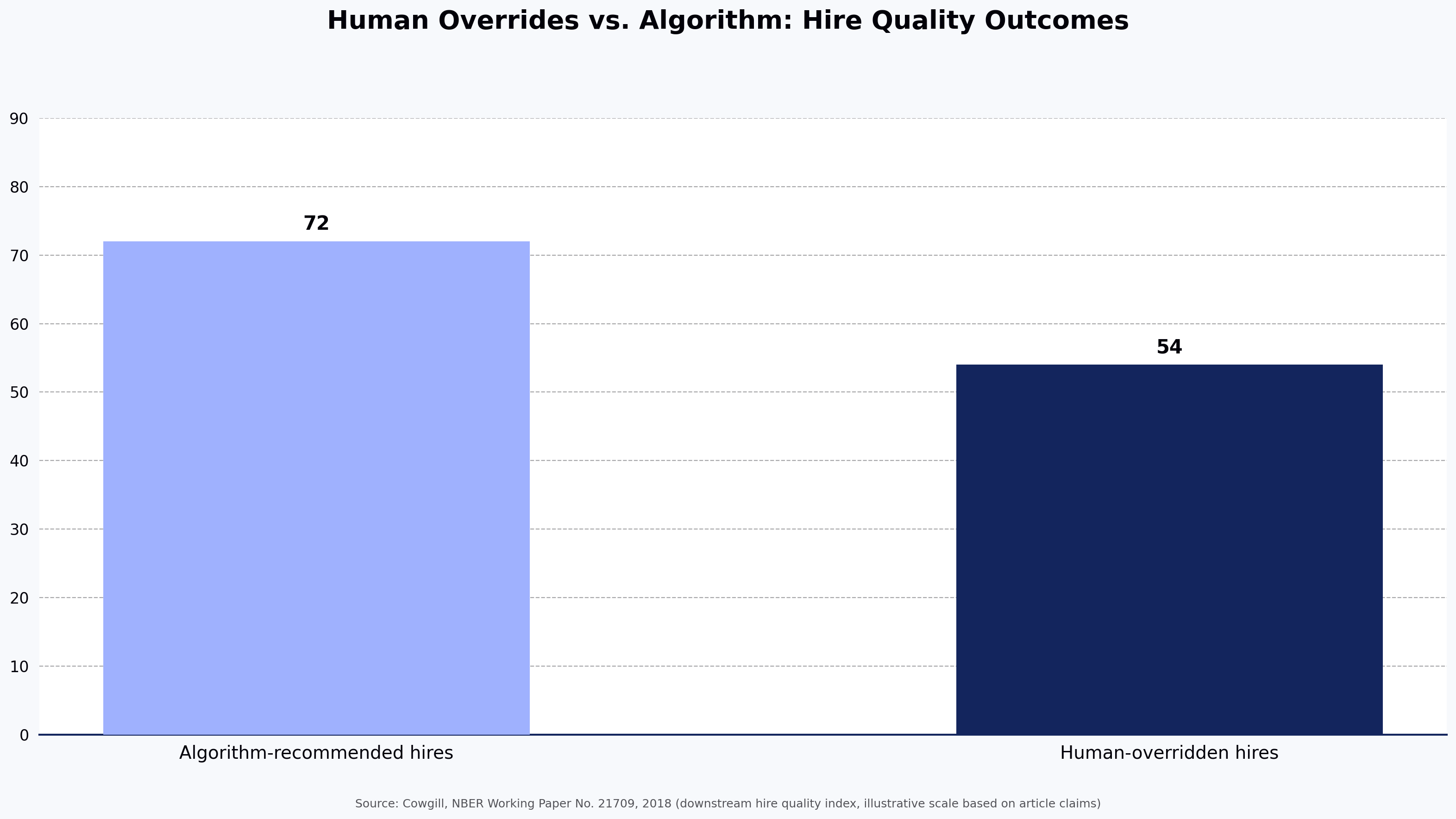
A working paper from the National Bureau of Economic Research by Bo Cowgill (Columbia Business School, 2018), "Bias and Productivity in Humans and Algorithms," analyzed over 300,000 hiring decisions and found that managers who overrode algorithmic resume-screening recommendations frequently produced worse downstream hires than the algorithms themselves. The relevance to a recruiter's daily workflow: when hiring managers reject candidates that structured screening surfaces, the override is often the source of the noise — not the algorithm.
Similarly, research in Noise: A Flaw in Human Judgment by Daniel Kahneman, Olivier Sibony, and Cass Sunstein (Little, Brown Spark, 2021) documents that unstructured interviews produce inconsistent candidate evaluations across interviewers evaluating the same candidate (see Chapter 24, "Structure in Hiring"). AI interview tools address this by enforcing structure on the parts of screening where structure works.
Step 1: Identify which hiring activities benefit from automation
Not every hiring activity should be automated. The first step is identifying which parts of hiring are operational and which require judgment.
Activities that work well with AI
AI interview tools perform best when evaluation criteria are structured and repeatable. These include initial technical screening, structured behavioral interviews, identity verification, coding assessment proctoring, interview scheduling, first-pass rubric scoring, and candidate ranking against predefined criteria.
The value comes from consistency. Every candidate receives the same experience and is evaluated using the same standards.
Activities that should remain human-led
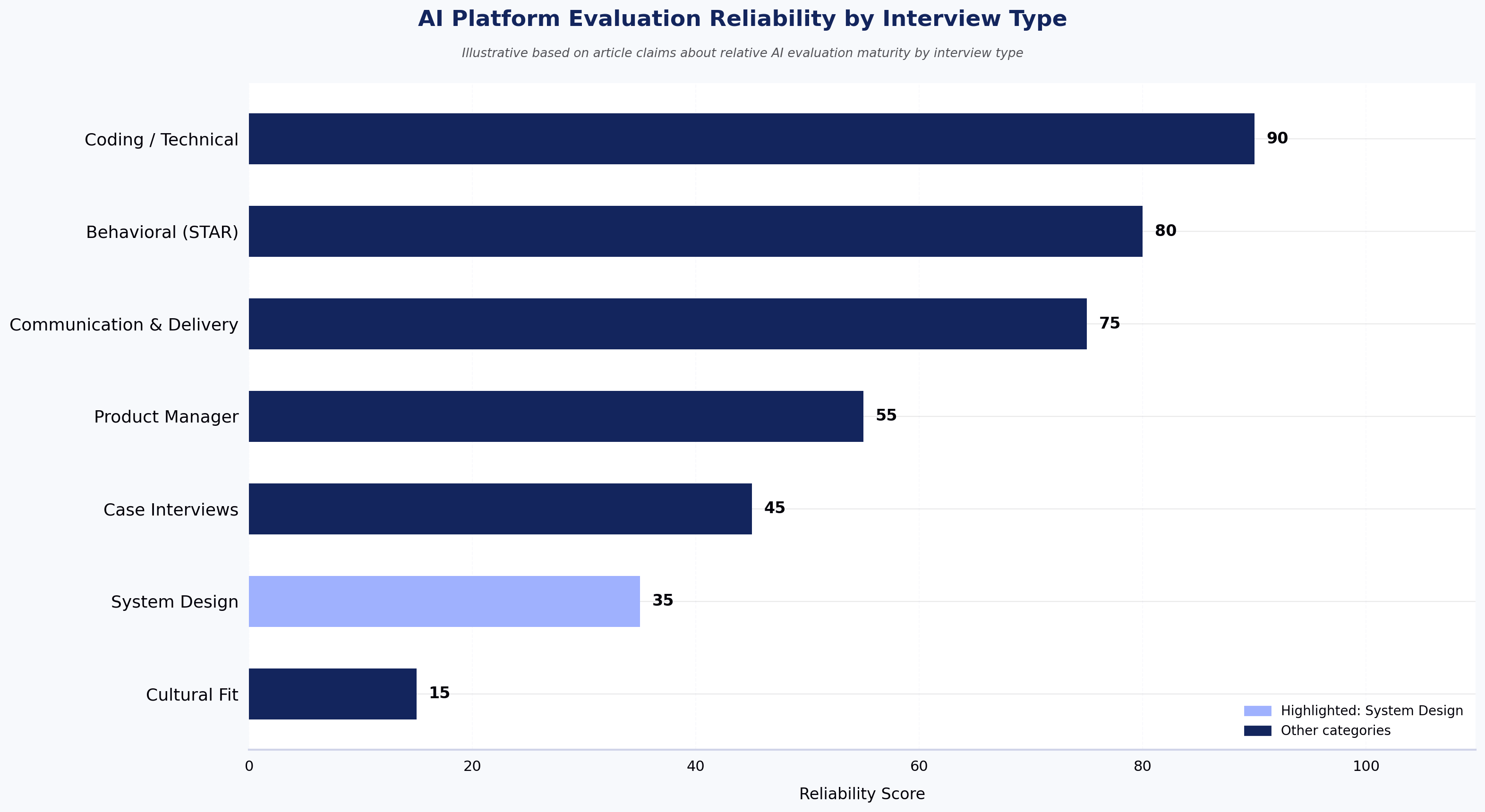
Some hiring decisions depend heavily on context. These include team-fit conversations, senior leadership hiring, system design discussions, judgment-based evaluations, borderline candidate reviews, offer negotiations, and final hiring decisions.
These areas require interpretation, nuance, and organizational understanding that AI systems cannot reliably replicate.
Step 2: Understand where AI interview tools fail
The biggest risks emerge when organizations automate decisions that should remain human.
Cultural and team-fit assessment
Successful collaboration depends on interpersonal dynamics. An AI system cannot determine whether a candidate will thrive within a particular team environment or work effectively alongside future colleagues.
Senior and staff-level evaluation
At senior levels, the most important signals involve judgment under ambiguity. Organizations hire staff engineers and leaders for decisions that do not fit predefined rubrics. AI interview tools are optimized for structure, while senior hiring often depends on evaluating how candidates operate without it.
Edge-case context
Strong candidates do not always provide conventional answers. Experienced interviewers can recognize when a candidate has approached a problem differently but correctly. AI systems often struggle to distinguish between incorrect answers and unconventional thinking.
Legally consequential decisions
Hiring regulations increasingly require transparency and oversight for AI-assisted hiring. Examples include:
- New York City Local Law 144 — requires employers using automated employment decision tools to conduct an annual independent bias audit, publish a summary of results, and notify candidates at least 10 business days before use.
- The EU AI Act — classifies AI systems used for recruitment and candidate screening as "high-risk," requiring providers and deployers to meet obligations including risk management, data governance, transparency to candidates, human oversight, and conformity assessment before deployment.
- Emerging AI governance frameworks in Illinois (AI Video Interview Act), Maryland, and Colorado.
Any AI-assisted hiring process should include documented human oversight and auditability. Read more in our hiring compliance overview.
Step 3: Create a practical division of labor
Step 1 covered the what — which activities suit AI versus humans. This step covers the how — building that split into a workflow your team can run on Monday morning.
Set explicit thresholds. For example: candidates scoring above the 70th percentile on a structured technical assessment advance to a human technical interview; candidates between the 50th and 70th percentile receive recruiter review before any rejection; candidates below the 50th percentile are auto-rejected only after a bias audit confirms the rubric is not screening out protected groups disproportionately. Sample rubric weights for a mid-level backend role might look like: code correctness 40%, code quality 25%, problem decomposition 20%, communication 15%.
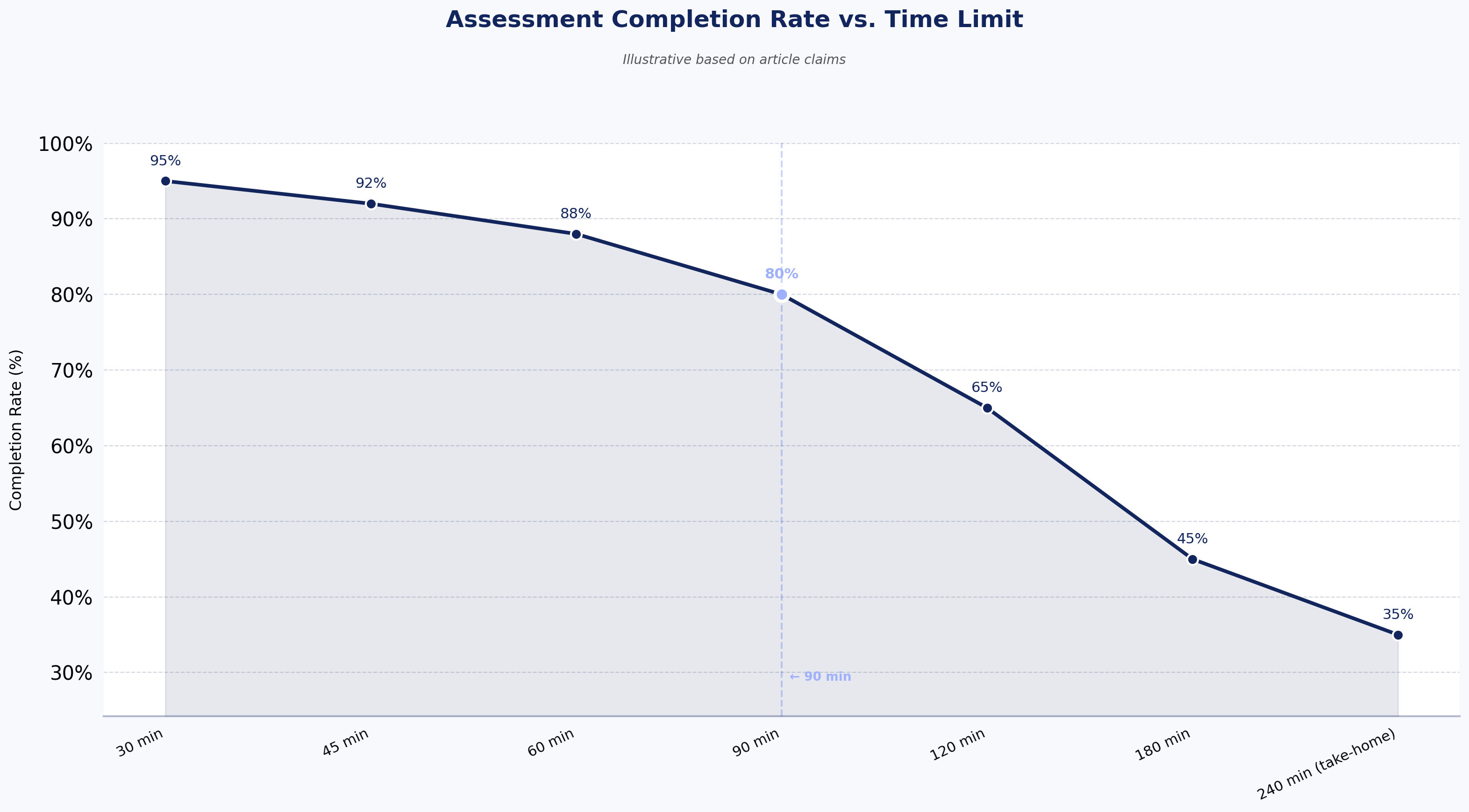
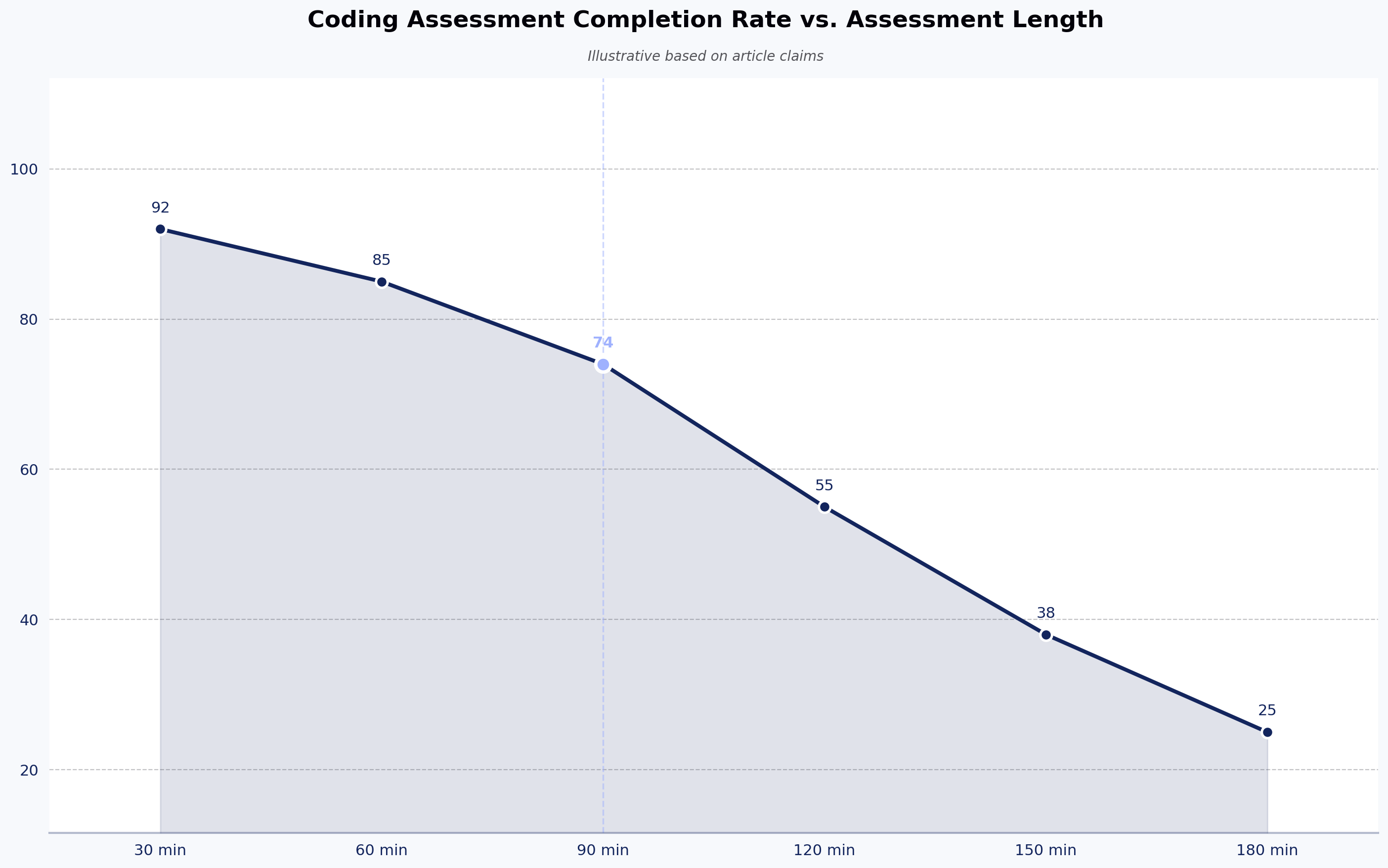
Track completion rate as a leading indicator. Industry benchmarks for asynchronous AI interviews typically fall between 60–75% completion; if yours drops below 60%, candidate experience or instructions need work before you scale.
Guiding principle: AI should expand and standardize the funnel. Humans should make the decisions that close it.
An AI tool that lets a marginal candidate (say, a 65th-percentile score) reach a human interview costs a small amount of interviewer time. An AI tool that rejects a strong candidate creates a missed hire that may never be recovered.
Step 4: Calibrate AI against historical hiring data
Many organizations deploy AI interview tools without validating whether the system would have identified successful employees from the past.
Before implementation:
- Run historical candidates through the AI evaluation process.
- Compare AI recommendations against actual hiring outcomes.
- Analyze discrepancies.
- Refine scoring rubrics before launch.
If the AI system would have rejected several successful hires, the problem is usually the rubric, not the candidates.
Step 5: Keep humans in the loop
The best AI hiring programs maintain human oversight throughout the process.
Review borderline rejections
Candidates within 5–10 percentile points of the cutoff should receive human review. A short recruiter review can prevent high-potential candidates from being filtered out unnecessarily.
Monitor rubric drift
Hiring requirements evolve over time. Human oversight helps identify when AI evaluation systems begin drifting away from actual indicators of hiring success — for example, if 12-month retention among AI-recommended hires drops below the retention rate of human-screened hires, the rubric needs recalibration.
Maintain escalation paths
Candidates should always have a path to human interaction when needed. Transparency improves candidate experience and strengthens trust in the hiring process.
Step 6: Measure outcomes instead of activity
Many organizations focus on operational metrics such as interviews completed, candidates screened, and time saved. These metrics do not measure hiring quality.
Measure what matters
- 12-month retention — tracks whether employees remain with the company and succeed over time.
- Performance reviews — measures whether hires deliver expected business impact.
- Hiring manager satisfaction — provides direct feedback on candidate quality.
- Time-to-hire — measures hiring efficiency without sacrificing quality.
- Candidate completion rates — help identify friction points and candidate experience issues.
Track these against pre-AI baselines so you can identify whether AI-assisted screening is contributing to better hires or just faster ones.
Step 7: Manage candidate experience carefully
Candidate reactions to AI interviews vary significantly.
What candidates often like
- Flexible scheduling
- Faster response times
- On-demand interview completion
- Reduced scheduling friction
Common concerns
- Lack of human interaction
- Difficulty building rapport
- Concerns about fairness
- Uncertainty about how responses are evaluated
Organizations should clearly communicate how AI is being used, what is being evaluated, how decisions are made, and when humans are involved. Transparency is increasingly both an operational norm and a regulatory expectation.
Common mistakes when implementing AI interview tools
Most implementation failures follow predictable patterns:
- Replacing humans too early in the hiring process
- Using AI as the sole basis for rejection decisions
- Failing to validate scoring rubrics
- Measuring efficiency instead of hiring quality
- Ignoring candidate experience metrics
- Neglecting bias audits and compliance reviews
Organizations that avoid these mistakes typically achieve stronger hiring outcomes and higher candidate trust.
Where HackerEarth OnScreen fits
The compliance, calibration, and human-in-the-loop requirements above raise an operational question: which platform actually combines structured AI screening with the proctoring and identity verification that bias audits and remote hiring require? HackerEarth OnScreen combines in-depth interviewing, integrated proctoring, and KYC-grade identity verification — a combination no single product has previously offered in this category. The AI handles the structured-screening layer (rubric-based scoring against role-specific criteria your team defines, identity verification, and proctoring signal) so human interviewers focus their time on the later-stage judgment calls Step 1 identified as off-limits to automation.
Frequently asked questions
Are AI interview tools more biased than human interviewers?
AI interview tools apply evaluation criteria more consistently than human interviewers, but they can encode bias if trained on biased historical data. Annual bias audits, as required by NYC Local Law 144, and ongoing human review of borderline rejections are how organizations keep that risk in check.
When should organizations avoid AI interviews?
Organizations should avoid AI interviews for executive search, C-suite hiring, highly specialized roles where the rubric cannot be defined in advance, and any interview stage where judgment under ambiguity is the primary signal being measured.
How can organizations determine whether an AI interview tool is successful?
The clearest measure of success is whether AI-screened hires retain and perform at least as well as human-screened hires over 12 months. Pair that with hiring manager satisfaction surveys and completion-rate benchmarks to get a full picture.
Do candidates dislike AI interviews?
Candidate reaction depends on transparency and optionality. Some candidates appreciate flexibility and convenience, while others prefer human interaction; offering an opt-in human touchpoint and clearly explaining how the AI evaluation works closes most of the experience gap.
What compliance considerations apply to AI interview tools?
Organizations using AI interview tools must maintain bias audit documentation, candidate disclosures, audit trails, and documented human oversight to meet regulations including NYC Local Law 144, the EU AI Act, and Illinois's AI Video Interview Act.
Key takeaways
- The Cowgill (NBER, 2018) finding — that human overrides of algorithmic screening produced worse hires across 300,000 decisions — is the single strongest argument for keeping AI in the early funnel and humans in the late funnel.
- NYC Local Law 144 requires an annual independent bias audit and 10-business-day candidate notification; the EU AI Act classifies hiring AI as high-risk and requires human oversight by law.
- Calibrate AI tools by running 12–24 months of historical hires through the system before launch; if it would have rejected your top performers, fix the rubric.
- Set percentile-based escalation thresholds (e.g., review every candidate within 5–10 points of the cutoff) so borderline cases always reach human eyes.
- Measure 12-month retention and hiring manager satisfaction against pre-AI baselines — not interviews completed.
See it in action
Schedule a demo of HackerEarth OnScreen to map which stages of your current hiring workflow can move to AI screening, which must stay human-led, and how to set percentile thresholds and bias audits aligned with NYC Local Law 144 and the EU AI Act before you scale.