Meta title: How to get hiring managers to complete scorecards Meta description: How to get hiring managers to complete scorecards: the conversation, the timing, and the systems that actually move debrief compliance past 80%.
How to get hiring managers to complete scorecards: a recruiter's guide to the conversation that actually works
Getting hiring managers to complete scorecards is less a workflow problem than a negotiation problem. The recruiters who consistently pull scorecards on time have figured out how to make completion feel like the hiring manager's win — not the recruiter's chore. This guide is about the specific conversation, timing, and lightweight systems that move debrief compliance from "chased for three days" to "in the ATS before the next interview."
If you have ever sent the fourth "gentle nudge" on a Thursday afternoon, you already know the standard advice — "make it part of your process" — doesn't survive contact with a hiring manager whose sprint just slipped. What follows is a recruiter-to-recruiter playbook on how to get hiring managers to complete scorecards without becoming the person they mute in Slack.
Why hiring managers don't complete scorecards (be honest about the cause)
Scorecard non-compliance is almost never about laziness. In our experience running assessments and interview loops for hundreds of hiring teams, the pattern breaks down into four causes, roughly in this order:
- The scorecard asks the wrong questions. Fields like "Culture fit: 1–5" with no rubric are impossible to fill in without feeling either dishonest or exposed to a bias complaint. Hiring managers stall because the form itself is broken.
- The debrief window closed. By the time a hiring manager sits down on Friday, the Tuesday interview is a blur. They either fabricate a score or avoid the task.
- No one has explained what the scorecard is for. If the hiring manager thinks it's an HR compliance artifact, it goes to the bottom of the list. If they think it's how the panel calibrates on the next candidate, it doesn't.
- The recruiter is the only person following up. When escalation never happens, the deadline is fictional.
Naming the cause changes the intervention. A recruiter who chases harder solves none of these. A recruiter who fixes the rubric, shrinks the window, reframes the purpose, or builds an escalation path solves all of them.
The conversation that actually works before the interview
The single highest-leverage moment for scorecard completion is the intake conversation with the hiring manager before the first interview is scheduled — not the reminder afterward.
In that meeting, three things get agreed:
- The rubric. What are we actually evaluating? Three to five competencies, each with a behavioral anchor. "System design at senior level" beats "technical strength." If the hiring manager can't articulate what "good" looks like, the scorecard will fail regardless of tooling.
- The completion window. Scorecard due within 24 hours of the interview, no exceptions. This is the number to negotiate hard on. Anything longer than 24 hours correlates with lower quality and higher attrition of detail — the research on memory decay is well-established, and interview debriefs are no exception (see the classic work summarized in Kahneman and Klein, 2009, on expert judgment, foundational but still cited).
- The escalation. "If a scorecard isn't in by end of day the following day, I'll ping you once. If it's not in 24 hours after that, I'll loop in [the hiring manager's manager or the VP of Engineering]." Say it out loud. Get the nod.
Recruiters often skip the third item because it feels aggressive. It isn't. It's the only thing that turns the deadline into a real one. The hiring manager who agrees to escalation up front rarely needs it invoked.
How to get hiring managers to complete scorecards after the interview (the 24-hour play)
Once the interview happens, the mechanics matter more than the reminders. Here is the sequence that works:
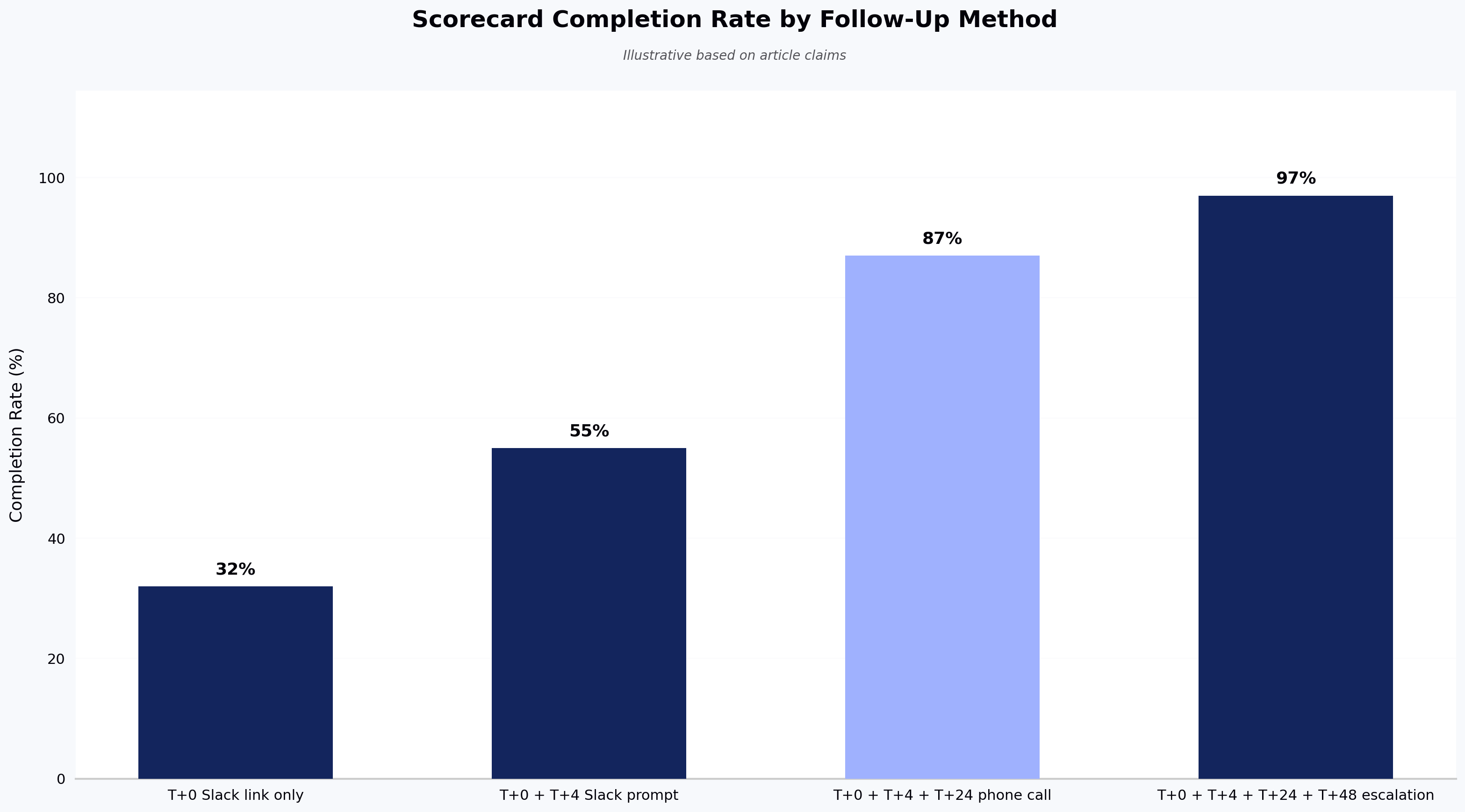
T+0 (immediately after the interview): Send a single Slack message with the scorecard link, the candidate's name, and the specific rubric competencies to score. Not a calendar invite. Not an email. A message they can act on from their phone between meetings.
T+4 hours: If not submitted, a second message. This one includes a one-line prompt: "Quick take — recommend/no recommend and one sentence on why. You can flesh out the rubric later." Lowering the bar to a directional answer often unblocks the full submission within the hour.
T+24 hours: If still not submitted, a call — not a Slack ping. Two minutes of "walk me through what you saw" and a recruiter typing the scorecard live. This is the least popular tactic among recruiters and the most effective. It costs 10 minutes. It closes the loop.
T+48 hours: Escalation, as agreed in the intake. Once. Publicly enough that the hiring manager remembers next time.
The recruiters who complain that they "can't get scorecards in" have almost always skipped step three. They pinged four times and never picked up the phone.
Redesign the scorecard so it can be completed in five minutes
If completion still lags after the conversation and timing fixes, the form itself is the problem. A scorecard that takes 20 minutes to fill in will not get filled in.
The scorecard that gets completed on time has:
- Three to five competencies, not 12
- A hire/no-hire recommendation at the top, not the bottom
- Behavioral anchors under each rating so a "3" means the same thing to every interviewer
- One free-text field for "what would change your mind"
- No "culture fit" field without a defined rubric — it invites bias complaints and produces no signal
The trade-off is real: shorter scorecards capture less nuance, and some engineering managers will push back that a five-competency rubric can't evaluate a staff hire. Fair point. For senior roles, add one rubric-anchored deep-dive competency rather than expanding all fields. Depth in one place beats shallowness across ten.
For teams running high-volume technical hiring, structured skills-based assessments can carry more of the evaluative load upstream, so the post-interview scorecard becomes a calibration document rather than the primary signal. That shifts the hiring manager's job from "assess from scratch" to "confirm or challenge the rubric-applied score" — which is a five-minute task, not a twenty-minute one.
The systems layer: what to automate and what to leave human
Automation helps at the edges. It doesn't fix the underlying accountability problem.
What to automate: - Scorecard link delivery immediately post-interview (most ATS platforms — Greenhouse, Lever, Ashby — do this natively) - Reminder pings at T+4 and T+24 - Dashboard visibility for the hiring manager's manager showing outstanding scorecards by owner
What to keep human: - The intake conversation and the escalation agreement - The T+24 phone call - The quarterly review of which hiring managers consistently miss and why
An honest note: vendor dashboards that promise "automated scorecard compliance" tend to overstate what automation alone can do. Reminders don't create accountability; agreements do. The system exists to make the agreement visible, not to replace it.
For teams where interview volume is high enough that the debrief bottleneck is structural — 40+ interviews a week per hiring manager — the upstream fix is reducing the number of interviews that need debriefs, not automating the debriefs harder. Tools like OnScreen handle initial screening with a deterministic rubric so the hiring manager only debriefs candidates who cleared a structured filter. Fewer interviews, tighter scorecards, better calibration.
When to stop chasing and start reporting
Some hiring managers will never comply consistently. That is a data point, not a failure of the recruiter. Track scorecard completion rate by hiring manager as a quarterly metric and share it with the head of TA and the hiring manager's own leader.
The pattern usually breaks one of three ways: - The hiring manager improves once completion is visible - Their leader intervenes - The organization decides that hiring manager shouldn't be leading loops
All three are acceptable outcomes. What isn't acceptable is a recruiter absorbing the compliance cost silently, quarter after quarter, while candidates drop out because feedback took eight days.
Frequently asked questions
How long should hiring managers have to complete scorecards? 24 hours from the end of the interview. Beyond that, memory decay and calendar pressure combine to produce either fabricated scores or no scores at all. Some teams allow 48 hours for senior loops with system design components; that's the outer limit worth defending.
What's a realistic scorecard completion rate to target? Above 85% within the agreed window is achievable for teams that run the intake conversation and the T+24 phone call. Above 95% requires the escalation path to be real and occasionally invoked. Teams that report 100% compliance are usually not measuring accurately.
Should recruiters fill in scorecards on the hiring manager's behalf? Only during a live 10-minute call where the hiring manager talks and the recruiter types, with the hiring manager reviewing and submitting. Recruiters filling in scorecards asynchronously creates a defensibility problem — the person who observed the interview didn't document it — and undermines calibration.
How do you handle a hiring manager who refuses to use the rubric? Escalate once, then involve the head of TA. Rubric-free hiring is a defensibility risk under most fair-hiring frameworks and a calibration risk regardless of geography. This isn't a preference conversation; it's a program-level decision that a recruiter shouldn't be absorbing alone.
Does AI-generated candidate content change how scorecards should work? Yes. If your screening upstream doesn't verify that the candidate you interviewed is the candidate who did the take-home, the scorecard rubric should include a "consistency with prior signal" check. Interviewers flag divergence; recruiters investigate. This is one of the fastest-growing sources of late-stage no-hires we see.
Key takeaways
- The conversation before the first interview matters more than the reminder after — negotiate the rubric, the 24-hour window, and the escalation path up front.
- Redesign scorecards to five minutes of work: three to five competencies, behavioral anchors, and a hire/no-hire at the top.
- The T+24 phone call is the highest-leverage recruiter move for scorecard completion and the most consistently skipped.
- Automation supports accountability but doesn't create it — agreements do.
- Track completion rate by hiring manager quarterly; make the data visible to their leader.
Next steps
If scorecard compliance is downstream of an interview process that's simply running too hot, the upstream fix — structured screening that reduces the number of full-loop interviews — often does more than any workflow change. See how HackerEarth's assessment and interview platform helps hiring teams tighten the funnel before the debrief bottleneck starts.