Meta title: How to run a hiring intake meeting that builds a rubric Meta description: How to run a hiring intake meeting that produces a usable rubric, not a wish list. A 60-minute agenda, questions, and traps to avoid.
How to run a hiring intake meeting that produces a usable rubric, not a wish list
Most technical hiring fails at the intake meeting. The recruiter walks out with a job description, a list of "must-haves" that reads like a LinkedIn profile of the departing engineer, and no shared definition of what "strong" actually looks like. Learning how to run a hiring intake meeting that produces a usable rubric — not a wish list — is the highest-leverage thing a recruiter can do for a req.
This is not a strategy exercise. A hiring intake meeting done well takes 60 to 90 minutes, produces a scoring rubric two interviewers can apply to the same candidate and reach the same score, and gets calibrated once with a real resume before the first candidate hits the pipeline. Done badly, it produces a wish list, three months of misaligned debriefs, and a closed req that took twice as long as it should have.
Why most intake meetings produce wish lists, not rubrics
The default intake meeting is a monologue. The hiring manager describes an ideal person, the recruiter takes notes, and both parties leave feeling productive. Six weeks later, when a candidate scores 4/5 on "communication" from one interviewer and 2/5 from another, nobody can point to the source of the disagreement — because the source is that "communication" was never defined.
A wish list has three tells: it lists traits instead of behaviors, it does not distinguish must-haves from nice-to-haves, and it cannot be applied to two different candidates and produce comparable scores. A rubric fixes all three. Research from Google's Project Oxygen and the widely cited Kahneman, Rosenfield, Gandhi, and Blaser work on noise in judgment shows that structured evaluation criteria — not smarter interviewers — reduce inconsistency in hiring decisions.
The wish-list-to-rubric conversion is the actual work of the intake meeting. Everything else is paperwork.
What a usable rubric looks like
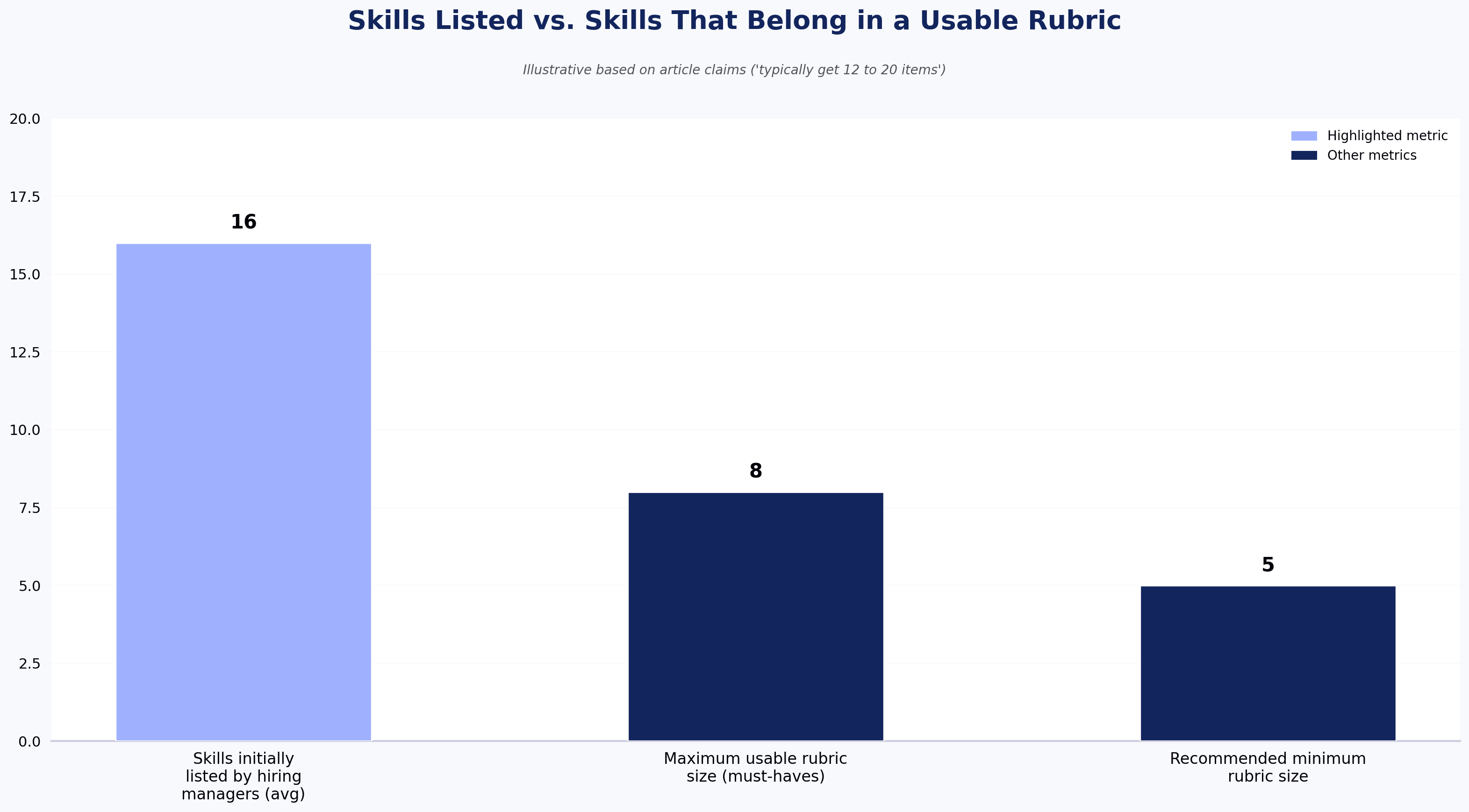
A usable rubric names 5 to 8 skills, defines each with an observable behavior, assigns a weight, and specifies which interview stage evaluates it. It fits on one page. Two interviewers reading it independently and scoring the same candidate should land within one point of each other on a 5-point scale.
Here is the minimum viable structure:
- Skill: the capability being evaluated (e.g., "system design for services at 1K+ RPS")
- Definition: one sentence describing what "meets bar" looks like in behavior, not adjectives
- Weight: must-have, strong-preference, or nice-to-have
- Stage: which interview round tests this — take-home, technical screen, panel, or hiring-manager round
- Anchor examples: one description of a 3/5 answer and one of a 5/5 answer
If any row in the rubric cannot be filled in during the intake, that skill is not ready for evaluation. Either the hiring manager needs to think harder, or the skill needs to be cut.
The 60–90 minute intake agenda
Block a full 90 minutes. Meetings under 45 minutes almost always produce wish lists because there is no time to force the specificity conversation. The agenda below assumes the recruiter runs the meeting and the hiring manager is the primary participant, with an optional second interviewer joining for the last 30 minutes to pressure-test the rubric.
Minutes 0–10: Confirm the role's business context
Open with the question the hiring manager has probably not been asked: what does this person deliver in their first six months that makes the hire worth it? Not their responsibilities. Their outputs.
If the answer is vague ("contribute to the team," "help us scale"), keep pressing. A senior backend hire whose first six months are "ship the payments-service rewrite" is a different rubric from one whose first six months are "stabilize on-call and reduce SEV1s." Both are legitimate, but they weight skills differently.
Minutes 10–25: List the skills, then cut half
Ask the hiring manager to list every skill they think matters. Write them all down without pushback. You will typically get 12 to 20 items — some technical, some behavioral, some cultural, some that are actually the same thing renamed.
Then do the cut. Force the hiring manager to rank the list and mark only 5 to 8 as must-haves. The rest become nice-to-haves or get removed. A rubric with 15 must-haves is a rubric that will fail candidates for the wrong reasons and will not survive contact with a real pipeline.
This is the moment where hiring managers push back. A common objection: "But I need someone who has all of these." The honest answer: candidates with all of them exist but will not accept your offer at the salary band you have approved. Pick the 5 to 8 you will actually reject on.
Minutes 25–50: Convert each skill into observable behavior
For each must-have, ask three questions:
- What does a candidate say or do that shows they have this? Not "they seem confident" — "they explain the trade-off between eventual consistency and strong consistency without prompting."
- What would a candidate say or do that shows they don't? This one is harder and more useful. Interviewers score more reliably when they have a clear negative anchor.
- Which interview stage tests this? If the answer is "the whole loop," the skill is not defined tightly enough.
This is the section where 30 minutes disappears fast. It is also the section that determines whether the rubric is usable.
Minutes 50–70: Assign weights and design the loop
With the skills defined, decide what fails a candidate. If a staff engineer candidate is weak on system design, is that a rejection or a discussable? If they are weak on cross-team communication, same question.
Then map each skill to a stage. A useful test: no stage should evaluate more than three skills, and no skill should be evaluated by more than two stages. If your take-home is trying to evaluate coding quality, system design, testing discipline, and communication, it is evaluating none of them well.
For teams using platforms like HackerEarth Assessments or FaceCode, this is the point to decide which skills get an automated assessment and which need a live evaluator. Automated scoring is more consistent for well-defined coding skills; live evaluation is more useful for judgment, communication, and edge-case reasoning.
Minutes 70–90: Calibrate with a real resume
Pull a resume from a candidate the team has hired in the past 12 months, ideally one everyone agrees was a good hire. Score them against the rubric you just built.
If the rubric would have rejected the person you just agreed was a good hire, the rubric is wrong. Fix it now. If two people at the meeting score the same resume more than one point apart on any skill, the definition for that skill is not tight enough. Fix it now.
Then do the same exercise with a candidate who was hired and did not work out. The rubric should have flagged them.
The three questions that separate rubrics from wish lists
When you find yourself running low on time, these are the three questions that do the most work:
"What behavior would I see?" Cuts through trait language ("smart," "driven," "collaborative") and forces observable definitions.
"Would I reject a candidate for this alone?" Sorts must-haves from nice-to-haves faster than any ranking exercise.
"Where in the loop does this get tested?" Exposes skills the team wants to evaluate but has no mechanism for.
If the hiring manager cannot answer these three for a given skill, the skill does not belong in the rubric yet.
Where intake meetings still fail — and honest trade-offs
Even a well-run intake meeting has limits. Three failure modes we see repeatedly:
Rubric drift after six weeks. The rubric is calibrated once at intake and then never revisited. By the tenth candidate, each interviewer is applying their own drift. The fix is not more training — it is a 15-minute re-calibration meeting after the first three candidates go through the full loop.
The hiring manager wasn't the hiring manager. In matrixed orgs, the person in the intake meeting is not always the person who approves the offer. If the actual decision-maker is a skip-level, get them in the room or accept that the rubric will be relitigated.
The rubric is right and the pipeline is wrong. A tight rubric applied to a weak pipeline produces the same result as a loose rubric applied to a strong one — closed reqs and unhappy hiring managers. Rubric work does not fix sourcing.
A rubric is also not a substitute for judgment on senior hires. For staff-and-above roles, the rubric constrains the debrief; it does not make the decision. That is a feature, not a bug.
Frequently asked questions
How long should a hiring intake meeting actually take?
60 to 90 minutes for a new role. 30 minutes for a backfill on an existing rubric. Meetings under 45 minutes for new roles almost always skip the specificity conversation and produce wish lists. If the hiring manager cannot give you 90 minutes, split the intake into two 45-minute meetings — one for skills, one for weights and calibration.
Who needs to be in the intake meeting besides the recruiter and hiring manager?
At minimum, one senior interviewer who will be on the loop. They pressure-test the rubric in the last 30 minutes and catch skills the hiring manager over- or under-weights. For roles where the hiring manager does not have the deepest technical expertise (common for eng managers hiring specialists), a technical peer is not optional.
How does a rubric differ from a scorecard?
A rubric defines what is being evaluated and what "meets bar" looks like. A scorecard is the form an interviewer fills out during or after the round. The rubric is the source of truth; the scorecard is the artifact. Most teams have scorecards without rubrics, which is why their scorecards do not agree with each other.
What if the hiring manager refuses to cut skills from the must-have list?
Ask them to rank the list and identify the bottom three. Then ask: "If a candidate was strong on the top five and weak on these three, would you reject them?" If the answer is no, those three are nice-to-haves. If the answer is yes, you have a compensation-band problem, not a rubric problem.
Can AI interview tools replace the intake meeting?
No. AI interview tools like HackerEarth's OnScreen apply a rubric consistently across candidates, which is valuable. They do not build the rubric. The intake meeting is where humans decide what to evaluate; the tooling decides how consistently to evaluate it.
Key takeaways
- A usable rubric has 5–8 must-haves with observable behaviors, weights, and stage assignments — not a wish list of traits.
- Block 60–90 minutes for a new-role intake; anything shorter skips the specificity conversation that separates rubrics from wish lists.
- Calibrate the rubric against a real past hire before the first candidate enters the pipeline — if the rubric would have rejected a known good hire, fix it.
- Re-calibrate after the first three candidates go through the loop; rubric drift is the most common post-intake failure.
- Rubrics constrain debriefs but do not replace judgment on senior hires — and no rubric fixes a weak pipeline.
See it in action
Want to see how a structured rubric translates into a repeatable assessment loop? Schedule a demo of HackerEarth Assessments and walk through a rubric-to-assessment mapping with our team.