Recruitment software guide: choosing the right platform in 2026
Recruitment software — the category of tools (applicant tracking systems, candidate relationship platforms, AI sourcing agents, and assessment engines) that recruiters use to source, screen, evaluate, and hire candidates — is the backbone of modern talent acquisition. This guide is written for Heads of Talent Acquisition evaluating their 2026 hiring stack, with a focus on what works, where AI is overhyped, and how to avoid compliance and implementation failures.
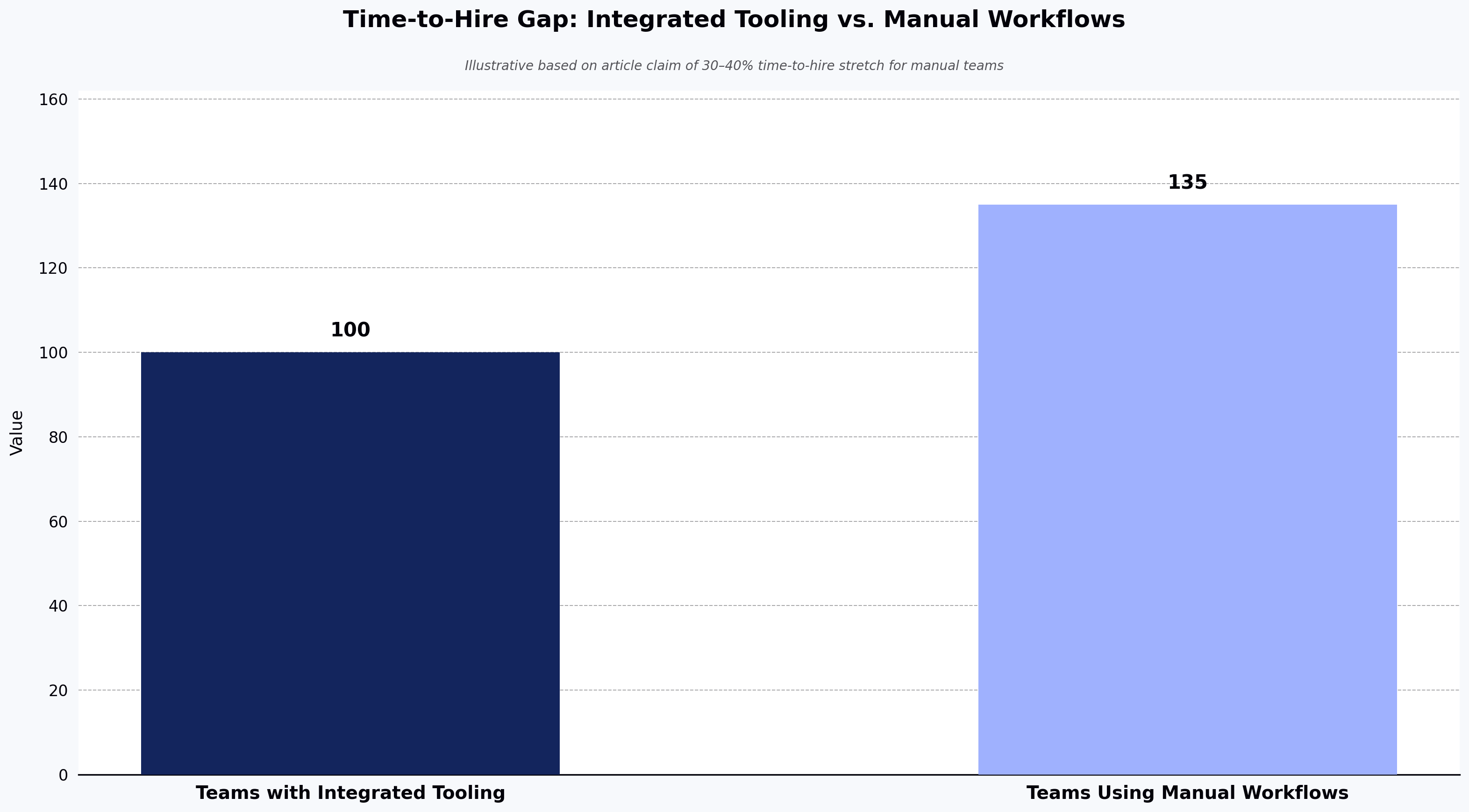
If you lead a recruiting team, three forces are changing your software stack in 2026: AI agents that act without prompting, a shift to skills-first evaluation, and new compliance obligations under the EU AI Act and NYC Local Law 144. Teams still running manual req intake, spreadsheet-based pipeline reviews, and inbox-driven candidate communication are now seeing time-to-hire stretch by 30–40% against peers with integrated tooling. The job now is choosing a hiring platform that balances administrative efficiency with a candidate experience that real people actually want to go through.
From applicant tracking to talent orchestration: the architectural shift in recruiting platforms
Recruitment software in 2026 is converging into unified talent orchestration platforms that combine applicant tracking, candidate relationship management, and sourcing in a single data layer. For decades, the applicant tracking system (ATS) served as the primary digital filing cabinet for HR departments, focused almost exclusively on compliance and the management of active applicants. That boundary has largely dissolved.
The traditional ATS remains essential for maintaining a system of record and ensuring compliance with labor laws, yet its reactive nature is insufficient for a market where, according to LinkedIn's 2024 Global Talent Trends report, most qualified candidates are passive and not actively applying. To address this, organizations have increasingly added recruitment CRMs, which focus on nurturing talent before a specific role opens. The candidate database is treated as a working network rather than a static list of names.
| System category | Primary function | Workflow stage | Key value proposition |
|---|---|---|---|
| Applicant tracking system (ATS) | Compliance and organization | Post-application | System of record; administrative efficiency |
| Candidate relationship management (CRM) | Relationship building | Pre-application | Pipeline warmth; long-term engagement |
| Sourcing and outreach platforms | Proactive talent discovery | Top of funnel | Access to passive talent; market mapping |
| Unified talent platforms | End-to-end orchestration | Full lifecycle | Data continuity; reduced manual handoffs |
Table 1: The functional taxonomy of recruitment software in 2026.
The integration of these systems matters because when an ATS and CRM share a unified data layer, recruiters get one view of every candidate interaction, from initial sourcing touchpoint to offer acceptance. This eliminates duplicate manual data entry and reduces administrative errors. Teams evaluating skills-based hiring approaches can pair these systems with assessment platforms — for example, HackerEarth's technical assessments integrate with most major ATS platforms and return a numeric skill score directly to the candidate record, so recruiters see capability data alongside resume data in a single workflow.
The rise of the AI co-pilot and autonomous agents in recruiting software
Autonomous AI agents — software that completes recruiting tasks like sourcing, screening, and scheduling without human prompting — are the most consequential 2026 development in recruitment software. Where early AI in HR focused on keyword matching, current systems use deep learning and natural language processing to conduct talent mapping and competency analysis, trained on historical hiring data, public profile data, and structured assessment outputs. These systems have real limits: they cannot evaluate cultural fit, they struggle with ambiguous role requirements, and they cannot reason about any signal that is not present in their training data.
Autonomous agents and time reclamation
Autonomous AI recruiting agents differ from traditional chatbots in that they operate independently to complete tasks such as sourcing, initial screening, and interview scheduling. Bullhorn's 2025 GRID Industry Trends Report found that roughly half of talent acquisition leaders intend to integrate autonomous agents into their workflows in the near term. Separate research from the Microsoft Work Trend Index 2024 — based on a survey of 31,000 workers across 31 countries — suggests AI users save roughly 20% of their work week, or about eight hours of a 40-hour week. Figures vary by role and tool maturity.
The productivity paradox in AI adoption
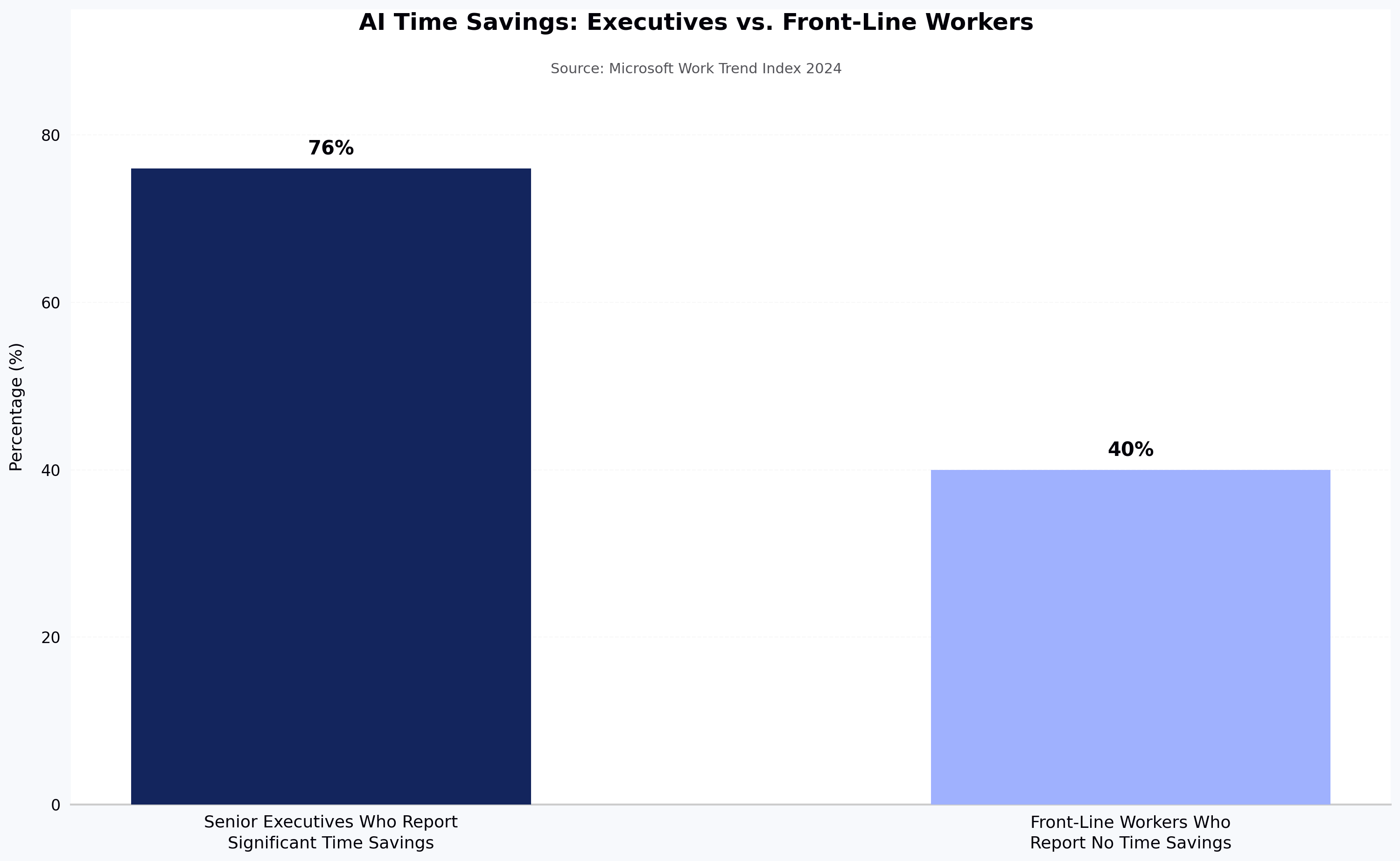
AI adoption has not delivered uniform gains. The Microsoft Work Trend Index 2024 reports that around 76% of senior executives say AI saves them significant time, while roughly 40% of front-line workers report it saves them no time — often due to limited training and noisy automated workflows. The gap is structural. Executives use AI for synthesis and drafting where output value is high; front-line recruiters often inherit AI outputs they must then verify, which can erase the time savings. A large enterprise that deployed an autonomous sourcing agent without recruiter retraining, for instance, may see candidate volume increase while screening time stays flat because recruiters still re-review every shortlist. Resumes are becoming less reliable as standalone signals of skill, as candidates also use generative AI to polish application materials.
| AI capability | Impact on HR workflow | Strategic benefit |
|---|---|---|
| Automated sourcing | Continuous pipeline building | Reduction in manual outreach; faster time-to-fill |
| Autonomous screening | Initial-review automation varies widely by vendor and role type; figures are not independently benchmarked | More consistent evaluation across candidates than unstructured human screens |
| Predictive analytics | Skills gap detection | Proactive workforce planning signals (vendor-reported, not independently benchmarked) |
| Voice and chat agents | Real-time candidate support | Improved candidate experience; 24/7 engagement |
Table 2: AI capabilities commonly offered by recruitment software vendors. Figures are vendor-reported and not independently audited.
Skills-first hiring: the new standard for talent evaluation in recruiting software
Skills-first hiring evaluates candidates on demonstrated competencies rather than degrees or job titles, and it is becoming the default evaluation model in 2026. Credentials often fail to predict on-the-job performance and can exclude capable candidates from non-traditional backgrounds.
Moving beyond the resume
AI-powered assessment tools evaluate candidates on demonstrable competencies rather than CV keywords. These systems use standardized coding challenges, logic tests, and structured assessments to provide a talent signal richer than a GPA or employer brand. In technical fields, assessment platforms can reduce reliance on pedigree signals like school or prior employer by scoring candidates on the same set of tasks. When the evaluation criterion is "candidates must complete the same scored exercise under the same conditions," a platform like HackerEarth's assessment library — covering 1,000+ skills across 40+ programming languages, plus sales, customer support, and finance roles — produces rubric-based scorecards that document how each candidate was evaluated against the same criteria.
The decline of the traditional job description
The shift also redesigns the job description. Effective postings in 2026 lead with the outcomes a person will achieve and the specific capabilities required, rather than a list of previous titles. Recruiters are using skills taxonomies to map internal talent and identify employees who can be reskilled into new roles, reducing pressure on external hiring. For a deeper walkthrough, see our guide to skills-based hiring.
| Evaluation method | Traditional focus | Skills-first focus |
|---|---|---|
| Screening criteria | Degrees, titles, and years of experience | Demonstrable competencies and potential |
| Assessment tool | Resume review and initial phone screen | Structured tests and coding simulations |
| Job requirement | "5+ years in a similar role" | "Ability to execute complex data modeling" |
| Diversity impact | High reliance on pedigree signals | Increased access for non-traditional talent |
Table 3: Traditional versus skills-first evaluation models.
Ethical hiring in the age of algorithms
Compliance with AI-specific hiring regulations is now a board-level concern, driven by the EU AI Act and NYC Local Law 144. The EU AI Act classifies AI systems used in employment as "high-risk" and requires employers to document, audit, and disclose use of these systems to candidates and authorities. NYC Local Law 144, in force since 2023 and enforced by the NYC Department of Consumer and Worker Protection (DCWP), requires employers using automated employment decision tools on NYC-based candidates to conduct an annual independent bias audit and notify candidates before use.
Not every AI hiring deployment has gone smoothly. Reuters reported in 2018 that Amazon scrapped an internal AI recruiting tool after discovering it penalized resumes containing the word "women's"; in 2023, the EEOC reached a $365,000 settlement with iTutorGroup over recruitment software that automatically rejected older applicants. These cases are why audit-ready documentation is now a procurement requirement, not a nice-to-have.
Bias mitigation and algorithmic transparency
Modern DE&I-focused hiring tools focus on bias interruption throughout the hiring lifecycle. This includes masked assessments that hide personally identifiable information — name, gender, graduation date — during initial screening, with the goal of reducing the weight of those signals in screening decisions. Leading platforms undergo periodic algorithmic audits intended to surface whether their scoring logic reproduces historical biases.
The human-in-the-loop model
The human-in-the-loop model remains important for fairness and candidate trust. Some research, including Pew Research Center surveys on AI in hiring, suggests candidates are wary of being evaluated by opaque systems and prefer employers that combine automation with human review. In 2026, the recruiter's role often includes monitoring AI outputs and ensuring that final hiring decisions reflect a candidate's skills, experience, and interview performance — not just an algorithm score.
| DE&I software feature | Mechanism of action | Compliance benefit |
|---|---|---|
| PII masking | Hides name, photo, and age | Reduces reliance on affinity signals |
| Augmented writing | Identifies gendered or restrictive language | Increases diverse applicant pools |
| Structured scorecards | Mandates consistent question kits | Supports defensible, documented decisions |
| Bias detection dashboards | Real-time monitoring of funnel conversion | Supports EEOC and EU AI Act reporting |
Table 4: DE&I-focused features common in recruitment software.
Market comparison: top recruitment platforms in 2026
The market is segmented into all-in-one HR suites, specialized applicant tracking systems, and AI point solutions. Choosing the right stack involves balancing core functionality with specialized intelligence. The tables below are descriptive, not endorsements. Pricing and feature parity change frequently. Buyers should validate claims directly with vendors.
Leading human capital management (HCM) platforms
HCM suites manage payroll, performance, and core HR in addition to recruiting. They are typically chosen when integrated HR data is the priority over best-of-breed recruiting features.
| Platform | Target market | Key strength |
|---|---|---|
| Rippling | Mid-to-large / Multi-state | Cross-functional automation |
| BambooHR | Small-to-mid businesses | Ease of use and reporting |
| Gusto | Startups / New businesses | Payroll-first HR tools |
| ADP Workforce Now | Mid-size to enterprise | Scalable compliance features |
| SAP SuccessFactors | Large global enterprises | Complex global operations |
| Deel | Global contractors / Remote | Cross-border hiring and payroll in one workflow |
Table 5: HCM platforms with recruiting modules. Positioning is based on publicly available vendor materials.
Specialized applicant tracking systems and AI tools
For organizations with high-volume or specialized technical hiring needs, standalone ATS and AI-native platforms offer features beyond what generic HR suites provide.
| Recruitment tool | Best for | Standout feature |
|---|---|---|
| Greenhouse | Process governance | Structured interview kits |
| Workable | Growing companies | All-in-one AI suite |
| Eightfold.ai | Talent intelligence | AI-based candidate-to-role matching (vendor-described) |
| Manatal | Startups and budget AI | AI candidate scoring |
| SeekOut | Diversity and tech sourcing | Profile discovery beyond LinkedIn |
Table 6: Specialized recruitment and AI-driven sourcing tools. Standout features are drawn from vendor materials and not independently benchmarked.
Avoiding system failures and audit panic
Most recruitment software implementations fail at the human-system interface, not at the model. Practitioners widely report that in 2026, the technology works as intended but ownership, training, and process design do not.
The risks of unowned rules and identity drift
Identity drift is what happens when candidate records become duplicated and inconsistent across disconnected systems — the same candidate exists in the ATS, the CRM, and the sourcing tool as three separate profiles with conflicting data. Unified talent platforms are designed to prevent it.
Implementations often stall when organizations automate steps without deciding where the source of truth lives. The result is identity drift: recruiters lose confidence in automation and revert to manual workarounds. Recruitment operations teams should own rules, versioning, and drift control, with every change in the hiring workflow logged and reviewed for performance impact.
Audit panic and compliance reporting
With the EU AI Act and NYC Local Law 144 in force, the ability to provide proof of fair hiring is now an operational requirement. Organizations that treat evidence as a byproduct rather than a requirement often face audit panic — the inability to retrieve the exact inputs and rules that produced a specific screening decision. Mature HR teams build exportable decision packages for every hire so they can demonstrate compliance without manual scrambling when an audit arrives.
| Implementation pitfall | Operational symptom | Mitigation strategy |
|---|---|---|
| Unowned rules | Workflow drift and inconsistent outcomes | Centralize rule ownership in Recruiting Ops |
| Identity drift | Duplicate candidate records; broken reporting | Enforce a single candidate record and writeback |
| Passive demos | Software doesn't solve real-world problems | Require vendors to demo specific user stories |
| Lack of training | Team uses a fraction of software features | Role-specific, hands-on training sessions |
| No ROI measurement | Costs don't align with hiring objectives | Establish KPIs (e.g., time-to-hire) before rollout |
Table 7: Common implementation failures and mitigations.
The path to 2030: from automated steps to orchestrated journeys
In our view, by 2030 the category will move from task automation to AI workforce orchestration — an emerging concept in which AI systems coordinate end-to-end hiring journeys across recruiters, managers, and candidates rather than executing isolated steps. The term is not yet standardized across vendors, so buyers should ask for specifics about what is being orchestrated and by what authority.
Personalization at scale
Personalization is likely to expand, with AI tailoring messaging and job recommendations to individual candidate communication styles and career patterns. The aim is to give recruiters more time for substantive candidate conversations rather than templated outreach.
Frequently asked questions
What is recruitment software?
Recruitment software is the set of tools recruiters and HR teams use to source, screen, assess, and hire candidates. The core categories are applicant tracking systems (ATS), candidate relationship management (CRM) platforms, sourcing tools, and assessment platforms. In 2026, many of these capabilities are converging into unified talent orchestration platforms.
What is the best recruitment software for small businesses in 2026?
There is no single best option. The non-obvious trade-off for small teams is data portability: many entry-tier HR suites lock candidate data behind paid export tiers or proprietary schemas, which makes a future migration to a best-of-breed ATS expensive. Before signing, confirm export formats, API access limits on the lowest paid plan, and whether historical candidate notes and assessment scores come with you if you switch.
How long does recruitment software implementation take?
Typical implementation timelines run 4–8 weeks for a standalone ATS, 3–6 months for an HCM suite with recruiting, and 6–12 months for a unified talent platform replacing multiple incumbent systems. The variables that extend timelines are not technical — they are data migration scope, the number of integrations to payroll and assessment tools, and the time required to retrain recruiters on new workflows. Build a buffer of 30–50% over vendor-quoted timelines.
How does AI reduce bias in recruitment?
AI can reduce reliance on biased signals through PII masking (hiding name, photo, age during screening), structured scorecards that apply the same criteria to every candidate, and bias detection dashboards that monitor funnel conversion by demographic group. No system removes bias entirely, and regulations such as NYC Local Law 144 require independent bias audits of automated employment decision tools.
What regulations apply to AI hiring tools?
The two most consequential frameworks in 2026 are the EU AI Act, which classifies hiring AI as high-risk and imposes documentation and audit obligations on employers, and NYC Local Law 144, which requires annual independent bias audits and candidate notification for automated employment decision tools used on NYC-based candidates. Other US states have introduced similar bills.
Should we buy an HCM suite or a best-of-breed ATS?
Choose an HCM suite (Rippling, BambooHR, SAP SuccessFactors) when integrated HR data across payroll, performance, and recruiting is the priority. Choose a best-of-breed ATS (Greenhouse, Workable) when hiring volume, structured interviewing, or recruiter productivity is the bottleneck. Many companies pair a best-of-breed ATS with an assessment platform for skills evaluation.
How do we measure ROI on recruiting tools?
Establish baseline metrics before rollout: time-to-hire, cost-per-hire, recruiter screening hours per role, offer acceptance rate, and quality-of-hire at 90 and 180 days. Compare post-implementation metrics against the baseline at six and twelve months. If a vendor cannot demonstrate impact against at least two of these, the tool is not paying for itself.
Next steps: see skills-based hiring in action
If your 2026 priority is moving from resume screening to demonstrated-skill evaluation, book a demo of HackerEarth's recruiter platform to see how role-specific assessments, structured scorecards, and ATS integration work together on real candidates.