How to Create a Structured Interview Process: A Step-by-Step Guide for Hiring Managers
Most interview processes feel broken
You’ve seen it before. One interviewer digs into technical details, another chats about career goals, and a third just vibes out “culture fit.” At the end, you’re left with a pile of inconsistent notes, gut-feel opinions, and a decision that’s more art than science. Maybe you miss out on a great hire or worse, bring on someone who just doesn’t work out. Meanwhile, your engineers grumble about wasted time, and your hiring process drags on for weeks.
If this sounds familiar, you’re not alone. Even at top tech companies, interview outcomes can hinge on which interviewer happens to be in the room or what questions someone happens to ask. The result? Inconsistent hiring, unconscious bias, and a process that drains resources with little to show for it.
But there’s a better way. Decades of research and the experience of the world’s best hiring teams point to one approach that consistently improves hiring quality, reduces bias, and saves time: the structured interview process.
In this article, you’ll get more than just theory. You’ll walk away with a strategy to standardize your interviews and make every hire count.
What is a structured interview?
A structured interview is more than just having a list of questions. It’s a systematic approach to interviewing, built on three core pillars:
- Predetermined, job-relevant questions: Every question is carefully crafted to assess specific competencies required for the role.
- Consistent process for all candidates: Every candidate is asked the same questions, in the same order, by every interviewer.
- Standardized evaluation criteria: Every answer is scored against a clear, pre-defined rubric, eliminating gut-feel decisions.
What sets structured interviewing apart is not just the questions, but the discipline: every candidate, every time, measured by the same yardstick. This enables apples-to-apples comparison and exposes true differences in candidate ability, not just who “clicked” with which interviewer.
Structured vs. semi-Structured vs. unstructured Interviews
Many hiring managers think they’re “structured” because they have some questions prepared. But there’s a spectrum:
Unstructured interviews:
- Ad-hoc, resume-driven.
- Each interviewer goes their own way, following threads that feel interesting.
- Evaluation is based on overall impressions or “gut feel.”
- Feels natural, but leads to bias, inconsistency, and poor predictive power.
Semi-structured interviews:
- Some questions are prepared, but interviewers deviate with follow-ups.
- Evaluation criteria are vague or flexible.
- Better than nothing, but bias creeps back in through unplanned questions and subjective scoring.
Structured interviews (the gold standard):
- All questions and follow-ups are predetermined.
- Scoring is based on anchored rubrics, not impressions.
- Consistency is enforced across all interviewers and candidates.
- More upfront work, but dramatically better outcomes.
Key insights:
Most organizations get stuck in the “semi-structured” middle ground. The biggest gains come from going the last mile, fully standardizing both questions and scoring.
Why structured interviews work: The science behind it
Cognitive bias reduction
Unstructured interviews are breeding grounds for confirmation bias (“they went to my college, must be good”), halo effect (“they’re confident, so they must be smart”), and similarity bias (“they’re just like me!”). Structured interviews force interviewers to focus on evidence, not impressions, mitigating these biases at every stage.
Predictive validity
Structured interviews do a better job of predicting who will succeed. Multiple studies show that when you standardize questions and scoring, your interview scores correlate much more strongly with on-the-job performance than unstructured approaches.
Legal protection
Standardization means every candidate is evaluated on the same criteria, supporting compliance with anti-discrimination laws. This isn’t just about risk avoidance. It’s about fairness and consistency.
Candidate experience
Contrary to the myth that structure feels robotic, candidates actually appreciate a fair, transparent process. They’re more likely to trust your decision even when rejected, when they see everyone is held to the same standards.
Step-by-step guide to building a structured interview process
Step 1: Conduct a job analysis and define success criteria
Structure starts before the interview.
The foundation of a great structured interview isn’t a question bank. It’s a clear understanding of what success in the role actually looks like.
How to identify key competencies:
- Interview your top performers. What do they do differently?
- Analyze actual job tasks. What skills and behaviors are required daily?
- Consult hiring managers. What distinguishes high performers from average ones?
- Distinguish must-haves from nice-to-haves. Focus on what’s truly essential.
Define success across time:
- What should a new hire accomplish in the first 30, 90, and 180 days?
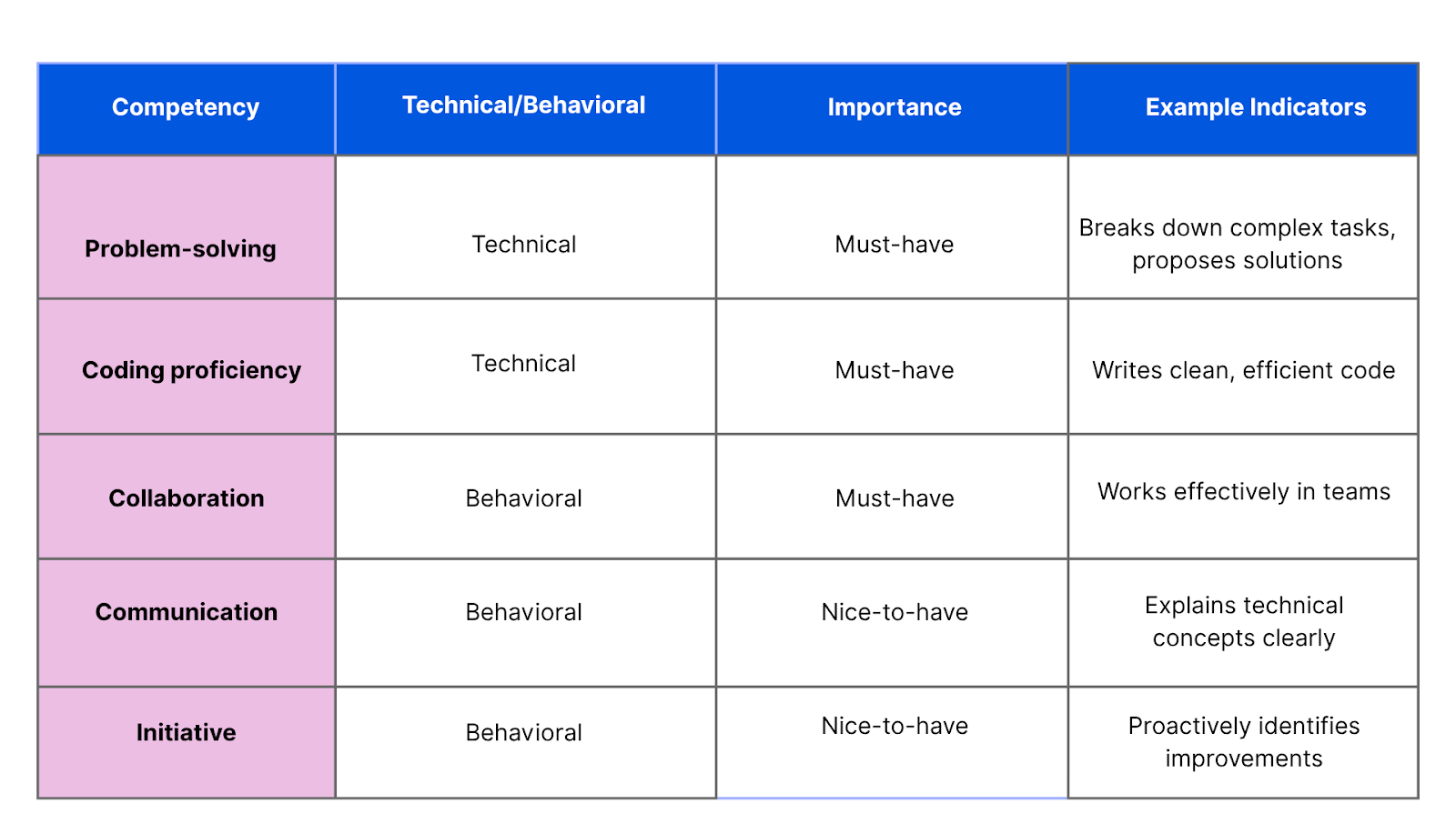
Every question, rubric, and evaluation should map back to these competencies. Get this step wrong, and everything that follows is compromised.
Step 2: Design job-relevant interview questions
Every question must tie directly to a competency. If you can’t explain what skill a question evaluates, cut it.
Types of questions:
- Behavioral: “Tell me about a time you debugged a complex system.”
Assesses past performance and approach to problems. - Situational: “What would you do if your code review revealed a major bug right before release?”
Assesses judgment and decision-making. - Technical/Job Knowledge: “How does garbage collection work in Java?”
Assesses expertise. - Problem-Solving: “Here’s a code sample with a hidden bug. Can you find and fix it?”
Assesses analytical approach.
What makes a question effective?
- Specific: Elicits detailed, job-relevant responses.
- Open-ended: Allows for different valid approaches.
- Consistent: Can be asked verbatim to every candidate.
Follow-up questions: Predetermine your follow-ups. Unplanned probing (“Can you elaborate?”) reintroduces bias. Prepare 1-2 clarifying prompts per question.
Legal considerations: Avoid asking questions about age, marital status, family plans, or anything not directly job-relevant.
It’s not the questions themselves that drive value. It’s that every candidate gets exactly the same questions, enabling true comparison.
Step 3: Create a standardized scoring rubric
Most teams with “standard questions” still get inconsistent results because they lack a rubric.
Anchored Rating Scales: Ditch vague rubrics (“1 = poor, 5 = excellent”). Instead, define what each score actually means for each question.
How to build behavioral anchors
- Strong answer (5): Candidate describes a complex bug, details their systematic approach, explains trade-offs, and shares results.
- Average answer (3): Candidate gives a general description, some steps, but lacks depth or specifics.
- Weak answer (1): Candidate struggles to recall an example, focuses on blame, or skips steps.
Weighting Competencies: Not all competencies matter equally. For a software engineer, “coding proficiency” might be weighted twice as heavily as “initiative.”
Red Flags and Knockouts: Define criteria that indicate an automatic concern (e.g., “Refused to seek help when stuck,” “Breached security protocols”).
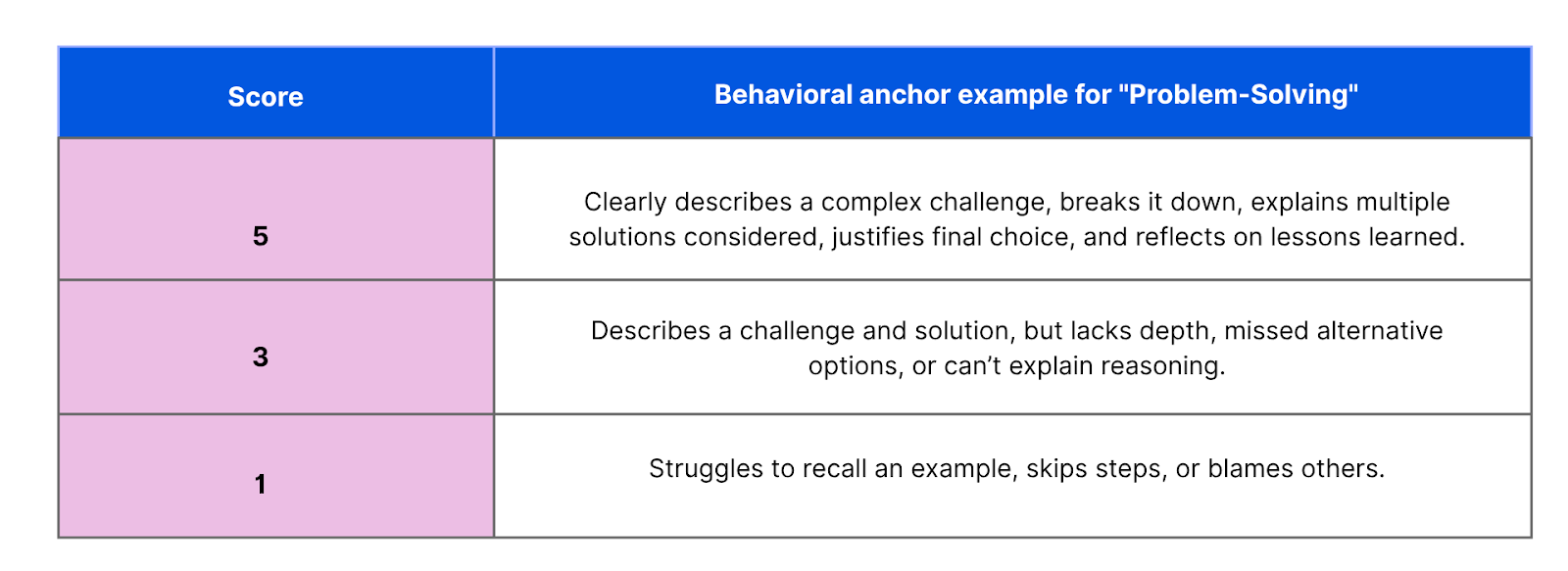
A good rubric makes scoring obvious. If interviewers are debating what score to give, your rubric isn’t specific enough.
Step 4: Train your interviewers
Even the perfect process fails if interviewers aren’t trained to use it. Many experienced interviewers feel structure constrains them or implies a lack of trust. The truth is, structure is about consistency, not micromanagement.
What training should cover:
- Consistent delivery: Ask questions verbatim, no leading or significant rephrasing.
- Scoring rubric: How to use anchors, not impressions.
- Evidence-based notes: Document what was said, not how you “felt.”
- Bias recognition: Train interviewers to spot and mitigate their own biases.
- Legal boundaries: What’s off-limits in questioning.
- Calibration exercises: Regular practice sessions to align scoring standards.
Ongoing vs. one-time training: Calibration isn’t a “set and forget” task. Run sessions regularly, especially when adding new questions or interviewers.
Key insight: Training builds interviewer confidence. Structured processes free up bandwidth to focus on evaluation, not improvisation.
Step 5: Standardize the interview day experience
Consistent format: Same interview duration, structure, and number of interviewers for every candidate in the same role.
Interview flow:
- Rapport building (5 min): Brief introduction, outline the process.
- Core questions (30-40 min): Ask predetermined questions in order.
- Candidate questions (10-15 min): Allow the candidate to ask about the role, team, or company.
- Close (5 min): Explain next steps and timeline.
Handling candidate Q&A: While not scripted, interviewers should prep standard answers to common questions for consistency.
Panel interviews: Assign questions in advance to avoid overlap. Ensure smooth handoffs and avoid cross-talk.
Sample interview flow
Key insight: A structured, organized interview experience not only improves evaluation quality but also boosts your employer brand.
Step 6: Evaluate candidates using evidence, not gut feeling
Each interviewer completes their scorecard independently, before any group discussion. This prevents groupthink and anchoring.
Running effective debriefs:
- Each interviewer shares scores and evidence.
- Discussion focuses on what was observed, not impressions.
- Discrepancies are discussed in terms of evidence (“What led you to rate that answer as a 5?”), not opinions.
Common pitfalls to avoid:
- Vague language (“great culture fit”) without behavioral examples.
- Letting one strong opinion dominate.
- Comparing candidates to each other rather than to the rubric.
- Failing to document the rationale for the final decision.
Documentation: Capture key evidence and the reasoning behind each decision. This is crucial for legal defensibility and process improvement.
You can have the world’s best questions and rubrics, but if the decision at the end is based on “vibes,” you’re back where you started.
Common mistakes to avoid during structured interviews
- Going off-script with follow-ups: Unplanned probing reintroduces bias. Prepare follow-ups in advance.
- Skipping training (or retraining): Without reinforcement, interviewers revert to old habits.
- Using generic questions: Role-specific questions are a must. Generic banks defeat the purpose.
- Never refreshing questions: Candidates share questions. Rotate regularly to maintain effectiveness.
- Discussing candidates before scoring: Even a casual pre-scoring chat can anchor opinions.
- Treating structure as a one-time setup: Ongoing calibration, updates, and audits are essential.
These are common organizational patterns that quietly undermine the process of structured interviews.
How to measure structured interview effectiveness
Structured interviews generate consistent, comparable data. But the implementation is just the start. How do you know it’s actually working?
Key metrics to track
- Time-to-hire: Structure may feel slower at first, but decisions come faster once implemented.
- Quality of hire: Are structured hires performing better than previous cohorts? Track interview scores against performance reviews.
- Interviewer consistency: Compare scoring patterns across interviewers. Wide discrepancies signal calibration gaps.
- Candidate experience: Survey both successful and rejected candidates. Are they reporting a fair, positive process?
- Offer acceptance rates: Structured, transparent interviews can improve candidate trust and acceptance.
- Pipeline diversity: Are you seeing improved representation at each hiring stage?
Automate structured interviews with HackerEarth
HackerEarth’s suite of tools is designed to help tech hiring teams implement structured interviews at scale without sacrificing quality.
AI Interview Agent
- Delivers structured, role-specific interviews with consistent questions and rubrics
- Masks candidate's personal information for bias-free evaluation
- Evaluates technical depth across programming languages and skill areas
- Generates detailed, comparable evaluation reports
- Frees engineering time for high-value work instead of repetitive interviews
Supporting Products
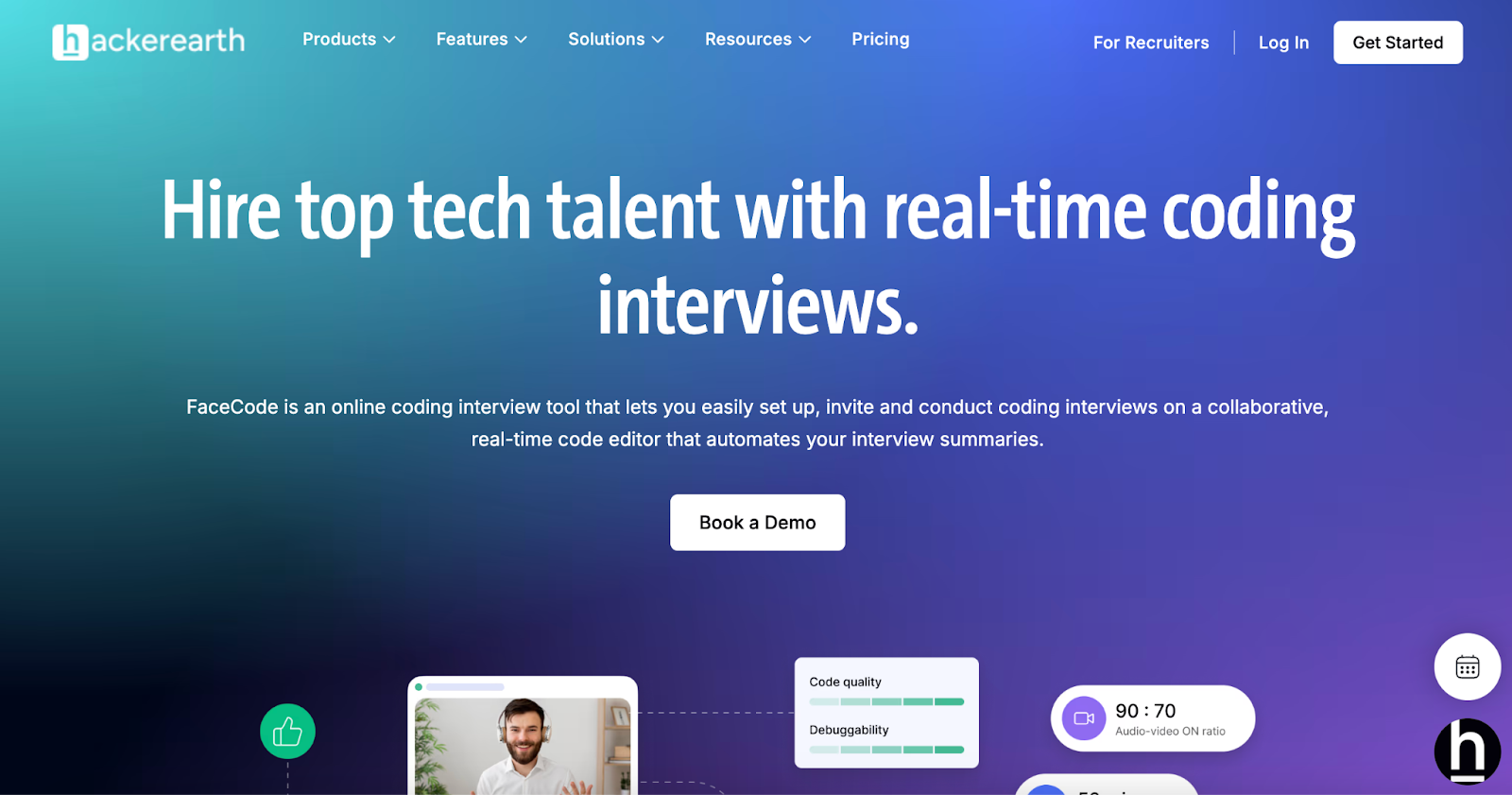
- FaceCode: Live coding interviews with real-time evaluation
- Technical and non-technical assessments: Pre-built and custom skills tests
- Soft skills assessments: Evaluate behavioral competencies alongside technical ones
With these tools, you can standardize your interview process end-to-end, ensure fairness, and scale your hiring without losing rigor.
Conclusion
A structured interview process is the single most effective way to reduce bias, improve hiring outcomes, and build high-performing teams, especially in technical roles. The right technology makes it achievable at any scale.
FAQs
How long does it take to implement a structured interview process?
Implementation can take as little as a few weeks for a single role, but expect a few months for full rollout and calibration—especially in larger organizations.
Can structured interviews be used for all roles?
Yes, though the competencies and questions will differ by role. The framework applies to technical, behavioral, and leadership positions alike.
Do candidates dislike structured interviews?
Most candidates appreciate the fairness and transparency. Even rejected candidates report a better experience when the process is consistent.
How do structured interviews reduce bias specifically?
By standardizing questions, order, and scoring, structured interviews eliminate many opportunities for unconscious bias to slip in—such as going off-script or relying on impressions.
What's the difference between a structured interview and a behavioral interview?
A behavioral interview is a type of question (“Tell me about a time…”). A structured interview is a process: every candidate gets the same questions (behavioral, technical, etc.) and is scored by the same rubric.
How often should we update our interview questions?
Refresh questions at least once a year, or whenever you see evidence that candidates are sharing them widely. Regular audits help maintain effectiveness and fairness.