Hiring Tools

Thank you! Your submission has been received!
Oops! Something went wrong while submitting the form.

Creating your first 2D game with A* Algorithm

Moving from point A to point B is the prime requirement for many games—whether it is a strategic tactic-based RPG (role-playing game) like Warcraft III or one that’s as simple as Snakes and Ladders. The source-to-destination navigation sometimes requires more intelligence from your character than you believe, it needs to find the path with ease. You can’t have your characters walking through a wall or bumping into a car while playing, can you?

This is where pathfinding algorithms are used. Pathfinding is the basic building block for most games. Players have to reach a destination by moving around blocks, cars, rivers, and prisons. The algorithm ensures that the character not only avoids the obstacles but also gets to the destination by using the shortest path.

Games like Warcraft III use the A* pathfinding algorithm, where the protagonist is not only expected to reach his destination by the shortest path, but also move around the castles, not get in through the huts, dungeon, or walk through a dragon on its way.

A* algorithm (Pronounced A-star algorithm)

The A* algorithm is the fastest graph search algorithm that finds the path that costs the least from source node to goal node. (A node can be hexagon, square or circle, etc.)

In the gaming world, a node graph is a map of your gaming world, and the path that costs the least is the shortest path; A* traverses a node graph and finds the path that costs the least.

A* algorithm has properties of both Dijkstra and Best-first search. Unlike DFS and BFS, the A* algorithm selects the node which looks most promising instead of guessing the next node.

The cost function

The cost of node F is calculated as:

F = G + H

  • G is the cost that is required to reach a particular node from the source node.
  • H often termed the Heuristic Value. It is the estimated cost from one square on the grid to the other square, which is the goal on the grid. H being heuristic, can never be perfect and is usually based on assumptions.

Here we implemented the Euclidean distance for the cost function. The Manhattan and the Chebyshev functions are also shown in case required.

def estimate(self, xDest, yDest):
    """
    Estimation function for the remaining distance to the goal.
    """
    dx = xDest - self.x_position
    dy = yDest - self.y_position
    # Euclidian Distance
    d = math.sqrt(dx ** 2 + dy ** 2)
    # Manhattan distance: d = abs(xd) + abs(yd)
    # Chebyshev distance: d = max(abs(xd), abs(yd))
    return d

Let’s look at the following example:

Traversing A* algorithm

Assume that the graph or table above is a game grid where our protagonist needs to move from the source node of the grid to the goal node.

class Node:
    """
    for handling the individual nodes or spaces in the given map
    """

    def __init__(self, coordinates, distance, priority, possible_directions):
        if isinstance(coordinates, Shift):
            self.x_position = coordinates.change_in_x
            self.y_position = coordinates.change_in_y
        elif isinstance(coordinates, Node):
            self.x_position = coordinates.x_position
            self.y_position = coordinates.y_position
        else:
            self.x_position = coordinates[0]
            self.y_position = coordinates[1]
        self.distance = distance
        self.priority = priority
        self.possible_directions = possible_directions

    def __lt__(self, other):
        """
        comparison method for priority queue
        """
        return self.priority < other.priority

    def estimate(self, xDest, yDest):
        dx = xDest - self.x_position
        dy = yDest - self.y_position
        d = math.sqrt(dx ** 2 + dy ** 2)
        return d

    def updatePriority(self, xDest, yDest):
        self.priority = self.distance + self.estimate(xDest, yDest) * 10

    def nextMove(self, d):
        if self.possible_directions == 8 and d % 2 != 0:
            self.distance += 14
        else:
            self.distance += 10

Let’s consider that every block to the left, right, top, and bottom of the selected (parent) node is at a distance of 1 unit. That means that each block is at a diagonal distance of √2, which is equal to 1.4.

To make things easier, multiply each value by 10, thereby converting the distance to 10 and 14 for adjacent and diagonal nodes, respectively.

Let’s make 2 lists of open and closed nodes. Any node that is selected for the path is moved to the closed node list. Any node that is not selected is considered to be an open node.

How to traverse in A* algorithm

Assume that our protagonist is at the location source. Every block surrounding the location source has a certain F cost, which is obtained by summing G and H.

For example, a block that is diagonally opposite to the source and marked in red would have a G value of 14, an H value of 10, and an F value of 52. You can compute the values for all other blocks similarly.

After we have the cost of all the blocks, select the block which has the lowest cost. In this case, F=52 and mark it as closed.

def a_chosen_direction(x, possible_directions):
    return (x + possible_directions // 2) % possible_directions


def generate_path(possible_directions, dir_map, dx, dy, xA, yA, x, y):
    path = ""
    while not (x == xA and y == yA):
        j = dir_map[y][x]
        c = str(a_chosen_direction(j, possible_directions))
        path = c + path
        x += dx[j]
        y += dy[j]
    return path

Repeat the entire process with all the open nodes and select the block with the lowest F value as you head towards your goal.

Once you reach the goal, the path traversed is the lowest possible path for a given matrix.

How A* algorithm works

Assume that, in a game, the section in black is the area which cannot be traversed by the player.

def collision_with_obstacle(x_y_shift, the_map, closed_nodes_map):
    return any((
        the_map[x_y_shift.change_in_y][x_y_shift.change_in_x] == 1,
        closed_nodes_map[x_y_shift.change_in_y][x_y_shift.change_in_x] == 1
    ))

Select the Source node and calculate the F cost of all its surrounding nodes. Now select the node with the smallest value, which in this case is 48. Then repeat the process.

What if two nodes have the same values, like F=48? In such cases, select any one of them and proceed.

Summary of A* Algorithm
  1. Select the starting point and put it in the open list.
  2. Find the F cost to the current node.
  3. Mark it in the closed list.
  4. For each of the 8 nodes adjacent to the current node:
    • If the node is in the closed list or cannot be walked through, then ignore it.
    • If it is not open, then put it on the open list and find the G, H, and F values for it.
    • If it is in the open list, then check if the path has a better cost and make it the parent node.
  5. Stop when your target node is marked as closed, or there are no more nodes to be marked as open.

At this point, you should have a decent conceptual understanding of how the A* pathfinding algorithm can be adapted to a platform. This article is a beginner’s guide of sorts.

Remember that A* only finds the most optimal path. The graph search is only one piece of the puzzle. A* does not handle things like object movement, map changes, etc.

Why don't you create your own 2D game with movement and hone your skills as your game evolves with better algorithms?

If you enjoy algorithms as much as I do, read my other article on the Elo rating algorithm.

PS: For code enthusiasts, here is the Python code to the A* algorithm.

# -*- coding: utf-8 -*-
"""
# A* Shortest Path Algorithm
# http://en.wikipedia.org/wiki/A*
"""
# ... (full code continues here as already shared)
Sending emails to our growing user community

At HackerEarth, we frequently send out emails to our user base. These are meant to keep them updated on upcoming challenges and on certain events related to their activity on our platform. For example, we send out emails when a user successfully solves a problem, whenever the user is sent a test invitation for a hiring challenge, or when there are new updates on his comments. Basically, whenever it is appropriate to convey important information to the user, we do it via email.

Architecture

It takes lot of computational power to send emails in such large quantities synchronously. So we implemented an asynchronous architecture to send emails.

Here is brief overview of the architecture:

  1. Construct an email and save the serialized email object in database.
  2. Queue the metadata for later consumption.
  3. Consume the metadata, recreate the email object, and deliver.

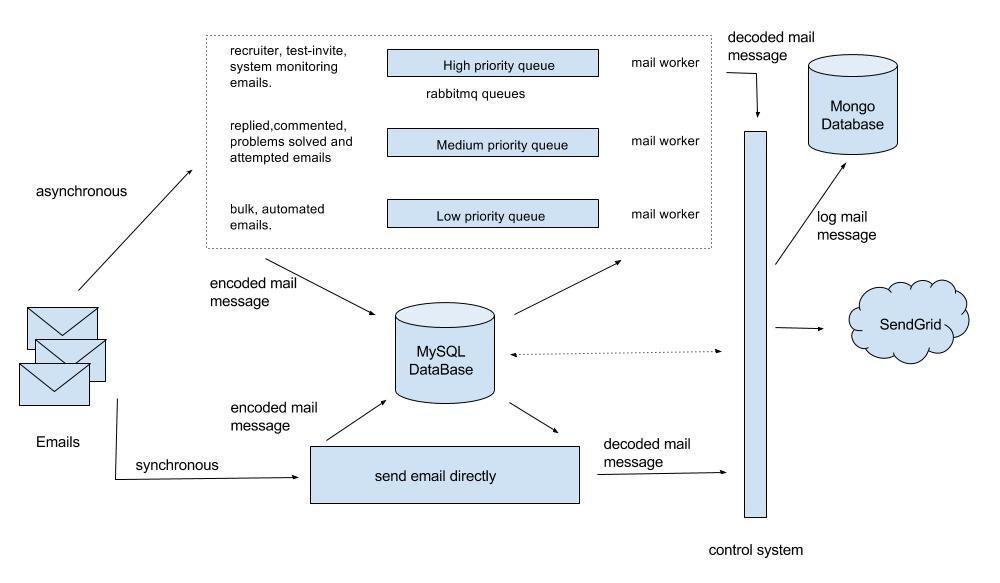
The diagram below shows the high-level architecture of emailing system. Solid lines represent the data flow between different components. Dotted lines represent the communications. HackerEarth email infrastructure consists of MySQL database, MongoDB database, and RabbitMQ queues.

Email Architecture Diagram

Journey Of Email

Step 1 - Construct email:

There are two different types of emails.

  1. Text - Plain text emails
  2. Html - Emails with rich interface using html elements, and made using django templates

API used by HackerEarth developers for sending emails:

send_email(ctx, template, subject, from_email, html=False, async=True, **kwargs)

The API above creates a SendGrid Mail object, serializes, and saves it in the DB with some additional data.

A piece of code similar to the bit shown below is used to create the SendGrid Mail object.

import sendgrid

sg = sendgrid.SendGridClient('YOUR_SENDGRID_API_KEY')

message = sendgrid.Mail()
message.add_to('John Doe <john@email.com>')
message.set_subject('Example')
message.set_html('Body')
message.set_text('Body')
message.set_from('Doe John <doe@email.com>')
status, msg = sg.send(message)

The model below is used to store the serialized mail object and additional data.

class Message():
    # The actual data - a pickled sendgrid.Mail object
    message_data = models.TextField()
    when_added = models.DateTimeField(default=datetime.now, db_index=True)

After constructing and saving the email object in the database, metadata is queued in the RabbitMQ queues.

Step 2 - Queue the metadata:

Not all emails have the same importance in terms of delivery time. So we have created multiple queues to reduce the waiting time in queue for important mails.

  1. High priority queue
  2. Medium priority queue
  3. Low priority queue

It’s up to the application developer to decide the importance of the email and queue it in appropriate queue.

We queue the following metadata in the queue as a JSON object: {‘message_id’: 123}

Step 3 - Reconstruct and deliver:

We run delivery workers, which consume metadata from queues, reconstruct an email object, and deliver it using DMARC solution.

These workers consume the messages from RabbitMQ queues, fetch the message object from Message model, and deserialize the data to reconstruct the SendGrid Mail object.

We run different numbers of workers depending on the volume of emails in each queue.

Before sending an email, we do final checks which help us decide whether to deliver the email or not, such as if the email id is blacklisted or if the emails have non-zero number of receivers. This validation layer is especially important during using email warm up tools, where controlled sending and strict checks help build sender trust safely.

After a request is sent to SendGrid to deliver the email, the email objects are logged into a MongoDB to maintain the history of delivered emails.

A/B Test In Emails

A million emails require optimization to improve user experience. This is done through A/B tests on emails type. We can test emails for subject and content variations. Every user on HackerEarth is assigned a bucket number to ensure emails are consistent during the experiment. Every A/B experiment is defined as dictionary mapped constants which contain all the information.

Here is one example of an A/B test with subject variation.

"""
EMAIL_VERSION_A_B
format of writing A/B test
key: test_email_type_version_number
value: email_dict

format for email_dict
keys: tuple(user_buckets)
values: category, subject, template
"""

EMAIL_VERSION_A_B = {
    'A_B_TEST_1': {
        tuple(user_bucket_numbers): {
            'a_b_category': 'email_category_v1',
            'subject': 'Hello hackerearth',
            'template': 'emails/email.html'
        },
        tuple(user_bucket_numbers): {
            'a_b_category': 'email_category_v2',
            'subject': 'Welcome hackerearth',
            'template': 'emails/email.html'
        }
    }
}

New experiments must update EMAIL_VERSION_A_B with experiment data. Information from EMAIL_VERSION_A_B is used to update the keyword arguments of HackerEarth sending email API (send_email). The category is propagated to update the category of SendGrid Mail object. Categories are used to see the variations in open rate and click rate for different A/B experiments.

Feel free to comment below or ping us at support@hackerearth.com if you have any suggestions!

This post was originally written for the HackerEarth Engineering blog by Kaushik Kumar.

Thanks to Pradeepkumar Gayam for improving it!

A/B testing using Django

Whenever we roll out an improvement on our platform at HackerEarth, we love to conduct A/B tests on the enhancement to understand which iteration helps our users more in using the platform in a better way. As the available third-party libraries did not quite meet our needs, we wrote our own A/B testing framework in Django. In this post, we will share a few insights into how we accomplished this.

The basics

A lot of products, especially on the web, use a method called A/B testing or split testing to quantify how well a new page or layout performs compared to the old one. The crux of the method is to show layout "A" to a certain set or bucket of users and layout "B" to another set of users. The next step is to track user actions leading to certain milestones, which would provide critical data about the "effectiveness" of both the pages or layouts.

Before we began writing code for the framework, we made a list of all the things we wanted the framework to do:

  • Route users to multiple views (with different templates)
  • Route users to a single view (with different templates)
  • Make the views/templates stick for users
  • A/B test visitors who do not have an account on HackerEarth (anonymous users)
  • Sticky views/templates for anonymous users as well
  • Support for A/A/B or A/B/C/D…./n/ testing
  • Analytics

A/B for Views

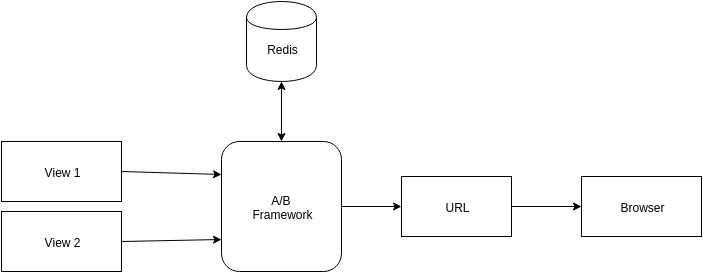
A/B test views

A/B for Templates

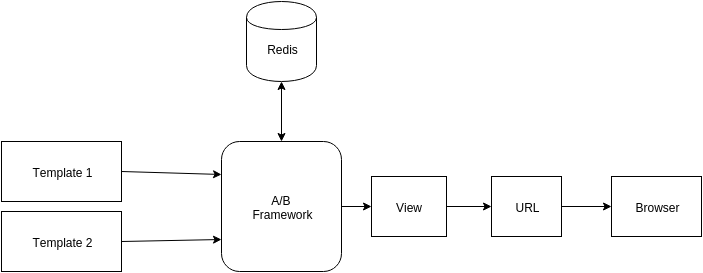
A/B test templates

Getting the logic right

To begin with, we had to categorize our users into buckets. So all our users were assigned a bucket number ranging from 1 to 120. This numbering is not strict and the range can be arbitrary or per your needs. Next, we defined two constants—the first one specifies which view a user is routed to, and the second one specifies the fallback or primary view.

AB_TEST = {
    tuple(xrange(1, 61)): 'example_app.views.view_a',
    tuple(xrange(61, 121)): 'example_app.views.view_b',
}

AB_TEST_PRIMARY = 'example_app.views.view_a'

Next, we wrote two decorators which we could wrap around views—one for handling views and the other for handling templates. In the first scenario, the decorator would take a dictionary of views, a primary view, and a Boolean value which specifies if anonymous users should be A/B tested as well.

Decorator Code

"""
Decorator to A/B test different views.
Args:
    primary_view:       Fallback view.
    anon_sticky:        Determines whether A/B testing should be performed on anonymous users.
    view_dict:          A dictionary of views (as string) with buckets as keys.
"""
def ab_views(primary_view=None, anon_sticky=False, view_dict={}):
    def decorator(f):
        @wraps(f)
        def _ab_views(request, *args, **kwargs):
            view = None
            try:
                if user_is_logged_in():
                    view = _get_view(request, f, view_dict, primary_view)
                else:
                    redis = initialize_redis_obj()
                    view = _get_view_anonymous(request, redis, f, view_dict, primary_view, anon_sticky)
            except:
                view = primary_view
            view = str_to_func(view)
            return view(request, *args, **kwargs)

        def _get_view(request, f, view_dict, primary_view):
            bucket = get_user_bucket(request)
            view = get_view_for_bucket(bucket)
            return view

        def _get_view_anonymous(request, redis, f, view_dict, primary_view, anon_sticky):
            view = None
            if anon_sticky:
                cookie = get_cookie_from_request(request)
                if cookie:
                    view = get_value_from_redis(cookie)
                else:
                    view = random.choice(view_dict.values())
                    set_cookie_value_in_redis(cookie)
            else:
                view = primary_view
            return view

        return _ab_views
    return decorator

Helper Function

def str_to_func(func_string):
    func = None
    func_string_splitted = func_string.split('.')
    module_name = '.'.join(func_string_splitted[:-1])
    function_name = func_string_splitted[-1]
    module = import_module(module_name)
    if module and function_name:
        func = getattr(module, function_name)
    return func

Putting things together

Let’s assume that we have already written the A and B views. Let’s call them view_a and view_b. To get the entire thing working, we will write a new view called view_ab and wrap it with the decorator.

@ab_views(
    primary_view=AB_TEST_PRIMARY,
    anon_sticky=True,
    view_dict=AB_TEST,
)
def view_ab(request):
    ctx = {}
    return ctx

For the sake of convenience, we require this new view to return a dictionary.

Finally, we need to integrate analytics to collect data. We used Mixpanel at the JavaScript end to track user behavior. You can use any analytics or event tracking tool for this purpose.

This is just one of the ways you can do A/B testing using Django. You can always take this basic framework and improve it or add new features.

P.S. If you want to experiment with an A/A/B or A/B/C testing, all you need to do is change the AB_TEST constant.

Feel free to comment or ping us at support@hackerearth.com if you have any suggestions!

This post was originally written for the HackerEarth Engineering blog by Arindam Mani Das.

Barcelona: From a town in the Roman empire to a modern smart city

In the 3rd century BC, the Carthaginian conqueror Hamilcar Barca established a settlement on the mouth of the rivers Llobregat and Besòs. He named it Barcino after his family. In the 15th century BC, Romans conquered Barcino and used it as their military base. As time passed, Barcino became popular as Barcelona.

Barcelona is the second-largest city in Spain with a population of 1.8 million inhabitants. It is a compact city with an ever-increasing population. There were certain factors that were hindering normal life, such as:

  • Traffic congestion
  • Noise pollution
  • Bad drainage system
  • Insufficient local transport system
  • Inefficient waste management
  • Unavailability of parking space, and more

In 2012, the city government of Barcelona found a solution for these problems in a project that was undertaken 30 years ago. The project was to network 2 municipal buildings with an optical fiber network. This sparked the idea of building a smart city under the umbrella of Smart City Barcelona. The technology infrastructure of Smart City Barcelona is built on top of this optical fiber network called Transversal. Currently, Barcelona is connected with an optical fiber network of a whopping 500 km!

Building Smart City Barcelona

So just how was the ambitious goal of converting "Barcelona, a heritage city" to "Barcelona, a smart city" accomplished?

To start with, the Barcelona city government divided the Smart City Barcelona project into 22 programs comprising 83 individual projects. These projects were chosen such that it addressed all the factors that were hindering normal life in Barcelona.

The approach for smart city Barcelona is the idea that the city would function as a network of networks. In this way, it could connect different individual networks in the city, for example, transportation, pollution board, technology etc.

Barcelona city government structured its various smart city projects in the following 3 technology layers:

Layer 1: Sensors to sense activities in the environment

The government has installed a sensor platform called “Sentilo”. Considering the potential of the platform, the city government has made the Sentilo platform open source and the repository is available on Github. This will enable anyone in the world to use the platform to build their own applications.

The sensors are deployed across the city based on the requirements of the projects. These sensors are used to monitor and detect changes in the environment, for example, changes in the pollution level in a specific area.

Layer 2: City OS

City OS is the key for unlocking IoT benefits associated with data analytics and predictive modeling. It aggregates the data from various city applications and Sentilo and analyses it. For example, using the data collected from Sentilo about the pollution level, City OS can create a graphical visualization. It can also predict the pollution level for the rest of the week. This mechanism helps the Pollution Control Board to take proactive measures.

Layer 3: Service layer for data sharing

The third layer is a service layer that is used for sharing the data and analytics that are collected from the City OS layer. This data can be used by the public to enhance the city services and operations. For example, with the data and predictions available at the City OS layer, application developers can build a mobile app. This app can be used to alert users about the pollution levels and recommend appropriate measures.

Transit system

Transports Metropolitans de Barcelona (TMB) has introduced an innovative orthogonal bus network (horizontal, vertical, and diagonal lines) with hybrid buses. With this initiative the buses are now faster, frequent, and easy-to-use.

The goal of TMB’s orthogonal bus network is to ensure that travelers make just one transfer between any two points to cover 95% of their journeys. To achieve this objective, TMB has 16 orthogonal bus lines. This ensures that all parts of the Barcelona are covered. With this improved geographical coverage, the distance from any point in the city to nearest bus stop is less than 400 m.

Hybrid buses in Barcelona

Orthogonal transit network

Smart bus stop in Barcelona

Impact

  • Bus frequency increased from 12 min to 5 min
  • Travelers can reach any part of Barcelona in less than 40 min
  • Travelers can save ~10 million hours annually
  • CO2 emission reduced by 5000 tons/year
  • Construction cost is recovered in just 2 years through reduction in operational cost

Rainwater harvesting system

Barcelona City Council came up with a mega project of constructing 33 underground water-retention tanks with a total capacity of 1,168,900 m³. The water retention tanks have 18 gates, which are controlled from a remote control station.

Rainwater retention tank

Impact

  • Prevented more than 940 tons of suspended matter from joining the sea
  • Saved 3.7 million m³ rainwater from flowing into the sea annually
  • Barcelona is now a robust flood-resistant city

Bicycle sharing system

Barcelona City Council introduced Bicing, a bicycle-sharing system, with an objective to provide a sustainable mode of transportation and to address traffic-congestion issues.

Bicing is an on-street scheme available all year round. Riders use an RFID swipe card to unlock a bike. There are 420 Bicing stations in the city with a capacity of 20 bicycles each, located near public transport stops to facilitate intermodal use.

Bicing station

Bicing stations in Barcelona

Impact

  • Acquired 99,600 subscribers
  • Each bike is used 7.5 times a day (~1.4 million journeys/month)
  • Average ride time is 13 min
  • Reduces CO2 emission by 4000 tons annually

Power generation and distribution network

The Barcelona City Council in association with other private players has established 2 power generation units in Forum and 22@.

The plants use steam from incinerated urban waste and store excess energy using an advanced ice storage system. Energy is distributed through a network of hot and cold water piping systems.

Impact

  • Decreased fossil fuel dependency by 22%
  • Reduced CO2 emission by 17,000 tons annually

The Smart City Barcelona project has not only increased the revenue for the city government but also created 47,000 new jobs. While countries are still sceptical of implementing IoT, Barcelona has demonstrated how smart cities make economic sense while solving problems like pollution and global warming.

Read this article for a detailed description about the Information and Communications Technology (ICT) architecture of smart cities.

Elo rating system: Common link between Facemash and chess!


Remember the scene from the Facebook movie, The Social Network where Mark Zuckerberg, while creating “Facemash” (the earlier version of Facebook), tells Eduardo Saverin, "I need the algorithm you used to rank chess players” who then writes an equation on the glass panel?

That equation is called the Elo rating or Elo rating system, named after its creator Arpad Elo. This rating system is used to rate the skills of the players in competitor-versus-competitor games like chess, football, baseball, and American football.

Elo believed in the following:

  1. Performance of each player in a game is a normal distribution of random variables
  2. The mean value of players irrespective of their performance in an individual game increases slowly.

Initially invented as a rating system for chess players, Elo is now used as a fundamental rating system in most video games, snooker, scrabble, etc.


Elo rating system explained -

This system is used to determine the output of a game by using a player’s Elo rating. It is all based on probability. Players with a higher Elo rating have a higher probability of winning a game than players with a lower Elo rating.

After the game, the winner takes points from the loser, thereby increasing his rating.

If a high-rated player wins, only a few points will be transferred from the lower rated player. However, if the lower rated player pulls off an upset win, then the number of points that are taken by the player with the lower rating is far greater. (Sounds unfair, doesn’t it?)


Elo rating system equation explanation -

Let's take a look at the Elo rating equation.

Elo rating equation

Elo rating equation

calc = (1.0 / (1.0 + pow(10, ((rating_2 - rating_1) / 400))));

In this equation, RA and RB stand for the current Elo ratings of a player.

In real-world competitive gaming, a player has a probability of winning, losing, and drawing a match. So when a player has a score of 0.64, the probability of winning, losing, and drawing is 64%, 26%, and 0%, respectively.

After the match, if a player’s match score exceeds his predicted score, then the player’s Elo rating is updated. Similarly, when a player’s match score falls short of the expected score, then the player’s rating is adjusted downward.

Assume that a player is required to score EA during a tournament but scores SA, then the player’s rating is updated by using the following formula:

Elo rating formula

calc = (rating + kfactor * (actual - expected));

K is known as "K factor". It is a measure of how strongly a match will influence a player rating. If K is of a lower value, then the rating is changed by a small fraction but if K is of a higher value, then the changes in the rating are significant. Different organizations use different K factors; there is no universal value defined for it.

Pseudo code for the Elo rating system

import math;

class elo_core:
    def getExpectation(rating_1, rating_2):
        calc = (1.0 / (1.0 + pow(10, ((rating_2 - rating_1) / 400))));
        return calc;

    def modifyRating(rating, expected, actual, kfactor):
        calc = (rating + kfactor * (actual - expected));
        return calc;
    

Elo rating system example -

Assume that Garry Kasparov has a rating of 2500 and Vishwanathan Anand has a rating of 2200.

Their expected scores are:

  • If Garry Kasparov (wins) = 1 / (1 + 10 ^ ((2200 - 2500)/400)) = 0.849
  • If Vishwanathan Anand (wins) = 1 / (1 + 10 ^ ((2500 - 2200)/400)) = 0.151

Now believe that the Federation has decided that the value of K is 24.

The new ratings of the players are as follows:

If Garry Kasparov wins
  • Garry Kasparov = 2500 + 24 * (1 - 0.849) = 2503
  • Vishwanathan Anand = 2200 + 24 * (0 - 0.151) = 2196
If Vishwanathan Anand wins
  • Garry Kasparov = 2500 + 24 * (0 - 0.849) = 2479
  • Vishwanathan Anand = 2200 + 24 * (1 - 0.151) = 2220

Since Garry Kasparov (with a better rating) is the favorite, his win did not change the rating drastically. However, if the underdog, who in this case is Vishwanathan Anand wins, the ratings change drastically.

This is why in a cricket series between India and Zimbabwe, when Zimbabwe (with a lower rating) beats India, its rating changes quickly and it moves up the table. However, if India wins there is hardly any change in its ranking (Though ICC uses a modified

HackerEarth Recruit—Introducing The New Pricing Structure

We've been busy at HackerEarth Recruit for the past few months and we have some exciting news—new pricing plans! We have switched from the current pay-as-you-go pricing plan to a subscription-based plan. The new pricing plan offers three subscription types that are tailor-made so that you pay only for the options that you require. The subscription types are designed to integrate seamlessly with your requirement needs. Custom plans can be designed to suit specific requirement needs.

So what changes have we made?

We have introduced three subscription types—Free, Startup, and Enterprise. With each of these subscription types, you need not predict the number of invites that you require during your recruitment season. Based on the type of subscription that you choose, we will load your account with a predefined number of invites. We have no limits on the number of invites because we have introduced a flexible billing plan which charges you based on your usage. The billing system is automated thus reducing the number of times that you have to log in. At the end of each billing cycle, your online invoice is delivered automatically to your inbox.

New Plans

  1. Free Plan

    The Free plan is suitable for organizations that aren’t hiring actively. The features of this plan are as follows:

    • You can sign up and start using our platform immediately
    • You will get 5 test invites and 3 interview invites every month
    • You can add up to 2 administrators

    After you have used up all your invites, you can seamlessly upgrade your plan to keep using the platform. Alternately, you can choose to use the platform next month when you receive next month’s invites.

  2. Startup Plan

    The Startup plan is suitable for organizations that have smaller hiring needs, such as hiring individuals or building small teams. The features of this plan are as follows:

    • Create tests
    • Schedule interviews
    • Access the HackerEarth library
    • Add up to 5 administrators from your organization with different levels of access
    • Choose to start your subscription by adding your preferred payment method

    After you start your subscription, you will receive 20 test invites and 5 interview invites every month.

  3. Enterprise Plan

    The Enterprise plan is a value-for-money plan that is suitable for organizations that are at the peak of their hiring season. These plans are also suitable if you are building big technical teams and have a large number of assessments and interviews to conduct.

    The features of this plan are as follows:

    • Create tests
    • Schedule interviews
    • Access the HackerEarth library
    • Access Recruit API
    • Add up to 10 administrators from your organization with different levels of access
    • Choose to start your subscription by adding your preferred payment method

    After you start your subscription, you will receive 50 test invites and 15 interview invites every month.

In both the Startup and Enterprise plans, you can sign up for a free, 14-day trial during which you can use up to 15 test invites and 3 interview invites.

After you have used up your monthly invites, you can continue using the platform. However, you will be billed for the additional invites that you use. View the Billing & Usage page to monitor your usage.

None of the above? Customize plans for your needs!

Introducing a customizable plan for your custom needs.

We realize that every company is unique and we want to meet all your needs. Therefore, if none of our standard paid plans suit your recruitment needs, we can create a custom plan for you.

After you sign up, you will receive a free, 14-day trial. During this trial, you can do the following:

  • Use up to 15 test invites and 3 interview invites
  • Use all the features of the Enterprise plan

An account manager from the HackerEarth team will be in touch with you to create your custom plan. You can also choose to switch to a standard subscription plan at any time.

Visit our pricing page now to learn more.

In the Spotlight

Technical Screening Guide: All You Need To Know

Read this guide and learn how you can establish a less frustrating developer hiring workflow for both hiring teams and candidates.
Read More
Top Products

Explore HackerEarth’s top products for Hiring & Innovation

Discover powerful tools designed to streamline hiring, assess talent efficiently, and run seamless hackathons. Explore HackerEarth’s top products that help businesses innovate and grow.
Frame
Hackathons
Engage global developers through innovation
Arrow
Frame 2
Assessments
AI-driven advanced coding assessments
Arrow
Frame 3
FaceCode
Real-time code editor for effective coding interviews
Arrow
Frame 4
L & D
Tailored learning paths for continuous assessments
Arrow
Authors

Meet our Authors

Get to know the experts behind our content. From industry leaders to tech enthusiasts, our authors share valuable insights, trends, and expertise to keep you informed and inspired.
Ruehie Jaiya Karri
Kumari Trishya

7 Tech Recruiting Trends To Watch Out For In 2024

The last couple of years transformed how the world works and the tech industry is no exception. Remote work, a candidate-driven market, and automation are some of the tech recruiting trends born out of the pandemic.

While accepting the new reality and adapting to it is the first step, keeping up with continuously changing hiring trends in technology is the bigger challenge right now.

What does 2024 hold for recruiters across the globe? What hiring practices would work best in this post-pandemic world? How do you stay on top of the changes in this industry?

The answers to these questions will paint a clearer picture of how to set up for success while recruiting tech talent this year.

7 tech recruiting trends for 2024

6 Tech Recruiting Trends To Watch Out For In 2022

Recruiters, we’ve got you covered. Here are the tech recruiting trends that will change the way you build tech teams in 2024.

Trend #1—Leverage data-driven recruiting

Data-driven recruiting strategies are the answer to effective talent sourcing and a streamlined hiring process.

Talent acquisition leaders need to use real-time analytics like pipeline growth metrics, offer acceptance rates, quality and cost of new hires, and candidate feedback scores to reduce manual work, improve processes, and hire the best talent.

The key to capitalizing on talent market trends in 2024 is data. It enables you to analyze what’s working and what needs refinement, leaving room for experimentation.

Trend #2—Have impactful employer branding

98% of recruiters believe promoting company culture helps sourcing efforts as seen in our 2021 State Of Developer Recruitment report.

Having a strong employer brand that supports a clear Employer Value Proposition (EVP) is crucial to influencing a candidate’s decision to work with your company. Perks like upskilling opportunities, remote work, and flexible hours are top EVPs that attract qualified candidates.

A clear EVP builds a culture of balance, mental health awareness, and flexibility—strengthening your employer brand with candidate-first policies.

Trend #3—Focus on candidate-driven market

The pandemic drastically increased the skills gap, making tech recruitment more challenging. With the severe shortage of tech talent, candidates now hold more power and can afford to be selective.

Competitive pay is no longer enough. Use data to understand what candidates want—work-life balance, remote options, learning opportunities—and adapt accordingly.

Recruiters need to think creatively to attract and retain top talent.


Recommended read: What NOT To Do When Recruiting Fresh Talent


Trend #4—Have a diversity and inclusion oriented company culture

Diversity and inclusion have become central to modern recruitment. While urgent hiring can delay D&I efforts, long-term success depends on inclusive teams. Our survey shows that 25.6% of HR professionals believe a diverse leadership team helps build stronger pipelines and reduces bias.

McKinsey’s Diversity Wins report confirms this: top-quartile gender-diverse companies see 25% higher profitability, and ethnically diverse teams show 36% higher returns.

It's refreshing to see the importance of an inclusive culture increasing across all job-seeking communities, especially in tech. This reiterates that D&I is a must-have, not just a good-to-have.

—Swetha Harikrishnan, Sr. HR Director, HackerEarth

Recommended read: Diversity And Inclusion in 2022 - 5 Essential Rules To Follow


Trend #5—Embed automation and AI into your recruitment systems

With the rise of AI tools like ChatGPT, automation is being adopted across every business function—including recruiting.

Manual communication with large candidate pools is inefficient. In 2024, recruitment automation and AI-powered platforms will automate candidate nurturing and communication, providing a more personalized experience while saving time.

Trend #6—Conduct remote interviews

With 32.5% of companies planning to stay remote, remote interviewing is here to stay.

Remote interviews expand access to global talent, reduce overhead costs, and increase flexibility—making the hiring process more efficient for both recruiters and candidates.

Trend #7—Be proactive in candidate engagement

Delayed responses or lack of updates can frustrate candidates and impact your brand. Proactive communication and engagement with both active and passive candidates are key to successful recruiting.

As recruitment evolves, proactive candidate engagement will become central to attracting and retaining talent. In 2023 and beyond, companies must engage both active and passive candidates through innovative strategies and technologies like chatbots and AI-powered systems. Building pipelines and nurturing relationships will enhance employer branding and ensure long-term hiring success.

—Narayani Gurunathan, CEO, PlaceNet Consultants

Recruiting Tech Talent Just Got Easier With HackerEarth

Recruiting qualified tech talent is tough—but we’re here to help. HackerEarth for Enterprises offers an all-in-one suite that simplifies sourcing, assessing, and interviewing developers.

Our tech recruiting platform enables you to:

  • Tap into a 6 million-strong developer community
  • Host custom hackathons to engage talent and boost your employer brand
  • Create online assessments to evaluate 80+ tech skills
  • Use dev-friendly IDEs and proctoring for reliable evaluations
  • Benchmark candidates against a global community
  • Conduct live coding interviews with FaceCode, our collaborative coding interview tool
  • Guide upskilling journeys via our Learning and Development platform
  • Integrate seamlessly with all leading ATS systems
  • Access 24/7 support with a 95% satisfaction score

Recommended read: The A-Zs Of Tech Recruiting - A Guide


Staying ahead of tech recruiting trends, improving hiring processes, and adapting to change is the way forward in 2024. Take note of the tips in this article and use them to build a future-ready hiring strategy.

Ready to streamline your tech recruiting? Try HackerEarth for Enterprises today.

(Part 2) Essential Questions To Ask When Interviewing Developers In 2021

The first part of this blog stresses the importance of asking the right technical interview questions to assess a candidate’s coding skills. But that alone is not enough. If you want to hire the crème de la crème of the developer talent out there, you have to look for a well-rounded candidate.

Honest communication, empathy, and passion for their work are equally important as a candidate’s technical knowledge. Soft skills are like the cherry on top. They set the best of the candidates apart from the rest.

Re-examine how you are vetting your candidates. Identify the gaps in your interviews. Once you start addressing these gaps, you find developers who have the potential to be great. And those are exactly the kind of people that you want to work with!

Let’s get to it, shall we?

Hire great developers

What constitutes a good interview question?

An ideal interview should reveal a candidate’s personality along with their technical knowledge. To formulate a comprehensive list of questions, keep in mind three important characteristics.

  • Questions are open-ended – questions like, “What are some of the programming languages you’re comfortable with,” instead of “Do you know this particular programming language” makes the candidate feel like they’re in control. It is also a chance to let them reply to your question in their own words.
  • They address the behavioral aspects of a candidate – ensure you have a few questions on your list that allow a candidate to describe a situation. A situation where a client was unhappy or a time when the developer learned a new technology. Such questions help you assess if the candidate is a good fit for the team.
  • There is no right or wrong answer – it is important to have a structured interview process in place. But this does not mean you have a list of standard answers in mind that you’re looking for. How candidates approach your questions shows you whether they have the makings of a successful candidate. Focus on that rather than on the actual answer itself.

Designing a conversation around these buckets of interview questions brings you to my next question, “What should you look for in each candidate to spot the best ones?”

Hire GREAT developers by asking the right questions

Before we dive deep into the interview questions, we have to think about a few things that have changed. COVID-19 has rendered working from home the new normal for the foreseeable future. As a recruiter, the onus falls upon you to understand whether the developer is comfortable working remotely and has the relevant resources to achieve maximum productivity.

#1 How do you plan your day?

Remote work gives employees the option to be flexible. You don’t have to clock in 9 hours a day as long as you get everything done on time. A developer who hasn’t always been working remotely, but has a routine in place, understands the pitfalls of working from home. It is easy to get distracted and having a schedule to fall back on ensures good productivity.

#2 Do you have experience using tools for collaboration and remote work?

Working from home reduces human interaction heavily. There is no way to just go up to your teammate’s desk and clarify issues. Virtual communication is key to getting work done. Look for what kind of remote working tools your candidate is familiar with and if they know what collaborative tools to use for different tasks.

Value-based interview questions to ask

We went around and spoke to our engineering team, and the recruiting team to see what questions they abide by; what they think makes any candidate tick.

The result? – a motley group of questions that aim to reveal the candidate’s soft skills, in addition to typical technical interview questions and test tasks.


Recommended read: How Recruiting The Right Tech Talent Can Solve Tech Debt


#3 Please describe three recent projects that you worked on. What were the most interesting and challenging parts?

This is an all-encompassing question in that it lets the candidate explain at length about their work ethic—thought process, handling QA, working with a team, and managing user feedback. This also lets you dig enough to assess whether the candidate is taking credit for someone else's work or not.

#4 You’ve worked long and hard to deliver a complex feature for a client and they say it’s not what they asked for. How would you take it?

A good developer will take it in their stride, work closely with the client to find the point of disconnect, and sort out the issue. There are so many things that could go wrong or not be to the client’s liking, and it falls on the developer to remain calm and create solutions.

#5 What new programming languages or technologies have you learned recently?

While being certified in many programming languages doesn't guarantee a great developer, it still is an important technical interview question to ask. It helps highlight a thirst for knowledge and shows that the developer is eager to learn new things.

#6 What does the perfect release look like? Who is involved and what is your role?

Have the developer take you through each phase of a recent software development lifecycle. Ask them to explain their specific role in each phase in this release. This will give you an excellent perspective into a developer’s mind. Do they talk about the before and after of the release? A skilled developer would. The chances of something going wrong in a release are very high. How would the developer react? Will they be able to handle the pressure?


SUBSCRIBE to the HackerEarth blog and enrich your monthly reading with our free e-newsletter – Fresh, insightful and awesome articles straight into your inbox from around the tech recruiting world!


#7 Tell me about a time when you had to convince your lead to try a different approach?

As an example of a behavioral interview question, this is a good one. The way a developer approaches this question speaks volumes about how confident they are expressing their views, and how succinct they are in articulating those views.

#8 What have you done with all the extra hours during the pandemic?

Did you binge-watch your way through the pandemic? I’m sure every one of us has done this. Indulge in a lighthearted conversation with your candidate. This lets them talk about something they are comfortable with. Maybe they learned a new skill or took up a hobby. Get to know a candidate’s interests and little pleasures for a more rounded evaluation.

Over to you! Now that you know what aspects of a candidate to focus on, you are well-equipped to bring out the best in each candidate in their interviews. A mix of strong technical skills and interpersonal qualities is how you spot good developers for your team.

If you have more pressing interview questions to add to this list of ours, please write to us at contact@hackerearth.com.

(Part 1) Essential Questions To Ask When Recruiting Developers In 2021

The minute a developer position opens up, recruiters feel a familiar twinge of fear run down their spines. They recall their previous interview experiences, and how there seems to be a blog post a month that goes viral about bad developer interviews.

While hiring managers, especially the picky ones, would attribute this to a shortage of talented developers, what if the time has come to rethink your interview process? What if recruiters and hiring managers put too much stock into bringing out the technical aspects of each candidate and don’t put enough emphasis on their soft skills?

A report by Robert Half shows that 86% of technology leaders say it’s challenging to find IT talent. Interviewing developers should be a rewarding experience, not a challenging one. If you don’t get caught up in asking specific questions and instead design a simple conversation to gauge a candidate’s way of thinking, it throws up a lot of good insight and makes it fun too.

Developer Hiring Statistics

Asking the right technical interview questions when recruiting developers is important but so is clear communication, good work ethic, and alignment with your organization’s goals.

Let us first see what kind of technical interview questions are well-suited to revealing the coding skills and knowledge of any developer, and then tackle the behavioral aspects of the candidate that sets them apart from the rest.

Recruit GREAT developers by asking the right questions

Here are some technical interview questions that you should ask potential software engineers when interviewing.

#1 Write an algorithm for the following

  1. Minimum Stack - Design a stack that provides 4 functions - push(item), pop, peek, and minimum, all in constant order time complexity. Then move on to coding the actual solution.
  2. Kth Largest Element in an array - This is a standard problem with multiple solutions of best time complexity orders where N log(K) is a common one and O(N) + K log(N) is a lesser-known order. Both solutions are acceptable, not directly comparable to each other, and better than N log(N), which is sorting an array and fetching the Kth element.
  3. Top View of a Binary Tree - Given a root node of the binary tree, return the set of all elements that will get wet if it rains on the tree. Nodes having any nodes directly above them will not get wet.
  4. Internal implementation of a hashtable like a map/dictionary - A candidate needs to specify how key-value pairs are stored, hashing is used and collisions are handled. A good developer not only knows how to use this concept but also how it works. If the developer also knows how the data structure scales when the number of records increases in the hashtable, that is a bonus.

Algorithms demonstrate a candidate’s ability to break down a complex problem into steps. Reasoning and pattern recognition capabilities are some more factors to look for when assessing a candidate. A good candidate can code his thought process of the algorithm finalized during the discussion.


Looking for a great place to hire developers in the US? Try Jooble!


#2 Formulate solutions for the below low-level design (LLD) questions

  • What is LLD? In your own words, specify the different aspects covered in LLD.
  • Design a movie ticket booking application like BookMyShow. Ensure that your database schema is tailored for a theatre with multiple screens and takes care of booking, seat availability, seat arrangement, and seat locking. Your solution does not have to extend to the payment option.
  • Design a basic social media application. Design database schema and APIs for a platform like Twitter with features for following a user, tweeting a post, seeing your tweet, and seeing a user's tweet.

Such questions do not have a right or wrong answer. They primarily serve to reveal a developer’s thought process and the way they approach a problem.


Recommended read: Hardest Tech Roles to Fill (+ solutions!)


#3 Some high-level design (HLD) questions

  • What do you understand by HLD? Can you specify the difference between LLD and HLD?
  • Design a social media application. In addition to designing a platform like Twitter with features for following a user, tweeting a post, seeing your tweet, and seeing a user's tweet, design a timeline. After designing a timeline where you can see your followers’ tweets, scale it for a larger audience. If you still have time, try to scale it for a celebrity use case.
  • Design for a train ticket booking application like IRCTC. Incorporate auth, features to choose start and end stations, view available trains and available seats between two stations, save reservation of seats from start to end stations, and lock them till payment confirmation.
  • How will you design a basic relational database? The database should support tables, columns, basic field types like integer and text, foreign keys, and indexes. The way a developer approaches this question is important. A good developer designs a solution around storage and memory management.
Here’s a pro-tip for you. LLD questions can be answered by both beginners and experienced developers. Mostly, senior developers can be expected to answer HLD questions. Choose your interview questions set wisely, and ask questions relevant to your candidate’s experience.

#4 Have you ever worked with SQL? Write queries for a specific use case that requires multiple joins.

Example: Create a table with separate columns for student name, subject, and marks scored. Return student names and ranks of each student. The rank of a student depends on the total of marks in all subjects.

Not all developers would have experience working with SQL but some knowledge about how data is stored/structured is useful. Developers should be familiar with simple concepts like joins, retrieval queries, and the basics of DBMS.

#5 What do you think is wrong with this code?

Instead of asking developer candidates to write code on a piece of paper (which is outdated, anyway), ask them to debug existing code. This is another way to assess their technical skills. Place surreptitious errors in the code and evaluate their attention to detail.

Now that you know exactly what technical skills to look for and when questions to ask when interviewing developers, the time has come to assess the soft skills of these candidates. Part 2 of this blog throws light on the how and why of evaluating candidates based on their communication skills, work ethic, and alignment with the company’s goals.

View all

Best Pre-Employment Assessments: Optimizing Your Hiring Process for 2024

In today's competitive talent market, attracting and retaining top performers is crucial for any organization's success. However, traditional hiring methods like relying solely on resumes and interviews may not always provide a comprehensive picture of a candidate's skills and potential. This is where pre-employment assessments come into play.

What is Pre-Employement Assessment?

Pre-employment assessments are standardized tests and evaluations administered to candidates before they are hired. These assessments can help you objectively measure a candidate's knowledge, skills, abilities, and personality traits, allowing you to make data-driven hiring decisions.

By exploring and evaluating the best pre-employment assessment tools and tests available, you can:

  • Improve the accuracy and efficiency of your hiring process.
  • Identify top talent with the right skills and cultural fit.
  • Reduce the risk of bad hires.
  • Enhance the candidate experience by providing a clear and objective evaluation process.

This guide will provide you with valuable insights into the different types of pre-employment assessments available and highlight some of the best tools, to help you optimize your hiring process for 2024.

Why pre-employment assessments are key in hiring

While resumes and interviews offer valuable insights, they can be subjective and susceptible to bias. Pre-employment assessments provide a standardized and objective way to evaluate candidates, offering several key benefits:

  • Improved decision-making:

    By measuring specific skills and knowledge, assessments help you identify candidates who possess the qualifications necessary for the job.

  • Reduced bias:

    Standardized assessments mitigate the risks of unconscious bias that can creep into traditional interview processes.

  • Increased efficiency:

    Assessments can streamline the initial screening process, allowing you to focus on the most promising candidates.

  • Enhanced candidate experience:

    When used effectively, assessments can provide candidates with a clear understanding of the required skills and a fair chance to showcase their abilities.

Types of pre-employment assessments

There are various types of pre-employment assessments available, each catering to different needs and objectives. Here's an overview of some common types:

1. Skill Assessments:

  • Technical Skills: These assessments evaluate specific technical skills and knowledge relevant to the job role, such as programming languages, software proficiency, or industry-specific expertise. HackerEarth offers a wide range of validated technical skill assessments covering various programming languages, frameworks, and technologies.
  • Soft Skills: These employment assessments measure non-technical skills like communication, problem-solving, teamwork, and critical thinking, crucial for success in any role.

2. Personality Assessments:

These employment assessments can provide insights into a candidate's personality traits, work style, and cultural fit within your organization.

3. Cognitive Ability Tests:

These tests measure a candidate's general mental abilities, such as reasoning, problem-solving, and learning potential.

4. Integrity Assessments:

These employment assessments aim to identify potential risks associated with a candidate's honesty, work ethic, and compliance with company policies.

By understanding the different types of assessments and their applications, you can choose the ones that best align with your specific hiring needs and ensure you hire the most qualified and suitable candidates for your organization.

Leading employment assessment tools and tests in 2024

Choosing the right pre-employment assessment tool depends on your specific needs and budget. Here's a curated list of some of the top pre-employment assessment tools and tests available in 2024, with brief overviews:

  • HackerEarth:

    A comprehensive platform offering a wide range of validated skill assessments in various programming languages, frameworks, and technologies. It also allows for the creation of custom assessments and integrates seamlessly with various recruitment platforms.

  • SHL:

    Provides a broad selection of assessments, including skill tests, personality assessments, and cognitive ability tests. They offer customizable solutions and cater to various industries.

  • Pymetrics:

    Utilizes gamified assessments to evaluate cognitive skills, personality traits, and cultural fit. They offer a data-driven approach and emphasize candidate experience.

  • Wonderlic:

    Offers a variety of assessments, including the Wonderlic Personnel Test, which measures general cognitive ability. They also provide aptitude and personality assessments.

  • Harver:

    An assessment platform focusing on candidate experience with video interviews, gamified assessments, and skills tests. They offer pre-built assessments and customization options.

Remember: This list is not exhaustive, and further research is crucial to identify the tool that aligns best with your specific needs and budget. Consider factors like the types of assessments offered, pricing models, integrations with your existing HR systems, and user experience when making your decision.

Choosing the right pre-employment assessment tool

Instead of full individual tool reviews, consider focusing on 2–3 key platforms. For each platform, explore:

  • Target audience: Who are their assessments best suited for (e.g., technical roles, specific industries)?
  • Types of assessments offered: Briefly list the available assessment categories (e.g., technical skills, soft skills, personality).
  • Key features: Highlight unique functionalities like gamification, custom assessment creation, or seamless integrations.
  • Effectiveness: Briefly mention the platform's approach to assessment validation and reliability.
  • User experience: Consider including user reviews or ratings where available.

Comparative analysis of assessment options

Instead of a comprehensive comparison, consider focusing on specific use cases:

  • Technical skills assessment:

    Compare HackerEarth and Wonderlic based on their technical skill assessment options, focusing on the variety of languages/technologies covered and assessment formats.

  • Soft skills and personality assessment:

    Compare SHL and Pymetrics based on their approaches to evaluating soft skills and personality traits, highlighting any unique features like gamification or data-driven insights.

  • Candidate experience:

    Compare Harver and Wonderlic based on their focus on candidate experience, mentioning features like video interviews or gamified assessments.

Additional tips:

  • Encourage readers to visit the platforms' official websites for detailed features and pricing information.
  • Include links to reputable third-party review sites where users share their experiences with various tools.

Best practices for using pre-employment assessment tools

Integrating pre-employment assessments effectively requires careful planning and execution. Here are some best practices to follow:

  • Define your assessment goals:

    Clearly identify what you aim to achieve with assessments. Are you targeting specific skills, personality traits, or cultural fit?

  • Choose the right assessments:

    Select tools that align with your defined goals and the specific requirements of the open position.

  • Set clear expectations:

    Communicate the purpose and format of the assessments to candidates in advance, ensuring transparency and building trust.

  • Integrate seamlessly:

    Ensure your chosen assessment tool integrates smoothly with your existing HR systems and recruitment workflow.

  • Train your team:

    Equip your hiring managers and HR team with the knowledge and skills to interpret assessment results effectively.

Interpreting assessment results accurately

Assessment results offer valuable data points, but interpreting them accurately is crucial for making informed hiring decisions. Here are some key considerations:

  • Use results as one data point:

    Consider assessment results alongside other information, such as resumes, interviews, and references, for a holistic view of the candidate.

  • Understand score limitations:

    Don't solely rely on raw scores. Understand the assessment's validity and reliability and the potential for cultural bias or individual test anxiety.

  • Look for patterns and trends:

    Analyze results across different assessments and identify consistent patterns that align with your desired candidate profile.

  • Focus on potential, not guarantees:

    Assessments indicate potential, not guarantees of success. Use them alongside other evaluation methods to make well-rounded hiring decisions.

Choosing the right pre-employment assessment tools

Selecting the most suitable pre-employment assessment tool requires careful consideration of your organization's specific needs. Here are some key factors to guide your decision:

  • Industry and role requirements:

    Different industries and roles demand varying skill sets and qualities. Choose assessments that target the specific skills and knowledge relevant to your open positions.

  • Company culture and values:

    Align your assessments with your company culture and values. For example, if collaboration is crucial, look for assessments that evaluate teamwork and communication skills.

  • Candidate experience:

    Prioritize tools that provide a positive and smooth experience for candidates. This can enhance your employer brand and attract top talent.

Budget and accessibility considerations

Budget and accessibility are essential factors when choosing pre-employment assessments:

  • Budget:

    Assessment tools come with varying pricing models (subscriptions, pay-per-use, etc.). Choose a tool that aligns with your budget and offers the functionalities you need.

  • Accessibility:

    Ensure the chosen assessment is accessible to all candidates, considering factors like language options, disability accommodations, and internet access requirements.

Additional Tips:

  • Free trials and demos: Utilize free trials or demos offered by assessment platforms to experience their functionalities firsthand.
  • Consult with HR professionals: Seek guidance from HR professionals or recruitment specialists with expertise in pre-employment assessments.
  • Read user reviews and comparisons: Gain insights from other employers who use various assessment tools.

By carefully considering these factors, you can select the pre-employment assessment tool that best aligns with your organizational needs, budget, and commitment to an inclusive hiring process.

Remember, pre-employment assessments are valuable tools, but they should not be the sole factor in your hiring decisions. Use them alongside other evaluation methods and prioritize building a fair and inclusive hiring process that attracts and retains top talent.

Future trends in pre-employment assessments

The pre-employment assessment landscape is constantly evolving, with innovative technologies and practices emerging. Here are some potential future trends to watch:

  • Artificial intelligence (AI):

    AI-powered assessments can analyze candidate responses, written work, and even resumes, using natural language processing to extract relevant insights and identify potential candidates.

  • Adaptive testing:

    These assessments adjust the difficulty level of questions based on the candidate's performance, providing a more efficient and personalized evaluation.

  • Micro-assessments:

    Short, focused assessments delivered through mobile devices can assess specific skills or knowledge on-the-go, streamlining the screening process.

  • Gamification:

    Engaging and interactive game-based elements can make the assessment experience more engaging and assess skills in a realistic and dynamic way.

Conclusion

Pre-employment assessments, when used thoughtfully and ethically, can be a powerful tool to optimize your hiring process, identify top talent, and build a successful workforce for your organization. By understanding the different types of assessments available, exploring top-rated tools like HackerEarth, and staying informed about emerging trends, you can make informed decisions that enhance your ability to attract, evaluate, and hire the best candidates for the future.

Tech Layoffs: What To Expect In 2024

Layoffs in the IT industry are becoming more widespread as companies fight to remain competitive in a fast-changing market; many turn to layoffs as a cost-cutting measure. Last year, 1,000 companies including big tech giants and startups, laid off over two lakhs of employees. But first, what are layoffs in the tech business, and how do they impact the industry?

Tech layoffs are the termination of employment for some employees by a technology company. It might happen for various reasons, including financial challenges, market conditions, firm reorganization, or the after-effects of a pandemic. While layoffs are not unique to the IT industry, they are becoming more common as companies look for methods to cut costs while remaining competitive.

The consequences of layoffs in technology may be catastrophic for employees who lose their jobs and the firms forced to make these difficult decisions. Layoffs can result in the loss of skill and expertise and a drop in employee morale and productivity. However, they may be required for businesses to stay afloat in a fast-changing market.

This article will examine the reasons for layoffs in the technology industry, their influence on the industry, and what may be done to reduce their negative impacts. We will also look at the various methods for tracking tech layoffs.

What are tech layoffs?

The term "tech layoff" describes the termination of employees by an organization in the technology industry. A company might do this as part of a restructuring during hard economic times.

In recent times, the tech industry has witnessed a wave of significant layoffs, affecting some of the world’s leading technology companies, including Amazon, Microsoft, Meta (formerly Facebook), Apple, Cisco, SAP, and Sony. These layoffs are a reflection of the broader economic challenges and market adjustments facing the sector, including factors like slowing revenue growth, global economic uncertainties, and the need to streamline operations for efficiency.

Each of these tech giants has announced job cuts for various reasons, though common themes include restructuring efforts to stay competitive and agile, responding to over-hiring during the pandemic when demand for tech services surged, and preparing for a potentially tough economic climate ahead. Despite their dominant positions in the market, these companies are not immune to the economic cycles and technological shifts that influence operational and strategic decisions, including workforce adjustments.

This trend of layoffs in the tech industry underscores the volatile nature of the tech sector, which is often at the mercy of rapid changes in technology, consumer preferences, and the global economy. It also highlights the importance of adaptability and resilience for companies and employees alike in navigating the uncertainties of the tech landscape.

Causes for layoffs in the tech industry

Why are tech employees suffering so much?

Yes, the market is always uncertain, but why resort to tech layoffs?

Various factors cause tech layoffs, including company strategy changes, market shifts, or financial difficulties. Companies may lay off employees if they need help to generate revenue, shift their focus to new products or services, or automate certain jobs.

In addition, some common reasons could be:

Financial struggles

Currently, the state of the global market is uncertain due to economic recession, ongoing war, and other related phenomena. If a company is experiencing financial difficulties, only sticking to pay cuts may not be helpful—it may need to reduce its workforce to cut costs.


Also, read: 6 Steps To Create A Detailed Recruiting Budget (Template Included)


Changes in demand

The tech industry is constantly evolving, and companies would have to adjust their workforce to meet changing market conditions. For instance, companies are adopting remote work culture, which surely affects on-premises activity, and companies could do away with some number of tech employees at the backend.

Restructuring

Companies may also lay off employees as part of a greater restructuring effort, such as spinning off a division or consolidating operations.

Automation

With the advancement in technology and automation, some jobs previously done by human labor may be replaced by machines, resulting in layoffs.

Mergers and acquisitions

When two companies merge, there is often overlap in their operations, leading to layoffs as the new company looks to streamline its workforce.

But it's worth noting that layoffs are not exclusive to the tech industry and can happen in any industry due to uncertainty in the market.

Will layoffs increase in 2024?

It is challenging to estimate the rise or fall of layoffs. The overall state of the economy, the health of certain industries, and the performance of individual companies will play a role in deciding the degree of layoffs in any given year.

But it is also seen that, in the first 15 days of this year, 91 organizations laid off over 24,000 tech workers, and over 1,000 corporations cut down more than 150,000 workers in 2022, according to an Economic Times article.

The COVID-19 pandemic caused a huge economic slowdown and forced several businesses to downsize their employees. However, some businesses rehired or expanded their personnel when the world began to recover.

So, given the current level of economic uncertainty, predicting how the situation will unfold is difficult.


Also, read: 4 Images That Show What Developers Think Of Layoffs In Tech


What types of companies are prone to tech layoffs?

2023 Round Up Of Layoffs In Big Tech

Tech layoffs can occur in organizations of all sizes and various areas.

Following are some examples of companies that have experienced tech layoffs in the past:

Large tech firms

Companies such as IBM, Microsoft, Twitter, Better.com, Alibaba, and HP have all experienced layoffs in recent years as part of restructuring initiatives or cost-cutting measures.

Market scenarios are still being determined after Elon Musk's decision to lay off employees. Along with tech giants, some smaller companies and startups have also been affected by layoffs.

Startups

Because they frequently work with limited resources, startups may be forced to lay off staff if they cannot get further funding or need to pivot due to market downfall.

Small and medium-sized businesses

Small and medium-sized businesses face layoffs due to high competition or if the products/services they offer are no longer in demand.

Companies in certain industries

Some sectors of the technological industry, such as the semiconductor industry or automotive industry, may be more prone to layoffs than others.

Companies that lean on government funding

Companies that rely significantly on government contracts may face layoffs if the government cuts technology spending or contracts are not renewed.

How to track tech layoffs?

You can’t stop tech company layoffs, but you should be keeping track of them. We, HR professionals and recruiters, can also lend a helping hand in these tough times by circulating “layoff lists” across social media sites like LinkedIn and Twitter to help people land jobs quicker. Firefish Software put together a master list of sources to find fresh talent during the layoff period.

Because not all layoffs are publicly disclosed, tracking tech industry layoffs can be challenging, and some may go undetected. There are several ways to keep track of tech industry layoffs:

Use tech layoffs tracker

Layoff trackers like thelayoff.com and layoffs.fyi provide up-to-date information on layoffs.

In addition, they aid in identifying trends in layoffs within the tech industry. It can reveal which industries are seeing the most layoffs and which companies are the most affected.

Companies can use layoff trackers as an early warning system and compare their performance to that of other companies in their field.

News articles

Because many news sites cover tech layoffs as they happen, keeping a watch on technology sector stories can provide insight into which organizations are laying off employees and how many individuals have been affected.

Social media

Organizations and employees frequently publish information about layoffs in tech on social media platforms; thus, monitoring companies' social media accounts or following key hashtags can provide real-time updates regarding layoffs.

Online forums and communities

There are online forums and communities dedicated to discussing tech industry news, and they can be an excellent source of layoff information.

Government reports

Government agencies such as the Bureau of Labor Statistics (BLS) publish data on layoffs and unemployment, which can provide a more comprehensive picture of the technology industry's status.

How do companies reduce tech layoffs?

Layoffs in tech are hard – for the employee who is losing their job, the recruiter or HR professional who is tasked with informing them, and the company itself. So, how can we aim to avoid layoffs? Here are some ways to minimize resorting to letting people go:

Salary reductions

Instead of laying off employees, businesses can lower the salaries or wages of all employees. It can be accomplished by instituting compensation cuts or salary freezes.

Implementing a hiring freeze

Businesses can halt employing new personnel to cut costs. It can be a short-term solution until the company's financial situation improves.


Also, read: What Recruiters Can Focus On During A Tech Hiring Freeze


Non-essential expense reduction

Businesses might search for ways to cut or remove non-essential expenses such as travel, training, and office expenses.

Reducing working hours

Companies can reduce employee working hours to save money, such as implementing a four-day workweek or a shorter workday.

These options may not always be viable and may have their problems, but before laying off, a company owes it to its people to consider every other alternative, and formulate the best solution.

Tech layoffs to bleed into this year

While we do not know whether this trend will continue or subside during 2023, we do know one thing. We have to be prepared for a wave of layoffs that is still yet to hit. As of last month, Layoffs.fyi had already tracked 170+ companies conducting 55,970 layoffs in 2023.

So recruiters, let’s join arms, distribute those layoff lists like there’s no tomorrow, and help all those in need of a job! :)

What is Headhunting In Recruitment?: Types &amp; How Does It Work?

In today’s fast-paced world, recruiting talent has become increasingly complicated. Technological advancements, high workforce expectations and a highly competitive market have pushed recruitment agencies to adopt innovative strategies for recruiting various types of talent. This article aims to explore one such recruitment strategy – headhunting.

What is Headhunting in recruitment?

In headhunting, companies or recruitment agencies identify, engage and hire highly skilled professionals to fill top positions in the respective companies. It is different from the traditional process in which candidates looking for job opportunities approach companies or recruitment agencies. In headhunting, executive headhunters, as recruiters are referred to, approach prospective candidates with the hiring company’s requirements and wait for them to respond. Executive headhunters generally look for passive candidates, those who work at crucial positions and are not on the lookout for new work opportunities. Besides, executive headhunters focus on filling critical, senior-level positions indispensable to companies. Depending on the nature of the operation, headhunting has three types. They are described later in this article. Before we move on to understand the types of headhunting, here is how the traditional recruitment process and headhunting are different.

How do headhunting and traditional recruitment differ from each other?

Headhunting is a type of recruitment process in which top-level managers and executives in similar positions are hired. Since these professionals are not on the lookout for jobs, headhunters have to thoroughly understand the hiring companies’ requirements and study the work profiles of potential candidates before creating a list.

In the traditional approach, there is a long list of candidates applying for jobs online and offline. Candidates approach recruiters for jobs. Apart from this primary difference, there are other factors that define the difference between these two schools of recruitment.

AspectHeadhuntingTraditional RecruitmentCandidate TypePrimarily passive candidateActive job seekersApproachFocused on specific high-level rolesBroader; includes various levelsScopeproactive outreachReactive: candidates applyCostGenerally more expensive due to expertise requiredTypically lower costsControlManaged by headhuntersManaged internally by HR teams

All the above parameters will help you to understand how headhunting differs from traditional recruitment methods, better.

Types of headhunting in recruitment

Direct headhunting: In direct recruitment, hiring teams reach out to potential candidates through personal communication. Companies conduct direct headhunting in-house, without outsourcing the process to hiring recruitment agencies. Very few businesses conduct this type of recruitment for top jobs as it involves extensive screening across networks outside the company’s expanse.

Indirect headhunting: This method involves recruiters getting in touch with their prospective candidates through indirect modes of communication such as email and phone calls. Indirect headhunting is less intrusive and allows candidates to respond at their convenience.Third-party recruitment: Companies approach external recruitment agencies or executive headhunters to recruit highly skilled professionals for top positions. This method often leverages the company’s extensive contact network and expertise in niche industries.

How does headhunting work?

Finding highly skilled professionals to fill critical positions can be tricky if there is no system for it. Expert executive headhunters employ recruitment software to conduct headhunting efficiently as it facilitates a seamless recruitment process for executive headhunters. Most software is AI-powered and expedites processes like candidate sourcing, interactions with prospective professionals and upkeep of communication history. This makes the process of executive search in recruitment a little bit easier. Apart from using software to recruit executives, here are the various stages of finding high-calibre executives through headhunting.

Identifying the role

Once there is a vacancy for a top job, one of the top executives like a CEO, director or the head of the company, reach out to the concerned personnel with their requirements. Depending on how large a company is, they may choose to headhunt with the help of an external recruiting agency or conduct it in-house. Generally, the task is assigned to external recruitment agencies specializing in headhunting. Executive headhunters possess a database of highly qualified professionals who work in crucial positions in some of the best companies. This makes them the top choice of conglomerates looking to hire some of the best talents in the industry.

Defining the job

Once an executive headhunter or a recruiting agency is finalized, companies conduct meetings to discuss the nature of the role, how the company works, the management hierarchy among other important aspects of the job. Headhunters are expected to understand these points thoroughly and establish a clear understanding of their expectations and goals.

Candidate identification and sourcing

Headhunters analyse and understand the requirements of their clients and begin creating a pool of suitable candidates from their database. The professionals are shortlisted after conducting extensive research of job profiles, number of years of industry experience, professional networks and online platforms.

Approaching candidates

Once the potential candidates have been identified and shortlisted, headhunters move on to get in touch with them discreetly through various communication channels. As such candidates are already working at top level positions at other companies, executive headhunters have to be low-key while doing so.

Assessment and Evaluation

In this next step, extensive screening and evaluation of candidates is conducted to determine their suitability for the advertised position.

Interviews and negotiations

Compensation is a major topic of discussion among recruiters and prospective candidates. A lot of deliberation and negotiation goes on between the hiring organization and the selected executives which is facilitated by the headhunters.

Finalizing the hire

Things come to a close once the suitable candidates accept the job offer. On accepting the offer letter, headhunters help finalize the hiring process to ensure a smooth transition.

The steps listed above form the blueprint for a typical headhunting process. Headhunting has been crucial in helping companies hire the right people for crucial positions that come with great responsibility. However, all systems have a set of challenges no matter how perfect their working algorithm is. Here are a few challenges that talent acquisition agencies face while headhunting.

Common challenges in headhunting

Despite its advantages, headhunting also presents certain challenges:

Cost Implications: Engaging headhunters can be more expensive than traditional recruitment methods due to their specialized skills and services.

Time-Consuming Process: While headhunting can be efficient, finding the right candidate for senior positions may still take time due to thorough evaluation processes.

Market Competition: The competition for top talent is fierce; organizations must present compelling offers to attract passive candidates away from their current roles.

Although the above mentioned factors can pose challenges in the headhunting process, there are more upsides than there are downsides to it. Here is how headhunting has helped revolutionize the recruitment of high-profile candidates.

Advantages of Headhunting

Headhunting offers several advantages over traditional recruitment methods:

Access to Passive Candidates: By targeting individuals who are not actively seeking new employment, organisations can access a broader pool of highly skilled professionals.

Confidentiality: The discreet nature of headhunting protects both candidates’ current employment situations and the hiring organisation’s strategic interests.

Customized Search: Headhunters tailor their search based on the specific needs of the organization, ensuring a better fit between candidates and company culture.

Industry Expertise: Many headhunters specialise in particular sectors, providing valuable insights into market dynamics and candidate qualifications.

Conclusion

Although headhunting can be costly and time-consuming, it is one of the most effective ways of finding good candidates for top jobs. Executive headhunters face several challenges maintaining the g discreetness while getting in touch with prospective clients. As organizations navigate increasingly competitive markets, understanding the nuances of headhunting becomes vital for effective recruitment strategies. To keep up with the technological advancements, it is better to optimise your hiring process by employing online recruitment software like HackerEarth, which enables companies to conduct multiple interviews and evaluation tests online, thus improving candidate experience. By collaborating with skilled headhunters who possess industry expertise and insights into market trends, companies can enhance their chances of securing high-caliber professionals who drive success in their respective fields.

View all