How to Communicate Company Culture When Hiring Remotely
Hiring remotely makes it harder to convey company culture — the intangibles like team rituals, values in action, and day-to-day energy — because candidates never set foot in your office. The fix is to translate culture signals into your written communication, your Employee Value Proposition (EVP), and your onboarding workflow so candidates can feel the culture before day one.
At HackerEarth, we used to match new employees with a buddy who got a "buddy bonus" for taking their fellow Hackster out on their first day of work. Coffee, bonding, and the bills told us which restaurant in town was the flavor of the month. Then in-person onboarding became impossible, and like most talent teams, we had to rebuild the candidate experience for a distributed world. No more in-person interviews. No more candidates walking around the office and soaking in the team energy we had spent years building.
This article is written for recruiters and talent acquisition leaders who need transferable tactics — not a play-by-play of one company's experience — for hiring remotely without losing the culture signal that closes candidates.

Culture is hard to document, but candidates expect to see it
A company's culture is more than ping-pong tables and graffiti walls. The everyday signals — leadership shoutouts, peer kudos on Slack, the way teams celebrate wins — communicate more about a workplace than a polished presentation ever could. The challenge for recruiters is that these intangibles are exactly what get lost when hiring remotely.
Leaves and perks can be quantified, but how do you document the intangibles that form the core of who you are as a brand and a workplace? That is the operational question this article works through.
Culture starts at first contact, not on day one
Company culture takes effect well before an employee joins. According to an Addison Group survey reported by CNBC, 70% of job seekers lose interest in a role if they do not hear back within a week — a signal that responsiveness and communication quality are themselves cultural cues that candidates read carefully.
Culture begins with the first "Hello," and recruiters are the torchbearers for the brand. When you are hiring remotely, three feelings should anchor every touchpoint with a candidate:
Included. Welcomed. Appreciated.
If every new hire feels this way on day one, the talent acquisition team has done its job. The rest of this article breaks that down into three practical steps you can apply to your own hiring workflow.
Three steps to communicate culture when hiring remotely
The plan below is built around communication, because coffees and office tours are off the table, but written and virtual touchpoints are not. Each step is something you can implement this quarter regardless of company size.
Step 1: Re-craft your EVP to answer the questions remote candidates actually ask
Your Employee Value Proposition (EVP) is the single most leveraged asset you have when hiring remotely. Rewriting it to lead with culture, diversity, and work-life balance is the highest-impact change a recruiter can make.
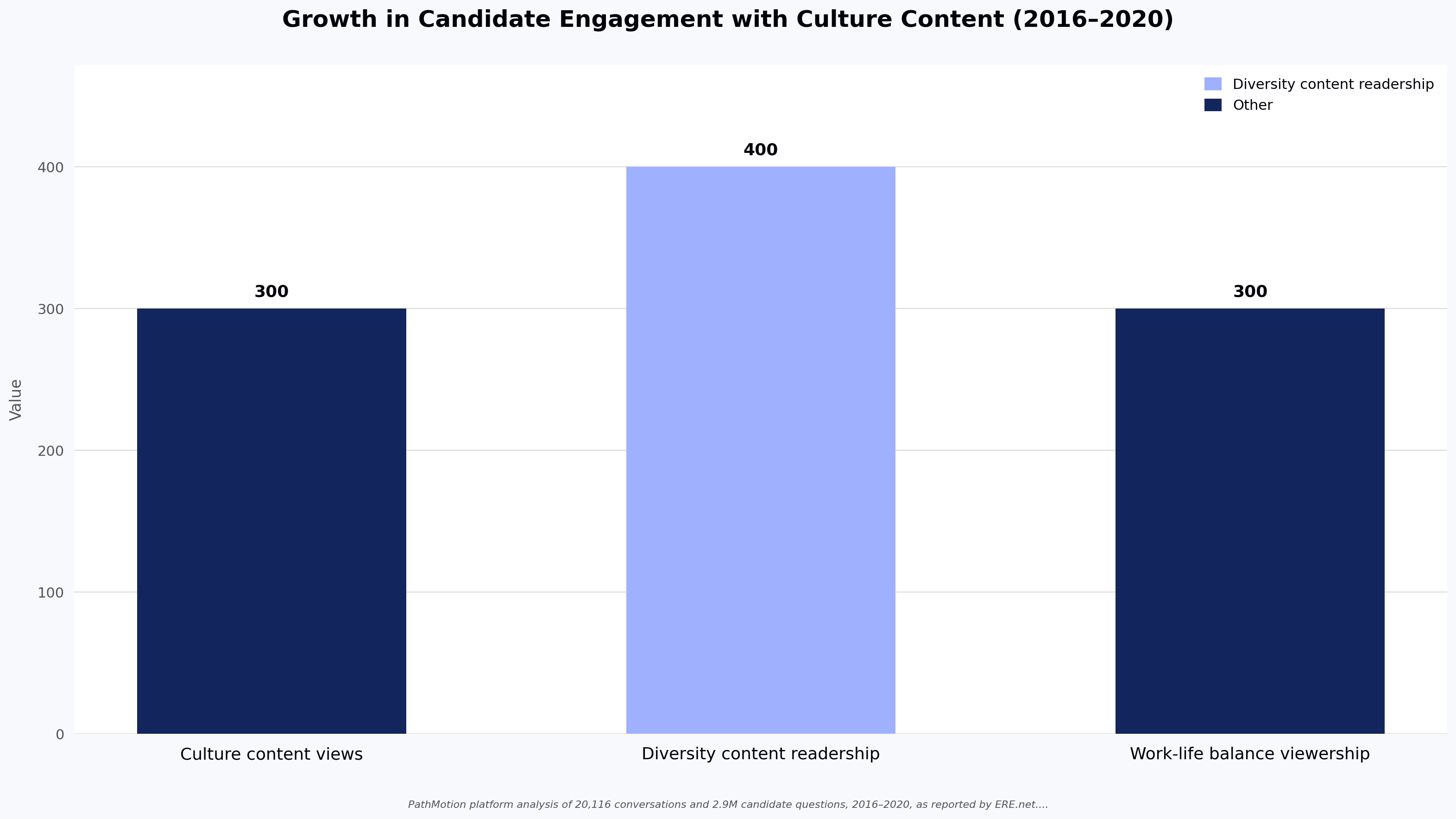
PathMotion, a recruitment technology company, analyzed 20,116 conversations and 2.9 million candidate questions on its platform between 2016 and 2020. According to ERE.net's reporting on the PathMotion data, among candidates on the PathMotion platform:
- Views of culture-related content increased roughly threefold
- Readership of diversity-related content increased roughly fourfold
- Viewership of work-life-balance content roughly tripled
These figures reflect behavior on a single platform and may not generalize to every candidate population, but the directional signal aligns with what most recruiters now see anecdotally: remote candidates dig deeper into culture content than they used to.
What to do with that signal: rewrite your EVP to put work-life balance, diversity, and culture in the first paragraph, not the last. When someone is working remotely, they care less about annual leave count and more about whether they will be expected to be available around the clock. Spell out boundaries explicitly — working hours, on-call expectations, mental health support, wellness leave. "Our EVP makes it very clear that we value our employees' time," is the kind of sentence that needs to be backed by actual line items in the document.
At the same time, do not let the EVP read like an HR policy file. A short video from a recent team event, a one-line description of Friday rituals, or a paragraph on upskilling programs gives candidates a feel for day-to-day life. If you have external credibility signals — analyst recognition, employer-brand awards — name them with the year and the issuing body so candidates can verify.
If you are also assessing technical candidates remotely, the EVP conversation pairs well with a clear explanation of how your interview process works. HackerEarth Assessments and virtual hiring tools are designed so candidates experience a structured, fair process — itself a culture signal.
Step 2: Build a communication cadence that keeps candidates engaged between offer and start date
The single biggest gap in most remote hiring workflows is the silence between offer acceptance and day one. Filling that gap with structured, low-effort communication is what turns a hire into an engaged employee before they ever log in.
A workable cadence looks like this:
- Day of offer acceptance: send a warm, on-brand welcome from the HR or hiring team. A short video or animated greeting works better than a formal letter.
- Weekly during the notice period: send a short "Did You Know" email with one factoid about the company, the team, or a recent product or customer win. Each email should take you under five minutes to write and reuse across hires.
- Two to three weeks before start date: schedule introductory calls with the direct manager and a couple of peers. Keep them to 20 minutes. Make attendance optional and confirm consent first.
- One week before start date: share the day-one agenda, system access steps, and a named contact for any questions.
Front-loading these touchpoints — instead of cramming them into the first week — gives the new hire space to absorb the information and arrive on day one knowing names, context, and expectations. It also reduces day-one drop-off, which is a measurable risk for remote roles.
Step 3: Treat onboarding as a recruiter responsibility, not a hand-off
In most companies the recruiter is the candidate's first relationship, and that relationship does not end at the offer letter. Staying involved through the first two to four weeks reduces early attrition more than any single onboarding document.
Some research suggests that roughly a quarter of new hires leave within their first 90 days, and that structured onboarding meaningfully improves long-term retention — a SHRM overview of onboarding research summarizes the available evidence. Treat those numbers as directional rather than absolute, but the implication is consistent: the first 90 days are where retention is won or lost.
Practical actions for recruiters:
- Stay on the candidate's calendar for at least two scheduled check-ins in the first month.
- Maintain a shared document with the onboarding team flagging any commitments made during the hiring process (relocation, equipment, role scope).
- Surface issues — equipment delays, missing access, unclear reporting lines — to the onboarding team yourself rather than asking the new hire to chase them.
- Use a checklist (here is a remote onboarding checklist you can adapt) so nothing falls between recruiting and people ops.
This is the step most teams skip, and it is also where the "included, welcomed, appreciated" promise from the EVP either lands or falls apart.
Where this advice does not apply cleanly
A few honest caveats before you operationalize the above:
- High-volume hourly hiring. A bespoke EVP rewrite and weekly "Did You Know" emails do not scale to thousands of frontline hires per quarter. For those workflows, prioritize fast time-to-offer and clear day-one logistics over culture storytelling.
- Roles where culture-fit screening carries legal risk. In several jurisdictions, "culture fit" assessments have been flagged as a vector for adverse impact. If you are hiring in regulated contexts, anchor your culture conversations in documented competencies, not subjective fit.
- Companies without existing culture documentation. If your team has never written down its values, do not try to invent them under deadline. Start with five interviews of long-tenured employees, then write the EVP — not the other way around.
- What did not work for us. Some tactics looked good on paper and underdelivered. Mass "welcome" group calls felt impersonal and were quietly retired. Heavy pre-start communication overwhelmed a few hires who wanted to disconnect from their previous job first; we now ask about preferred cadence rather than defaulting to weekly contact.
Frequently asked questions
How do you maintain company culture when hiring remotely?
Maintain culture when hiring remotely by translating in-person signals into written communication, video, and structured touchpoints. Rewrite your EVP to lead with culture and work-life balance, build a weekly communication cadence between offer and start date, and keep recruiters involved through the first 30–60 days.
What is an EVP for remote hiring?
An Employee Value Proposition (EVP) for remote hiring is a written statement of what your company offers employees, weighted toward what remote candidates actually evaluate: clear working hours, mental health and wellness support, diversity practices, growth opportunities, and the rhythms of daily team life. It differs from an office-era EVP by deprioritizing physical perks and emphasizing boundaries, autonomy, and asynchronous collaboration.
How long should the gap be between a remote offer accepted and the first day?
The gap is dictated by the candidate's notice period, but the recruiter's job is to make that gap feel short. Plan for at least three structured touchpoints (welcome message, factoid emails, team intros) across the notice period regardless of length.
What is the biggest mistake recruiters make when hiring remotely?
Treating the offer letter as the finish line. Remote candidates have more time, more information, and more competing offers in the gap between acceptance and start date. Silence in that window is the leading driver of no-shows on day one.
How do you assess culture fit fairly in a remote hiring process?
Replace subjective "culture fit" with structured behavioral interviews tied to documented values, and use the same questions and scoring rubric for every candidate. Tools like HackerEarth's technical assessments help by standardizing the technical signal so culture conversations are not contaminated by inconsistent technical evaluation.
Does remote hiring weaken company culture over time?
Not inherently. Culture is shaped by how teams communicate, decide, and recognize each other — not by whether they share a postcode. Companies that lose culture during remote hiring usually do so because they stopped investing in the rituals and feedback loops that built it in the first place.
Final thoughts
Culture is not defined by the hours you spend at an office desk, and it is not killed by distributed work. It manifests in how you communicate, how you listen, and how you make new hires feel from the first email forward. When you are hiring remotely, the recruiter is the culture — every message, every delay, every follow-up is a data point the candidate is reading.
The three steps above are a starting point, not a finished playbook. Adapt them to your hiring volume, your roles, and the candidate populations you are actually trying to reach.
Next steps
If you are rebuilding your remote hiring workflow and want to standardize how candidates experience your process, see how HackerEarth Assessments supports structured, fair technical evaluation at scale — or book a demo with the team to walk through your specific use case.