Meta title: How IT services firms win pitches with workforce skills data Meta description: Enterprise buyers now demand skills evidence in proposals. Here's what to measure, show, and fix before your next IT services pitch in 2026.
How IT services firms use workforce skills data to win client pitches in 2026
Read time: 8 minutes (to be confirmed against final word count / 250 before publication)
IT services firms use workforce skills data to win client pitches by replacing capability narratives with evidence — showing prospective clients exactly how many engineers hold a specific skill at a specific proficiency, and how quickly the bench can be assembled for the engagement. The firms doing this well in 2026 treat the skills inventory as a sales asset, not an HR artifact. The firms doing it poorly still send slides that say "we have deep expertise in cloud modernization" and lose to competitors who can show it. The pitch itself has changed — and the shift starts with what buyers now expect to see on page one.
This is a shift in what a services pitch is. For a decade, the pre-sales conversation was about case studies, delivery methodology, and named senior architects. In 2026, procurement teams at banks, retailers, and healthcare enterprises are asking for skills evidence up front — sometimes before the statement of work is drafted. Workforce skills data is now the answer to a question the buyer already has.
Why workforce skills data has become a pitch requirement
Three shifts have pushed skills data into the pre-sales conversation.
The first is AI. Clients evaluating a services partner for a GenAI or agentic-workflow engagement want to know whether the delivery team can actually work in that stack — not whether the firm has trained 5,000 people on a two-hour course. Industry surveys of enterprise AI adoption, including reporting from major consultancies, consistently identify talent and skills gaps as a leading barrier to scaling AI in the enterprise — which puts pressure on services firms to prove capability rather than claim it.
The second is the collapse of pyramid economics as a differentiator. The old services pitch — "we'll staff this at the right price point" — assumed clients cared primarily about cost per FTE. In 2026, most enterprise buyers care about capability density: how many senior-plus engineers with the exact skill, on the account, from day one.
The third is procurement maturity. Sourcing teams at large enterprises now issue capability questionnaires that ask for headcount at skill level, certification data, and recency of hands-on work. Procurement-led skills scrutiny has become a commonly observed part of enterprise vendor evaluation. A firm that answers "our team has strong experience in Kubernetes" against a competitor that can present a specific, assessed headcount at proficient-or-above on that same skill — for example, imagine a firm able to show that several hundred engineers cleared a defined Kubernetes assessment within the last two quarters — is not winning that section.
How workforce skills data wins pitches: what the evidence pack must show
A useful skills evidence pack answers four questions the buyer will otherwise assume the worst about.
How many people hold this skill, at what proficiency. Not "trained on" — assessed at. A pitch that includes proficiency distribution (foundational, working, proficient, expert) for the specific skills in scope reads differently from one that lists course completions.
How recently they used it. Skills decay fast, especially in AI and cloud. Industry HR bodies have repeatedly observed how quickly technical skill relevance erodes without recent hands-on use. Recency data — last project, last assessment, last certification refresh — is often what separates a real capability claim from an aspirational one.
How quickly the team can be assembled. Bench visibility mapped against the skill requirement. If the client needs 40 engineers with a specific combination of skills by a target date, the pitch that shows the current bench plus the internal-mobility pipeline wins. This is one area where skills-based hiring and internal mobility infrastructure start to overlap; HackerEarth's technical assessments are designed to generate exactly this kind of role-aligned, proficiency-banded signal.
How defensible the measurement is. Increasingly, procurement asks how the firm knows what it says it knows. "Manager attestation" is a weak answer. Assessment-based evidence, tied to a documented rubric, holds up.
Where most IT services firms lose credibility
In our experience working with IT services firms running skills programs, many pitches lose credibility at the same three points.
The first is the skills taxonomy itself. If the firm's internal taxonomy has 200 skills and the client's RFP references 40 specific technologies, the pitch team spends the night before mapping one to the other by hand — and gets it wrong in the section the client actually reads. A taxonomy that isn't role-aligned and client-mappable is a liability. For related context, HackerEarth's skills intelligence platform is built around this mapping problem.
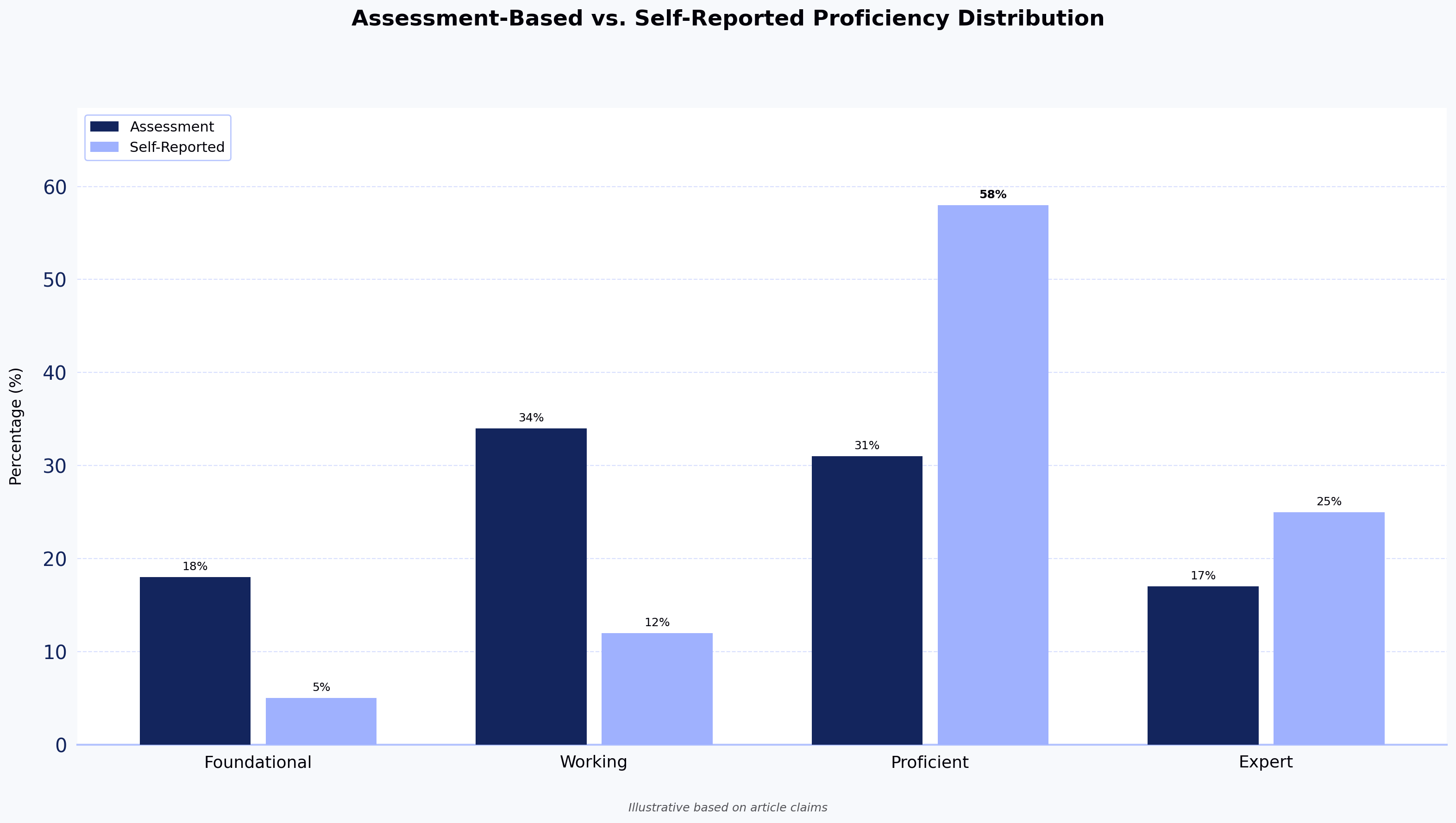
The second is proficiency inflation. Firms that self-report proficiency without assessment show suspiciously flat distributions — 70% "proficient" across every skill. Procurement teams have seen this pattern too many times. Genuine assessment data has a distribution shape, and buyers now look for it.
The third is the AI-fluency claim specifically. Every services firm says its workforce is AI-ready. Very few can define what they mean. The firms that can — with a defined evaluation of prompt quality, agentic-workflow reasoning, and code-review-of-AI-output — are winning the AI-adjacent work. The rest are getting screened out earlier in the process. A structured AI-readiness evaluation, using HackerEarth's AI assessments, is increasingly what closes this gap.
What the pitch document actually looks like
The pitch artifact has shifted from a static slide to a live capability view. What worked in 2022 — a slide titled "Our Talent" with logos and headcount — does not work in 2026.
The current pattern, at firms doing this well, is a two-page skills annex embedded in the technical proposal. Page one: the skill requirements pulled from the RFP, mapped to the firm's internal skill IDs, with headcount by proficiency band. Page two: the delivery pod composition — named or unnamed depending on the stage — with skill signatures per role, recency data, and any certifications relevant to the client's compliance context (particularly relevant in BFSI, where audit defensibility of the delivery team's qualifications is now a procurement checkpoint).
Consider an anonymized example: a mid-size BFSI-focused services firm with roughly 800 engineers, competing for a cloud-modernization program against two Tier-1 competitors. Rather than a generic capability slide, the firm submitted a two-page skills annex — assessed headcount by proficiency band for each of the 22 skills named in the RFP, plus recency data drawn from project history. That firm moved from long-list to short-list on the strength of the annex alone; the technical evaluation panel cited the assessment-backed distribution shape as the reason.
Some firms are adding a third page: benchmarking. How the proposed pod's skill signature compares to industry benchmarks for the same role. This works when the underlying data is credible and fails badly when it isn't.
The infrastructure that makes this possible
A services firm cannot generate this evidence from an LMS. Course completion is not skill. What is needed is:
- A skills taxonomy that maps to client-facing technology categories, not just internal training curricula
- Assessment data at the individual level, refreshed on a defined cadence (a quarterly refresh is a common practice for AI and cloud skills; in our experience, annual refresh tends not to be enough for fast-moving stacks)
- Integration between assessment data, HRIS role data, and project-history data so recency can be inferred
- A workforce analytics layer that lets the pre-sales team pull a pod-shaped view against an RFP without a two-week data pull
This is where HackerEarth's SkillsGraph fits directly into the pre-sales workflow: it benchmarks workforce skills against global and industry standards and turns workforce capability into a measurable input for client pitches and strategic positioning — the exact inputs the two-page skills annex depends on. Some large services firms have built internal systems on top of their HRIS and their own assessment engines. Either path works. What does not work is answering RFP skill questions from a spreadsheet updated once a year.
Trade-offs worth naming
Skills-data-driven pitching has real costs.
Building and maintaining the taxonomy is a persistent investment. In our experience working with services firms, reaching the point where the data is trusted by both delivery leaders and the pre-sales team typically takes 12–18 months, driven by three factors: taxonomy complexity (how many skills, how role-aligned), assessment tooling maturity (whether valid, role-relevant assessments already exist), and stakeholder alignment (pre-sales, delivery, and L&D agreeing on definitions and refresh cadence). Assessment fatigue is also a legitimate risk; if engineers are asked to prove the same skill repeatedly across multiple disconnected systems, retention suffers. And there is a defensibility trade-off: the more precise the claim, the more auditable it becomes. If the pitch names a specific number of engineers holding a certification and the client audits during delivery, that number needs to still be true.
We recommend treating data older than 18 months as either flagged in the pitch or excluded — presenting stale data as current is the fastest way to lose credibility during a client audit.
The firms getting the most out of this approach treat the skills data as a shared asset across pre-sales, delivery, and L&D — not owned by any one function. When L&D owns it alone, the taxonomy drifts toward training categories. When pre-sales owns it alone, it drifts toward whatever won the last deal.
Frequently asked questions
How do IT services firms use workforce skills data during a client pitch specifically?
The counterintuitive part is that most of the value is created before the RFP arrives, not during pitch prep. Firms that win are the ones whose pre-sales team can query the skills data in the first client conversation — not the ones who spend three days assembling evidence after the RFP lands. The pitch document itself (typically a one- to three-page skills annex in the technical proposal) is downstream of that query capability. If the data can only be assembled retroactively, the pitch will always be reactive to what the client asked, rather than shaping what the client asks for next.
What is the difference between training data and skills data in this context?
Training data records what an employee was exposed to; skills data records what they can do, assessed against a rubric. Course completion rates and certification counts are inputs to skills data, not substitutes for it. Procurement teams in 2026 are increasingly explicit about this distinction and will discount capability claims backed only by training records.
How often should skills data be refreshed for pitch use?
A common practice is quarterly refresh for fast-moving areas — GenAI tooling, cloud platforms, security stacks — and annual refresh for slower-moving skills like functional domain knowledge or established programming languages. We recommend flagging or excluding data older than 18 months; presenting stale data as current is the fastest way to lose credibility if the client audits.
Does workforce skills data matter for smaller services firms?
It matters more, not less. Large firms can win on brand and scale even with weaker skills evidence. A 500-person firm competing against a Tier-1 needs to show specific, verifiable capability density in the exact skill area the client is buying — that is often the only path to winning against a bigger competitor.
What is the most common reason IT services firms lose credibility in skills-based pitches?
Proficiency inflation. When self-reported proficiency data shows most of the workforce as "proficient" or above in every skill, procurement teams read it as unreliable and discount the entire claim. Assessment-based data with a real distribution — including honest counts of "foundational" and "working" — is more credible than a flat inflated curve.
Key takeaways
- Workforce skills data has moved from HR reporting into pre-sales — enterprise buyers now expect skill evidence inside the technical proposal.
- Course completions and manager attestations no longer count as capability proof; assessment-based data with proficiency distributions does.
- The pitch artifact is a skills annex mapping RFP requirements to internal skill IDs, with headcount, recency, and defensibility notes.
- The three most common failure points are taxonomy misalignment, proficiency inflation, and undefined AI-fluency claims.
- Building this capability requires shared ownership across pre-sales, delivery, and L&D — it is not a single-function project.
See it in action
To see how the RFP-to-skill-ID mapping and benchmark views come together in a pre-sales workflow, book a walkthrough of HackerEarth SkillsGraph.