Coding assessment platforms: how they improve technical hiring
Meta title: Coding Assessment Platforms: How They Improve Technical Hiring
Meta description: How coding assessment platforms cut screening time, catch AI-generated CVs, and improve technical hiring signal.
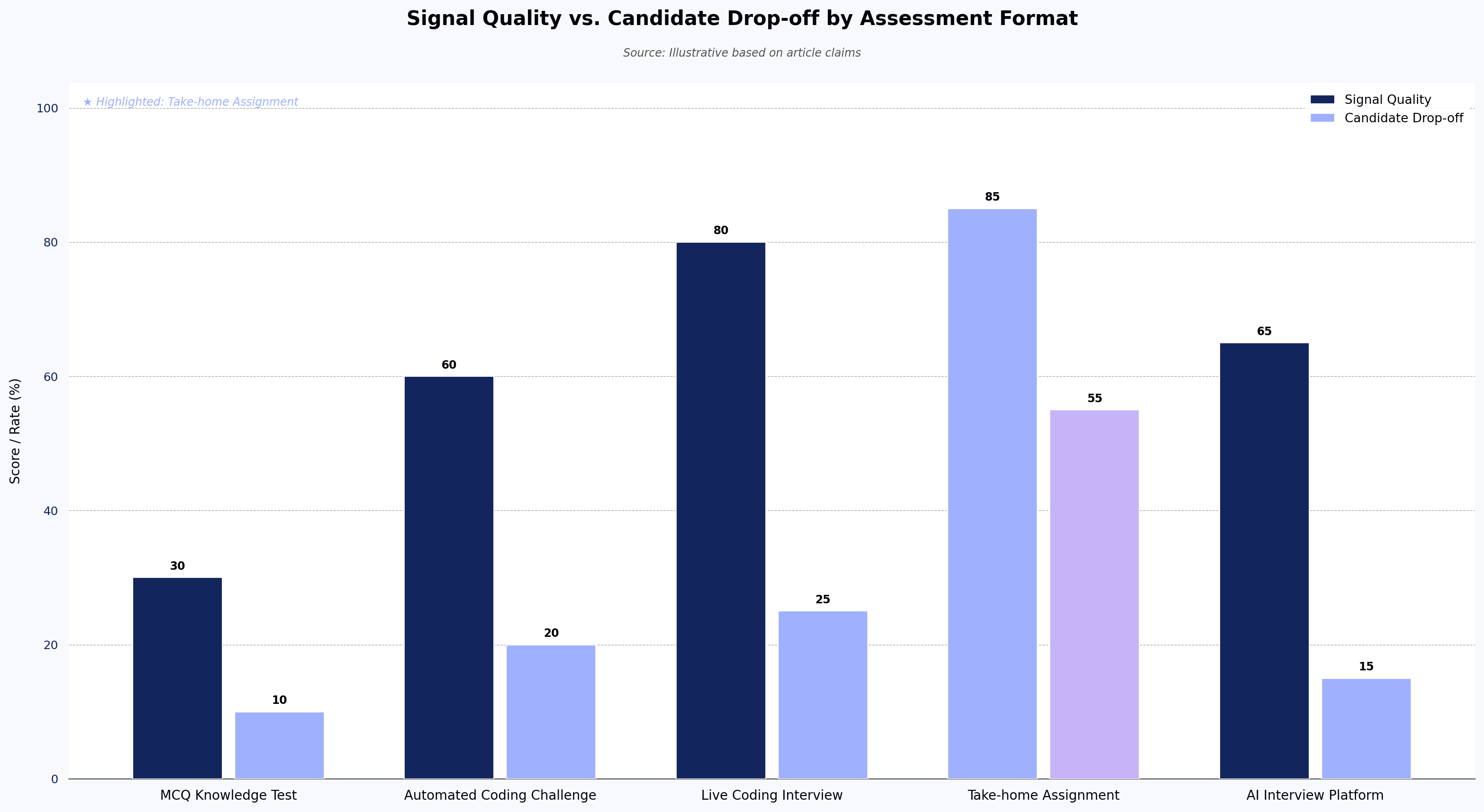
Coding assessment platforms are software tools that evaluate a developer's technical skills through structured coding tasks, automated grading, and standardized rubrics — replacing resume-first screening with evidence-first screening. They matter more in 2026 than they did two years ago, because resumes and cover letters are now often AI-generated, and hiring teams need a signal that resists prompt engineering.
The best coding assessment platforms do one thing consistently: they give every candidate the same test, score it the same way, and hand hiring managers a comparable result. Everything else — question libraries, IDE features, proctoring, analytics — is downstream of that core job. This guide is written for technical recruiters, engineering managers, and heads of talent acquisition who are choosing, replacing, or evaluating a coding assessment platform. It covers what these tools actually do, where they help, where they fail, and how to pick one that fits your hiring reality.
What is a coding assessment platform?
A coding assessment platform is a system that administers coding tests to candidates, runs their submitted code against test cases, and returns a score against a defined rubric. It sits between sourcing and the technical interview loop. Instead of a recruiter or engineer reading a resume and guessing whether the candidate can code, the platform gives that candidate a task the team has already decided is representative of the job.
Modern coding assessment platforms handle three categories of evaluation:
The category has matured. Ten years ago, most of these tools were glorified LeetCode-with-a-timer. Today the useful ones handle proctoring, plagiarism detection, AI-generated-code detection, and integration with the ATS. The bad ones still ship a timer and a code editor. For a deeper walkthrough of what to prioritize when evaluating vendors, see our coding assessment guide for hiring teams.
How a coding assessment platform works
The workflow is consistent across serious vendors, even if the interfaces differ.
A recruiter or hiring manager creates an assessment by picking questions from a library or writing custom ones. They set a time limit, decide whether the test is proctored, and configure how results flow back to the ATS. The platform sends a link to candidates, either directly or through the ATS. Candidates take the test in a browser-based IDE — some platforms offer full development environments with terminal access, dependency installation, and multi-file projects.
When the candidate submits, the platform runs their code against pre-defined test cases, checks output correctness, and often measures time and space complexity. A rubric-based score gets attached to the candidate record. Hiring managers see the score, the code, replay of how the candidate wrote it, and — on better platforms — flags for copy-paste patterns, tab-switching, and AI-generated-code likelihood.
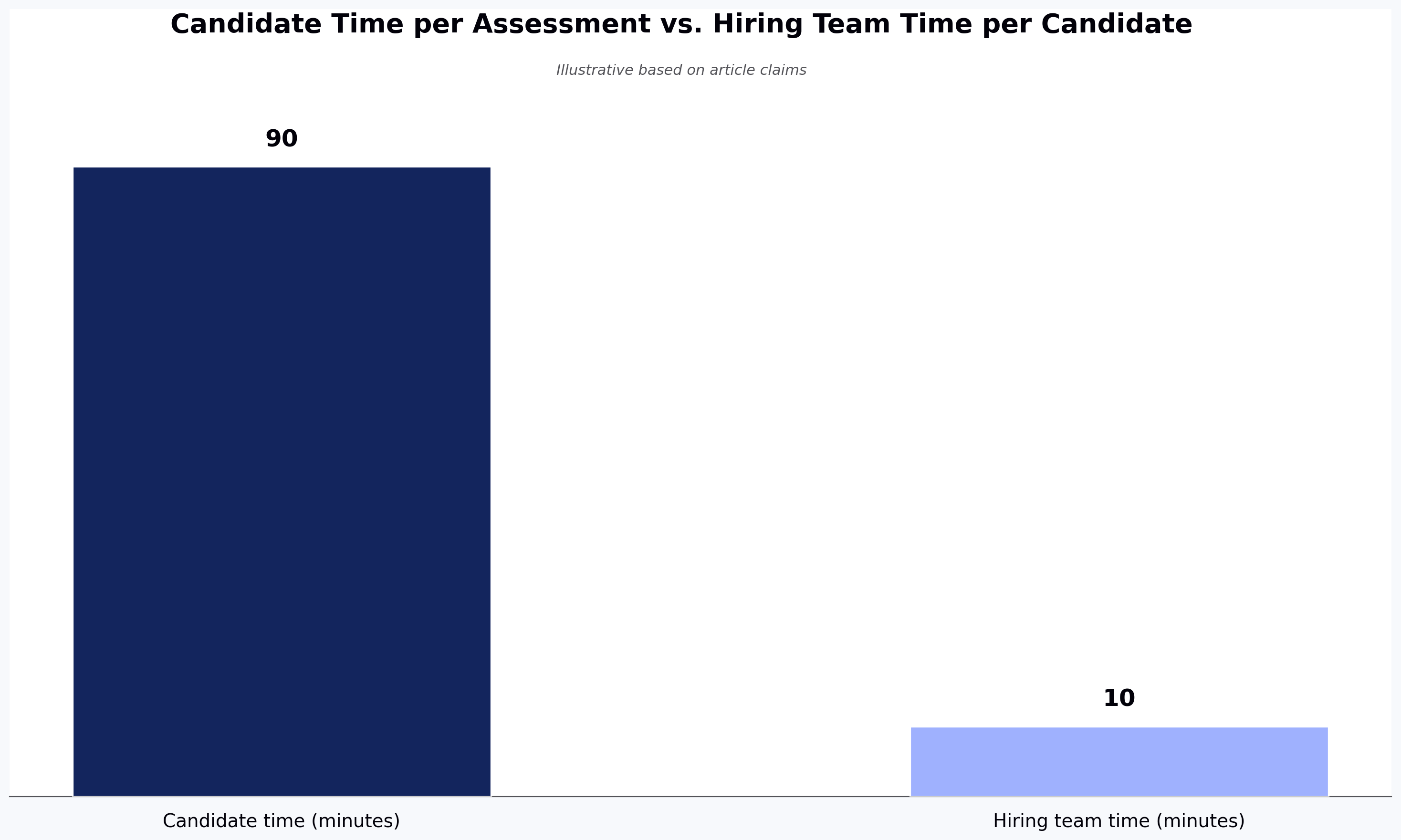
The whole cycle takes 60 to 120 minutes of candidate time and roughly 10 minutes of hiring team time per candidate. That ratio is the actual value proposition. It is not "we found a better developer"; it is "we spent one-tenth the senior engineer time to get a comparable filter."
What are the key features of a modern coding assessment platform?
The features that matter in 2026 are different from the ones that mattered in 2020. Here is what a serious coding assessment platform should offer today. For a more detailed feature-by-feature breakdown, see 6 things to look for in your coding assessment tool.
A deep, current question library. Algorithmic problems age well; framework-specific problems do not. A React question written for class components is worse than useless for hiring in 2026. Look for libraries that cover 40+ programming languages, are refreshed regularly, and include role-based assessments beyond generic DSA. Established platforms such as HackerEarth, HackerRank, and Codility all maintain libraries covering broad skill and language coverage at enterprise scale.
Realistic coding environments. A candidate writing production code needs the tools they use in production: an IDE with autocomplete, a terminal, package installation, and multi-file support. Assessments that force developers to write code in a stripped-down text box test their tolerance for artificial constraints, not their skill.
Anti-cheating that respects candidates. Proctoring in 2026 has to solve for two problems: proxy candidates (someone other than the applicant taking the test) and AI-generated code (the candidate pasting ChatGPT output). The first requires identity verification — webcam checks, ID validation, sometimes live proctoring for high-stakes roles. The second requires typing-pattern analysis, similarity checks against public code, and paste detection. No platform catches everything. The good ones flag likelihood; the bad ones make binary accusations candidates can dispute.
ATS integration. If scores don't flow back into Greenhouse, Lever, Workday, or SAP SuccessFactors, recruiters spend hours reconciling spreadsheets. The platforms that get adopted are the ones that disappear into the existing workflow.
Analytics that answer a real question. Time-to-fill by role, offer-accept-rate by assessment score band, false-positive rate on take-homes. Not a dashboard of question difficulty averages.
How coding assessment platforms improve technical hiring
The improvement is not that these platforms find better developers. Any competent hiring team can find good developers given enough time. The improvement is that coding assessment platforms let you spend that time on the candidates who are worth interviewing, instead of on the ones whose resumes read well.
Three specific gains show up consistently:
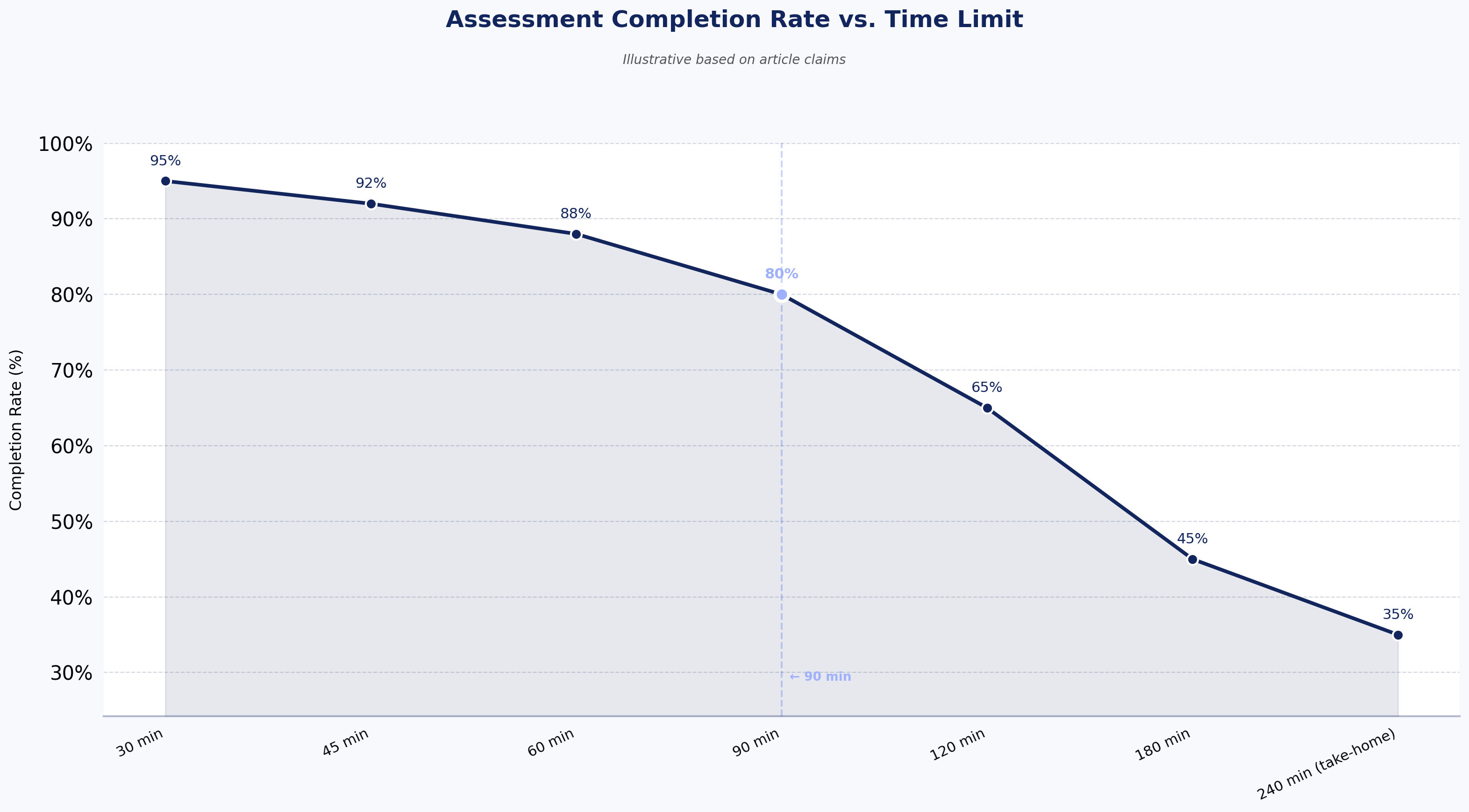
Senior engineer time gets protected. In most teams, the technical screen is done by a senior IC or engineering manager. That is an expensive hour. A coding assessment run before the screen typically filters out a large majority of applicants — the ones who can't complete a mid-level task in 90 minutes. The senior engineers who remain talk only to candidates who cleared a real bar.
Evaluation becomes comparable. Research consistently shows significant inter-rater disagreement when two interviewers run unstructured screens on the same candidate. A 2022 reanalysis by Sackett, Zhang, Berry, and Lievens in the Journal of Applied Psychology revised prior validity estimates for selection methods downward after correcting for range restriction — and under those revised estimates, structured interviews ranked as the strongest single predictor of job performance, ahead of unstructured judgment. A coding assessment enforces the structure that most teams don't enforce on their own.
AI-generated CVs stop working. Resume-based screening filters candidates through prose. Prose is exactly what LLMs produce well. A coding assessment filters candidates through code that runs. That is harder to fake, and the platforms that do it well now flag AI-generated code with reasonable accuracy — not perfect, but enough to change the conversation from "we can't tell" to "we know which submissions to look at more carefully."
Where these platforms fail is worth naming. They filter out real senior candidates who refuse to take timed tests, particularly experienced engineers with public GitHub work. They over-index on speed for roles where speed is not the job. And they can codify a hiring bias — a rubric written badly is applied consistently, which is worse than the same bias applied inconsistently.
Coding assessment platforms vs. traditional technical screening
Traditional technical screening is the phone screen: a recruiter or engineer spends 30 to 45 minutes talking to a candidate about their resume and asks a few technical questions. It has three problems. The signal is inconsistent between interviewers. It scales linearly with headcount — every candidate consumes an engineer hour. And it evaluates communication and self-presentation as much as it evaluates skill, which is fine for some roles and wrong for many.
Coding assessment platforms trade some of that human signal for consistency and scale. A structured coding test won't tell you whether the candidate is pleasant to work with or explains their thinking well — that comes later in the loop. It will tell you whether they can solve the class of problem you hire for.
The right answer is not "replace the phone screen." It is "put the coding assessment first, use the phone screen for candidates who cleared it, and use the technical interview loop for candidates who cleared the phone screen." Each stage does what it is best at. For a more structured breakdown of how to evaluate developers accurately at each stage, see our guide to technical skills tests for hiring.
How do coding assessment platforms support high-volume hiring?
High-volume hiring — campus recruiting, IT services intake, contest-driven sourcing — is where coding assessment platforms show their sharpest ROI. When you are hiring 500 engineers a quarter, the math changes.
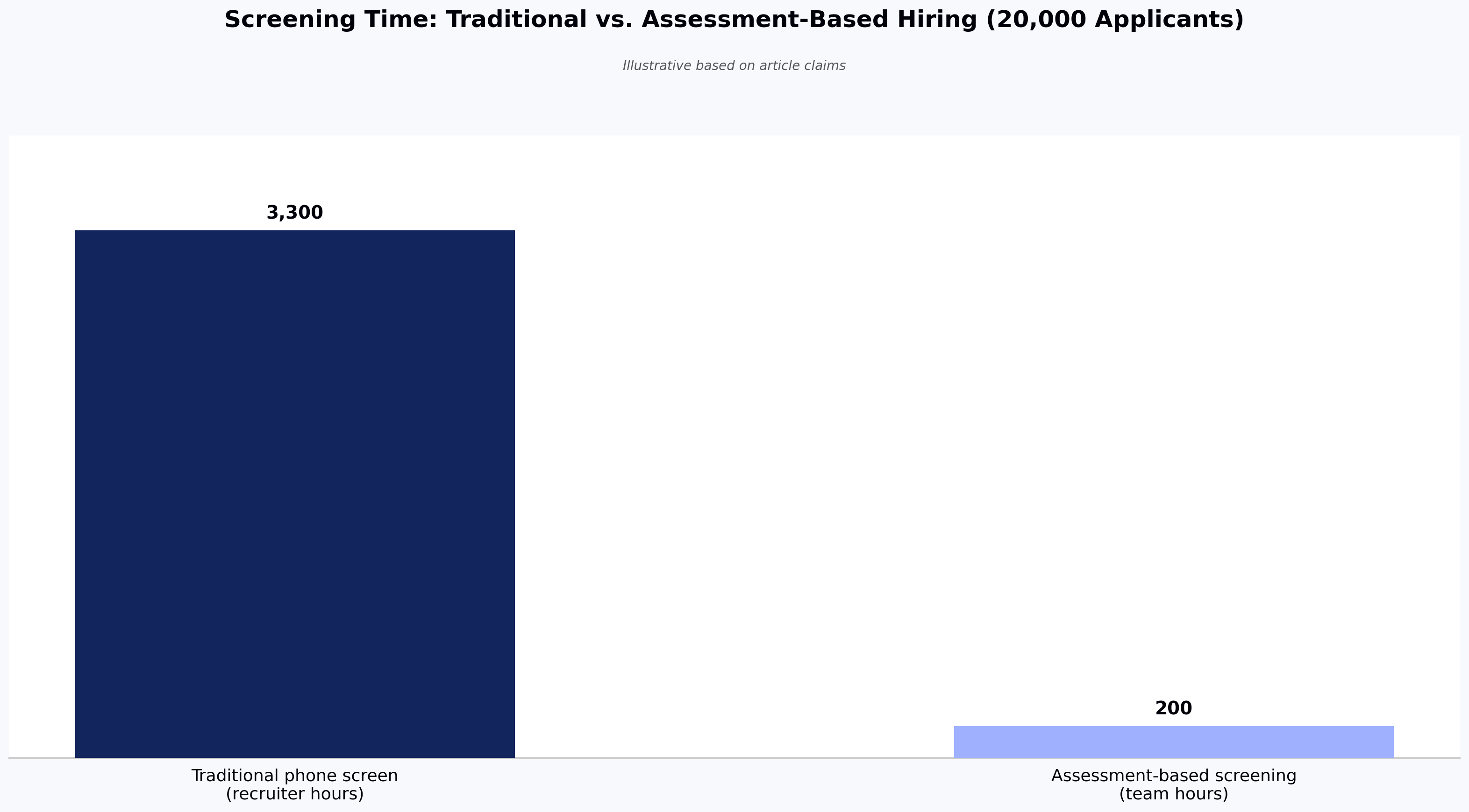
An IT services firm running campus recruitment across 50 colleges cannot phone-screen 20,000 applicants. Even at 10 minutes per candidate, that is 3,300 recruiter-hours per season. A coding assessment cuts that to 20,000 candidate-hours (theirs, not yours). Evaluation time on the shortlist drops to roughly 200 hours. The math only works with automation.
The platforms that specialize in high-volume hiring add capabilities specific to that context: campus-branded assessment pages, staggered start windows to prevent question leakage, anti-cheating that can withstand a 5,000-candidate weekend, and integrations with ATS platforms configured for bulk requisitions. Vendors including HackerEarth have reported enterprise customers screening thousands of candidates in a single weekend using rubric-applied evaluation — a pattern that is impossible with human-led screening and unremarkable with the right assessment infrastructure.
For product-software companies hiring senior engineers, high-volume dynamics rarely apply. A staff engineer role gets 200 applicants, not 2,000. The value there is not throughput; it is calibration.
Coding assessment platforms for different hiring needs
The right platform depends on what you are hiring for. A single vendor rarely serves all cases equally well.
Campus and high-volume junior hiring. Prioritize question library depth, anti-cheating at scale, and campus branding. Platforms with large developer communities can double as sourcing channels. HackerEarth, HackerRank, and Codility all serve this segment; the choice usually comes down to price-per-candidate at scale.
Senior engineering hiring. Prioritize project-based assessments over algorithm timers. A staff engineer should be asked to review or extend a real codebase, not to reverse a linked list. Look for platforms that support multi-file projects, longer completion windows, and take-home formats. CoderPad and Coderbyte support multi-file projects and longer-form take-homes suited to senior evaluation. Live pair-coding tools like FaceCode — which supports multi-language live coding with a shared IDE, playback, and interviewer notes — or CoderPad's live mode are usually more useful than any timed assessment for senior roles.
Non-technical role adjacencies. Some vendors extend coding-style structured assessment into sales, customer support, and finance roles. The signal quality varies. Use these where the role has clear evaluable outputs; skip them where the job is primarily interpersonal.
AI-fluency hiring. A new category as of 2025. Traditional coding assessments test whether a developer can write code from scratch. AI-fluency assessments test whether a developer can direct an LLM to produce working code, review its output, and integrate it into a codebase. This is genuinely different signal, and the tooling is still early.
Common use cases for coding assessment platforms
Most customers use these platforms for one of five workflows:
The one to be careful with is #2. Replacing the technical screen with an automated assessment saves engineer time but removes the last-chance human check before the loop. Teams that go straight from assessment to onsite often report a rise in loop rejection rate, which wipes out the time savings. Teams that insert a 15-minute recruiter call between assessment and loop typically find it pays for itself.
What should you look for in a coding assessment platform?
Skip the feature-checklist approach. Every serious vendor claims every feature. Ask instead:
What does the question library look like for roles like ours? Ask to see the actual questions. Depth for algorithmic hiring is different from depth for backend hiring is different from depth for data engineering. A library with 40,000 questions that skews toward LeetCode-style problems is not deep for a company hiring Rust systems engineers.
How does the platform handle AI-generated code? Every vendor has an answer. The useful answers describe what signals they use — typing patterns, paste detection, code similarity against public sources — and are honest about false-positive rates. The unhelpful answers say "AI-powered detection." Ask for the false-positive rate. If the vendor doesn't know it, they haven't measured.
What is the candidate experience? Take the assessment yourself, end-to-end, on a laptop and a phone. Note the friction. Candidates who abandon assessments are candidates you didn't screen out — they screened you out.
How does data flow into the ATS? If the answer involves a CSV export, budget for the workflow debt.
What is the actual cost per candidate at your volume? Vendor pricing pages are rarely accurate for enterprise deals. Get a quote based on your annual volume and compute the per-candidate cost. At 10,000 candidates a year, a $2-per-candidate difference is $20,000. At 100,000 candidates, it's $200,000.
A note on free tiers: most enterprise coding assessment platforms offer free trials or limited sandboxes rather than meaningful free plans — free and open-source options exist but rarely include proctoring, ATS integration, or the question-library depth needed for production hiring.
Trade-offs worth naming: the platforms with the deepest question libraries tend to have less-modern candidate UIs. The platforms with the best candidate UIs tend to have thinner question libraries. The platforms with the best proctoring create the most candidate friction. There is no vendor that wins on every axis.
How can hiring teams measure the effectiveness of coding assessments?
Most teams don't measure this, which is why so many assessment programs quietly stop delivering value after 18 months. Four metrics matter.
Assessment-to-offer conversion rate. Of candidates who pass the assessment, what percentage receive an offer? As a rough guide, a very low rate can suggest the assessment is filtering for the wrong things, while a very high rate can suggest it isn't filtering enough — the right band depends on your role and funnel.
False-positive rate at the loop stage. Of candidates who pass the assessment, how many get rejected in the technical interview loop for reasons the assessment should have caught? Track this by rejection reason.
Candidate completion rate. What percentage of candidates who receive the assessment link complete it? A markedly low completion rate typically points to a candidate-experience problem, not a candidate-quality problem.
Time saved per hire. Compare senior engineer hours spent screening before and after the platform. This is the number that justifies the budget in the CFO conversation.
An assessment platform that improves time-to-fill but degrades quality-of-hire is not a win. Both metrics have to move in the right direction, or the program is trading one problem for another.
Frequently asked questions about coding assessment platforms
There isn't one. The best platform depends on what you're hiring for, at what volume, and what your ATS is. For high-volume and campus hiring, HackerEarth, HackerRank, and Codility are the mature choices. For senior engineer live coding, CoderPad and similar live-coding tools tend to win. For AI-led structured interviews at scale, the category is still forming —
Yes. Every platform has been cheated on. Determined candidates can use proxies, paste from LLMs, or coordinate with others. What good platforms do is raise the cost of cheating and flag the likely cases. Combining a timed asynchronous assessment with a follow-up live technical conversation makes cheating unprofitable for most candidates — the follow-up exposes the gap between the submitted code and the candidate's actual understanding.
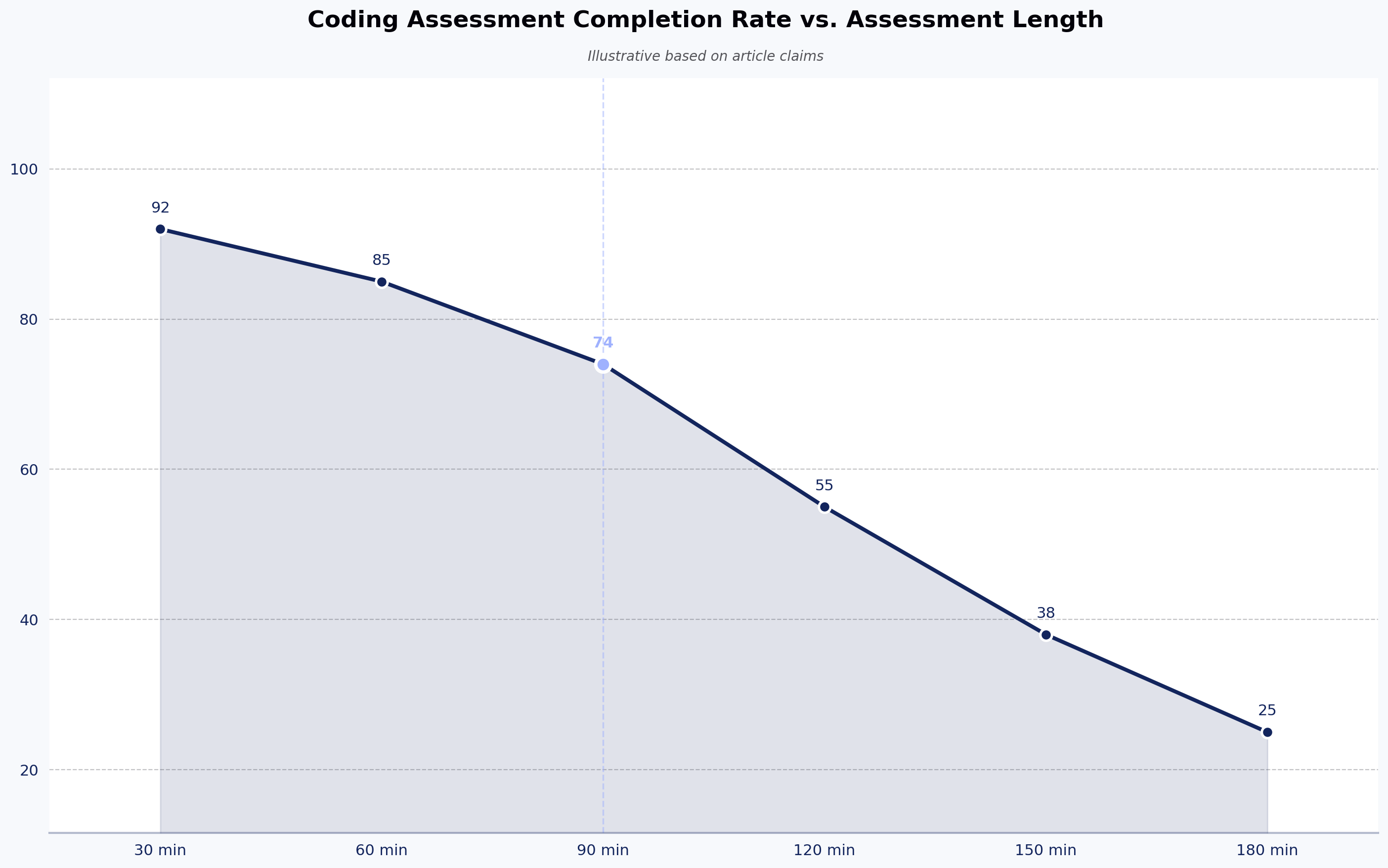
For pre-screening, 60 to 90 minutes. Beyond 90 minutes, completion rates drop sharply and you filter for candidates with free time, not candidates with skill. For take-home assignments used later in the process, 3 to 5 hours over a week is defensible. Anything longer is uncompensated work and will hurt your acceptance rates with senior candidates.
Timed algorithmic assessments generally don't. Senior engineers reasonably resent being asked to solve toy problems on a clock. Project-based assessments and live pair coding work better. For staff and principal roles, a code review or system design conversation usually produces stronger signal than any automated assessment.
Enterprise pricing is usually per-candidate or per-seat, and public pricing pages rarely match the actual quoted price. Costs vary significantly by volume, feature set, and contract length. Get quotes from three vendors before signing.
They can be. A rubric written badly — for example, one that rewards LeetCode-style pattern matching over problem decomposition — will consistently favor candidates who trained on that style. Structured assessment is more consistent than unstructured judgment, but consistency and fairness are not the same thing. Audit your assessment for adverse impact by demographic group at least annually — employers subject to regulations like NYC Local Law 144 are already required to run independent bias audits on automated hiring tools.
Key takeaways
Next steps
If you are evaluating or replacing a coding assessment platform, the fastest way to judge fit is to run a live pilot against a real role. Explore HackerEarth Assessments to see how the question library, proctoring, and ATS integration work for your specific hiring context — or see how OnScreen handles AI-led structured interviews if scheduling friction and proxy candidates are your bigger problems.