AI Interviewers for Software Engineer Screening: 10 Tools Compared
An AI interviewer for software engineer screening is software that conducts a structured technical interview coding, system design, or role-specific questions without a human on the other side of the call. Anecdotally, the category has moved from novelty to line item in a growing number of technical hiring stacks over roughly the past 18 months, driven by two commonly cited forces: senior engineer time is expensive, and recruiters report that resume signal has weakened as AI-generated CVs become more common.
This article compares 10 tools that companies are actually using for AI interviewer software engineer screening in production hiring pipelines. Not every tool fits every team.
The differences that matter are less about which one has flashier avatars and more about how each handles rubric consistency, identity verification, and the specific type of engineer you are hiring.
What is an AI interviewer for software engineer screening?
An AI interviewer for software engineer screening is an automated system that conducts a technical interview with a candidate usually asynchronously and returns a structured evaluation against a defined rubric. The best implementations do three things: ask calibrated follow-ups based on candidate responses, evaluate code in-session, and verify the candidate's identity so the person interviewed is the person being hired.
There are two broad categories.
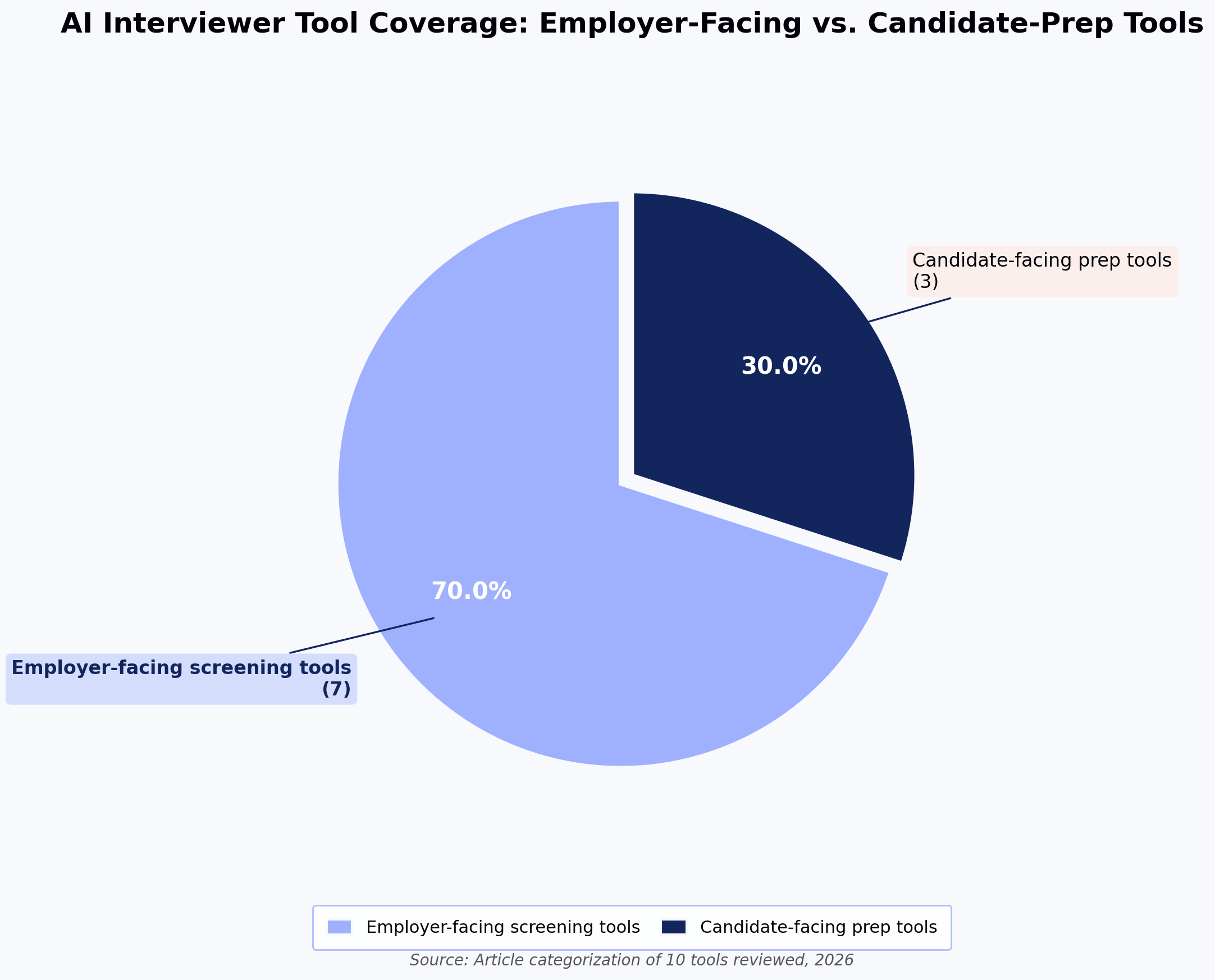
- Candidate-facing prep tools (interviewing.io, HackerRank's mock interviews, MockAI) help engineers practice for real interviews.
- Employer-facing screening tools (HackerEarth OnScreen, Karat, Metaview, and others) sit inside a company's hiring pipeline and produce interview reports for recruiters. This article focuses on the second category, with brief coverage of the first where relevant.
Source: Article categorization of 10 tools reviewed, 2026
How does an AI interviewer screen software engineers?
The typical flow: a candidate receives a link, verifies their identity, and joins a session that combines conversational questions, coding tasks, and sometimes system design prompts. The AI adapts follow-up questions based on how the candidate answers probing depth on data structures, asking about trade-offs on system design, or requesting an explanation of the code the candidate just wrote.
Under the hood, most current tools are wrappers around a large language model with a coding sandbox, a proctoring layer, and a scoring rubric. The differences between products are usually not in the underlying model most use variants of GPT-4, Claude, or Gemini but in the rubric design, the question library, and the integrity layer. A well-designed rubric run on a mid-tier model beats a poor rubric run on the best model.
What skills should an AI interviewer evaluate in software engineers?
At a minimum: coding fluency in the languages the role requires, problem decomposition, ability to reason about edge cases, and communication of technical trade-offs. For senior roles, add system design, debugging under uncertainty, and the ability to defend a decision when the interviewer pushes back.
What AI interviewers do poorly today: culture fit, long-horizon collaboration signal, and judgment about ambiguous requirements. If those are the primary skills you are hiring for, an AI interview is a filter before the human panel, not a replacement for it. Any vendor claiming otherwise is oversold.
How does AI interviewing assess coding and problem-solving skills?
The strongest implementations run candidate code in a sandboxed environment, evaluate against hidden test cases, and score not just correctness but approach did the candidate think through edge cases before writing, or did they submit and hope? Some tools now analyze intermediate keystrokes and revision patterns, though signal from that data is mixed.
For problem-solving, the AI evaluates how the candidate responds when the initial approach fails a test case. A candidate who calmly diagnoses and refactors scores differently from one who guesses at fixes. This is where AI interviewers can outperform inconsistent human interviewers — the rubric applies the same way at 3 PM Tuesday as it does at 11 PM Sunday.
What makes an AI interviewer for software engineer screening effective?
Three properties, in order of importance:
- Deterministic evaluation. Two candidates who give substantively equivalent answers should receive substantively equivalent scores. If the same answer scores differently across sessions, the tool is not ready.
- Identity verification. Proxy candidates are a real problem in remote hiring. A screening interview that cannot confirm who is on the other end produces reports you cannot trust.
- Rubric transparency. The hiring manager should be able to see why the AI scored the candidate the way it did — which criteria were met, where the candidate fell short, and what the follow-up question tested.
Tools that treat these as afterthoughts fail the "would I forward this report to the hiring manager" test.
10 AI interviewer tools for software engineer screening
The list below covers seven employer-facing screening tools and three candidate-prep tools engineers use to prepare for them. The comparative sections that follow focus on the employer-facing tools; candidate-prep tools are included so employers understand what candidates are practicing with. Positioning is drawn from each vendor's public materials as of 2026; verify current pricing and capabilities directly before procurement.
- HackerEarth OnScreen: Employer-facing. Structured technical interviews using video avatars with built-in KYC-grade identity verification and integrated proctoring. Deterministic rubric across candidates. Designed to sit alongside HackerEarth's Skill Assessments, Hiring Challenges, and FaceCode for later-stage panels.
- Karat: Human-led, AI-native. Karat combines trained interview engineers with live AI-native interview simulations as a core offering (not a peripheral support layer) launched December 2025 as Karat NextGen. Strong for companies that want defensible reports and are willing to pay for it. Strongest defensibility for regulated hiring and senior roles where reports may be reviewed by legal or compliance.
- HireVue: Long-standing video interview platform that has added AI-driven coding assessment and evaluation. Enterprise-heavy customer base. Coding evaluation is a more recent addition to a product built around behavioral video. Established ATS integrations across major enterprise systems and a long-standing behavioral video evaluation product that predates its coding assessment additions.
- CodeSignal AI Interviewer: CodeSignal's AI interview product, Interviewer Agents, launched in August 2025 on top of the existing CodeSignal coding assessment infrastructure. Strong coding-task library; the conversational layer is newer. The coding-task library draws on years of assessment data from CodeSignal's existing platform.
- Metaview: Combines an interview intelligence layer (transcription, summarization, note-taking) with a screening agent that conducts adaptive conversational AI screens. Useful when you want to keep humans in the loop for later stages but automate the top of funnel.
- HackerRank AI Mock Interviews: Candidate-facing prep tool that simulates coding and system design rounds. Not an employer screening product, but worth understanding because your candidates are using it.
- interviewing.io: Candidate-facing AI interviewer for coding and system design mocks in a FAANG-style format. Also operates as a hiring channel, routing high-performing candidates directly to employers.
- MockAI (aceinterview.app): Candidate-facing coding interview practice with customizable AI interviewers. Positioned as a lightweight prep tool rather than an employer screening solution.
- Talently.ai: Newer AI interviewer targeting recruiting teams with fast setup and per-interview pricing; feature depth is lighter than established platforms.
- Micro1: AI recruiter platform focused on vetting and matching engineers, positioned for startups and mid-market teams hiring globally.
For a broader view of how these platforms stack up, see our comparison of AI interview agent platforms.
How AI interviewer tools compare for technical evaluation
Employer-facing tools split into two camps on technical evaluation. HackerEarth OnScreen, CodeSignal AI Interviewer, and HackerRank's employer products draw on established coding assessment libraries - the question banks are deep and the scoring has been calibrated over years. Karat sits in its own category, combining trained human interview engineers with AI-native interview simulations.
Newer entrants often have thinner question libraries and rely more heavily on generating questions dynamically from role descriptions. This works well for common roles (backend, full-stack, frontend) and less well for specialized ones (embedded systems, ML infrastructure, low-level graphics). If you are hiring for something narrow, ask to see the actual question set before signing. For a role-by-role view of where AI interviews hold up, see why AI interviews are becoming standard practice in technical hiring.
How AI interviewer tools compare for coding and problem-solving assessment
The best tools evaluate more than pass/fail on test cases. They score approach, edge-case handling, and the candidate's ability to explain their code. CodeSignal AI Interviewer does this well. Karat's human interviewers still set the bar for probing follow-ups, at proportional cost.
Where all AI tools struggle: distinguishing a candidate who genuinely understands their code from one who wrote it with AI assistance and can plausibly narrate it. Integrity checks help, but the honest position is that this problem is not fully solved. Any vendor telling you they have solved it is overpromising.
How AI interviewer tools handle interview integrity and candidate verification
Integrity has three components: identity, environment, and authorship of the code produced. HackerEarth OnScreen combines identity verification with in-session proctoring. Karat's human interviewers verify identity conversationally. HireVue and CodeSignal offer proctoring layers of varying depth.
Tools like Interview Coder - a candidate-side product that uses low-level graphics overlays to stay invisible to screen-sharing software are part of why integrity layers matter. No employer tool prevents a determined candidate with a second device from receiving external help; what good integrity does is raise the cost enough that the median candidate does not attempt it, and flag irregularities for human review. Treat integrity claims as risk reduction, not elimination.
How AI interviewer tools support high-volume software engineer hiring
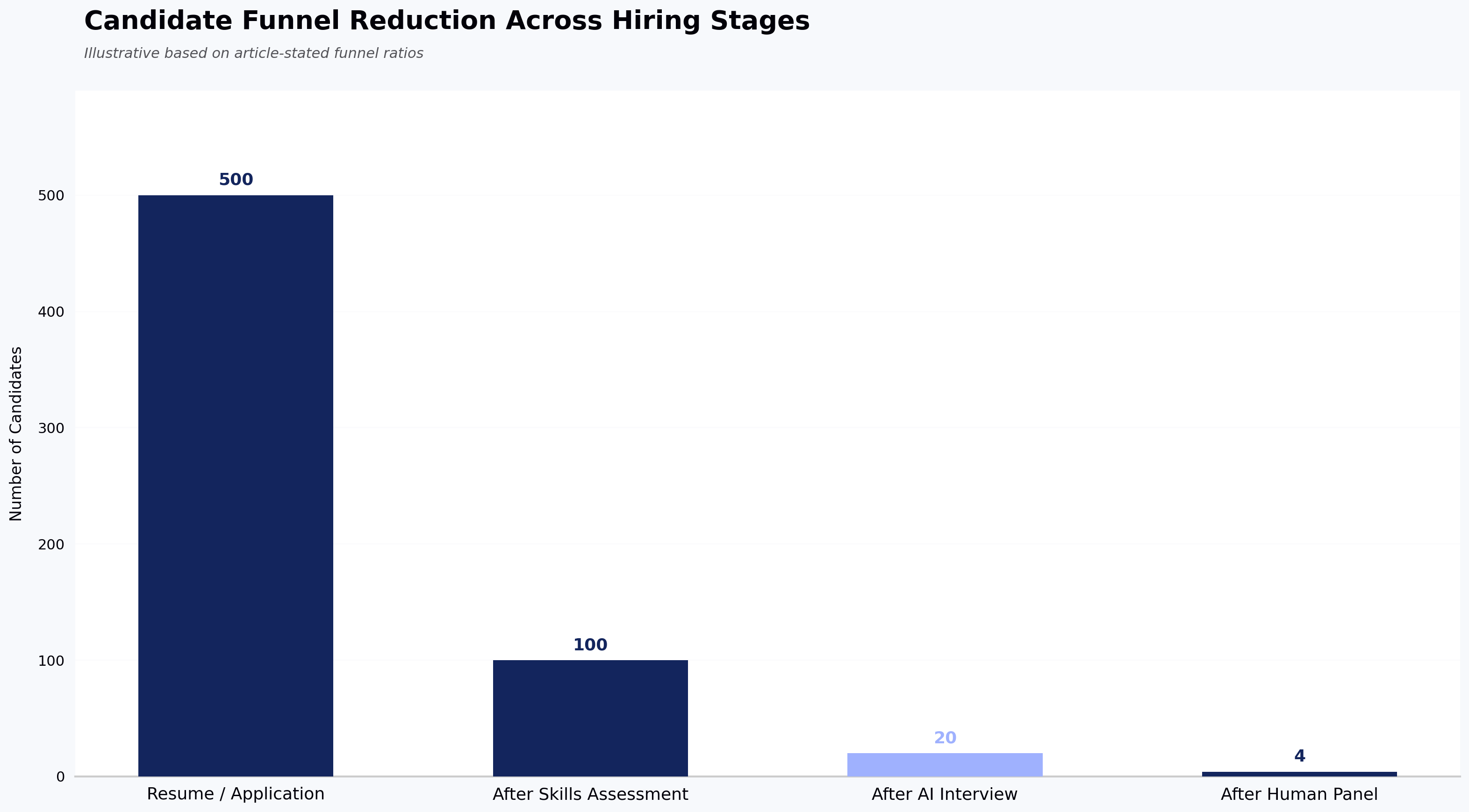
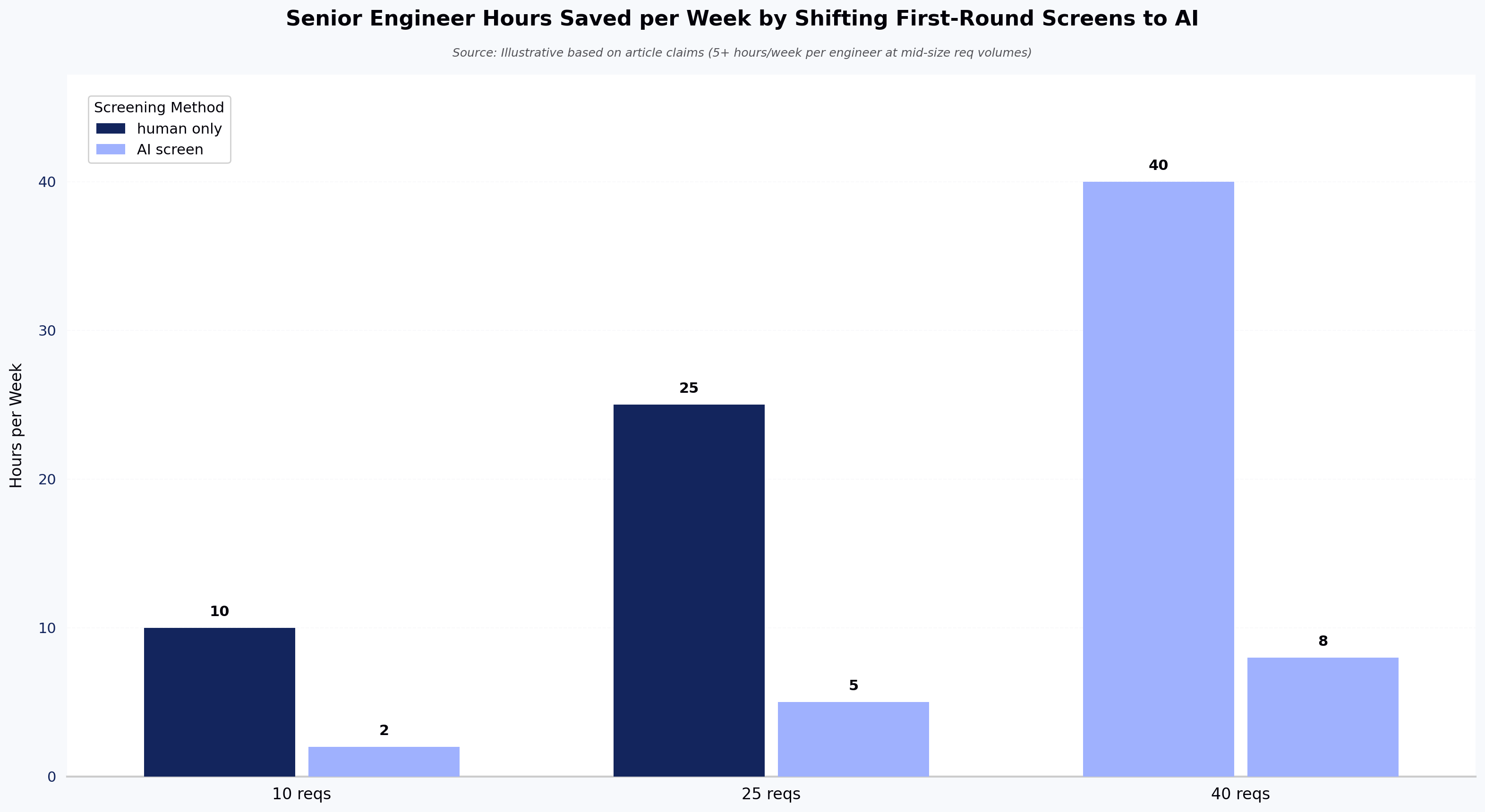
Volume is where AI interviewers earn their budget. A team hiring 500 engineers a year, doing 3–5 initial screens per hire, is spending 5,000–10,000 senior engineer hours on early-stage interviews. Moving that to AI, even for the first round, is measured in engineer weeks reclaimed.
HackerEarth OnScreen was designed for this pattern, with rubric-applied evaluation that stays consistent across large candidate cohorts. Karat and CodeSignal also scale, though pricing math differs. Newer entrants often price per interview, which becomes expensive fast at IT services or campus hiring scale.
For high-volume contexts, three questions matter more than product features:
- Does the tool integrate cleanly with your ATS so reports do not sit in a separate portal?
- Does the rubric produce reports that hiring managers actually read, or that get skimmed and ignored?
- Can candidates complete the interview on the devices and bandwidth they actually have?

Source: Illustrative based on article claims (500 hires × 3–5 screens × ~1 hour per screen)
What features should you look for in an AI interviewer for software engineer screening?
Non-negotiable: deterministic scoring, identity verification, ATS integration, candidate-visible time boundaries (nothing loses good candidates faster than an unbounded interview), and audit-ready reports for defensibility.
Nice-to-have: video avatars (they help engagement more than we expected), multi-language support if you hire globally, and role-specific rubric templates you can customize without vendor services. If you cannot edit the rubric yourself, calibration drift will become a real problem within six months.
How much do AI interviewer tools for software engineer screening cost?
Pricing models vary widely and vendors publish little. Broad patterns as of 2026:
These are rough market estimates based on publicly available positioning; vendors publish little firm pricing and figures should be verified directly.
- Per-interview pricing (common among newer entrants): $10–$50 per completed interview. Predictable at low volume, painful at high volume.
- Seat or platform pricing (Karat, CodeSignal, HackerEarth): annual contracts with volume tiers. Enterprise deals typically start in the low five figures and scale with hiring volume.
- Human-plus-AI hybrid pricing (Karat): meaningfully higher per interview because trained interview engineers are still involved.
The ROI math that matters is not cost per interview — it is cost per interview times volume, minus senior engineer hours reclaimed. Run that calculation with real numbers from your team before comparing sticker prices.
What are the limitations of AI interviewers for software engineer screening?
AI interviewers have four honest limitations that hiring teams should understand before committing.
- Judgment on ambiguous requirements. AI interviewers ask clean questions and evaluate clean answers. Real engineering involves interpreting messy requirements, and current AI interviewers are weak here.
- Culture and collaboration signal. An AI cannot tell you whether the candidate will be a good teammate on a long project.
- Novel problem types. AI evaluators trained on common patterns handle common problems well. Ask a genuinely novel question and scoring quality drops.
- Candidate perception. Some strong candidates decline to interview with AI, viewing it as impersonal or as a signal about company culture. The effect appears to be real; whether it is shrinking as the format normalizes is contested public discussion (including active Reddit threads) suggests skepticism remains high among senior candidates in 2025-2026.
Reddit threads on AI interviews reflect this candidate ambivalence some engineers see AI screens as fairer than inconsistent human ones, others see them as a red flag about the employer. Both reactions are defensible. The employer's job is to make sure the AI screen is one stage in a process that includes real humans, not the whole process.
How to choose an AI interviewer for software engineer screening
Pick the tool that fits your hiring pattern, not the tool with the most features. A team hiring 20 senior engineers a year needs different things from a team hiring 5,000 freshers off campus.
For senior product engineering hiring, prioritize rubric depth, integrity, and integration with a live technical panel tool like FaceCode for live technical interviews for later stages. For high-volume campus or IT services hiring, prioritize throughput, cost per interview, and ATS integration. For regulated hiring (BFSI, government), prioritize defensibility, audit trails, and identity verification standards.
Pilot two tools with real candidates for at least four weeks before committing. Vendor demos show the tool at its best; a pilot shows it at its median. Newer entrants like Talently.ai and Micro1 in particular warrant a live pilot before committing, since feature depth and scoring calibration are still maturing.
Frequently asked questions about AI interviewers for software engineers
Is an AI interview a red flag for candidates?
Sometimes. Senior candidates with strong options may decline AI-only processes, particularly if the AI screen is the entire evaluation rather than the first stage. The mitigation is to be transparent about where the AI interview sits in your process and to ensure human interviewers own final decisions. Companies that use AI to save time at the top of funnel and invest that time in higher-quality later-stage interviews tend to see less pushback.
What are common AI interview questions for software engineers?
The same categories human interviewers ask: data structures and algorithms (arrays, hashmaps, trees, graphs), system design at appropriate seniority (design a URL shortener, design a rate limiter, design a distributed cache), debugging scenarios, and language-specific fundamentals. AI interviewers tend to lean on well-known problem patterns because scoring is more reliable there.
How do you calibrate an AI interviewer rubric across seniority levels?
Start by defining what a passing answer looks like at each level for the same question - a junior candidate might earn full marks for a working brute-force solution with edge-case awareness, while a senior candidate needs to discuss trade-offs and scaling. Most calibration drift comes from applying one rubric across levels; separate rubrics per level, reviewed quarterly against hire outcomes, prevent the drift that makes AI interview reports lose credibility with hiring managers after six months.
What should you tell candidates about AI interviews to reduce drop-off?
Be explicit about three things before the invite: where the AI screen sits in the process, that human interviewers own final decisions, and how long the interview takes. Senior candidates decline AI-only processes most often when they suspect the AI screen is the entire evaluation. Companies that name the human stages upfront see materially lower drop-off than those that lead with the AI screen and leave the rest vague.
Can AI interviewers detect AI-assisted candidates?
Partially. Integrity layers can catch obvious cases -multiple faces on camera, unusual audio patterns, tab switching. Sophisticated cases where a candidate uses a second device silently are harder to catch. The best defense is a rubric that probes understanding, not just correctness asking the candidate to modify their code, explain a trade-off, or debug an intentional bug reveals whether they wrote it.
How can candidates prepare for an AI interview?
Treat it like a structured technical screen with a strict time budget. Practice speaking through your approach before writing code (AI rubrics score reasoning, not just correctness), rehearse common patterns (arrays, hashmaps, trees, graphs, basic system design), and do at least one timed mock with a tool like interviewing.io or HackerRank AI Mock Interviews to get used to talking to an AI interviewer. Confirm your camera, microphone, and network before the session - most integrity flags come from environment issues, not intent.
See it in action
If you are evaluating AI interviewers for software engineer screening, request a walkthrough of HackerEarth OnScreen with a candidate flow from your own pipeline. Bring a real role and a real rubric that is the only way to see whether the tool fits how your team actually hires.