AI Interview Platform: How to Screen Software Engineers at Scale
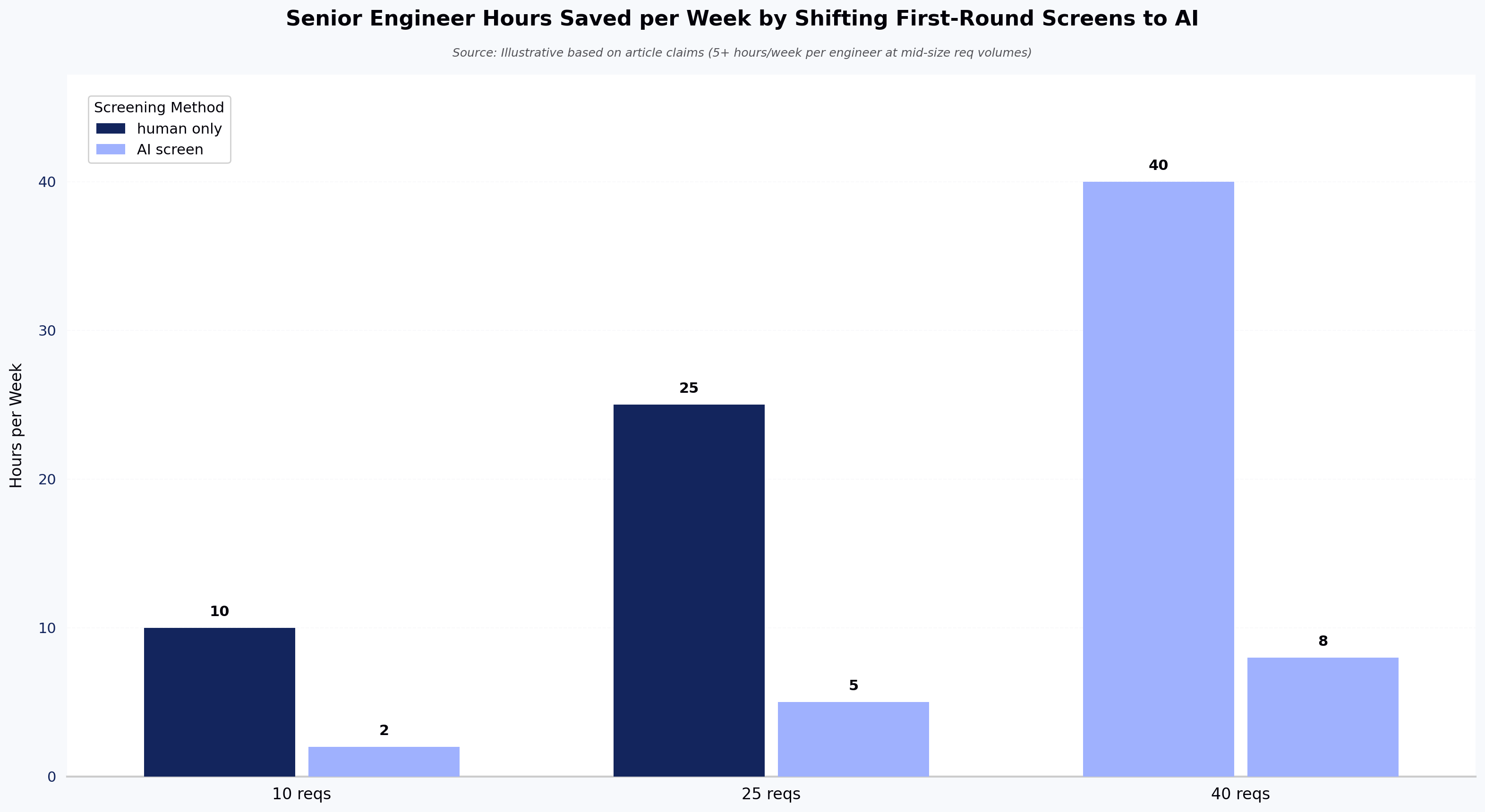
Technical hiring has a math problem. Candidate volume keeps rising, resume signal keeps falling, and the people best qualified to evaluate engineers your senior engineers have the least time to spend on first-round screens.
Add scheduling delays across time zones, inconsistent evaluations between interviewers, and the quiet dropout of strong candidates waiting a week for their next call, and the funnel starts leaking at the top before you've even seen your shortlist.
An AI interview platform is one of the clearer responses to that problem. Used well, it compresses the slowest, most expensive part of the pipeline — the first technical screen without lowering the bar for who makes it to a human conversation. Used badly, it adds a step without removing one.
This guide covers what AI interview platforms and AI screening platforms actually do, where they fit in a technical hiring workflow, how to evaluate them for software engineer hiring, and how HackerEarth OnScreen approaches the problem.
The real cost of traditional technical interviews
Before deciding whether an AI interview platform solves your problem, it's worth being specific about the problem itself. Traditional technical interview loops break down in four predictable places:
- Interviewer availability. Staff engineers are expensive to pull off product work for 45-minute phone screens, and the more senior they are, the less willing the org is to spend them on top-of-funnel evaluation.
- Scheduling delay. A strong developer who applies late Sunday night needs to hear back before Tuesday or they're deep in another process. Calendar coordination across time zones routinely stretches the first conversation to five or six days.
- Inconsistent evaluation. Two interviewers running the same candidate against the same rubric often disagree. Interviewer variance has been documented in hiring research for years, including Google's internal analysis reported in Laszlo Bock's Work Rules!.
- Screening throughput. AI-generated resumes have made the resume stack bigger and the signal thinner. The volume of "plausible" candidates per role has grown faster than the engineering hours available to filter them.
The result is that the hiring stage with the most volume, the first technical conversation is also the stage most constrained by human calendars and the most prone to inconsistent scoring. That's the gap AI interview platforms are built to fill.

What is an AI interview platform?
An AI interview platform is software that conducts a structured interview: audio, video, or chat-based between a candidate and a system that asks role-calibrated questions, probes with follow-ups, and scores responses against a predefined rubric. For technical roles, the platform typically includes a code editor, automated code execution, identity verification, and a recording and transcript the recruiter can review.
The important distinction: an AI interview platform is not a video recording tool with a scoring sheet. Three capabilities separate serious platforms from thin wrappers:
- Deterministic rubric evaluation. The same answer produces the same score, every time, regardless of when the candidate takes the interview.
- Conversational depth. The system asks follow-up questions based on what the candidate actually said, not from a fixed script.
- Identity and integrity verification. The platform confirms the candidate is who they claim to be and flags behavior that suggests external assistance.
Without those three, you have a glorified recording tool. With them, you have something that can replace a first-round technical screen without lowering the bar.
AI interview platform vs. AI screening platform: how they differ
The two terms get used interchangeably, but they describe different scopes.
An AI screening platform is broader. It covers any automated system that filters candidates before a human recruiter engages — resume parsing, skills assessments, knockout questions, coding tests, and basic conversational screens. The output is usually a shortlist with scores.
An AI interview platform is a specific type of AI screening platform. It conducts a full structured interview — not just a test — and produces an evaluation across coding, problem-solving, and technical knowledge, with a recording and transcript attached.
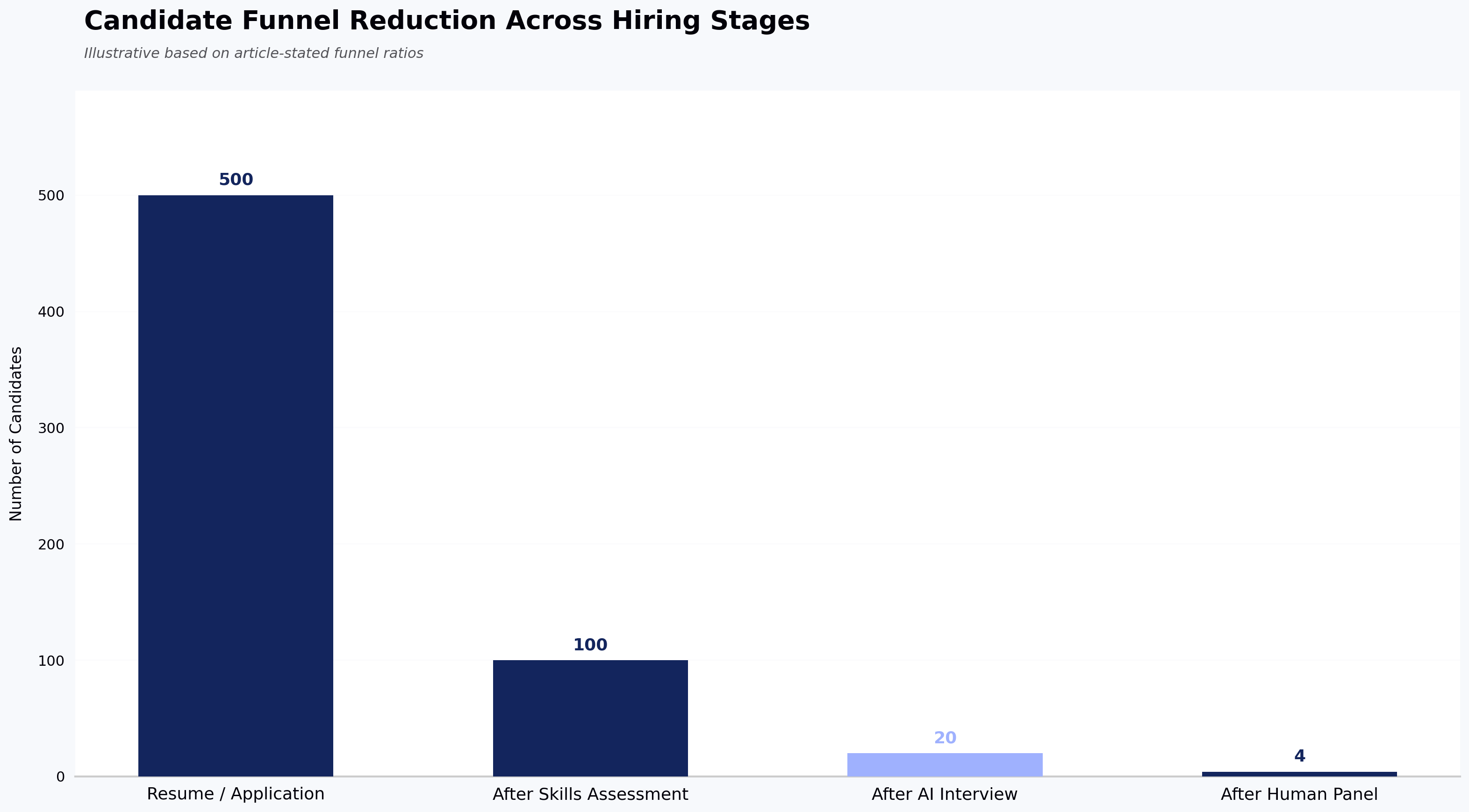
In a technical hiring workflow, they typically stack:
- AI screening filters the initial applicant pool against job-relevant skills (often a timed coding assessment).
- AI interview conducts a deeper evaluation on the candidates who passed screening — code written live, verbal explanation, follow-up probing.
- Human technical interview handles senior calibration, system design, and judgment-heavy conversations.
- Hiring manager and panel rounds close the loop.
An AI interview platform replaces step 2 and sometimes compresses step 1 into the same session. It does not replace step 3 for senior roles, and if a vendor claims otherwise, that's a reason to be cautious.
How AI interview platforms evaluate technical candidates
Most AI interview platforms for technical hiring follow a similar flow. The candidate receives a link, verifies identity (usually photo ID plus live face match), completes a structured interview that includes code tasks and verbal explanation, and the recruiter sees a score alongside the recording and transcript.
What varies is how the evaluation actually happens underneath. Weaker platforms transcribe the candidate's answer and run it through a general-purpose language model to produce a score — which gives you fluent-sounding but inconsistent output. Stronger platforms run responses against a role-specific rubric with defined scoring anchors, use automated code execution to verify correctness, and generate scores from a deterministic framework rather than ad-hoc LLM judgment.
The three technical dimensions the platform needs to evaluate separately:
Coding skills. Evaluated by running candidate-written code against test cases. This is the easiest dimension to automate and the one most platforms do reasonably well. Watch for platforms that score code solely on text analysis without execution — they will mark plausible-looking wrong answers as correct.
Problem-solving. Evaluated by asking the candidate to explain their approach before writing code, probing on edge cases, and watching how they respond when the first solution doesn't work. This is where conversational depth matters most. A script-based system cannot adapt its follow-ups and will miss the signal.
Technical knowledge. Evaluated through targeted questions on language, framework, and systems concepts, with follow-ups that distinguish rote recall from working understanding. "Explain how a hash map handles collisions" asked once is a weak signal. The same question with three follow-ups on load factor, resize cost, and when to use a different data structure is a strong one.
The practical test for a vendor: ask them to run the same candidate response through the system twice and compare the scores. If the numbers drift noticeably, the platform is doing LLM-as-judge without discipline, and your scoring won't survive an audit.
Where AI interview platforms fit — and where they don't
AI interview platforms and live human interviews are not substitutes. They're better understood as two tools for different stages of the same funnel.
Where AI interviews are stronger:
- First-round technical screens on high-volume roles
- Consistency across large candidate cohorts
- 24/7 availability for candidates across time zones
- Audit trails for compliance-sensitive hiring
- Surge hiring events where a human-only loop would collapse
Where human interviews are stronger:
- Senior and staff engineer calibration
- Open-ended system design where context dependency matters
- Cultural and leadership judgment
- Any conversation where reading real-time reasoning is the point
The useful question isn't which to use. It's which stage to use each at. For a mid-level backend candidate on a first screen, a well-calibrated AI interview is often more consistent than the humans it's replacing. For a staff engineer evaluating architectural trade-offs with incomplete information, a human interviewer still wins.

Features that actually matter in an AI screening platform
Vendor spec sheets are long. These are the capabilities that determine whether the platform works for technical hiring at scale:
- Deterministic rubric scoring. Same answer, same score, every time. Ask to see the scoring methodology, not just the output.
- Automated code execution. The platform runs candidate code against test cases rather than scoring the text of the answer.
- Role-calibrated question libraries. Pre-built content for the roles you actually hire for, not a generic question bank you configure from scratch.
- Identity verification and proctoring. Photo ID match, live face verification, and signals that detect obvious external assistance. KYC-grade verification matters more in regulated verticals.
- Conversational follow-ups. The system asks the next question based on what the candidate said, not from a fixed script.
- ATS integration. Scores and recordings flow into Greenhouse, Lever, Workday, or your ATS without manual copying. "Integrates with Greenhouse" can mean anything from a native app to a CSV export — verify the difference.
- Audit-ready evidence trail. Recording, transcript, rubric, and score stored together, because at some point your legal team will ask.
Features that sound impressive and matter less for technical hiring: avatar polish, voice naturalness, "sentiment analysis," and anything labeled "emotional intelligence scoring." For engineering roles, you want signal on code and reasoning, not on whether the candidate smiled.
Candidate experience and responsible AI use
AI interviews are a mixed experience signal for candidates, and the implementation determines which way it tips. Candidates generally dislike AI interviews that feel scripted, provide no feedback, or offer no transparent path to a human reviewer. They generally accept — and sometimes prefer — AI interviews when the alternative is waiting a week for a human screen that still happens on a Monday morning they can't make.
Responsible use of AI in hiring comes down to a few practical commitments:
- Transparency. Candidates should know they're being interviewed by an AI system and understand how their data will be used.
- Human review of decisions. Automated scores should inform recruiter and hiring manager decisions, not replace them, especially at borderline thresholds.
- Bias auditability. Structured rubric-based evaluation is more auditable than unstructured human evaluation, but it is not bias-free. The defensible claim is that consistency and auditability improve, not that bias disappears.
- Data handling. Recordings, transcripts, and biometric verification data need defensible retention and access controls, particularly under GDPR and similar frameworks.
Platforms that cannot clearly answer questions on these four areas are a risk, not a shortcut.
How to reduce time-to-hire without adding interview bottlenecks
The bottleneck in technical hiring is almost never the first candidate conversation. It's the second, third, and fourth — the panels, the take-homes, the debriefs that require named humans with calendars. An AI interview platform only helps if it genuinely narrows the pool going into those stages.
Three operational moves make the difference:
- Calibrate the AI screen against your existing bar. Run 20–30 recent hires and 20–30 recent rejects through the platform. If the system passes your rejects or fails your hires at a rate above roughly 15%, the rubric is wrong for your context. That's your problem to fix before scaling, not the platform's fault.
- Set a hard pass threshold the hiring manager has signed off on. If recruiters interpret scores differently, you've recreated the calibration drift you were trying to eliminate.
- Cap the AI screen at 45–60 minutes. Longer sessions correlate with drop-off, not better signal. Candidates won't sit through 90 minutes with a bot the way they'll sit through 90 minutes with a person.
Time-to-hire savings compound where volume is high. At 50 candidates per role, cutting the first screen from six days to under 48 hours is a two-week improvement on time-to-fill. At three candidates per role, the same change is barely visible against senior-interview and offer-stage delays. If your bottleneck lives in the back half of the funnel, no AI interview platform will fix it.
How to choose an AI interview platform for software engineer hiring
Most AI interview platform evaluations go wrong the same way: the buyer compares feature lists, picks the one with the best demo, and discovers six months in that the rubric doesn't match their actual hiring bar. A better process:
- Run a calibration pilot before signing. Put 30–50 past candidates through the platform — hires and rejects — and compare the system's scores to your actual outcomes. If the correlation is weak, no feature list fixes it.
- Involve one engineering manager, not just TA. Engineering has veto power on technical hiring whether the org chart says so or not. A platform TA loves and engineering distrusts will not survive the first calibration disagreement.
- Check the integrity story specifically. Ask what signals the platform uses to detect external assistance, how often it produces false positives, and what the recruiter sees when a flag fires.
- Verify ATS integration end-to-end. Walk through a real candidate from invitation to scorecard in your actual ATS. Mock the handoff.
- Price per interview, not per seat. Volume-based pricing aligns incentives; seat-based pricing penalizes the recruiters who use the tool most.
The platforms competing in this category — HireVue, Sapia.ai, Interviewer.AI, and HackerEarth OnScreen among others — differ most on how deeply they evaluate code versus how polished the conversational layer is. For software engineer hiring specifically, code evaluation depth matters more than conversational polish.
HackerEarth OnScreen: AI interviews built for technical hiring
HackerEarth OnScreen is our AI interview platform, built for structured technical screening at scale. It conducts role-calibrated interviews around the clock using lifelike video avatars, applies a deterministic evaluation framework so every candidate is scored against the same rubric, and includes KYC-grade identity verification and integrated proctoring in the same product.
A few capabilities worth calling out against the challenges covered above:
- Rubric-based scoring with automated code execution addresses the consistency gap in traditional interviewer-led screens.
- Integrated identity verification and proctoring reduce the integrity exposure that comes with remote interviews.
- 24/7 candidate access removes the scheduling delay that costs the strongest candidates in competitive markets.
- Conversational follow-ups probe on reasoning, not just final answers, giving stronger signal on problem-solving.
OnScreen sits alongside HackerEarth Assessments and FaceCode in the same platform, so candidate data, rubrics, and scores flow between products without separate integrations. For TA teams running coding tests at the top of the funnel and live interviews at the bottom, that continuity matters more than any single feature.
OnScreen fits best for first-round technical screens on high-volume roles, surge hiring events, and any pipeline where consistency and audit trail matter. It's not the right call for senior leadership hires where cultural judgment is the primary signal, or for roles where live whiteboarding with the hiring team is the point of the interview — those belong in a human interview tool.
Frequently asked questions
Is there an AI tool for interviews?
Yes. The category includes several established options — HireVue, Sapia.ai, Interviewer.AI, and HackerEarth OnScreen, among others. They differ most on whether they target technical hiring specifically, where code evaluation depth matters, or general hiring, where conversational scoring dominates. For software engineer roles, the technical-hiring-focused platforms produce stronger signal.
Which AI agent is best for an interview?
No single platform wins across all use cases. For high-volume technical screening where code evaluation and identity verification matter, platforms with deterministic rubric scoring and automated code execution fit best. For general enterprise hiring focused on conversational competency assessment, more general-purpose platforms are commonly adopted. The "best" platform is the one whose rubric survives a calibration pilot against your actual hiring bar.
Can I use ChatGPT for an interview?
As an interviewer, no — ChatGPT has no identity verification, no deterministic scoring, no ATS integration, and no audit trail. As a candidate preparation tool it works, which is one reason resume signal has eroded. If you're building an interview process, the question is not whether to use a general LLM but whether your evaluation platform uses a structured rubric or is itself just an LLM wrapper. The second category produces inconsistent scoring.
Are AI interviews a red flag?
For candidates, AI interviews are a mixed signal, and the implementation determines the reaction. Candidates generally dislike AI interviews that feel scripted, give no feedback, or offer no path to a human reviewer. They generally accept them when the alternative is a week-long wait for a human screen. The red flag isn't the AI — it's a poorly implemented process without transparency or human review on the back end.
How accurate are AI interview platforms?
Accuracy depends on how the platform scores answers. Platforms with deterministic rubrics and automated code execution produce consistent scoring across candidates — more consistent than human interviewers across the same cohort, which is the fair comparison. Platforms that use general-purpose LLMs to score free-text answers without rubric anchoring produce scores that drift. Ask vendors for test-retest reliability data, not accuracy claims.
Do AI interview platforms introduce bias?
AI interview platforms have different bias profiles from human interviewers, not no bias. They are more consistent across candidates on the same day, less affected by interviewer mood or fatigue, and more auditable. They can also encode bias from training data or rubric design. The defensible position is that structured rubric-based evaluation applied consistently is more auditable than unstructured human evaluation — not that AI eliminates bias.
See HackerEarth OnScreen in action
Technical hiring breaks down in the places where human time is most expensive and least differentiated — the first-round screen, the scheduling cycle, the inconsistent scoring across interviewers. An AI interview platform fixes those specific problems if the rubric is sound and the integration into your pipeline is real.
Schedule a demo of HackerEarth OnScreen to see how structured AI interviews, identity verification, and deterministic scoring work against your actual roles. For context on where AI interviews fit in a broader hiring stack, see our guide to technical interview design. ```