Home
/
Blog
/
AI Recruiting
/
AI Interview Agent for Automation Testing Screening

AI Interview Agent for Automation Testing Screening

Author
Shruti Sarkar
Calendar Icon
April 29, 2026
Timer Icon
3 min read
Share

Explore this post with:

Key Takeaways:
  • Using an ai-interview-agent-to-screen-automation-testing-candidates requires four deliberate configuration steps: designing a skill rubric, selecting question types, enabling integrity safeguards, and integrating results into your existing ATS workflow.
  • 58% of candidates used AI tools to complete job assessments or applications in 2024, according to Capterra, which means credentials and self-reported automation experience can no longer function as reliable screening filters on their own.
  • A well-configured automation testing rubric weights specific dimensions — framework proficiency, test architecture, CI/CD integration, and debugging skills — rather than generic QA concepts like the defect lifecycle that measure the wrong profile entirely.
  • Code replay capability, which shows keystroke-by-keystroke playback of how a candidate built their solution, gives engineering managers verifiable evidence of genuine skill before they commit time to a live interview.
  • AI interview agents are not the right fit for every scenario: low-volume hiring, portfolio-driven roles, or jurisdictions with AI hiring laws such as New York City Local Law 144 may require a different approach or additional legal steps before deployment.

How to use an AI interview agent to screen automation testing candidates

Read time: 10 minutes

An AI interview agent is an autonomous system that conducts structured first-round technical interviews — asking role-specific questions, evaluating live code, and generating scored reports — without human involvement. For automation testing roles, an AI interview agent to screen automation testing candidates augments manual resume reviews and phone screens with skill-specific evaluations that surface genuine framework proficiency. Recruiters tell us roughly half the candidates who list Selenium on their resume cannot write a working test script — less a matter of dishonesty than of how dramatically the barrier to looking qualified has dropped. According to Capterra, 58% of candidates used AI tools to complete job assessments or applications in 2024, and the Identity Theft Resource Center reported a sharp rise in resume and application fraud over the same period. When AI can generate a polished application in minutes, credentials and self-reported experience stop functioning as reliable filters for automation testing screening — and recruiters cannot validate framework depth from a resume alone, while engineering managers cannot screen every applicant.

This guide gives you a step-by-step implementation path for using an AI interview agent to screen automation testing candidates. You will learn how to design a skill rubric, configure question types, set up integrity safeguards, and integrate the agent into your existing ATS workflow for technical screening and candidate evaluation.
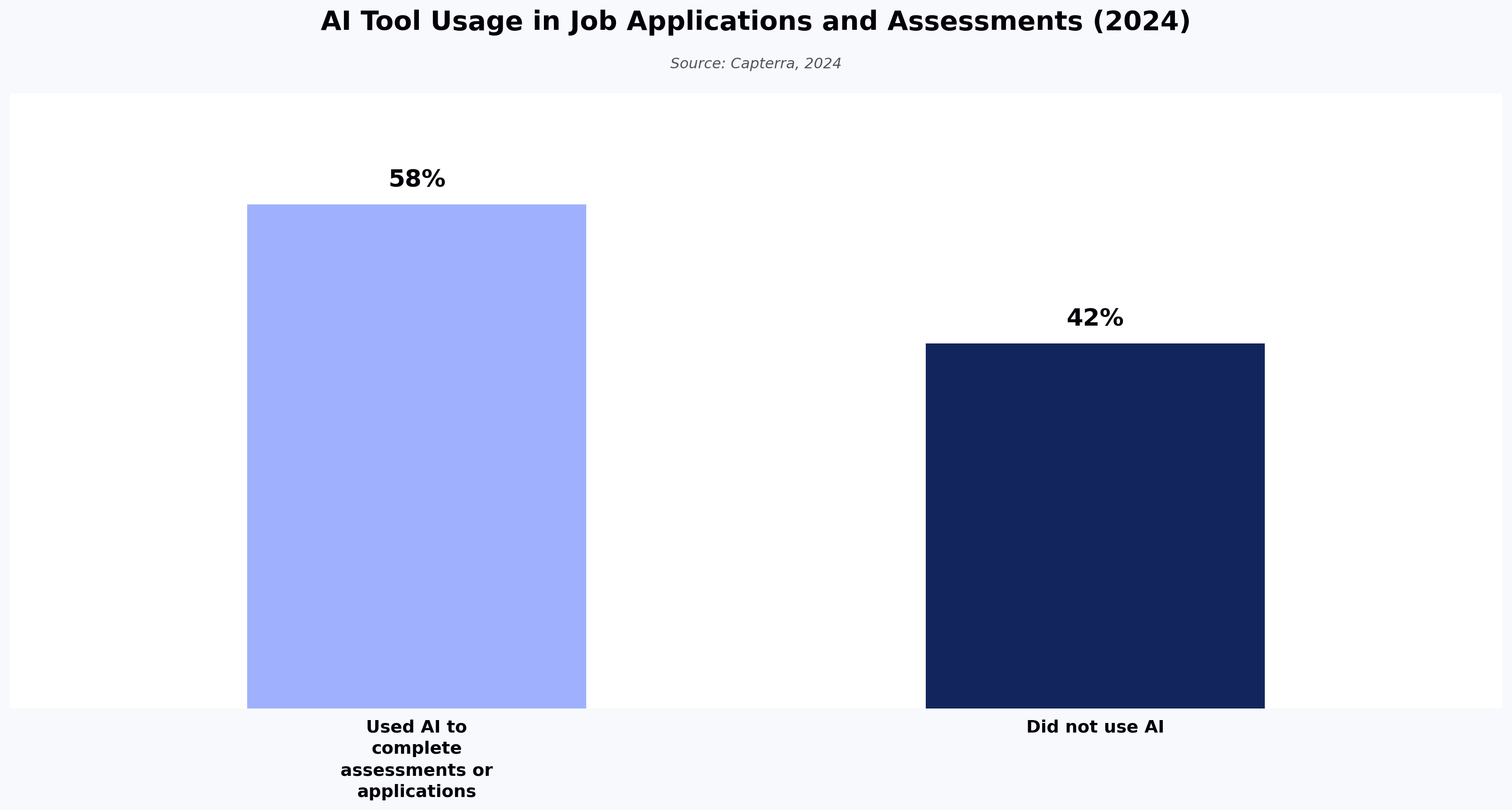
AI Tool Usage in Job Applications and Assessments (2024)
Source: Capterra, 2024

Why automation testing roles are uniquely hard to screen

Automation testing resumes are keyword-dense by nature. A candidate who completed a weekend course may list Selenium, Cypress, TestNG, Jenkins, and Docker on their resume. Another candidate with five years of Page Object Model (a test design pattern that wraps UI elements into reusable classes) and CI/CD pipeline integration experience may list many of the same terms. Keywords tell you little about proficiency level, and resumes are often where the signal ends.

1. Recruiters cannot reliably validate technical depth

Your recruiters compound the problem through no fault of their own. Most technical recruiters can confirm that a candidate has used Selenium. They cannot confidently assess whether that candidate understands dynamic wait strategies, data-driven testing patterns, element locator design (how tests find and target UI components), or cross-browser test orchestration.

This is not a recruiter skills gap. It is a structural mismatch between recruiter expertise and what automation testing roles actually demand.

2. Traditional screening methods are losing effectiveness

Take-home assignments once helped bridge this gap, but they are weakening under two pressures. Completion rates drop sharply when candidates face lengthy exercises. AI-generated submissions are also becoming harder to distinguish from genuine work without live verification.

Companies that rely on phone screens face a similar issue. A 30-minute call can gauge communication and enthusiasm, but it cannot reveal whether someone can debug a flaky test suite or architect a maintainable automation framework.

3. AI has flattened candidate differentiation

There is also a convergence problem. AI-prepped candidates now deliver polished, STAR-formatted answers to behavioral questions about automation testing experience. When every candidate sounds rehearsed and uses similar structure, polish stops being a useful signal. Your interview automation process must shift from what candidates say to what they can demonstrably build and explain in real time.

4. Structured interviews create better hiring signals

Some meta-analytic research, including widely cited work by Frank Schmidt and John Hunter, suggests structured interviews can yield meaningfully higher predictive validity for job performance compared to unstructured interviews, as summarized by SHRM. An AI interview agent brings that structure to the screening stage, where it has historically been absent.

What an AI interview agent actually does (and doesn't do) to screen automation testing candidates

Before you configure anything, you need a clear picture of what an AI interview agent handles and where its limits are.

An AI interview agent is an autonomous system that conducts structured technical and behavioral interviews without human involvement. It evaluates candidate responses against predefined rubrics, generates scored, evidence-based reports, and delivers the results to your hiring team. Think of it as a consistent, always-available first-round interviewer that applies the same standard to every candidate regardless of time zone, hiring volume, or interviewer availability.

The table below summarizes the core capabilities and explicit limits of an AI interview agent in an automation testing context.

What It Does What It Does Not Do
Runs structured first-round interviews Replace final-round human interviews
Tests role-specific automation skills Guarantee a perfect hire
Evaluates coding performance against a rubric Work well with generic setup
Generates scored reports Replace manager judgment
Supports asynchronous screening across time zones Measure presentation over substance
Applies a consistent rubric to every candidate Remove all hiring risk

For automation testing screening, a well-configured agent handles several critical functions.

  • It conducts role-calibrated conversations that adapt to candidate responses, asking Selenium, Cypress, or API testing questions and adjusting the line of inquiry as the candidate answers.
  • It evaluates submitted code against a configured rubric — typically through a combination of automated test case execution, static analysis, and LLM-assisted rubric matching against criteria you define — assessing logic, efficiency, and adherence to common patterns.
  • It generates structured scorecards with scoring rationale for every evaluation dimension, giving your engineering manager reviewable evidence instead of a vague thumbs-up.
  • And it does all of this at scale, running many simultaneous interviews with rubric-applied evaluation that does not vary by interviewer mood or fatigue. While no automated system is free of bias, applying the same rubric to every candidate is typically more consistent across candidates than human-led screens.

What the agent does not do is equally important.

  • It does not replace final-round human interviews for senior roles where architecture discussions and team-fit evaluation require human judgment.
  • It does not guarantee a perfect hire; it improves signal quality at the screening stage, not at the offer stage.
  • It does not produce useful results without proper configuration, because a generic rubric produces generic evaluations.
  • And it does not measure presentation over substance. Some AI video interview tools assess surface-level proxies like eye contact and speech cadence.

The better-configured agents evaluate output, not optics. If your candidate writes a working Selenium script that handles dynamic waits correctly, that matters far more than their webcam posture.

When an AI interview agent is the wrong tool

AI interview agents are not the right fit for every hiring scenario. If your annual automation testing hiring volume is in the single digits, the configuration effort may outweigh the time savings. Roles where the primary signal is a portfolio of prior work (e.g., open-source test framework contributions) are better evaluated through code review than synchronous assessment. And in jurisdictions with specific AI hiring regulations — such as New York City Local Law 144 or Illinois' AI Video Interview Act — you may need bias audits, disclosures, or candidate consent workflows before deploying any automated screening tool. Confirm legal requirements with counsel before rollout.

One concern deserves honest acknowledgment. A 2024 Tidio survey reported that a majority of job seekers expressed reservations about AI-driven video interviews lacking human interaction. (Tidio is a vendor rather than an independent research body; treat the figure as directional and consider supplementing with independent HR research before publication.) The response is not to avoid AI screening but to design the candidate experience deliberately around it: provide clear instructions before the assessment begins, explain how the evaluation will be used, allow candidates to retake practice questions, offer a human point of contact for technical issues, and share scorecard summaries where policy allows. When the agent handles first-round verification well, your engineering manager spends their limited interview time on system design philosophy and problem-solving approach instead of retesting Selenium basics — which often improves the candidate experience in the rounds that matter most.

HackerEarth's AI Interview Agent (OnScreen) puts this approach into practice, using role-calibrated conversations to conduct structured AI interviews and drawing on HackerEarth's broader assessment library, which covers 40+ programming languages and 1,000+ skills. For a broader look at how AI interviewers fit into modern recruiting workflows, see this Complete Guide for Recruiters.

Step-by-step: configuring an AI interview agent to screen automation testing candidates

Configuring an AI interview agent for automation testing roles requires intentional choices at four stages: rubric design, question selection, integrity safeguards, and workflow integration. Shortcut any of these, and the agent will underperform.

Step 1: Define the automation testing skill rubric

Your job description says "3+ years Selenium experience." Your rubric needs to define what that means in evaluative terms. Map the dimensions your AI interview agent will assess. For a mid-level automation testing role, these typically include:

  • Core framework proficiency: Selenium WebDriver, Cypress, Playwright, or Appium, depending on the tech stack
  • Test architecture: Page Object Model, Screenplay Pattern (a design pattern that separates actors, tasks, and abilities), data-driven testing, and keyword-driven frameworks
  • Programming language depth: Java, Python, JavaScript, or TypeScript as applied specifically to test automation
  • CI/CD integration: Jenkins, GitHub Actions, GitLab CI, or CircleCI pipeline configuration and test execution
  • API testing: REST Assured, Postman/Newman, or framework-native API testing capabilities
  • Debugging and maintenance: Flaky test handling, dynamic waits, element locator strategies, and test data management

Weigh these dimensions according to the role's actual priorities. For a mid-level position, framework proficiency and test architecture might carry 40% of the total score, CI/CD integration 20%, and communication skills 10%. Avoid the common mistake of using a generic QA assessment that evaluates manual testing concepts, such as the defect lifecycle, rather than automation-specific skills. The wrong rubric will screen for the wrong profile, no matter how capable the AI agent is. Platforms like HackerEarth's Technical Assessments let you upload a job description, auto-generate a role-specific assessment, and customize it from a library spanning a wide range of skills and languages — useful when you need to translate a generic rubric into role-calibrated questions quickly.

Step 2: Select and configure the right question types to screen automation testing candidates

The rubric tells the agent what to evaluate. Question types determine how. When you select question types for your AI interview agent to screen automation testing candidates, you are deciding what evidence the scorecard will rest on.

Coding challenges place the candidate in a sandboxed IDE to write real automation test code. Example: "Write a Selenium WebDriver script that navigates to a login page, enters credentials from a data file, and verifies the dashboard loads within 3 seconds." The AI evaluates code quality, logic, efficiency, and adherence to common automation patterns.

Architecture questions test structural thinking. Ask the candidate to design a test automation framework for a microservices application with 15 services and independent deployment pipelines. The agent evaluates depth of reasoning, not keyword density.

Debugging scenarios present broken test scripts with common automation issues: stale element references, incorrect locator strategies, misused implicit waits, and hardcoded test data. The candidate identifies and fixes each problem, while the agent tracks the candidate's diagnostic approach.

Behavioral questions surface real-world experience. "Describe a time you maintained a large test suite that became unreliable" reveals communication clarity and problem-solving methodology beyond what any resume conveys.

The critical differentiator across all question types is the agent's role-calibrated conversation. When a candidate mentions Page Object Model, the agent can probe further: "What are its limitations, and when would you choose an alternative pattern?" This is where memorized definitions tend to fail. Candidates who prepped with ChatGPT can recite textbook answers, but they often cannot navigate unpredictable follow-up depth. Recruiters worry that AI screening tools miss qualified candidates due to rigid filtering. Calibrated follow-ups address this concern directly by finding each candidate's actual proficiency boundary rather than applying a binary pass/fail on a single answer.

Step 3: Set up integrity and proctoring safeguards

For roles where AI-generated submissions are a real risk, this step determines whether the assessment measures automation skill or prompt-engineering ability. AI-assisted cheating on coding assessments is now well-documented — candidates can paste a prompt into ChatGPT and receive working Selenium code in seconds. Without proctoring, your assessment may measure prompt-engineering ability rather than automation-testing competency.

Layer your defenses in two tiers.

Must-have (table stakes):

  • Tab-switching detection flags when candidates navigate away from the assessment environment.
  • AI-based plagiarism detection compares submitted code against known AI-generated patterns and other submissions.
  • Copy-paste prevention blocks externally generated code from entering the IDE.

Nice-to-have (higher-stakes or senior roles):

  • Webcam monitoring and screen capture verify identity and detect suspicious behavior.
  • Extension detection identifies browser tools providing real-time AI assistance.

Balance firmness with candidate experience. Proctoring that feels like interrogation drives top candidates out of your pipeline.

Prioritize code replay capability across both tiers. After the assessment, your team watches a keystroke-by-keystroke playback of how the candidate built their solution. Fluent, iterative typing signals genuine knowledge. Large pasted code blocks or sudden jumps in complexity signal external help. This evidence trail gives engineering managers confidence before they invest their own time in a live interview.

Step 4: Integrate the AI agent into your existing hiring workflow

Results that live in a separate platform will not be used. The output of an AI interview agent to screen automation testing candidates must flow directly into the systems your team already works in.

ATS integration

Connections to your applicant tracking system ensure candidate scores, code replays, and AI-generated summaries appear inside your recruiter's existing workflow without manual data transfer or platform switching. Confirm which ATS integrations are available for your plan with your vendor.

Workflow placement

The AI interview agent supplements the manual phone screen rather than replacing the final-round interview. Your funnel becomes: Application → AI interview agent screening → Recruiter reviews shortlisted candidates → Live technical interview with engineering → Offer. This preserves the human touchpoints candidates value while removing the bottleneck that slows your pipeline.

Asynchronous scheduling

This eliminates timezone coordination entirely. Candidates receive a link, complete the interview on their own schedule, and results appear in your dashboard within minutes. For global automation testing hiring, this alone can shave days off the screening cycle.

Stakeholder visibility

Give engineering managers read access to scorecards and code replays before the live interview. With that context, the live conversation focuses on architecture decisions and cross-team collaboration style rather than retesting framework fundamentals.

Screening automation testers with confidence starts with the right setup

The gap between an automation testing job posting and a qualified hire is a screening problem. Resumes overstate proficiency, take-home assignments invite AI-generated submissions, and phone screens filter for confidence rather than competency. Every day your team spends on manual screening is a day the role stays open, and release cycles slow down.

An AI interview agent helps close that gap when you configure it with intention. Define a rubric that maps to real automation testing work — not just resume keywords. Select question types that force candidates to write, debug, and explain code under observed conditions. Layer proctoring safeguards that verify authenticity without alienating strong candidates. Then integrate the agent directly into the ATS your recruiters already use so that results reach the right stakeholders without extra steps.

If you want to compare your current screening setup against the four steps above, start by auditing your existing automation testing rubric for the dimensions listed in Step 1 — most teams find at least two gaps on first review.

Next steps: see it in action

Book a demo to see how HackerEarth's AI Interview Agent fits your open automation testing roles.

FAQs

1. How long does it take to configure an AI interview agent for an automation testing role?

In our experience working with hiring teams, most can go from job description to live assessment in roughly an hour, though actual timing depends on team familiarity and role complexity. Setup time typically breaks down across JD upload and auto-generation, rubric weighting, question customization from the library, and proctoring configuration. The longest stage tends to be question customization for niche roles — mobile automation with Appium, for example, or specialized API testing frameworks — where you may want to review or supplement library questions to match your stack precisely.

2. Can an AI interview agent evaluate both junior and senior automation testers?

Yes, if you configure separate rubrics for each level. A junior rubric might focus on core Selenium scripting and basic locator strategies, while a senior rubric emphasizes framework architecture, CI/CD pipeline design, cross-browser orchestration, and mentoring approach. Role-calibrated conversations automatically adjust depth based on candidate responses.

3. When should you NOT share automated candidate feedback?

Sharing automated feedback sounds candidate-friendly, but it carries trade-offs worth weighing. In regulated industries or jurisdictions with AI hiring laws (e.g., NYC Local Law 144, Illinois AI Video Interview Act, EU AI Act), automated scoring rationale shared with candidates may become discoverable in adverse-action disputes — and any ambiguity in the rubric language becomes a legal exposure. Detailed feedback can also coach future candidates on how to game the rubric if leaked. The pragmatic middle ground: share high-level performance summaries and let recruiters deliver specific feedback verbally, where context and tone can be managed. Run any candidate-facing automated feedback past legal before turning it on.

4. How do you measure the ROI of AI interview screening for automation testing hires?

Track four metrics before and after implementation: time from application to shortlist, engineering hours spent on screening interviews, interview-to-offer ratio, and 90-day performance scores for new hires. The cumulative effect is recovered recruiter capacity and a meaningful reduction in hours engineering spends on first-round interviews — both of which can be measured directly inside your ATS reporting once the workflow has been in place for a full hiring cycle.

5. Can an AI interview agent screen for niche frameworks like Appium or Playwright?

Yes. The key is rubric specificity. If you are hiring for mobile automation, your rubric should include Appium-specific dimensions like device farm configuration, gesture handling, and hybrid app testing. Platforms with deep question libraries spanning a wide range of skills and programming languages support these niche configurations out of the box.


Editorial notes for publication:

  • Meta title and description are not present in the draft and must be locked before publishing. Suggested meta title (under 60 chars): "How to Use an AI Interview Agent for Automation Testers". Suggested meta description: trim the opening definition sentence to ~155 characters.
  • Target word count is a metadata constraint not addressed here; confirm the displayed "10 minutes" read time matches the final word count at 250 wpm before publishing.
  • Verify all external links (Capterra, ITRC, SHRM, Tidio) are live and that cited figures match the linked sources. The ITRC reference has been softened pending confirmation that the 118% figure refers specifically to resume/application fraud rather than identity fraud broadly. The Schmidt & Hunter "2x" framing has been softened to a directional claim pending source confirmation.
  • The "150M+ assessment signals" claim has been removed from the body pending proper attribution to a HackerEarth data page or named report with year anchor.
  • Confirm OnScreen capability claims (real-time code evaluation mechanism, sandboxed IDE) with product before publication; the body has been softened to describe rubric-based evaluation generally rather than asserting OnScreen-specific behavior.
  • The "Page Object Model" internal link in Step 1 was a placeholder pointing to the blog root and has been removed; replace with a specific article URL if one exists.
Subscribe to The HackerEarth Blog

Get expert tips, hacks, and how-tos from the world of tech recruiting to stay on top of your hiring!

Author
Shruti Sarkar
Calendar Icon
April 29, 2026
Timer Icon
3 min read
Share

Hire top tech talent with our recruitment platform

Access Free Demo
Related reads

Discover more articles

Gain insights to optimize your developer recruitment process.

AI Interview Tools: Keep Humans Where They Matter

How to use AI interview tools without losing human judgment

Automate the parts of screening that humans do badly anyway — consistency, scheduling, identity verification, and rubric application — and protect the parts humans still do better: context, judgment, and read-the-room calls. That is the practical division behind every AI hiring rollout worth running.

If you're a recruiter or hiring manager evaluating AI interview tools — software that conducts, scores, or supports structured candidate interviews using machine learning — the question is rarely whether to adopt them. It's where to draw the line. The mistake we see most often is binary thinking. Teams either bolt an AI interviewer onto the top of their funnel and call it done, or they refuse to use AI-assisted screening at all because "hiring is human." Both positions miss the point.

This guide explains where AI interview tools create value, where human involvement remains essential, and how hiring teams can implement automated interviewing without sacrificing hiring quality.

What are AI interview tools?

AI interview tools are platforms that automate specific parts of the hiring process. Depending on the use case, they can:

  • Conduct structured interviews
  • Ask standardized questions
  • Score responses against predefined rubrics
  • Verify candidate identity
  • Detect suspicious assessment behavior
  • Schedule interviews automatically

Note: some vendors in the broader market also offer note-taking, transcription, and post-interview summary features under the label "AI interview assistants." These are general market capabilities and are not part of every platform, including HackerEarth's. Buyers should verify which features any specific product supports.

What these tools share is the ability to introduce consistency into hiring processes that are often highly variable.

Types of AI interview tools and where each fits

Organizations typically use AI interview tools in several ways. AI screening interviews are used for early-stage candidate evaluation and high-volume hiring — for example, screening 500+ applicants for entry-level software engineering or customer support roles before committing recruiter time. AI technical interviews evaluate technical skills using structured coding exercises and predefined scoring criteria, common for mid-level engineering hiring at companies like Atlassian, Stripe, or similar volume technical employers. AI proctoring tools focus on fraud prevention and identity verification during remote assessments — increasingly important as remote-first hiring becomes standard. AI candidate evaluation platforms help recruiters compare, rank, and shortlist candidates based on structured frameworks, typically integrated into an ATS like Greenhouse or Workday.

Most hiring teams use a combination of these rather than relying on a single solution. HackerEarth's technical assessments and OnScreen interview platform cover screening, technical evaluation, and proctoring in one workflow.

Why AI hiring tools matter for recruiters today

The biggest challenge in hiring is not attracting applicants. It is generating reliable hiring signals.

Human interviewers are naturally inconsistent. Different interviewers ask different questions, evaluate candidates differently, and often rely on intuition rather than structured evidence. For a recruiter managing 40+ open requisitions, that variability means two equally qualified candidates can receive opposite recommendations depending on who interviewed them.

A working paper from the National Bureau of Economic Research by Bo Cowgill (Columbia Business School, 2018), "Bias and Productivity in Humans and Algorithms," analyzed over 300,000 hiring decisions and found that managers who overrode algorithmic resume-screening recommendations frequently produced worse downstream hires than the algorithms themselves. The relevance to a recruiter's daily workflow: when hiring managers reject candidates that structured screening surfaces, the override is often the source of the noise — not the algorithm.

Similarly, research in Noise: A Flaw in Human Judgment by Daniel Kahneman, Olivier Sibony, and Cass Sunstein (Little, Brown Spark, 2021) documents that unstructured interviews produce inconsistent candidate evaluations across interviewers evaluating the same candidate (see Chapter 24, "Structure in Hiring"). AI interview tools address this by enforcing structure on the parts of screening where structure works.

Step 1: Identify which hiring activities benefit from automation

Not every hiring activity should be automated. The first step is identifying which parts of hiring are operational and which require judgment.

Activities that work well with AI

AI interview tools perform best when evaluation criteria are structured and repeatable. These include initial technical screening, structured behavioral interviews, identity verification, coding assessment proctoring, interview scheduling, first-pass rubric scoring, and candidate ranking against predefined criteria.

The value comes from consistency. Every candidate receives the same experience and is evaluated using the same standards.

Activities that should remain human-led

Some hiring decisions depend heavily on context. These include team-fit conversations, senior leadership hiring, system design discussions, judgment-based evaluations, borderline candidate reviews, offer negotiations, and final hiring decisions.

These areas require interpretation, nuance, and organizational understanding that AI systems cannot reliably replicate.

Step 2: Understand where AI interview tools fail

The biggest risks emerge when organizations automate decisions that should remain human.

Cultural and team-fit assessment

Successful collaboration depends on interpersonal dynamics. An AI system cannot determine whether a candidate will thrive within a particular team environment or work effectively alongside future colleagues.

Senior and staff-level evaluation

At senior levels, the most important signals involve judgment under ambiguity. Organizations hire staff engineers and leaders for decisions that do not fit predefined rubrics. AI interview tools are optimized for structure, while senior hiring often depends on evaluating how candidates operate without it.

Edge-case context

Strong candidates do not always provide conventional answers. Experienced interviewers can recognize when a candidate has approached a problem differently but correctly. AI systems often struggle to distinguish between incorrect answers and unconventional thinking.

Legally consequential decisions

Hiring regulations increasingly require transparency and oversight for AI-assisted hiring. Examples include:

  • New York City Local Law 144 — requires employers using automated employment decision tools to conduct an annual independent bias audit, publish a summary of results, and notify candidates at least 10 business days before use.
  • The EU AI Act — classifies AI systems used for recruitment and candidate screening as "high-risk," requiring providers and deployers to meet obligations including risk management, data governance, transparency to candidates, human oversight, and conformity assessment before deployment.
  • Emerging AI governance frameworks in Illinois (AI Video Interview Act), Maryland, and Colorado.

Any AI-assisted hiring process should include documented human oversight and auditability. Read more in our hiring compliance overview.

Step 3: Create a practical division of labor

Step 1 covered the what — which activities suit AI versus humans. This step covers the how — building that split into a workflow your team can run on Monday morning.

Set explicit thresholds. For example: candidates scoring above the 70th percentile on a structured technical assessment advance to a human technical interview; candidates between the 50th and 70th percentile receive recruiter review before any rejection; candidates below the 50th percentile are auto-rejected only after a bias audit confirms the rubric is not screening out protected groups disproportionately. Sample rubric weights for a mid-level backend role might look like: code correctness 40%, code quality 25%, problem decomposition 20%, communication 15%.

Track completion rate as a leading indicator. Industry benchmarks for asynchronous AI interviews typically fall between 60–75% completion; if yours drops below 60%, candidate experience or instructions need work before you scale.

Guiding principle: AI should expand and standardize the funnel. Humans should make the decisions that close it.

An AI tool that lets a marginal candidate (say, a 65th-percentile score) reach a human interview costs a small amount of interviewer time. An AI tool that rejects a strong candidate creates a missed hire that may never be recovered.

Step 4: Calibrate AI against historical hiring data

Many organizations deploy AI interview tools without validating whether the system would have identified successful employees from the past.

Before implementation:

  • Run historical candidates through the AI evaluation process.
  • Compare AI recommendations against actual hiring outcomes.
  • Analyze discrepancies.
  • Refine scoring rubrics before launch.

If the AI system would have rejected several successful hires, the problem is usually the rubric, not the candidates.

Step 5: Keep humans in the loop

The best AI hiring programs maintain human oversight throughout the process.

Review borderline rejections

Candidates within 5–10 percentile points of the cutoff should receive human review. A short recruiter review can prevent high-potential candidates from being filtered out unnecessarily.

Monitor rubric drift

Hiring requirements evolve over time. Human oversight helps identify when AI evaluation systems begin drifting away from actual indicators of hiring success — for example, if 12-month retention among AI-recommended hires drops below the retention rate of human-screened hires, the rubric needs recalibration.

Maintain escalation paths

Candidates should always have a path to human interaction when needed. Transparency improves candidate experience and strengthens trust in the hiring process.

Step 6: Measure outcomes instead of activity

Many organizations focus on operational metrics such as interviews completed, candidates screened, and time saved. These metrics do not measure hiring quality.

Measure what matters

  • 12-month retention — tracks whether employees remain with the company and succeed over time.
  • Performance reviews — measures whether hires deliver expected business impact.
  • Hiring manager satisfaction — provides direct feedback on candidate quality.
  • Time-to-hire — measures hiring efficiency without sacrificing quality.
  • Candidate completion rates — help identify friction points and candidate experience issues.

Track these against pre-AI baselines so you can identify whether AI-assisted screening is contributing to better hires or just faster ones.

Step 7: Manage candidate experience carefully

Candidate reactions to AI interviews vary significantly.

What candidates often like

  • Flexible scheduling
  • Faster response times
  • On-demand interview completion
  • Reduced scheduling friction

Common concerns

  • Lack of human interaction
  • Difficulty building rapport
  • Concerns about fairness
  • Uncertainty about how responses are evaluated

Organizations should clearly communicate how AI is being used, what is being evaluated, how decisions are made, and when humans are involved. Transparency is increasingly both an operational norm and a regulatory expectation.

Common mistakes when implementing AI interview tools

Most implementation failures follow predictable patterns:

  • Replacing humans too early in the hiring process
  • Using AI as the sole basis for rejection decisions
  • Failing to validate scoring rubrics
  • Measuring efficiency instead of hiring quality
  • Ignoring candidate experience metrics
  • Neglecting bias audits and compliance reviews

Organizations that avoid these mistakes typically achieve stronger hiring outcomes and higher candidate trust.

Where HackerEarth OnScreen fits

The compliance, calibration, and human-in-the-loop requirements above raise an operational question: which platform actually combines structured AI screening with the proctoring and identity verification that bias audits and remote hiring require? HackerEarth OnScreen combines in-depth interviewing, integrated proctoring, and KYC-grade identity verification — a combination no single product has previously offered in this category. The AI handles the structured-screening layer (rubric-based scoring against role-specific criteria your team defines, identity verification, and proctoring signal) so human interviewers focus their time on the later-stage judgment calls Step 1 identified as off-limits to automation.

Frequently asked questions

Are AI interview tools more biased than human interviewers?

AI interview tools apply evaluation criteria more consistently than human interviewers, but they can encode bias if trained on biased historical data. Annual bias audits, as required by NYC Local Law 144, and ongoing human review of borderline rejections are how organizations keep that risk in check.

When should organizations avoid AI interviews?

Organizations should avoid AI interviews for executive search, C-suite hiring, highly specialized roles where the rubric cannot be defined in advance, and any interview stage where judgment under ambiguity is the primary signal being measured.

How can organizations determine whether an AI interview tool is successful?

The clearest measure of success is whether AI-screened hires retain and perform at least as well as human-screened hires over 12 months. Pair that with hiring manager satisfaction surveys and completion-rate benchmarks to get a full picture.

Do candidates dislike AI interviews?

Candidate reaction depends on transparency and optionality. Some candidates appreciate flexibility and convenience, while others prefer human interaction; offering an opt-in human touchpoint and clearly explaining how the AI evaluation works closes most of the experience gap.

What compliance considerations apply to AI interview tools?

Organizations using AI interview tools must maintain bias audit documentation, candidate disclosures, audit trails, and documented human oversight to meet regulations including NYC Local Law 144, the EU AI Act, and Illinois's AI Video Interview Act.

Key takeaways

  • The Cowgill (NBER, 2018) finding — that human overrides of algorithmic screening produced worse hires across 300,000 decisions — is the single strongest argument for keeping AI in the early funnel and humans in the late funnel.
  • NYC Local Law 144 requires an annual independent bias audit and 10-business-day candidate notification; the EU AI Act classifies hiring AI as high-risk and requires human oversight by law.
  • Calibrate AI tools by running 12–24 months of historical hires through the system before launch; if it would have rejected your top performers, fix the rubric.
  • Set percentile-based escalation thresholds (e.g., review every candidate within 5–10 points of the cutoff) so borderline cases always reach human eyes.
  • Measure 12-month retention and hiring manager satisfaction against pre-AI baselines — not interviews completed.
Human Overrides vs. Algorithm: Hire Quality Outcomes
Source: Cowgill, NBER Working Paper No. 21709, 2018 (downstream hire quality index, illustrative scale based on article claims)

See it in action

Schedule a demo of HackerEarth OnScreen to map which stages of your current hiring workflow can move to AI screening, which must stay human-led, and how to set percentile thresholds and bias audits aligned with NYC Local Law 144 and the EU AI Act before you scale.

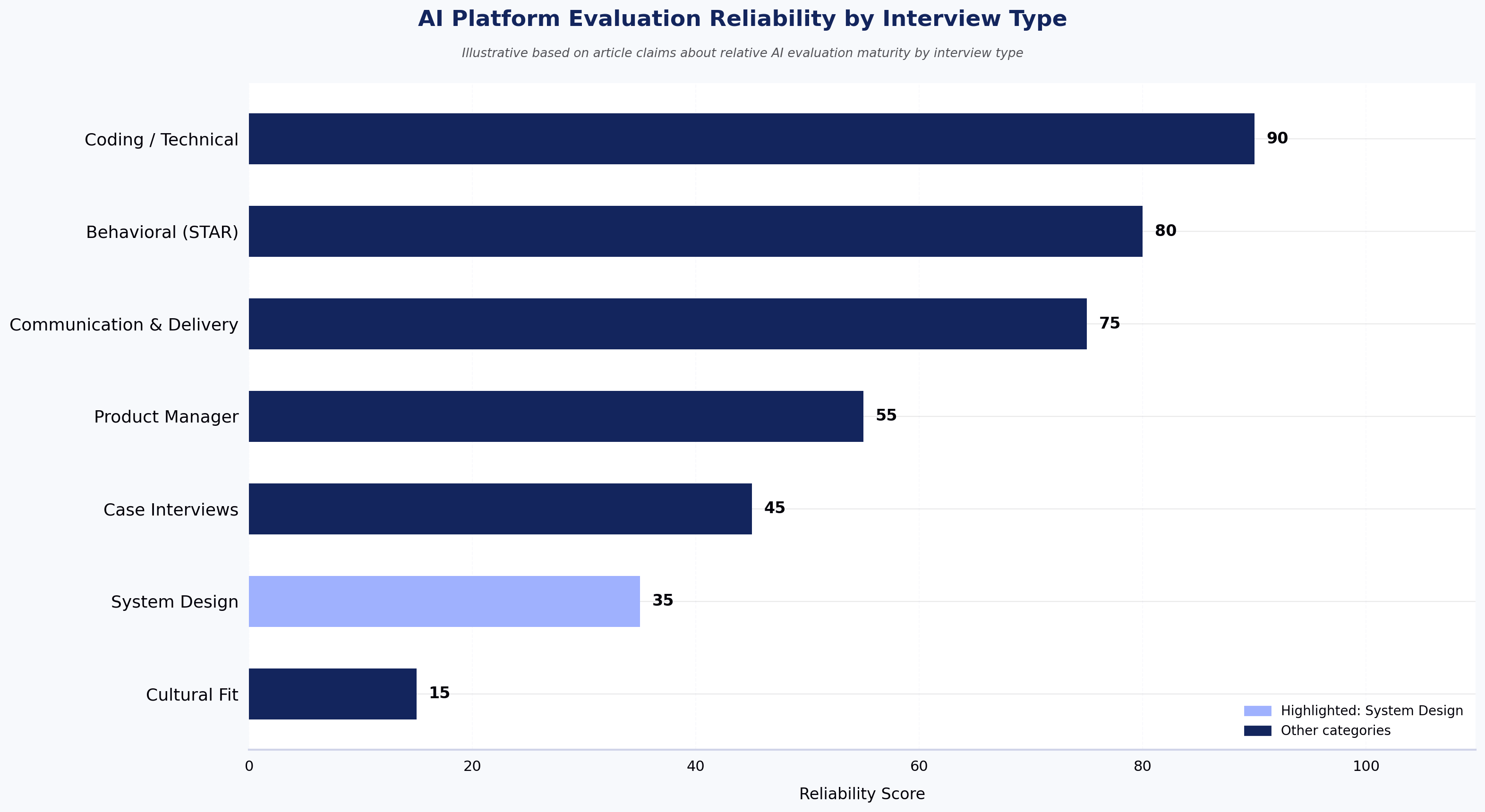
When AI Interviews Work and When They Don't: An Honest Breakdown by Role Type and Seniority

When AI Interviews Work and When They Don't: An Honest Breakdown by Role Type and Seniority

AI interviews work well for structured, rubric-driven screening of high-volume and mid-skill technical roles. They fail predictably when evaluation depends on judgment, context, collaboration, or organizational fit.

The honest answer to "when AI interviews work and when they don't" is simple: AI follows the rubric. If the rubric captures what matters for the role, AI interviews generate useful signal. If the role depends on context, judgment, or nuanced decision-making, AI interviews miss what matters most.

This guide is for recruiters, hiring managers, and talent acquisition leaders evaluating where AI interviews belong in the hiring process. It covers what AI interviews are, where they work best, where they fall short, how effectiveness changes by seniority level, and how to integrate them into a modern hiring workflow.

What Is an AI Interview?

An AI interview is a structured screening process conducted through software that asks standardized questions, evaluates responses against predefined criteria, and produces a consistent candidate assessment.

Most AI interview platforms include:

  • Automated questioning
  • Structured scoring rubrics
  • Video or voice interactions
  • Identity verification
  • Proctoring and integrity checks
  • Candidate ranking and reporting

The defining characteristic of AI interviews is consistency.

Unlike human interviewers, who may evaluate candidates differently depending on experience, fatigue, or bias, AI applies the same evaluation framework to every candidate.

The trade-off is straightforward:

  • Greater consistency
  • Less contextual judgment

AI interviews are not bias-free. Like any evaluation system, outcomes depend on training data, scoring logic, and rubric design. The goal is not eliminating bias entirely but reducing variability and improving consistency.

When AI Interviews Work

High-Volume Technical Screening

This is the strongest use case for AI interviews.

When organizations need to evaluate hundreds or thousands of candidates, consistency becomes more important than depth.

AI interviews can apply identical evaluation criteria across large applicant pools while significantly reducing recruiter workload.

Organizations conducting large-scale engineering recruitment often use AI interviews to maintain calibration across thousands of applications.

Campus and Early-Career Hiring

Campus hiring creates ideal conditions for AI screening:

  • Large candidate volumes
  • Clearly defined skill requirements
  • Standardized evaluation criteria
  • Structured hiring workflows

For organizations hiring hundreds or thousands of graduates annually, human-only screening is often impractical.

Mid-Level Individual Contributor Roles

AI interviews perform well for roles where expectations are well understood and measurable.

Examples include:

  • Backend Engineers
  • Frontend Developers
  • Data Analysts
  • QA Engineers
  • DevOps Engineers

For these positions, structured evaluation often produces reliable screening outcomes before human interviews begin.

Hiring Pipelines Impacted by Scheduling Delays

Interview scheduling remains one of the biggest causes of candidate drop-off.

AI interviews allow candidates to complete screening immediately rather than waiting days for recruiter availability.

For global hiring teams operating across multiple time zones, reduced scheduling friction can significantly improve candidate experience and pipeline speed.

When AI Interviews Don't Work

Senior and Staff-Level Engineering Roles

At senior levels, technical competence is only part of the evaluation.

Organizations need to assess:

  • Decision-making under uncertainty
  • System design trade-offs
  • Stakeholder management
  • Technical leadership
  • Long-term architectural thinking

These capabilities are difficult to evaluate through a fixed rubric.

AI interviews can validate technical fundamentals but should not replace senior-level technical discussions.

Leadership and Executive Hiring

Leadership hiring depends heavily on:

  • Strategic thinking
  • Organizational fit
  • Vision
  • Influence
  • Team-building ability

These qualities are highly contextual and difficult to standardize.

AI interviews should generally not serve as a primary evaluation mechanism for director, VP, or executive roles.

Culture-Driven Hiring

Some hiring decisions are fundamentally conversational.

Examples include:

  • Founding engineers
  • Startup leadership hires
  • Early-stage team members
  • Strategic partnership roles

In these situations, relationship-building and mutual assessment matter more than standardized scoring.

Live Collaboration Assessments

If collaboration is central to the role, collaboration should be part of the interview process.

Examples include:

  • Pair programming
  • Design reviews
  • Team problem-solving sessions
  • Cross-functional workshops

AI interviews can assess baseline competency, but live interaction remains essential.

Highly Contextual Non-Technical Roles

AI interviews struggle when success depends on:

  • Relationship management
  • Negotiation
  • Executive presence
  • Network-building
  • Client judgment

Roles such as enterprise sales, partnerships, executive recruiting, and senior customer success generally benefit more from human-led evaluation.

AI Interview Effectiveness by Seniority Level

The pattern across technical hiring is remarkably consistent.

Entry-Level and Fresher Hiring

AI interviews work extremely well.

Characteristics:

  • High applicant volume
  • Stable evaluation criteria
  • Structured skill requirements

Recommended approach:

AI Interview → Human Validation → Offer

Mid-Level Individual Contributors (L3–L4)

AI interviews work effectively as a first-round screen.

Recommended approach:

Assessment → AI Interview → Human Technical Interview

Senior Individual Contributors (L5)

AI interviews provide useful signal but should not determine hiring outcomes.

Recommended approach:

Assessment → AI Interview → Senior Panel Interview

Staff and Principal Engineers (L6+)

AI interviews offer limited value.

Evaluation should focus on:

  • Architecture
  • Decision-making
  • Leadership
  • Influence

Recommended approach:

Structured Human Panel Interviews

Managers and Directors

Behavioral interviews, leadership evaluations, and reference checks provide stronger signal than AI screening.

VP and Executive Roles

AI interviews are generally not recommended.

What This Means for the Hiring Process

The most common mistake organizations make is treating AI interviews as an all-or-nothing decision.

AI interviews are most effective when positioned as a stage within the hiring funnel rather than a replacement for human evaluation.

For many technical hiring programs, the ideal sequence is:

Skills Assessment → AI Interview → Human Technical Interview → Final Panel

In this model:

  • Assessments validate technical skills
  • AI interviews provide structured screening
  • Human interviews evaluate judgment and collaboration
  • Final panels determine overall fit

This approach combines scalability with human decision-making.

Frequently Asked Questions

Are AI Interviews Fair?

AI interviews generally provide more consistent evaluations than human screeners because every candidate receives the same questions and scoring criteria.

However, fairness depends heavily on:

  • Question design
  • Rubric quality
  • Calibration processes

How Do AI Interviews Handle Candidates Using AI Tools?

Modern platforms combine:

  • Identity verification
  • Proctoring
  • Screen monitoring
  • Dynamic follow-up questions

While no system is perfect, these measures significantly increase assessment integrity.

Can AI Interviews Replace Human Interviewers?

No.

AI interviews can replace or augment first-round screening for many technical roles.

They cannot replace human judgment for senior, leadership, or highly collaborative positions.

What Is the Biggest Risk?

False negatives.

Candidates with unconventional backgrounds or problem-solving approaches may not fit expected scoring patterns despite having strong potential.

Organizations should periodically audit rejected candidates to ensure the screening process remains effective.

How Long Should an AI Interview Be?

For technical screening, 30–45 minutes is typically optimal.

Interviews longer than 60 minutes often increase candidate drop-off without improving signal quality.

When Should Organizations Avoid AI Interviews Entirely?

Avoid AI interviews for:

  • Staff and Principal Engineers
  • Leadership Roles
  • Executive Hiring
  • Culture-Critical Positions
  • Low-volume hiring where personalized evaluation is feasible

Key Takeaways

  • AI interviews perform best for high-volume, structured technical hiring.
  • Campus hiring and mid-level technical roles are ideal use cases.
  • Senior, leadership, and culture-driven roles require human judgment.
  • The practical transition point is typically around the L5 level.
  • AI interviews should complement human decision-making, not replace it.
  • The primary value comes from consistent screening and reduced recruiter workload.

Next Steps

If you're evaluating where AI interviews fit within your hiring process, start by identifying which roles depend primarily on measurable skills and which depend on judgment, collaboration, and leadership.

The strongest hiring funnels combine assessments, AI screening, and human interviews in a sequence that matches the role being hired.

Pre-Employment Coding Tests: Recruiter's Guide 2026

Pre-Employment Coding Tests: Recruiter's Guide 2026

The U.S. Department of Labor estimates a bad hire costs at least 30% of the employee's first-year salary. For a $130,000 senior engineer, that is $39,000 before you account for lost productivity, team disruption, and the weeks spent restarting the search. Most of that risk traces back to a broken screening process: resumes that inflate skills, unstructured interviews that measure confidence over competence, and hiring decisions made on instinct.

Pre-employment coding tests solve this directly. A well-designed pre-employment coding test gives every candidate the same objective problem, evaluates the result against consistent criteria, and produces a defensible, data-backed signal before anyone has spent an hour of interview time.

This guide is for recruiters, hiring managers, and engineering leads building or refining a technical hiring process. It covers what coding tests are, how to choose the right format, how to design assessments that actually predict job performance, how to protect integrity, how to evaluate results fairly, and how to avoid the mistakes that turn a good testing program into a candidate drop-off machine. Note: this is a practical implementation guide focused on screening workflow; it does not exhaustively cover EEOC legal review, accessibility accommodations under the ADA, or multi-region data privacy compliance (GDPR, India DPDP, etc.). Consult qualified counsel for those areas.

What is a pre-employment coding test?

A pre-employment coding test is a standardized assessment given to job candidates before the live interview stage to objectively measure programming skills, problem-solving ability, and code quality. Candidates receive coding challenges on an assessment platform, write code in a real or simulated IDE, and results are scored automatically or reviewed by engineers against consistent criteria.

What every format shares is that it creates a concrete, reproducible record of what a candidate can actually do, rather than what they claim on a resume.

Types of coding tests used in hiring

The five main formats each serve different evaluation goals. Algorithmic coding challenges test data structure and problem-solving fluency under timed conditions. Project-based take-home assignments evaluate real-world code quality, architecture thinking, and documentation. Multiple-choice tests screen foundational language knowledge at high volume. Live coding interviews let interviewers observe how a candidate thinks in real time. Pair programming assessments evaluate collaboration alongside technical ability. Each format is covered in full in Step 2.

When pre-employment coding tests are not the right tool

Pre-employment coding tests are powerful for high-volume technical screening, but they are not universally appropriate. For highly specialized research roles (e.g., applied ML researchers, compiler engineers, cryptography specialists), a standardized challenge rarely captures the depth of the work, and a portfolio review plus deep technical conversation is typically a stronger signal. Internal transfers with documented performance histories generally should not be re-screened with the same assessment used for external candidates. Niche language experts or open-source maintainers with verifiable public portfolios may also be better evaluated on the artifacts they have already shipped. Scoping when not to test is part of designing a defensible hiring process.

Why pre-employment coding tests are critical for technical hiring

The problem is not a shortage of applicants: it is a shortage of reliable signal. Engineering roles take an average of 62 days to fill globally, according to Workable's 2024 benchmarking data, and roughly 70% of tech recruiters say they consistently receive unqualified applicants for every technical role they post, according to industry reporting from DevSkiller. Without a structured pre-hire coding challenge, teams discover skills gaps during live interviews, which is the most expensive point in the funnel to find out a candidate cannot do the job.

The research supports this directly. Schmidt and Hunter's 1998 meta-analysis, and the updated analysis by Schmidt, Oh, and Shaffer (2016), found that work sample tests have a validity coefficient of .33 to .54 for predicting on-the-job performance, substantially higher than education (.10) or years of experience (.18). A coding aptitude test is, by design, a work sample test. According to TestGorilla's 2025 State of Skills-Based Hiring report, roughly 85% of employers now use some form of skills-based hiring, up from 73% in 2023. The question is not whether to use coding tests. It is how to use them effectively.

Predictive Validity of Hiring Selection Methods
Source: Schmidt, Oh & Shaffer (2016); Schmidt & Hunter (1998)

Step 1: Define the role requirements and testable skills

The most common reason a pre-employment coding test fails to predict job performance is that it tests the wrong things, and that is entirely preventable if you start with a job analysis rather than a question library.

Work backward from what the engineer will do in their first 90 days. Identify must-have skills, where a gap disqualifies the candidate regardless of everything else, and distinguish them from nice-to-have skills that can be learned on the job. Map skills to test formats based on what each format can actually measure: algorithm design for backend roles, DOM manipulation for frontend engineers, API integration scenarios for full-stack developers. System design belongs in the live interview, not a pre-employment skills testing stage.

A skills matrix structures this before you build anything:

SkillPriorityTest FormatDifficulty LevelPython data structuresMust-haveAlgorithmic coding challengeMidREST API designMust-haveProject-based taskMid-seniorSQL query optimizationMust-haveCoding challengeMidGit workflowNice-to-haveMCQFoundationalSystem architectureNice-to-haveLive interviewSenior

The matrix forces alignment between engineering and recruiting before the test is built. It is also your first line of legal defense: tests traceable to specific job tasks are far easier to defend under EEOC scrutiny than tests assembled from a generic question bank.

Step 2: How to choose the right type of coding assessment

A pre-employment coding test that works well for junior backend hiring will actively mislead you when evaluating a senior full-stack candidate, and this is one of the most common and preventable process mistakes in technical hiring.

Multiple-choice questions (MCQs)

MCQs are useful as a first-pass filter for high-volume junior pipelines, but answering a multiple-choice question about recursion is not the same as writing a recursive function. Use them to screen out candidates who lack basic fluency before they invest time on a coding problem. Never use them as a standalone technical skills evaluation.

Algorithmic coding challenges

Algorithm tests are the most common format for backend and infrastructure roles, and the most misused. The well-documented limitation is that LeetCode-style challenges favor candidates who have practiced competitive programming, and senior engineers with real-world experience frequently underperform relative to their actual capability. Use algorithmic tests as one signal, not the deciding one.

Project-based and take-home assignments

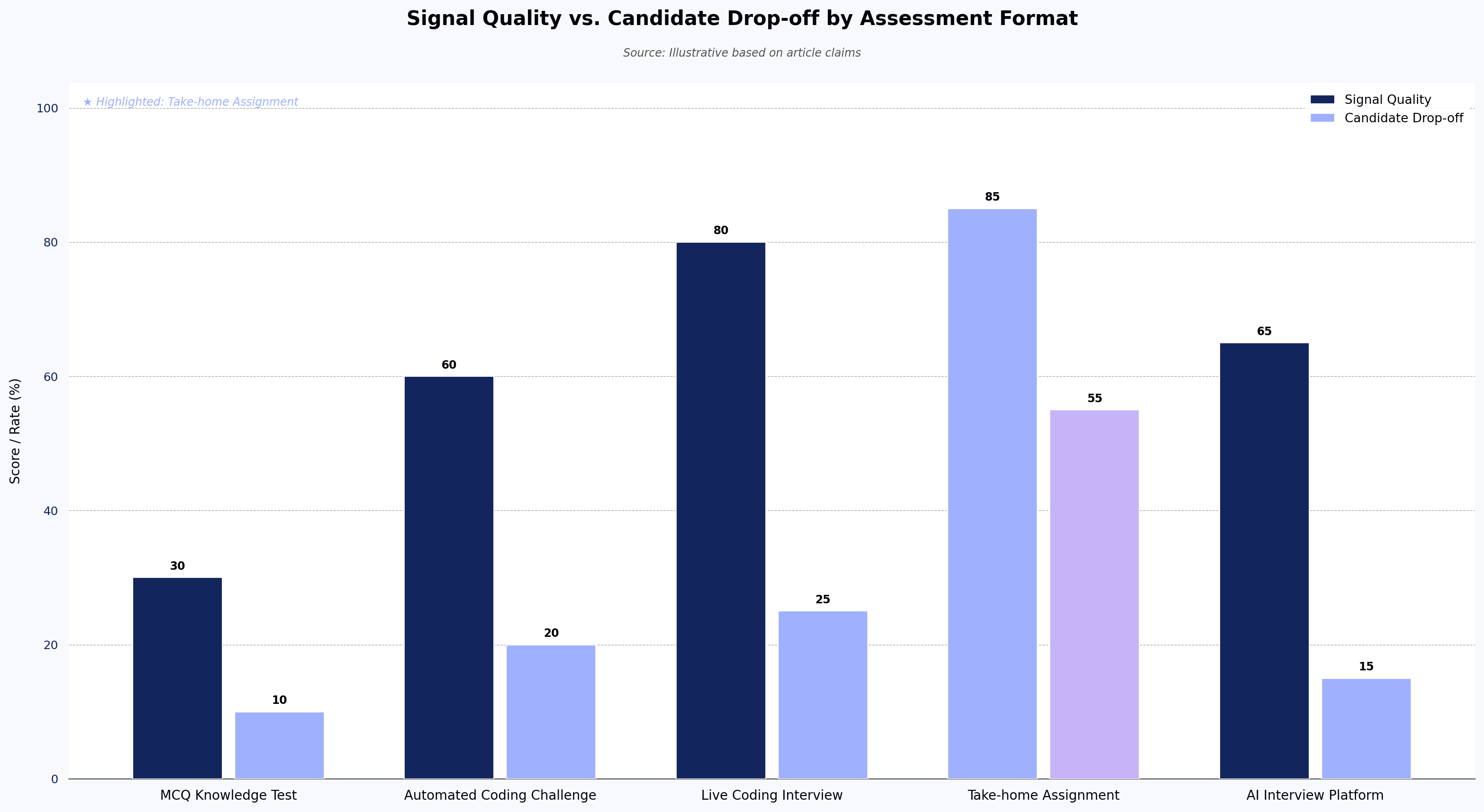
Take-home assignments produce the richest signal of any pre-hire coding challenge format because reviewers can see how a candidate structures a solution, handles edge cases, and documents their thinking. The tradeoff is that candidates with competing offers will not complete an assignment that feels open-ended or excessive. Keep scope tight, share the evaluation criteria upfront, and cap the expected time at two to four hours.

Live coding interviews

Live coding is best reserved for final-round evaluation, where observing thought process and debugging behavior in real time is worth the scheduling cost. Some strong engineers simply perform poorly when watched, so use this as a late-stage filter, not an early screen.

Pair programming assessments

Pair programming works well for collaboration-heavy teams and senior roles where working style matters as much as raw output. Scheduling complexity limits scalability, which makes it practical mainly for final-round or specialized role evaluation.

Assessment type comparison

Assessment TypeScalabilityRealismCandidate ExperienceEvaluation EffortBest ForMCQHighLowLow frictionLowHigh-volume, foundational screeningAlgorithmic ChallengeHighMediumMixedLow (automated)Backend, infrastructure, junior-to-mid rolesProject / Take-HomeLow-mediumHighHigh frictionMedium-highMid-to-senior, code quality focusLive CodingLowHighVariableHighFinal-round, process observationPair ProgrammingLowVery HighPositiveHighSenior, team-fit evaluation

Step 3: Select a coding assessment platform

Platform selection has downstream consequences for every hire you make, and a weak choice here creates friction at exactly the points where hiring speed matters most.

When evaluating coding assessment platforms, focus on criteria that are independent of any specific vendor: does the question library cover the languages and frameworks you actually hire for, or will your team spend weeks authoring custom content? Does the platform integrate natively with your ATS (Greenhouse, Lever, Workday, iCIMS), or will recruiters re-key candidate data? What signals does the proctoring system surface, and can you interpret them quickly when reviewing flagged sessions? Can you customize scoring rubrics for proprietary questions, or are you locked into the vendor's defaults? Does the reporting let hiring managers compare candidates against a cohort, or only against a static score? Capterra's 2024 candidate research, summarized in their job seeker survey coverage, found that around 58% of candidates used AI tools to complete assessments — making proctoring signal quality a load-bearing criterion, not a checkbox.

Different platforms make different tradeoffs here. Codility is widely cited for clean candidate-facing UX and a strong focus on engineering-team workflows. HackerRank has one of the deepest public question libraries and a large developer community footprint, which helps with content variety. TestGorilla's strength is breadth: multi-skill assessments that extend beyond pure coding into cognitive, personality, and role-fit testing, which suits generalist hiring.

HackerEarth, positioned as a skills intelligence platform, takes a different approach on integrity signal: rather than surfacing raw proctoring logs and asking recruiters to interpret them, the platform consolidates plagiarism, environment, and behavioral signals into a single per-candidate integrity output that recruiters can act on without forensic review — a tradeoff competitor platforms often leave to the reviewer. HackerEarth covers 40+ programming languages, supports 1,000+ skills across role types, and offers role-specific templates for frontend, backend, data science, and DevOps so hiring managers do not start from a blank slate. ATS integrations with Greenhouse, Lever, iCIMS, and Workday route results into the candidate record automatically. It is used by 500+ global enterprises including Google, Microsoft, Elastic, Flipkart, and Brillio.

Step 4: Design a fair, effective, and job-relevant pre-employment coding test

Platform selection is the infrastructure decision. Test design is the content decision, and most well-resourced technical hiring programs still underperform here.

Set the right duration

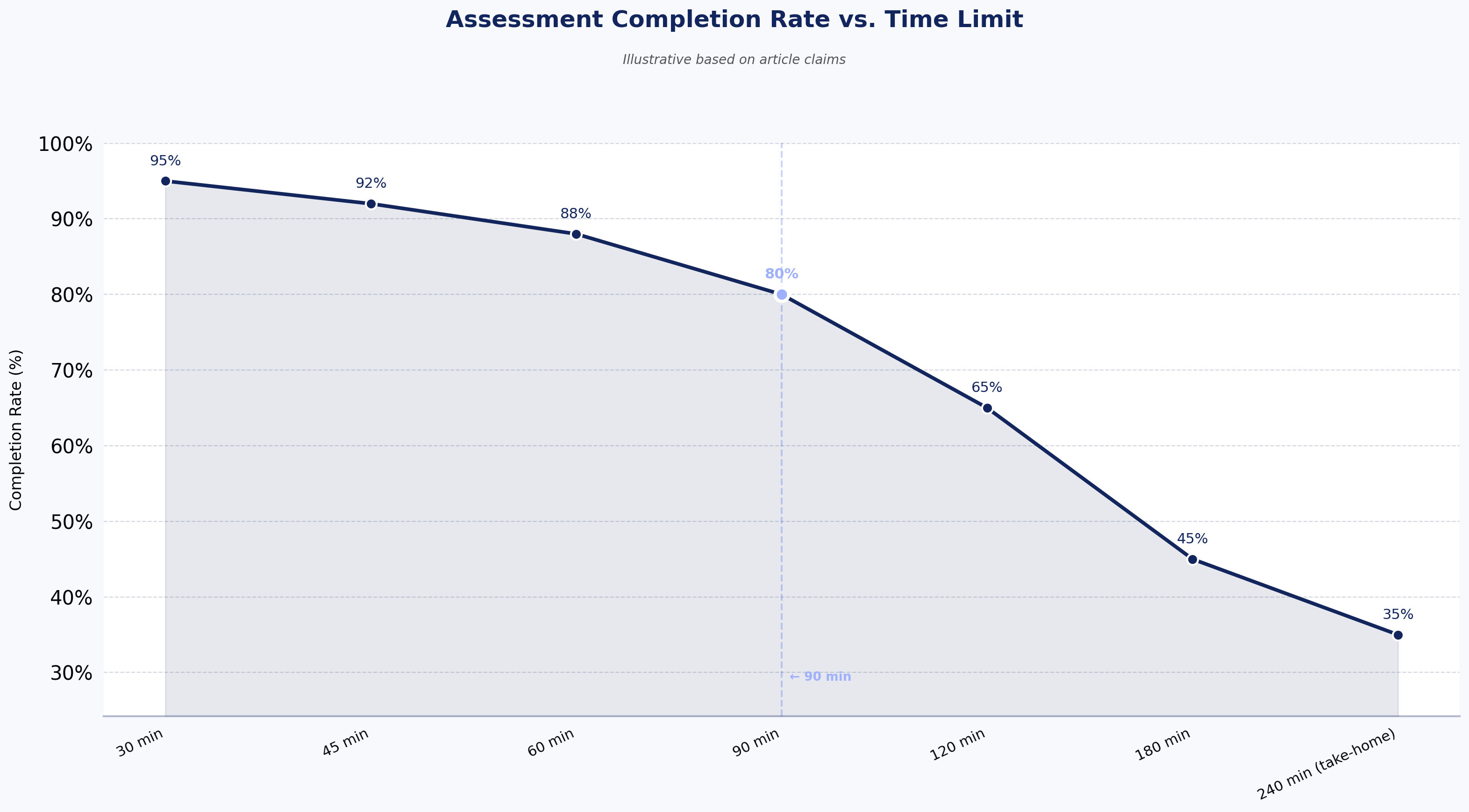
Forty-five to 90 minutes is the optimal range for a timed online pre-employment coding test. Below 45 minutes, complex challenges cannot be evaluated meaningfully. Beyond 90 minutes, completion rates drop sharply among senior candidates with competing offers. Take-home projects are the exception: two to four hours is acceptable when scope is explicitly defined and candidates know what "done" looks like.

Calibrate difficulty to the role

Testing a senior engineer on problems they solved in year one is the equivalent of asking a seasoned chef to boil water to prove they can cook. Define difficulty bands before building the test: Junior (0-2 years) needs language fundamentals and basic data structures; Mid-level (3-5 years) needs applied problem-solving and API integration; Senior (6+ years) needs system design judgment, code review, and performance optimization.

Mix question types strategically

One to two MCQs combined with one to two coding challenges produces a more accurate signal than either format alone. MCQs identify candidates who lack basic fluency before they invest time on a harder problem; coding challenges surface gaps that MCQ performance does not predict.

Reduce bias in test design

This is the area where most competitor guides stop short, and it is the most consequential one for both fairness and legal compliance. Avoid questions that require knowledge of specific cultural contexts, idioms, or domains that favor particular educational backgrounds. The test should measure coding ability, not cultural familiarity.

The EEOC's May 2023 technical guidance makes explicit that adverse impact and job-relatedness requirements under Title VII apply to algorithmic and AI-assisted selection tools. Any test producing a disproportionate pass or fail rate for a protected group must be demonstrably job-related and consistent with business necessity, or it creates legal liability.

Practical steps: document the link between each question and a specific job task before publishing the test; apply the four-fifths rule (if a protected group's pass rate falls below 80% of the highest-performing group's pass rate, investigate); and do not use LeetCode performance as a proxy for software engineering ability. Research, including work summarized in the ACM's review of technical interview practices, suggests the correlation between competitive-programming performance and real-world engineering effectiveness is weaker than commonly assumed. These tests can also systematically disadvantage candidates from non-traditional backgrounds who are strong practical engineers.

Step 5: Implement anti-cheating and proctoring measures

Skipping proctoring is not a neutral decision heading into 2026: it is a decision to accept that a meaningful portion of your results cannot be trusted. Capterra's 2024 candidate research reported that around 58% of candidates used AI tools to complete assessments, and the Identity Theft Resource Center's 2024 trends report documented that application fraud rose more than 118% between 2023 and 2024.

Effective remote proctoring for online assessments layers multiple signals: plagiarism detection that compares submissions against known published solutions and other candidates in the cohort, browser lockdown to block access to AI tools and search engines, webcam monitoring using computer vision rather than manual review, randomized question pools so candidates cannot share answers, and IP tracking to flag submissions from the same device.

The balance with candidate trust is real. Communicate proctoring measures in the assessment invitation, explain why they exist, and calibrate oversight to the role's sensitivity. Senior engineers view intrusive monitoring as a signal about organizational culture, and the employer brand damage from that reaction is harder to undo than the integrity risk you were trying to prevent.

Step 6: Evaluate results and make data-driven hiring decisions

A test score is not a hiring decision, and teams that treat it as one will make the same mistakes as teams that never ran the test at all.

Automated scoring vs. manual review

Automated scoring removes the variance that comes from different engineers reviewing the same submission with different standards. Rubric-applied evaluation is more consistent across candidates than human-led screens and does not vary by interviewer mood or fatigue, where variable naming style and code structure conventions can unconsciously influence how a reviewer rates competence. For mid-to-senior roles, combine automated scoring for correctness and efficiency with targeted manual review of code architecture and readability.

Build a scoring rubric

Every candidate should be evaluated against the same weighted criteria. A sample rubric:

CriterionWeightWhat to EvaluateCorrectness40%Does the code produce the right output across all test cases, including edge cases?Efficiency25%Is the time and space complexity appropriate? Are obvious optimizations made?Code Quality20%Is the code readable? Are naming conventions consistent? Is the logic well-structured?Edge Case Handling15%Does the candidate account for null inputs, boundary conditions, and unexpected states?

Set benchmarks and pass thresholds

An arbitrary cutoff like "everyone above 70% passes" is not a benchmark, it is a guess. Use percentile-based cutoffs calibrated to your actual candidate pool: the top 30% of submissions for a role type is a more defensible threshold than a static score. HackerEarth's reporting supports cohort-level comparisons so pass thresholds can reflect real performance distributions rather than guesses.

Avoid common evaluation pitfalls

Speed is not skill. A candidate who solves a problem in 30 minutes is not necessarily better than one who takes 60; penalize only when completion time indicates the candidate could not arrive at a solution, not because they were slower than average. A valid but unconventional solution is also not a failure: if the code is correct, efficient, and readable, the approach the candidate used tells you something positive about how they think.

Step 7: Communicate clearly with candidates before, during, and after

The developers you most want to hire have options, and a confusing or silent assessment process is enough to lose them to a competitor who treats communication as part of the job.

Provide timely, constructive feedback

Talent Board's CandE Benchmark Research consistently shows that candidates who receive feedback (even a rejection) rate the employer more favorably than those who receive nothing. In a market where roughly 61% of job seekers report being ghosted after an interview, per Greenhouse's 2024 candidate experience research, any communication at all is a differentiator. A note indicating the general area where a candidate did not meet the bar protects the employer brand and keeps the door open for future applications.

Set clear expectations for the interview stage

Tell shortlisted candidates what the live interview will cover before they arrive. The assessment invitation itself should include the expected duration, what to have ready, a description of what skills are being tested, the proctoring measures in use, the submission deadline, and a contact for technical issues.

Step 8: Integrate pre-employment coding tests into your hiring workflow

A pre-employment coding test produces its full value only when it sits in the right place in the funnel, and that place is stage two, after the resume screen and before any engineer's time is committed.

A typical technical hiring funnel with coding tests placed correctly:

ATS integration makes this practical at scale. Platforms that connect natively with Greenhouse, Lever, and Workday trigger assessment invitations automatically, route results back into the candidate record, and apply pass/fail logic without manual recruiter intervention. The long-term refinement loop matters as much as the initial setup: track which questions correlate with strong 90-day performance reviews and retire the ones that do not predict what you need them to predict. For deeper guidance on building this end-to-end, see HackerEarth's resources on skills-based hiring and technical interview design.

Common mistakes that undermine your coding assessments

Most assessment programs fail not because the platform was wrong but because of predictable process errors that go unexamined.

Testing skills that are irrelevant to the actual job. Every question should trace back to the skills matrix from Step 1. A puzzle that has nothing to do with the day-to-day work filters for interview prep performance, not job readiness, and strong candidates who recognize the disconnect opt out.

Making the test too long. Senior developers with multiple offers will not complete a three-hour screen before they have had any meaningful interaction with the company. Completion rates drop sharply past 90 minutes, and over-length tests produce more drop-off, not more signal.

Using a one-size-fits-all assessment for all roles and levels. A test calibrated for a mid-level backend engineer is wrong for a junior frontend hire and wrong again for a senior DevOps lead. Each role requires its own skills matrix and difficulty calibration.

Relying solely on automated scores without context. A candidate who scores 68% on a well-designed test may be significantly more capable than one who scores 75% on a poorly designed one. Scores are inputs to a decision, not the decision itself.

Not validating the test for adverse impact or job-relatedness. Failing to document the link between test content and job requirements, or failing to monitor pass rate disparities across demographic groups, creates Title VII liability under the EEOC's Uniform Guidelines on Employee Selection Procedures. This is the most consistently overlooked area in pre-employment testing programs.

Failing to iterate on test design. A coding test that was well-designed 18 months ago may now have its questions circulating on developer forums. Track the correlation between assessment scores and 90-day performance reviews; the questions that are no longer predicting performance are the ones to retire.

Frequently asked questions about pre-employment coding tests

Is a pre-employment coding test the same as a LeetCode-style interview?

No, and conflating the two is one of the most common reasons hiring programs underperform. A LeetCode-style problem is one narrow input — competitive-algorithm fluency under time pressure. A well-designed pre-employment coding test is broader: it can include work-sample tasks, debugging exercises, API integration scenarios, or framework-specific problems that resemble the actual job. The "test" is the design philosophy, not a specific question format, and the most effective programs deliberately move away from pure algorithm puzzles for non-algorithm-heavy roles.

How long should a pre-employment coding test take?

Forty-five to 90 minutes is the optimal range for a timed coding challenge; take-home projects should be capped at two to four hours with clearly defined scope. Senior candidates in particular will abandon anything that feels like an unreasonable time investment before a first interaction with the company.

Are coding tests a reliable predictor of job performance?

Work sample tests have a validity coefficient of .33 to .54 for predicting on-the-job performance according to Schmidt and Hunter's 1998 meta-analysis (and the 2016 update by Schmidt, Oh, and Shaffer), which is substantially better than education (.10) or years of expert

Top Products

Explore HackerEarth’s top products for Hiring & Innovation

Discover powerful tools designed to streamline hiring, assess talent efficiently, and run seamless hackathons. Explore HackerEarth’s top products that help businesses innovate and grow.
Frame
Hackathons
Engage global developers through innovation
Arrow
Frame 2
Assessments
AI-driven advanced coding assessments
Arrow
Frame 3
FaceCode
Real-time code editor for effective coding interviews
Arrow
Frame 4
L & D
Tailored learning paths for continuous assessments
Arrow
Get A Free Demo