Meta title: Skills-Based Hiring Rollouts: Why Most Fail at Month 18 Meta description: Skills-based hiring rollouts need rubric discipline, hiring manager buy-in, and honest metrics. Here's what breaks at month 18.
Primary persona: CHRO / Head of People Analytics (secondary: Head of Talent Acquisition) Read time: 7 min read
Skills-Based Hiring Rollouts That Actually Stick: Why Most Fail at Month 18
If you're a CHRO or head of people analytics who greenlit a skills-first hiring program 12 to 18 months ago, this article is for you. Skills-based hiring rollouts — the operational shift from credential-based screening to evaluated skill evidence — fail at month 18 for the same reason most HR programs fail: the launch was funded, the maintenance wasn't. The rubrics drift, the hiring managers ask for resumes again, and the CHRO who announced the program has moved on. What looked like a strategic shift becomes a slide in last year's board deck.
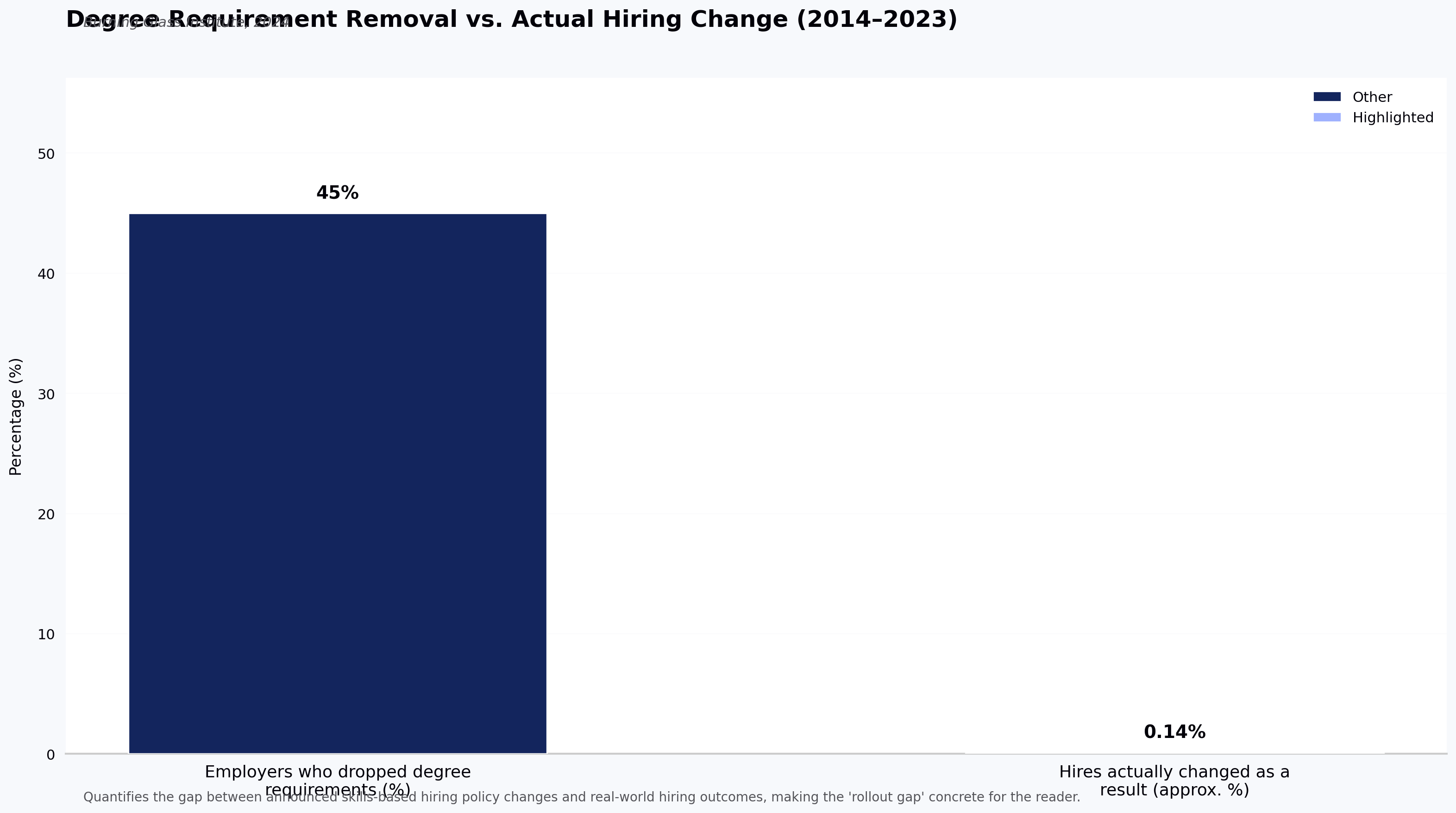
Skills-based hiring can work — when the rollout is maintained. The Burning Glass Institute's 2024 analysis of skills-based hiring practices found that while roughly 45% of employers dropped degree requirements between 2014 and 2023, only about one in 700 hires actually changed as a result (per Burning Glass Institute, "The Emerging Degree Reset," 2024; figure should be verified against the source report before republication). The rollout gap — announced versus operational — is where the money goes.
Why skills-based hiring rollouts fail at month 18
Month 18 is when the launch coalition thins out. The executive sponsor is on to the next initiative. The consultants are gone. The recruiters who were trained on the new rubric have been backfilled twice. The hiring managers who nodded through the town hall have quietly started asking for "resumes just to get a feel" — and no one is pushing back.
Three patterns show up in almost every failed rollout we've seen:
Rubric drift
The rubric was built once and never recalibrated. Skills evolve; the rubric didn't. By month 18, the criteria for a mid-level data engineer no longer match what the team is actually building.
Inconsistent evaluation
The evaluation was inconsistent from the start. Two panels, same candidate, different verdicts. When that happens twice in a quarter, hiring managers lose faith and default back to resume signals.
Activity metrics instead of outcomes
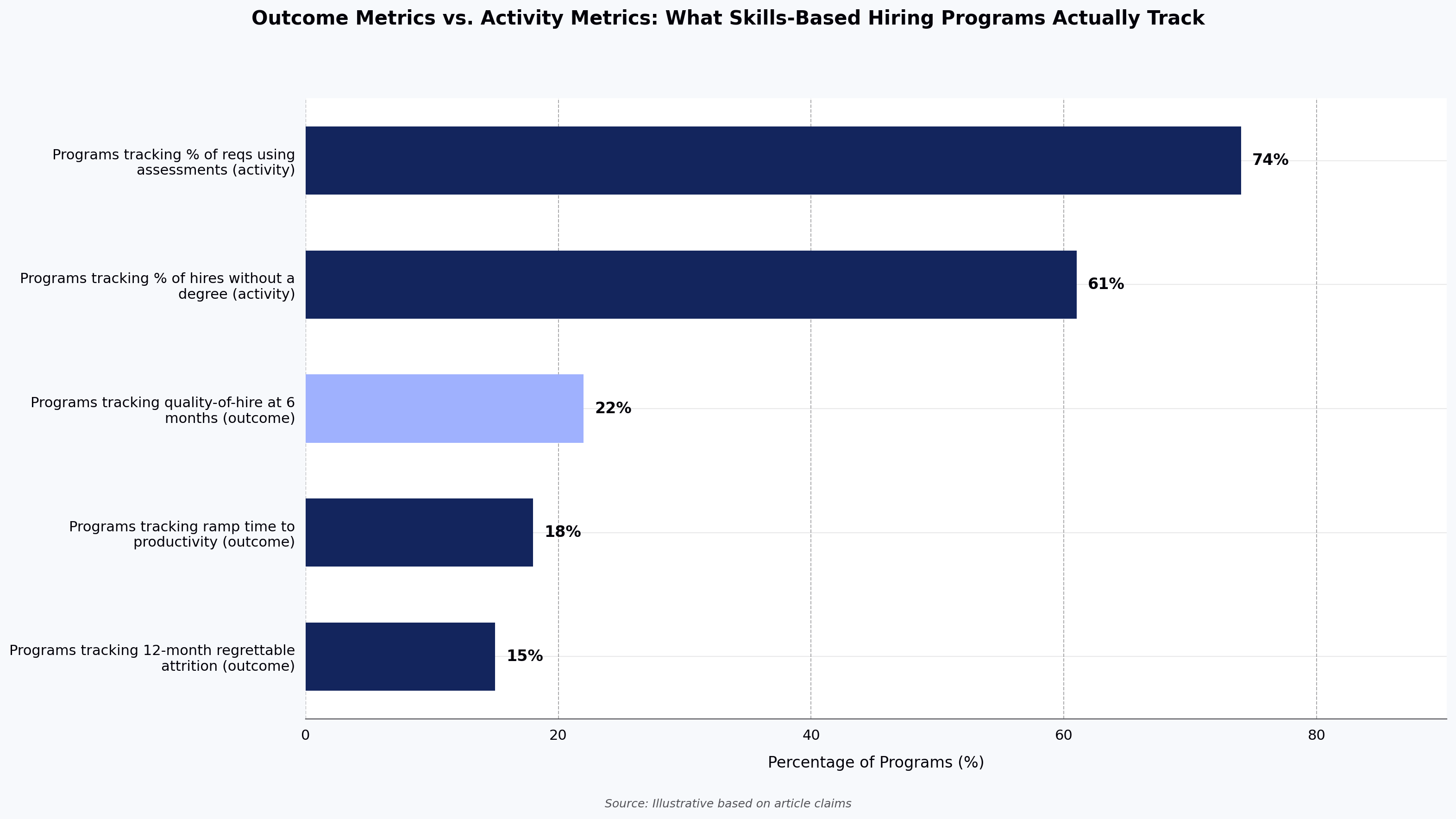
The metrics tracked activity, not outcomes. "Percentage of reqs using skills assessments" is an activity metric. Quality-of-hire at 6 months, ramp time to productivity, and 12-month retention are outcome metrics. Programs measured on activity die when activity dips.
What "skills-based hiring" actually means in practice
Skills-based hiring — also called skills-first hiring or competency-based hiring — means the hiring decision rests on evaluated skill evidence, not on proxies like degree, prior employer, or years of experience. In practice, that requires three things: a defined skill inventory for each role (often mapped against a taxonomy like O*NET or a SHRM competency model), a validated way to evaluate each skill, and a decision rubric that weights skills consistently across candidates.
Most rollouts get the first part right. They build a taxonomy — sometimes with a vendor, sometimes internally — and publish it. The second and third parts, along with the ATS integration work needed to actually route candidates through structured evaluation, are where things break down.
The rubric is the whole game
If a skills-first hiring program has a single point of failure, it is rubric discipline. A rubric that lives in a Notion doc, gets updated by whoever remembers to update it, and gets interpreted differently by every interviewer is not a rubric. It is a wish.
A working rubric has four properties:
- Defines evaluation method per skill. Each skill is tied to a specific method — assessment, structured interview question, or work sample — and the method doesn't change between candidates for the same role.
- Uses anchored scoring scales. Each skill has a scoring scale with written examples. "3 out of 5 on system design" means the same thing to every interviewer because there's a written description of what a 3 looks like.
- Passes two-reviewer calibration. Two independent reviewers score the same submission and land within one point on most items. In our experience, a working benchmark is roughly 80% agreement; below about 75% suggests the rubric is drifting, above 90% suggests you're underweighting judgment. (These are internal HackerEarth guidelines, not industry standards.)
- Gets reviewed quarterly. The rubric is revised on a regular cadence. Skills that no longer predict on-the-job performance come out. New skills go in.
The National Bureau of Economic Research's 2021 working paper on hiring and machine learning by Hoffman, Kahn, and Li examined how managers use — and override — structured evaluation tools, and found that discretionary overrides can degrade the gains from structured selection when overrides are frequent (readers should consult the paper directly; specific findings should be verified before citing). In other words, the rubric only works if it is enforced. That's the piece month 18 tends to lose.
Where hiring manager buy-in breaks
Hiring managers don't push back on skills-based hiring in the town hall. They push back on the third bad slate, when they're behind on their req and the recruiter shows them five candidates who scored well on the assessment but "don't feel like engineers."
Diagnosing the pushback
That feeling is usually one of two things: a rubric that's measuring the wrong signal, or a hiring manager who wants the resume back. Both are real problems and they require different responses.
Fixing a mis-calibrated rubric
If the rubric is measuring the wrong signal, fix the rubric. Pull the last 20 hires who cleared the assessment, look at 6-month performance, and see which rubric items actually correlated with outcome. Drop the ones that didn't. Add the signals your top performers share that the rubric missed.
Enforcing the program
If the hiring manager wants the resume back, that's a management problem, not a program problem. It gets solved by the head of TA and the CHRO agreeing on what's non-negotiable and enforcing it. Programs that let hiring managers opt out of the rubric on their reqs are not skills-based hiring programs. They are optional pilots with a marketing budget.
The AI-generated CV problem makes skills-first hiring more urgent
Resume signal was already noisy. AI-assisted CVs have made it noise-heavy. Any recruiter who has been in the pipeline for 12 months has seen the pattern: candidates whose written materials look strong, screen well on the phone, and then fall apart in a technical evaluation because the resume was generated and the phone screen was rehearsed.
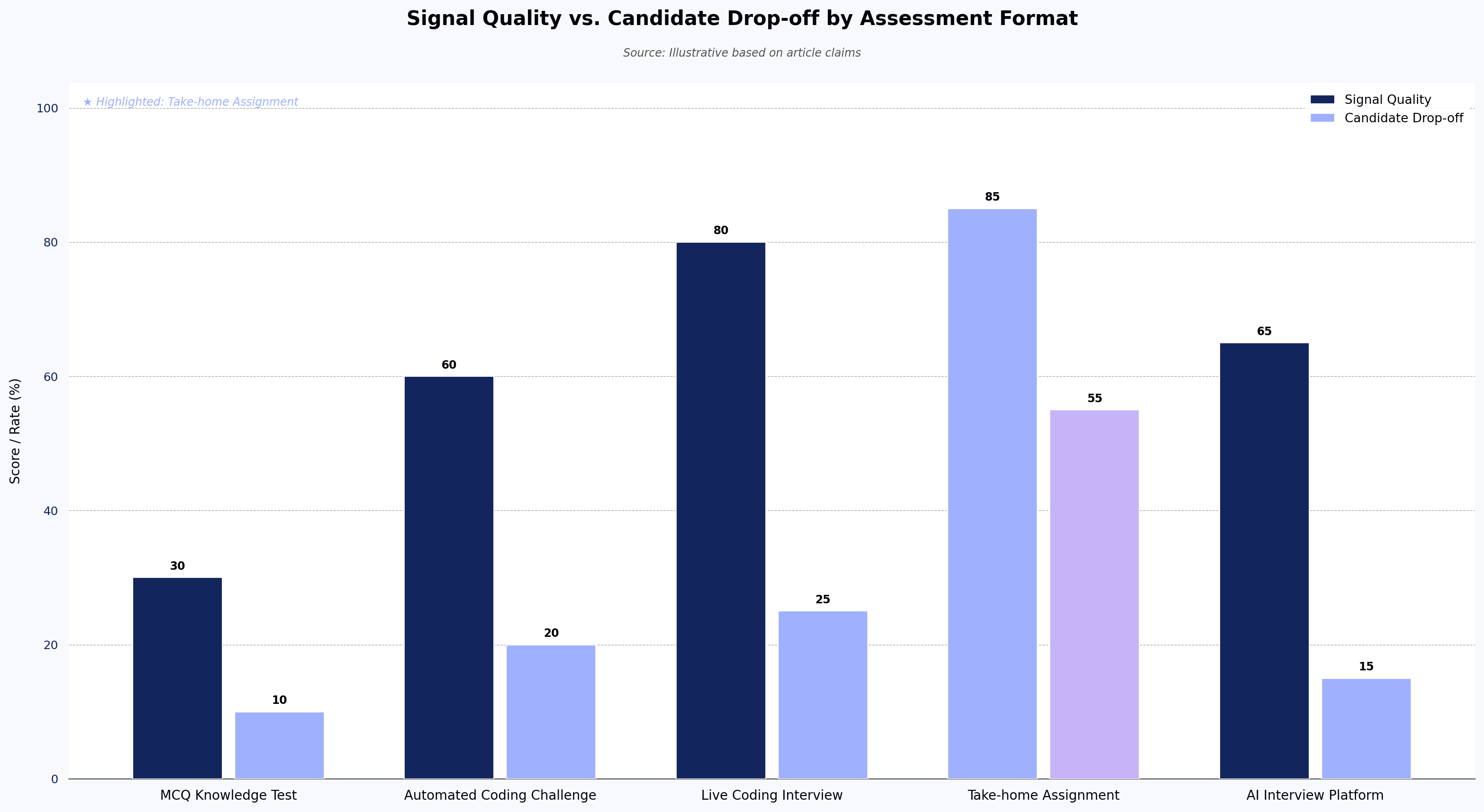
Competency-based hiring — done with evaluated skill evidence rather than self-reported credentials — is the response to that problem, not a cause of it. Structured assessments, live coding rounds, and identity-verified interviews all narrow the gap between what a candidate claims and what they can do. Programs that treat AI-CV detection as separate from skills-based hiring miss that they're the same problem.
For a deeper look at how the top of the funnel has shifted, see our guide on AI in recruitment and candidate assessment.
Metrics that keep skills-based hiring rollouts alive
Programs die when the metrics stop being watched. The metrics that keep a rollout alive share one property: they connect the hiring decision to a business outcome the CFO cares about.
The four we recommend tracking from month one:
- Quality-of-hire at 6 months. Measured by hiring manager rating on a fixed scale, not by "did they stay." A hire who stays and underperforms is not a quality hire.
- Ramp time to productivity. Number of weeks from start date to independent contribution, measured against a role-specific benchmark. Skills-first hiring should shorten this; if it doesn't, the rubric isn't finding the right skills.
- Rubric calibration rate. Percentage of candidates where two independent reviewers scored within one point. In our practice, below 75% signals drift; above 90% suggests underweighted judgment. Treat these as internal guardrails, not universal benchmarks.
- 12-month regrettable attrition. Hires the company wanted to keep who left within a year. Programs that raise this number are matching skills to jobs that don't exist.
Notice what's not on that list: number of reqs using the rubric, number of assessments administered, percentage of hires without a degree. Those are activity metrics. They are fine as internal health checks. They should not appear in the board deck.
What to do at month 12 to avoid the month 18 collapse
The best time to shore up a skills-based hiring rollout is roughly six months before it starts wobbling. At the 12-month mark, three moves buy you the next 18 months:
Recalibrate the rubric against outcomes
Pull the hires from months 1–9, look at their 6-month performance, and see which rubric items predicted it. Rewrite the rubric based on evidence, not on the original launch document.
Re-train the hiring managers
The ones who were trained at launch have forgotten most of it. The ones who joined since haven't been trained at all. A two-hour recalibration session with real candidate examples resets the muscle memory more than any policy document.
Publish the numbers internally
Quality-of-hire, ramp time, and rubric calibration rate should go to every hiring manager quarterly. Programs that stay measured stay funded.
For engineering hiring specifically, calibration gets harder at senior levels, where rubrics tend to fail first. Our writeup on technical hiring and assessment strategy covers what changes at staff-plus levels.
Where HackerEarth fits
Skills-first hiring rollouts need comparable signal at the top of the funnel and consistent evaluation deeper in. HackerEarth Assessments produces standardized skill signal across candidates by scoring against a library of validated technical tasks — meaning two candidates who took the same assessment produce directly comparable rubric inputs, not free-text panel notes. For the workforce view, SkillsGraph benchmarks workforce skills against global and industry standards and identifies AI-readiness gaps at the org level — the layer that translates individual hiring rubrics into a CHRO-facing skills map.
The tools make rubric discipline, hiring manager enforcement, and honest metrics easier to maintain. They don't create the discipline for you.
Frequently asked questions
How long does a skills-based hiring rollout typically take before it produces measurable results? Based on HackerEarth's work with mid-to-large hiring programs, expect roughly six to nine months for early signal on ramp time and rubric calibration, and 12–18 months for reliable quality-of-hire data. These are guideline ranges, not industry norms. Programs that promise results in the first quarter are usually measuring activity, not outcomes.
Do skills-based hiring rollouts work for senior roles? Yes, but rubrics fail at staff-plus levels for reasons that don't apply to mid-level roles. The most common failure modes: scoring anchors that don't discriminate between "senior" and "staff" because the anchor language is too generic; overweighting scoped technical exercises that don't test scope-setting or cross-team influence; and reviewer disagreement on ambiguous "judgment" items, which pulls calibration rates below usable thresholds. Structured skill evaluation should complement — not replace — judgment-based rounds at these levels.
What's the biggest hidden cost of a rollout? Rubric maintenance. Building the initial rubric is a one-time project; keeping it aligned with the skills your teams actually need is a permanent one. As a rough internal estimate, budget on the order of one FTE-quarter per year on recalibration for a mid-size hiring program — the actual figure depends on role count and hiring volume.
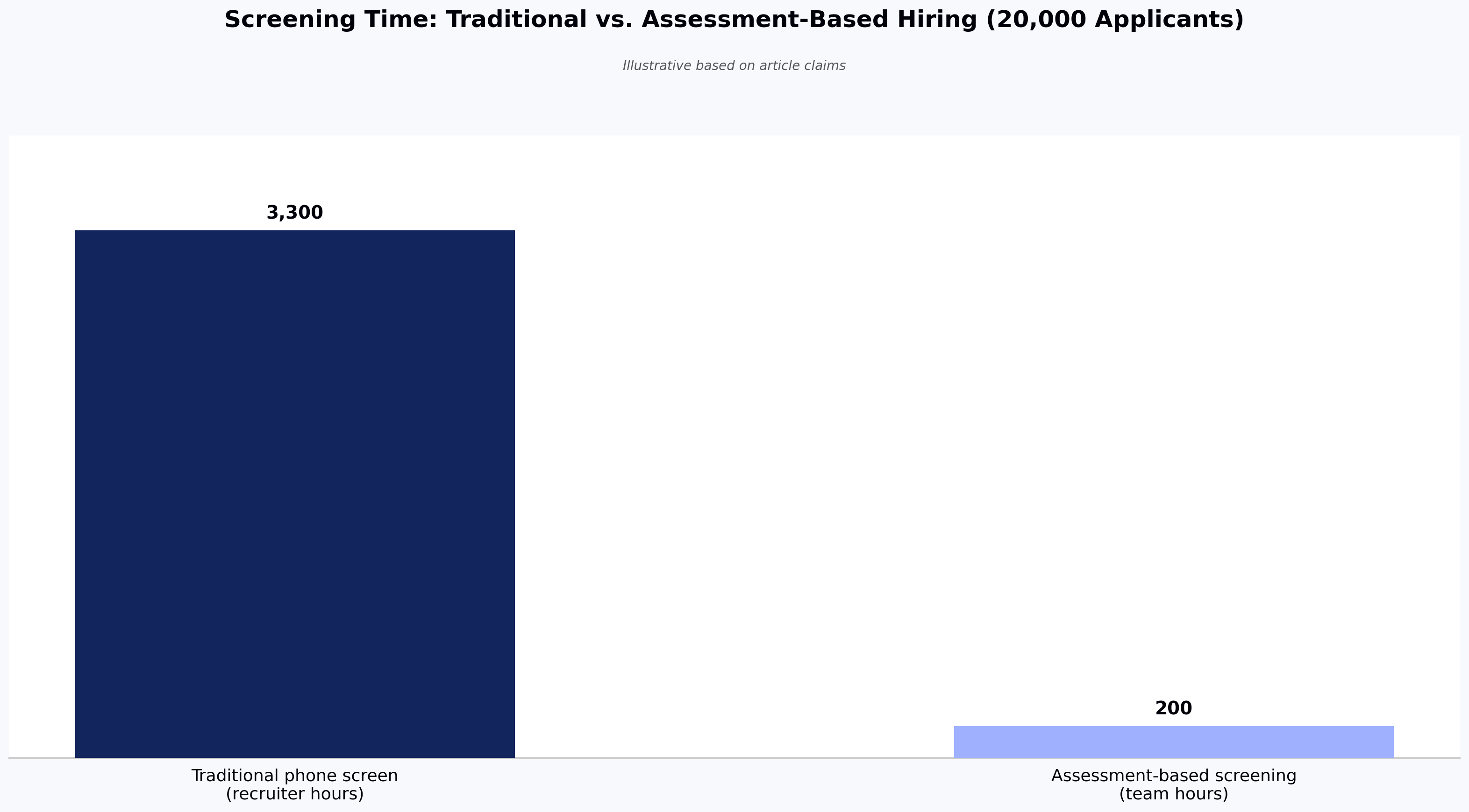
Can it reduce time-to-hire? It depends on role mix. For high-volume roles (e.g., early-career software engineering), automated assessments typically cut screening time meaningfully because unqualified candidates drop out before recruiter review. For low-volume specialist roles, added calibration and structured-interview time can lengthen the cycle — the net effect there is often flat or slightly negative. Model the mix before promising the CFO a time-to-hire number.
How do you get hiring managers to stop asking for resumes? You don't, entirely — and you shouldn't try. The goal is that resumes don't drive the decision, not that they're invisible. Programs that ban resumes outright tend to trigger the underground-resume workaround. Programs that make the rubric the decision layer while allowing resume context in the background hold up better.
Key takeaways
- Rollouts fail at month 18 because rubrics drift, hiring managers opt out, and metrics track activity instead of outcomes.
- The rubric is the whole game — anchored scoring, two-reviewer calibration, and quarterly recalibration are non-negotiable.
- Measure quality-of-hire, ramp time, calibration rate, and regrettable attrition, not the percentage of reqs using the assessment.
- Recalibrate at month 12 with outcome data from the first year of hires — not with the original launch document.
- The AI-generated CV problem makes evaluated skill evidence more urgent, not less; skills-first hiring is the response, not the risk.
See it in action
See how HackerEarth Assessments produce comparable skill signal for the roles you're hiring at scale. Request a product demo to walk through how assessments and SkillsGraph plug into your current hiring workflow.