5 Lessons From Running 200+ Remote Hackathons
Originally published: January 2021 | Last reviewed: 2025
2025 retrospective note: This article documents operational lessons from HackerEarth's 2020 remote hackathon program. The core mechanics — drop-off management, AMA structure, community-first sponsorship — still hold in 2025, but tooling (async judging platforms, AI-assisted evaluation) and participant expectations have evolved. Where 2020-specific data is cited, it is labeled as such.
A remote hackathon is a time-boxed online competition — typically 48–72 hours of active build time within a 2–4 week program — where developers build solutions to a defined problem statement, coordinate via chat and video, and submit work for judging without traveling to a physical venue. Remote hackathons became a mainstream talent engagement channel in 2020, and the operational playbook looks very different from in-person events. Over the course of that year, HackerEarth ran a reported 200+ remote hackathons for enterprise clients — spanning branding, crowdsourced innovation, internal upskilling, and technical hiring (event count reflects internal reporting and may vary by counting methodology). The lessons below distill what worked, what didn't, and where virtual formats still fall short. This piece is written for Innovation and DevRel leaders evaluating whether online hackathons belong in their 2025 community and engineering-brand strategy.
When COVID-19 shut down in-person events in early 2020, HackerEarth's hackathon calendar had to be rebuilt from scratch. The team moved the format online and closed the year with more than 200 remote hackathons delivered (see the 2020 recap). Here are five lessons from that year — and one section on where the format still underperforms.

Lesson 1: Remote hackathons let developers tackle real-world challenges at scale
Remote hackathons remove geographic barriers, letting a single well-designed innovation challenge attract developers from dozens of countries. In 2020, we saw this play out across public-interest themes: a Pride Circle hackathon on sexual expression rights, a COVID-19 mitigation hackathon, and a missing-persons hackathon (challenge pages are archived from 2020 and may have limited functionality). AI-assisted solutions submitted during pandemic-era hackathons contributed to broader industry efforts documented here.
The scale advantage compounds when the problem statement is well-scoped: our HackCovid challenge drew submissions from participants across multiple continents in under three weeks, and the missing-persons hackathon paired ML practitioners with a civic dataset most of them would never have encountered through commercial work. That kind of reach — subject-matter breadth plus geographic spread — is structurally difficult to achieve with a physical event of comparable budget.
How specifically to replicate this: pick a theme with clear societal or business relevance, publish a detailed problem statement 3–4 weeks before kickoff, and provide sample datasets or APIs so participants can start building on day one.
A contested take: for companies hiring fewer than 20 engineers per year, the ROI of a large public remote hackathon is almost never positive — the fixed cost of prize pools, promotion, and evaluation exceeds the incremental hiring value, and an invitation-only hiring challenge is a better fit. Public hackathons pay off for community and brand goals, not small-volume recruiting.
Lesson 2: Virtual hackathons work as branding, engagement, crowdsourcing, and upskilling tools — not primarily as hiring funnels
Remote hackathons are best deployed as community, branding, and upskilling programs, not as primary recruiting funnels. In 2020, most enterprise clients used remote hackathons for branding, crowdsourced innovation, or internal upskilling rather than external hiring. The Microsoft Azure hackathon we ran mid-lockdown, for example, was a developer-education and platform-awareness initiative designed to familiarize Java developers with Azure services. Hackathons can also offer a cost-efficient alternative to traditional in-person developer events, though comparative ROI depends on scale, prize structure, and post-event content reuse.
A product distinction matters here: HackerEarth Hackathons is designed for community engagement, crowdsourced innovation, and employer-brand goals, while Hiring Challenges is the product built specifically for recruiting funnels. Teams that expect a public hackathon to function as a primary sourcing channel typically get better results by running an invitation-only hiring challenge instead.
Lesson 3: Virtual AMAs work as workshop substitutes when restructured into shorter, interactive segments
Virtual AMAs (Ask Me Anything sessions) can deliver comparable learning outcomes to a day-long in-person workshop, but only when broken into shorter, interactive segments. In-person workshops benefit from unstructured hallway conversation and long-form deep dives; virtual sessions have to work around video-call fatigue, which many participants report setting in after roughly 45–60 minutes of continuous engagement (see Stanford's Virtual Human Interaction Lab research on Zoom exhaustion for the underlying mechanisms).
How specifically to adapt: replace one 6-hour workshop with three 45-minute AMAs spaced across the remote hackathon timeline. Provide the speaker's slides and a recorded primer 48 hours in advance so live time is spent on Q&A. Expect this format to extend total hackathon lead time by 5–7 days compared to an equivalent in-person event.
For a worked example, see how HackerEarth helped IBM run a hackathon across 10 countries — a multi-region program where the AMA cadence was the decisive lever on engagement.
Lesson 4: Communication discipline is the single biggest driver of remote hackathon completion rates
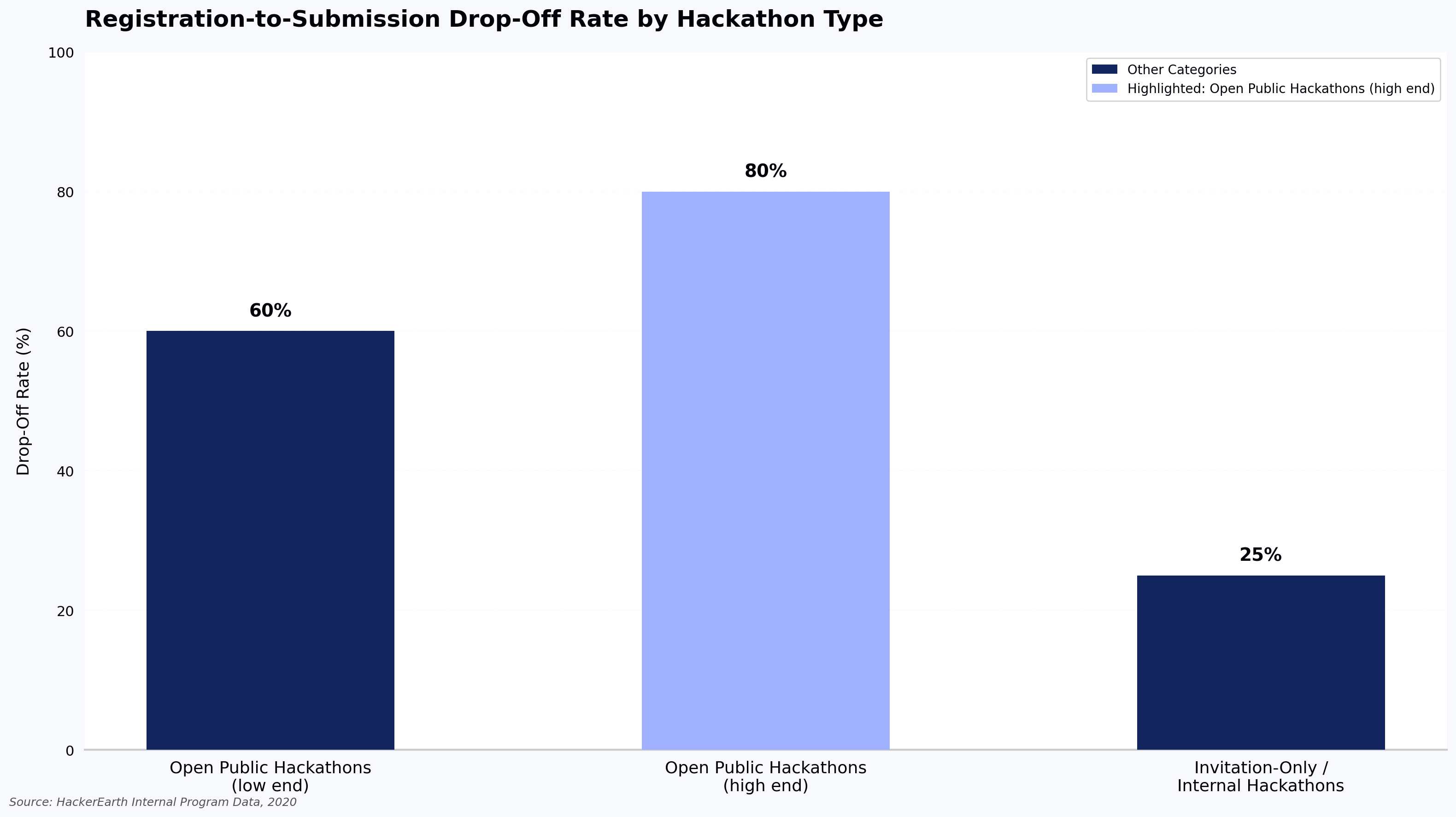
Drop-off is the defining risk of any remote hackathon, and structured lifecycle communication is the strongest lever teams have to reduce it. In-person events benefit from sunk-cost commitment (travel booked, hotel paid); remote events lose participants at every stage from registration to submission. Based on HackerEarth's internal observations across 200+ remote hackathons in 2020, open public hackathons commonly see registration-to-submission drop-off in the 60–80% range, while invitation-only and internal hackathons run materially lower.
How specifically to reduce drop-off: - Send at least 5 lifecycle emails: registration confirmation, kickoff reminder (24 hours prior), mid-event check-in, submission deadline warning (12 hours prior), and post-submission thank-you. - Publish precise event descriptions with problem statement, evaluation criteria, prize structure, and timeline visible on the landing page. - Use a shared Slack or Discord channel for participant Q&A during the build phase. - Assign a named event manager whose contact details are on every communication.
This approach helped us tailor events to community needs during the pandemic and maintain traction across both upskilling projects and hiring challenges.
Lesson 5: Community-invested brands see stronger developer recall in remote hackathons
Brands that invest in developer community — even without an active hiring need — tend to see stronger brand recall and higher-quality inbound interest when they later open roles. Across our 2020 program, sponsors who ran non-hiring innovation challenges frequently reported stronger inbound applicant interest when they resumed hiring in subsequent quarters, though the exact lift varies by program and we do not claim a controlled measurement.
Developers gravitate toward companies that treat them as a long-term technical community rather than a short-term hiring funnel. HackerEarth's 2020 Developer Survey surfaced sustained developer interest in employer-provided upskilling during the pandemic, consistent with the pattern of stronger downstream recall for brands that sponsored educational or open-innovation challenges.
The operational implication: run at least one community or upskilling challenge per year between recruiting cycles. A concrete example is a company running a quarterly internal ML hackathon alongside an annual public open-innovation challenge — the internal cadence maintains skill baselines, while the public challenge refreshes external visibility. Upskilling used this way strengthens the technical employer brand and keeps the top of the recruiting funnel warm between hiring cycles.
Where remote hackathons underperform in-person events
Remote hackathons are not a like-for-like replacement for physical events. Based on 2020 operational data, the format underperforms in-person hackathons in four specific areas:
- Spontaneous collaboration. Hallway conversations and impromptu team formation are difficult to replicate on video calls, even with breakout rooms.
- Network-building depth. Participants report shallower peer connections after virtual events; long-tail community follow-up is weaker.
- Hardware-dependent challenges. IoT, robotics, and hardware hackathons are difficult to run remotely without shipping kits, which adds cost and lead time.
- Judge–participant interaction. In-person judge walk-arounds surface project nuance that video demos flatten.
Teams choosing between formats should weigh these gaps against the reach and cost advantages of the remote model.
Key takeaways
- If you're a DevRel or Innovation lead planning 2025 activity, expect community and upskilling — not direct hiring — to deliver the strongest measurable returns on public remote hackathons.
- The next efficiency gain in reducing drop-off will come from tightening the mid-event window, not adding more emails; invest in async mentor coverage between kickoff and submission.
- Assume virtual AMAs will replace, not supplement, long-form workshops going forward — plan speaker time in 45-minute blocks by default.
- Treat community-first sponsorship as a lagging indicator: budget it 2–4 quarters ahead of the hiring cycle it is intended to support.
- Reserve in-person hackathons for the specific cases where they still outperform — hardware, deep-networking, and invitation-only formats.
Frequently asked questions
How do you run a remote hackathon? Running a remote hackathon requires a hosting platform, a clear problem statement, a 3–4 week promotion window, a defined timeline with kickoff and submission deadlines, an AMA or workshop schedule, and a named event manager. Most enterprise remote hackathons run 2–4 weeks end to end, with 48–72 hours of active build time.
What are remote hackathon practices that are less obvious than they look? The counterintuitive one: over-communicating during the build phase often backfires. Once participants are heads-down building, additional emails and Slack pings raise drop-off rather than lower it — the lifecycle emails that matter are pre-kickoff and pre-deadline, not mid-build. Similarly, larger prize pools do not linearly increase submission quality; above a threshold that varies by domain, they attract prize-hunters whose submissions dilute judging bandwidth. Scope-limit: these patterns hold for public open hackathons, not invitation-only internal events.
How do you keep participants engaged in a virtual hackathon? Engagement in virtual hackathons typically improves with a shared Slack or Discord channel, mid-event check-ins, mentor office hours, short AMA sessions, and visible leaderboards. Prize structures that reward participation milestones (not just winners) also reduce drop-off.
What is the typical drop-off rate for online hackathons? Based on HackerEarth's internal 2020 program data, registration-to-submission drop-off for open online innovation challenges commonly falls in the 60–80% range. Invitation-only or internal hackathons typically see materially lower drop-off, though specific thresholds depend on participant vetting and prize structure.
How much does it cost to run a remote hackathon? Costs vary widely by scale, prize pool, and platform. Typical enterprise remote hackathons range from a few thousand dollars for internal events to significantly higher budgets for global public challenges with large prize pools and heavy promotion.
When should you choose an in-person hackathon over a virtual one? In-person hackathons are the stronger choice for hardware-dependent challenges (IoT, robotics), events where deep peer networking is a stated goal, and smaller, invitation-only events where spontaneous collaboration matters more than reach.
Ready to plan a remote hackathon for your team? Schedule a demo with the HackerEarth hackathons team to walk through problem-statement design, participant sourcing, and evaluation setup.