It is easy to feel overwhelmed by how fast tech hiring is changing. New AI recruitment tools promise to screen candidates faster, smarter, and with less bias. It almost sounds like recruiters might be replaced.
But humans and technology make a great team, especially in hiring.
Codility is often the first choice for many teams. It is familiar, reliable, and widely used. But as hiring needs grow, recruiters start exploring Codility alternatives that offer more flexibility and better candidate experiences. At the same time, AI recruitment tools are changing how hiring works, helping teams move faster while making smarter decisions.
HackerEarth and Codility are two platforms that often come up in this conversation. This comparison will help you understand how they differ and which one best fits your hiring needs.
Overview of HackerEarth and Codility
Is there a way to see what a developer can actually do without sitting through endless interviews?
Resumes and phone screens can only tell so much, and even coding exercises on their own can miss how someone thinks and solves problems in real time. Luckily, the best developer assessment tools have made this process much easier. They give recruiters a way to see candidates’ actual skills without spending hours evaluating them.
HackerEarth and Codility help recruiters do exactly that. Both combine coding assessments, interview tools, and analytics to give a clear picture of a candidate’s capabilities.
What is HackerEarth?
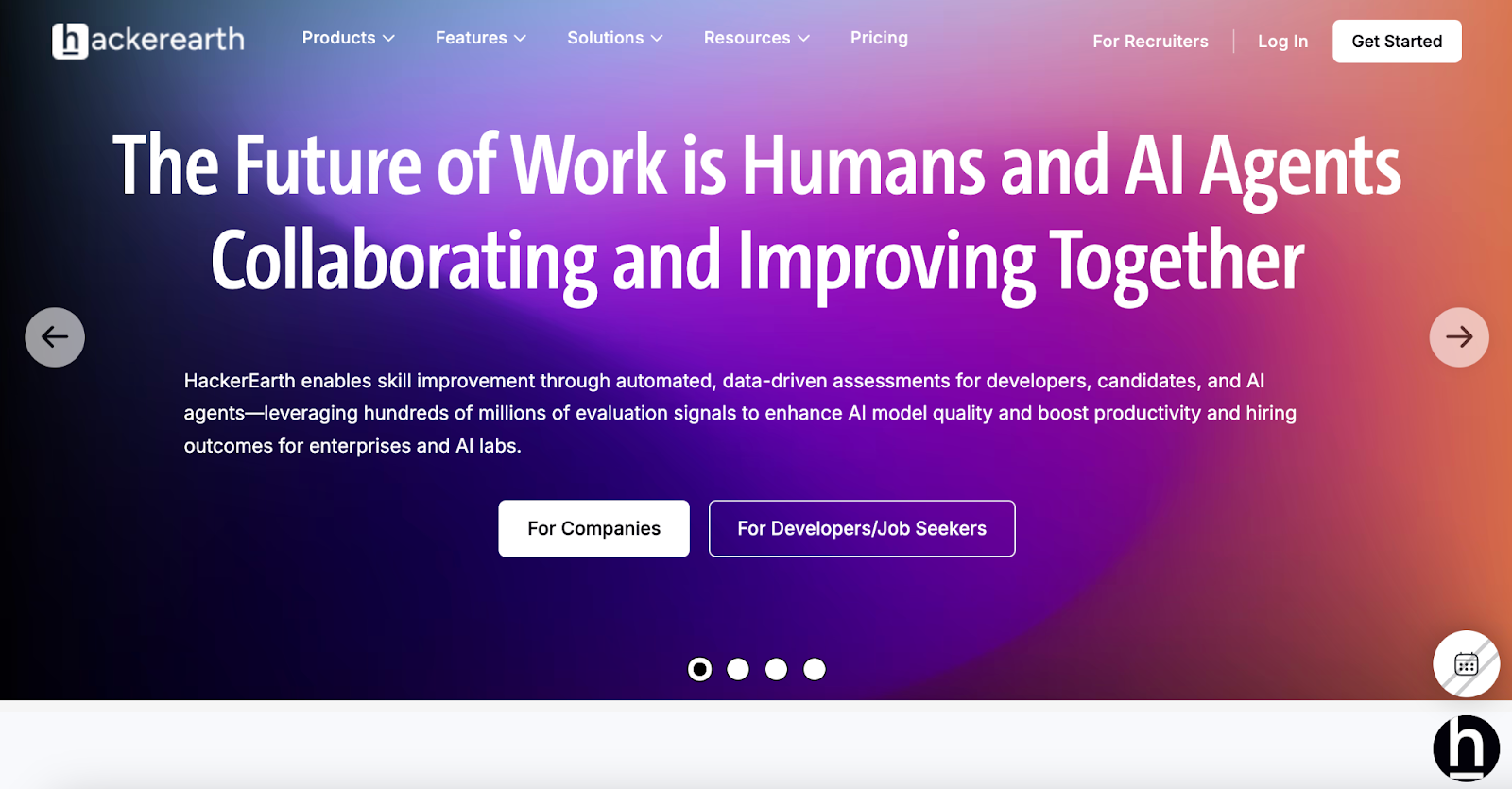
HackerEarth is an all-in-one AI tool for recruitment that combines coding tests with virtual interviews. It guides candidates from their first test to live interviews and final reviews, keeping the process simple for both recruiters and applicants.
Some of its main features include:
- Assessments: Pre-built or customizable coding tests with high reliability for large-scale hiring
- AI Proctoring: Smart Browser, webcam monitoring, audio tracking, and screen locking to maintain integrity
- FaceCode: Live video interviews with a built-in IDE for collaborative coding and system design tasks
- Question Library: Over 40,000+ questions covering multiple programming languages, full stack, SQL, and AI-driven tasks
- Analytics & Reports: Deep insights into candidate performance, plagiarism checks, and benchmarking
HackerEarth works well for small and mid-sized teams looking for a clear, organized recruitment pipeline.
What is Codility?
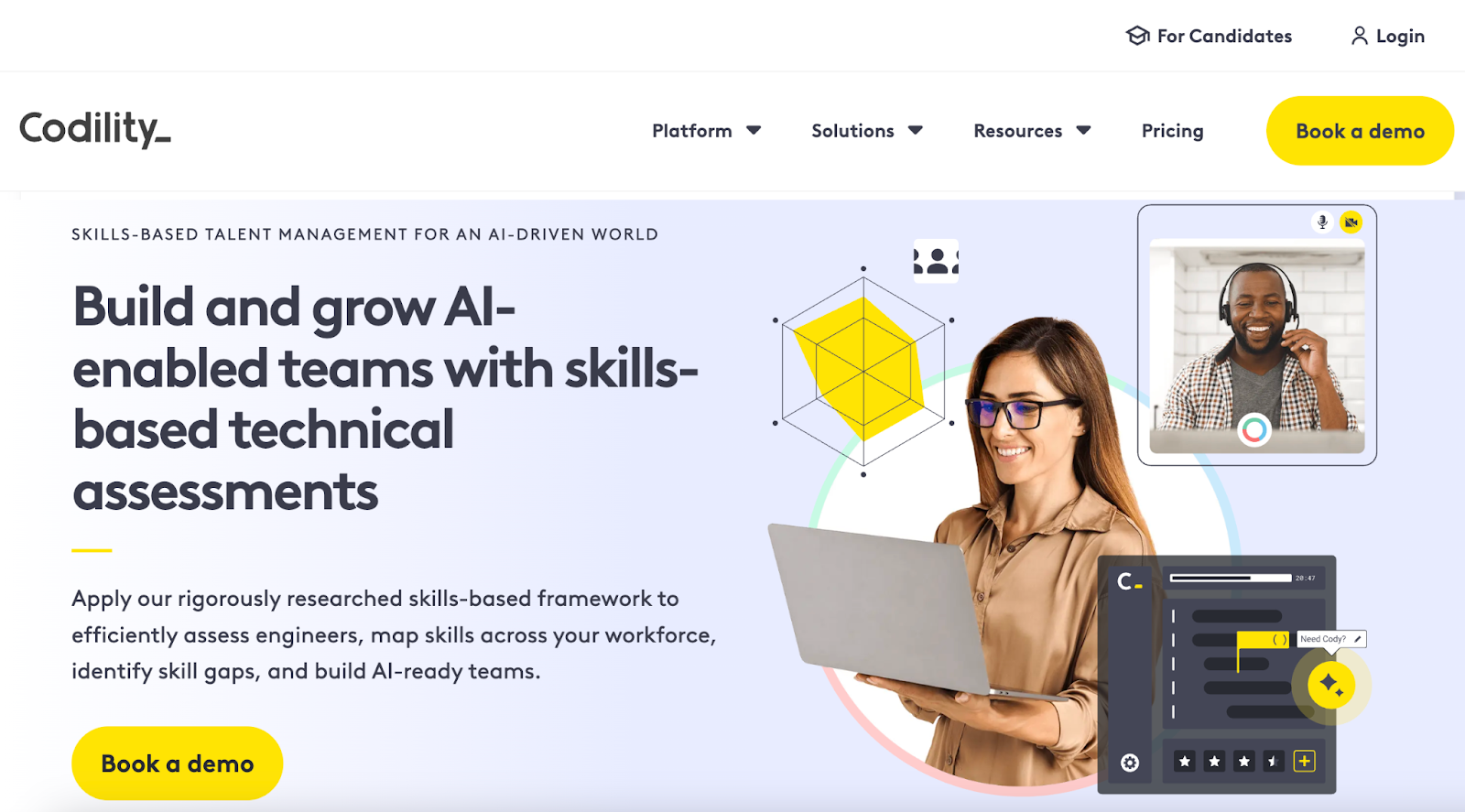
Codility helps companies build and grow AI-enabled teams through skills-based technical assessments. It gives recruiters a structured way to evaluate candidates’ engineering skills, map team capabilities, and spot skill gaps.
Its features focus on practical, real-world evaluation:
- Screen: Asynchronous, role-specific coding assessments to qualify top candidates efficiently
- Interview: Structured technical interviews to see how candidates perform in real-time
- Skill Mapping: Tools to identify skill gaps within teams and support targeted development or AI upskilling
Codility also brings AI tools for recruitment into the process, helping teams measure skills reliably and make faster hiring decisions. It combines assessment science with practical workflows to give data-driven insights without slowing down the hiring process.
Feature Comparison: HackerEarth vs Codility
Before we dive deeper, here’s a side-by-side comparison between HackerEarth and Codility across the features that actually shape your hiring process:
Key Benefits of HackerEarth and Codility for Tech Recruiters
To help you decide which platform best fits your hiring needs, we will explore the key features of both Codility and HackerEarth in detail.
Benefits of HackerEarth for tech recruiters
HackerEarth is built for teams that need a complete view of a candidate’s technical abilities without adding friction to the hiring process. It combines coding assessments, live interviews, proctoring, and analytics for technical screening into one platform, giving recruiters clear, actionable insights at every stage.
Here’s how:
Real-time, AI-assisted coding interviews
FaceCode is HackerEarth’s live coding interview tool. It allows recruiters to set up interviews, invite candidates, and collaborate on a real-time code editor. Each session automatically generates detailed reports that include technical performance as well as communication, problem-solving approach, and teamwork skills.
Recruiters can conduct panel interviews with up to 5 interviewers at once. FaceCode supports more than 40+ programming languages, making it easy to evaluate candidates regardless of their technical background.
At the same time, features like diagram boards let candidates walk you through system design thinking, which adds another layer to the evaluation. Then when the interview wraps up, recordings and transcripts stay accessible, so even if you revisit a profile days later, the full context is still right there waiting for you.
Customizable coding tests
HackerEarth’s recruitment assessment tool allows recruiters to design coding tests that match specific job roles. Recruiters can choose from a library of over 40,000 pre-built questions, covering programming languages, full-stack development, SQL, and AI-driven tasks.
As candidates start taking these tests, leaderboards automatically rank performance, so strong profiles start standing out almost immediately. This naturally leads to faster shortlisting, since you are no longer manually going through every submission.
What makes this even more useful is how closely these tests can mirror real work. Project-based questions let you see how someone approaches actual problems, not just textbook scenarios. Additionally, advanced proctoring ensures fair assessments, monitoring candidate activity to prevent impersonation, tab switching, or copy-pasting.
As results come in, detailed reports and code replays help you understand what the candidate wrote and even how they got there.
Seamless integrations
Once assessments and interviews start moving, the last thing you want is to keep switching between tools just to track progress. HackerEarth integrates with your existing workflow, so everything stays connected.
It integrates with major applicant tracking systems (ATS) such as Lever, Workable, JazzHR, Keka, and LinkedIn Talent Hub. This allows recruiters to send assessments, track candidate progress, and view performance reports directly within the ATS. The platform also provides robust APIs for custom integrations, enabling secure data transfer and flexible workflows.
Benefits of Codility for tech recruiters
If your hiring process needs consistency across roles, teams, or even regions, Codility leans heavily into structured evaluation.
Here are some of the features it provides:
Standardized assessments
Codility’s skills-based framework gives you a consistent way to evaluate candidates, which makes comparisons feel fair instead of subjective. As candidates move through screening and interviews, the platform keeps the same structure intact to connect every decision back to measurable skills.
This approach also extends beyond hiring. You can map skills across your existing teams, identify gaps, and plan training with the same data you used during recruitment.
Automated grading
The platform’s automated grading system evaluates candidate code for correctness, efficiency, and performance using hidden test cases. It instantly generates detailed reports with scores, time complexity analysis, and plagiarism detection. This eliminates the need for manual grading, allowing recruiters to assess large volumes of candidates without losing accuracy.
The platform also includes AI-assisted assessments that evaluate skills related to generative AI and modern engineering practices. This makes it easier to hire developers who can work with emerging technologies and build AI-ready teams.
Scalable solutions
With Codility, recruiters can test thousands of candidates at once and run remote interviews without compromising assessment quality. The platform supports performance-based evaluations that measure how well code handles large datasets and real-world conditions.
It includes enterprise-ready features such as ATS integrations, anti-plagiarism checks, and the AI assistant Cody, which helps recruiters assess how candidates collaborate with AI tools. These capabilities make Codility a strong solution for organizations that need to hire efficiently while preparing teams for future technology demands.
📌Suggested read: FaceCode vs. Traditional Coding Interviews: Why Live Code Testing Wins
Codility Alternatives: How HackerEarth Stands Out
Recruiters looking beyond Codility often find that HackerEarth offers more flexibility, smarter assessments, and a better candidate experience.
How does HackerEarth compare to Codility’s alternatives?
Here’s how HackerEarth compares to Codility's assessment features:
1. Proctoring that actually covers the full environment
Most platforms talk about proctoring, but HackerEarth goes deeper into how candidates behave during a test. It combines Smart Browser, AI snapshots, and surprise questions to keep a constant check on the environment without interrupting the flow.
This setup helps flag things like external AI tool usage, dual screens, or screen sharing as they happen. Codility offers proctoring, too, but it relies more on standard snapshots and video monitoring, which may miss certain unusual testing scenarios.
2. A much deeper question library
The difference in scale becomes obvious the moment you start building tests. HackerEarth gives you access to over 40,000 questions, including a strong set for niche areas like Selenium.
Codility, in comparison, offers around 850 tasks, which can start to feel limiting when you are hiring across multiple roles or seniority levels. This naturally affects how varied and role-specific your assessments can get over time.
3. AI evaluation for subjective answers
HackerEarth’s AI model evaluates long-form answers by comparing them against benchmark responses that you define. This means you can assess thought process, clarity, and depth without manually reviewing every response.
Codility does not support automated evaluation for subjective answers, which adds more manual effort as your hiring volume grows.
4. Better experience for data science roles
For data-heavy roles, the interface itself can shape how candidates perform. HackerEarth integrates Jupyter Notebook directly into the assessment environment, so candidates can work the way they normally would.
This makes the experience feel natural and reduces friction during the test. Codility offers an R-based simulator that works for specific use cases but lacks the flexibility needed for modern data science workflows.
📌Also read: Top 6 Online Technical Interview Platforms to Use in 2026
How to Choose the Right Technical Assessment Platform for Your Organisation
If you pick a recruitment AI tool only by ticking boxes on a feature list, you might miss how well it fits into your team’s workflow and hiring experience.
The right choice becomes clearer when you look at these practical areas:
Customization needs
Every role asks for something slightly different, and your assessment platform should reflect that without slowing you down. When you create automated assessments, you should be able to build them around real job requirements instead of adjusting roles to fit pre-built tests.
HackerEarth lets you pull from a large question library, tweak difficulty levels, and even add project-based tasks that mirror actual work. This makes your hiring process feel more aligned with the role, which naturally leads to better candidate evaluation.
Live vs. asynchronous assessments
Hiring rarely happens in one format, and your platform should support both without friction. At times, you want asynchronous tests to quickly screen a large pool, and at other times, you need live interviews to understand how a candidate thinks in real time.
HackerEarth bridges this gap through its assessment platform and FaceCode interviews, where candidates can code, explain, and collaborate in the same space. This continuity makes the transition from screening to interviews feel natural. For teams using recruitment tools for HR, this flexibility reduces back and forth and helps keep candidates engaged throughout the process.
Scalability
As your hiring needs grow, the process that once felt simple can become complicated. A good platform grows with you, so it should handle high candidate volumes without compromising evaluation quality.
HackerEarth supports large-scale assessments with automated ranking, detailed reports, and proctoring layers that stay consistent across all candidates. This helps your team focus on decision-making rather than on managing the process itself.
Similarly, built-in technical screening analytics give you a clearer view of your hiring funnel, which helps you refine your approach with every hiring cycle.
Integrations
Finally, the right platform should connect smoothly with your existing systems, especially your ATS. HackerEarth integrates with tools like Lever and Workable, which means you can create automated assessments, send them to candidates, and review results without leaving your core workflow.
This keeps everything in sync and reduces manual updates across systems.
📌Bonus read: How to Choose the Best Sourcing Tools for Your Recruitment Process
Which Platform Works Better for Your Team: HackerEarth or Codility?
In the end, the choice between HackerEarth and Codility comes down to how much depth and control you want in your hiring process.
HackerEarth brings together everything you need to create automated assessments, run live coding interviews, and evaluate candidates with AI-backed insights. In contrast, Codility offers a structured, consistent approach to technical screening that works well for teams seeking standardized evaluations across roles. Each platform brings value, though the experience they offer feels quite different once you start using them day-to-day.
If you are ready to rethink how you hire, now is a good time to explore what HackerEarth can actually do in a real hiring setup. Book a demo today and see for yourself!
FAQs
How does FaceCode by HackerEarth compare to Codility’s live coding interviews?
FaceCode by HackerEarth creates a more complete interview experience where candidates can code, explain, and collaborate in the same space. It adds AI-generated summaries and interview recordings, which help you revisit decisions later. In comparison, Codility also supports live coding, though it offers fewer insights after the session ends.
What are the benefits of using HackerEarth over Codility for coding assessments?
HackerEarth gives you a rich library of 40,000+ questions, deeper proctoring, and AI-based evaluation that goes beyond basic scoring. This helps you understand how candidates think, not just what they submit. Codility handles structured assessments well, though it offers less flexibility for role-specific or project-based evaluations.
Does Codility support AI-powered candidate matching like HackerEarth?
HackerEarth uses AI to evaluate responses, generate interview summaries, and add more context to each candidate profile. This makes it easier to compare candidates across multiple dimensions. Codility focuses more on structured scoring and performance analysis, and it does not offer the same level of AI-driven candidate evaluation or matching.
How does the pricing of HackerEarth compare to Codility?
HackerEarth offers clear monthly tiers, starting at $99, which makes it easier for smaller teams to get started and scale gradually. Codility follows a higher annual pricing model, starting at $1200 per user, which can feel more rigid for growing teams.
What types of coding assessments does HackerEarth support?
HackerEarth supports a wide range of assessments, including programming challenges, full-stack tasks, data science problems, machine learning, SQL, DevOps, and Selenium testing. It also supports subjective and project-based questions that help you evaluate real-world problem-solving and technical accuracy.