How to conduct coding interviews: a practical guide for hiring managers
Conducting coding interviews — the process of evaluating a developer's technical skill through real-time problem-solving — is one of the highest-leverage decisions a hiring team makes, and one of the most inconsistently executed. A poorly run interview costs engineering hours, damages candidate experience, and produces hires that don't perform. A well-run one gives you signal you can actually defend.
This guide covers what interviewers should prepare, how to structure the session, how to score fairly, and how tools like HackerEarth's FaceCode can support a rubric-driven process.
Note: This article covers how to run coding interviews as a hiring manager or interviewer. If you're researching coding interviews as a qualitative research method (e.g., structured content analysis in academic research), this guide won't cover that topic.
Why coding interviews go wrong
In our experience working with hiring teams across engineering organizations, three problems show up again and again:
1. Non-standardized, subjective evaluations due to lack of preparation time: From conversations with hiring managers and recruiters, many interviewers report starting prep only minutes before the interview begins. Candidate resumes are often skimmed just before the call. With little preparation, questions get pulled from a generic pool or invented on the spot — which means evaluation parameters aren't tied to the role. Independent guidance from engineering leaders such as Li Haoyi and Robert Heaton makes the same point: interviewer preparation, not candidate performance, is often the weakest link.
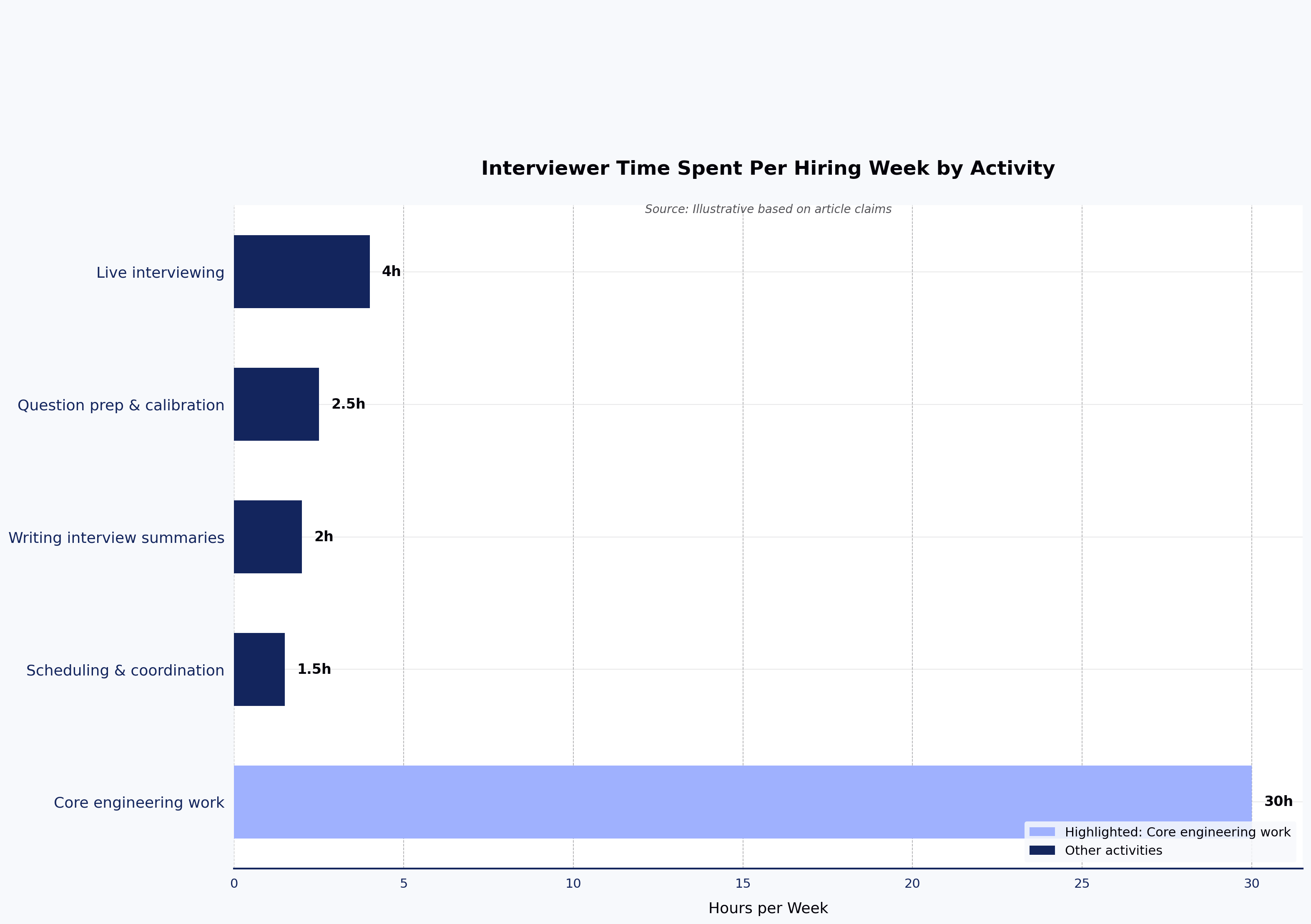
2. Time away from core engineering work: Finding good questions, calibrating evaluation criteria, and writing manual feedback takes hours. Hiring managers often spend a significant share of their week interviewing rather than shipping.
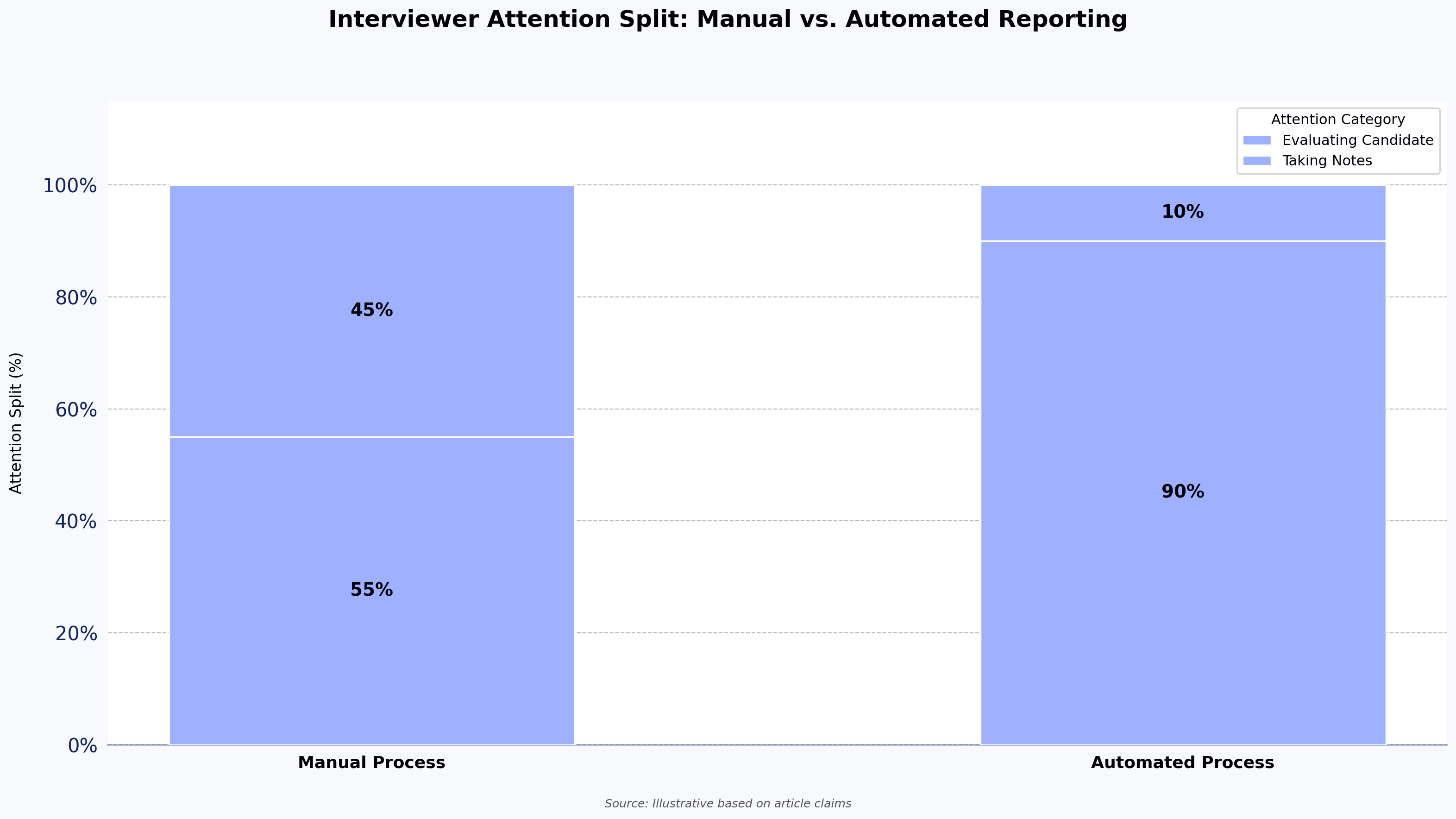
3. The pain of writing detailed interview summaries: Many hiring managers delay feedback until the last minute due to time crunch. Summarizing an hour-long conversation into succinct points requires patience and a good memory. When rushed, interviewers tend to fall back on "gut feel," which introduces inconsistency. The result: broken post-interview feedback and persistent miscommunication between recruiters and hiring managers.
How coding interviews are typically done
A standard coding interview runs 45–60 minutes and includes:
- Introductions and context-setting (5 minutes): Explain the format, what you're evaluating, and how the candidate should think out loud.
- Problem statement (5 minutes): Present the problem clearly. Encourage clarifying questions.
- Live coding (30–40 minutes): The candidate writes and runs code in a shared editor. The interviewer observes reasoning, not just output.
- Candidate Q&A and wrap-up (5–10 minutes): Let the candidate ask about the team, tech stack, or role.
The point is not to trick candidates. It's to see how they think, how they handle ambiguity, and whether their code works.
What to look for: a simple evaluation rubric
Interviewer-side guidance from top-ranking resources consistently recommends scoring against fixed criteria rather than overall impression. A workable rubric includes four dimensions:
- Problem understanding — Did the candidate clarify requirements before coding?
- Approach and trade-offs — Did they consider more than one solution and articulate why they chose one?
- Code quality — Is the code readable, tested, and reasonably efficient?
- Communication — Did they narrate their thinking and respond to hints without defensiveness?
Score each dimension 1–4 immediately after the interview. Aggregate scores across interviewers before making a decision.
How to select coding interview questions
Question selection is where most interviews go wrong. A few working principles:
- Match the question to the role. A backend engineer should not be quizzed on graph algorithms unless graphs are part of the job.
- Prefer problems the candidate can run and debug. Whiteboard-style puzzles filter for test-taking, not engineering.
- Avoid trivia. If the answer depends on memorizing a library method, it's testing recall, not skill.
- Calibrate difficulty. Run new questions past two internal engineers first. If they take more than 25 minutes, the question is too hard for a 45-minute interview.
Common frameworks candidates and interviewers reference
The 30-60-90 rule
The 30-60-90 framework refers to what a new hire is expected to accomplish in their first 30, 60, and 90 days on the job. In interviews, some hiring managers ask candidates to outline a 30-60-90 plan for the role. It's more common in leadership or senior IC interviews than in early-round coding screens.
The 5 Cs of interviewing
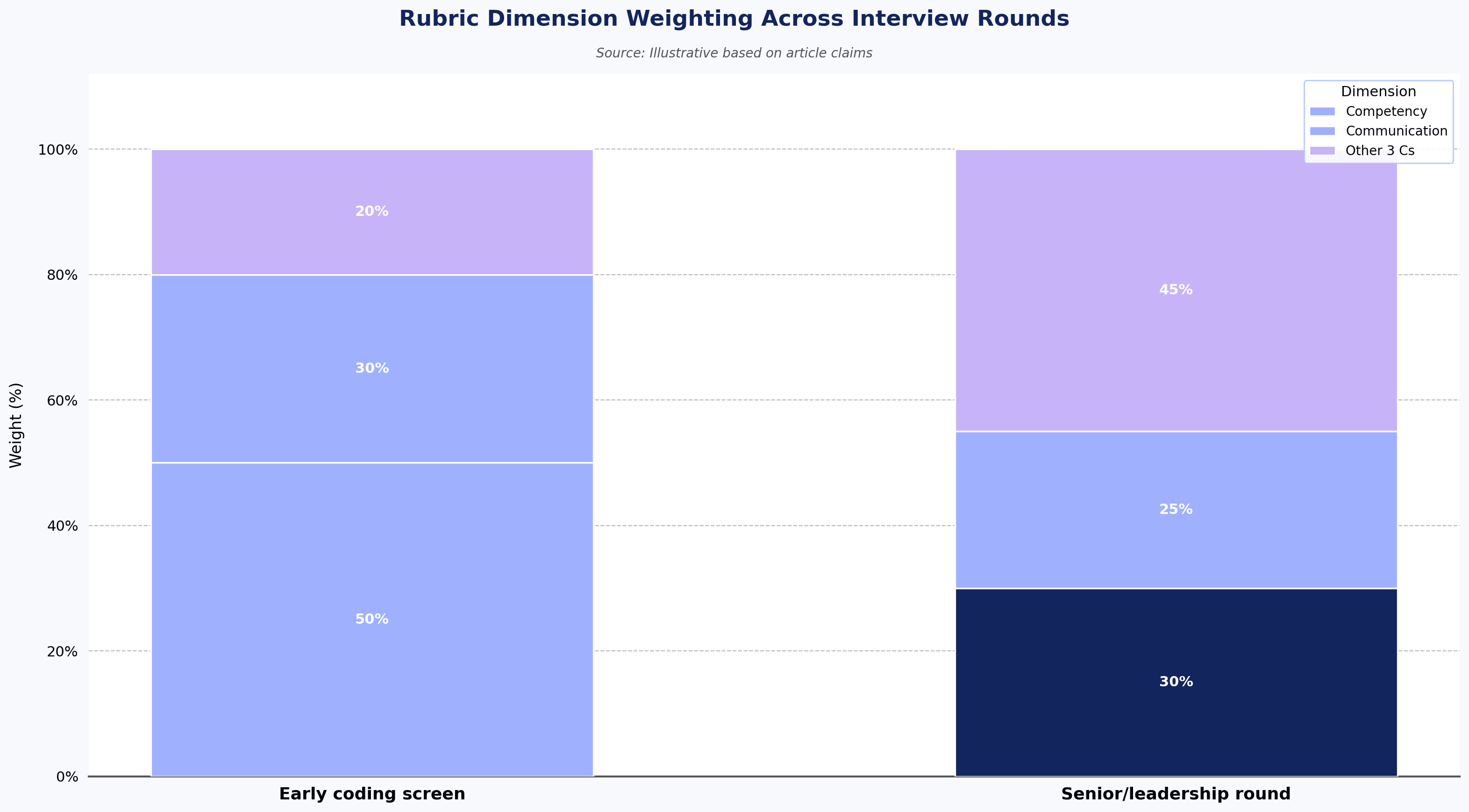
The 5 Cs are a widely cited framework for what interviewers should evaluate: competency, character, communication skills, culture fit, and career direction. In a coding interview, competency and communication carry most of the weight, but the other three matter in later rounds.
Is Cracking the Coding Interview still relevant?
Gayle Laakmann McDowell's Cracking the Coding Interview remains a widely used candidate-prep resource. The core patterns it teaches — arrays, strings, trees, dynamic programming — still appear in most technical screens. That said, many companies have moved toward practical, project-style problems, so interviewers should not assume all candidates have prepped from the same playbook.
Reducing bias in coding interviews
No process removes bias entirely, but structured practices can reduce interviewer reliance on candidate identity during evaluation. Research on structured interviewing — summarized by the U.S. Office of Personnel Management and echoed in SHRM guidance on reducing hiring bias — consistently finds that consistent questions, pre-agreed rubrics, and independent scoring reduce evaluator variance:
- Use the same question set and rubric across candidates for the same role.
- Score each rubric dimension before discussing the candidate with other interviewers.
- Where possible, obscure personally identifiable information (name, photo, school) during the technical evaluation stage.
- Debrief with a structured template rather than open-ended discussion.
Platforms designed for technical hiring can support these practices — for example, by providing structured scorecards and shared rubrics that keep evaluations consistent across interviewers.
Where a coding interview platform helps
Most of the above can be done with a video call and a shared document, but purpose-built tools reduce friction. A coding interview platform typically provides:
- A collaborative, real-time code editor with a built-in compiler. Candidates run and debug their code during the session, which aligns with the guidance from lihaoyi.com that whiteboard coding produces weaker signal than executable code.
- A curated question library. Reduces prep time and helps standardize difficulty across interviewers.
- A system-design canvas. Useful for senior roles where architecture discussion is part of the evaluation.
- Structured feedback templates. Prompts interviewers to score against the rubric rather than write freeform impressions.
HackerEarth's FaceCode is one option in this category and integrates with HackerEarth Assessments for teams that use online screening before the live interview.
Trade-offs to consider
No tool fits every team. Before adopting a coding interview platform, weigh:
- Cost. Dedicated platforms carry a per-seat or per-interview cost that small teams may not need.
- Learning curve. Interviewers need time to learn a new interface; expect a ramp period.
- Fit for role type. Platforms optimized for algorithmic coding may be less useful for design-heavy or systems roles where a whiteboard or Miro session works better.
- Candidate experience. Some candidates find video-based coding tools stressful. Communicate the format in advance.
FAQ
What is the 30-60-90 rule in an interview? It refers to a plan for what a new hire will accomplish in their first 30, 60, and 90 days. Interviewers sometimes ask candidates — especially for senior or leadership roles — to outline one during the interview.
Is Cracking the Coding Interview still relevant in 2026? Yes, for the fundamentals — though relevance varies significantly by company tier: FAANG and other large-scale employers still lean heavily on the algorithmic patterns it covers, while many startups and mid-size teams have shifted toward practical, project-style problems. The data structure and algorithm patterns it teaches still appear in most technical screens, but candidates should supplement it with practical coding practice and system-design study for senior roles.
What are the 5 Cs of interviewing? Competency, character, communication skills, culture fit, and career direction. In coding interviews, competency and communication carry most of the weight.
How are coding interviews done? Typically as a 45–60 minute live session where the candidate solves a problem in a shared code editor while the interviewer observes their approach, questions, and code quality. The candidate is scored against a rubric, and results are aggregated with other interviewer scores before a hiring decision.
Next steps
If you're refactoring your coding interview process, start with the rubric — not the tool. Once you know what you're measuring, evaluate whether a dedicated platform will save enough interviewer time to justify the cost.
To see how a structured coding interview platform works in practice, book a walkthrough of FaceCode or explore HackerEarth Assessments for pre-interview technical screening.