How to choose the best sourcing tools for recruitment process in 2025
Recruiters lose roughly a third of their week to manual profile searches, outreach copy-paste, and response tracking spread across half a dozen tabs — work that the best sourcing tools for recruitment process now automate end-to-end. Sourcing tools are platforms that find, enrich, and engage candidate profiles across job boards, professional networks, and niche communities before those candidates ever apply to a req.
There's a counterintuitive risk worth naming up front: sourcing tools often surface volume over fit unless your search criteria are tightly scoped to the role. More profiles in the funnel isn't the goal; more qualified profiles per hour of recruiter effort is.
Candidate sourcing tools shift the volume-over-fit problem. They automate discovery, improve shortlisting, and support outreach, so recruiters spend more time on candidate conversations and less on tab-switching.
In this guide, you'll learn how the best sourcing tools for recruitment process actually work in a recruiter's day, what features matter for different req types, and how to choose one that fits your pipeline.

What are sourcing tools and why do you need them?
Sourcing tools are platforms that find, enrich, and engage candidates before they apply. They sit upstream of your ATS, working across job boards, professional networks, and niche communities to bring qualified profiles into your pipeline proactively rather than waiting on inbound applications.
A recent survey shows that 58% of recruiters using AI find it most valuable for sourcing candidates — which tells you where the operational weight sits in most pipelines today.
Definition of sourcing tools
Candidate sourcing tools help recruiters find, engage, and qualify potential candidates before they apply. Instead of waiting for applications, these tools actively search across databases and platforms to surface relevant profiles against an open req.
They also enrich candidate data, which gives you context before reaching out. That makes outreach more specific and more likely to get a reply. Over time, this builds a stronger pipeline of candidates who actually match the role.
In short, sourcing tools help you find talent you'd otherwise miss and pull them into your funnel early.
Why are sourcing tools essential?
Inbound applications alone rarely fill a req on time, especially for niche or senior roles. Sourcing tools help you reach passive candidates who aren't applying but fit the role.
They also reduce screen time by automating searching, filtering, and shortlisting. Unverified vendor claims suggest teams using AI sourcing can cut time-to-hire substantially, though specific figures vary widely by team, tool, and role type and should be treated as directional rather than benchmarked. A faster process improves candidate experience and reduces drop-off.
The pipeline quality also improves: you see more candidates who match the req, which usually means fewer mismatches at the offer stage and a lower time-to-fill across the quarter.
Key features to look for in the best sourcing tools
The best sourcing tools for recruitment process should support how you source, evaluate, and engage talent — not just search. Here's what to look for:
AI matching and candidate screening
Strong platforms use AI to match candidates on skills, experience, and role fit instead of keyword overlap, which means fewer false positives in your shortlist.
LinkedIn's Future of Recruiting report notes that a growing share of talent teams are using AI for sourcing and screening, citing faster shortlisting as the primary value. Tools that surface ranked candidates with the why behind the match help recruiters defend shortlists to hiring managers.
When matching is tighter, the steps that follow get easier.
Multi-channel sourcing
Candidates don't sit in one place. The best tools pull from job boards (Indeed, Monster), professional networks (LinkedIn), and niche platforms (GitHub, Stack Overflow, Kaggle). That mix gives you both active applicants and passive candidates. For technical reqs, multi-channel sourcing pairs naturally with skills-based screening so you can validate the profiles you find before moving them to interview.
Candidate engagement automation
Finding a candidate is step one; the response rate is what makes or breaks the pipeline. Good sourcing tools support personalized outreach, sequenced follow-ups, and reply tracking without forcing recruiters to manage email threads manually. Faster, more relevant follow-ups generally lift reply rates.
Integration with your ATS and other recruitment platforms
Sourcing has to feed your ATS cleanly, otherwise you're rebuilding records by hand. The best platforms connect with systems like Greenhouse, Lever, Workday, and SAP so candidates move through stages with their data intact and audit trails preserved.
Top AI sourcing tools for recruiting
Here are three widely used third-party tools and how they support different sourcing needs. Each one comes with trade-offs — there's no single tool that solves every req type.
1. Fetcher
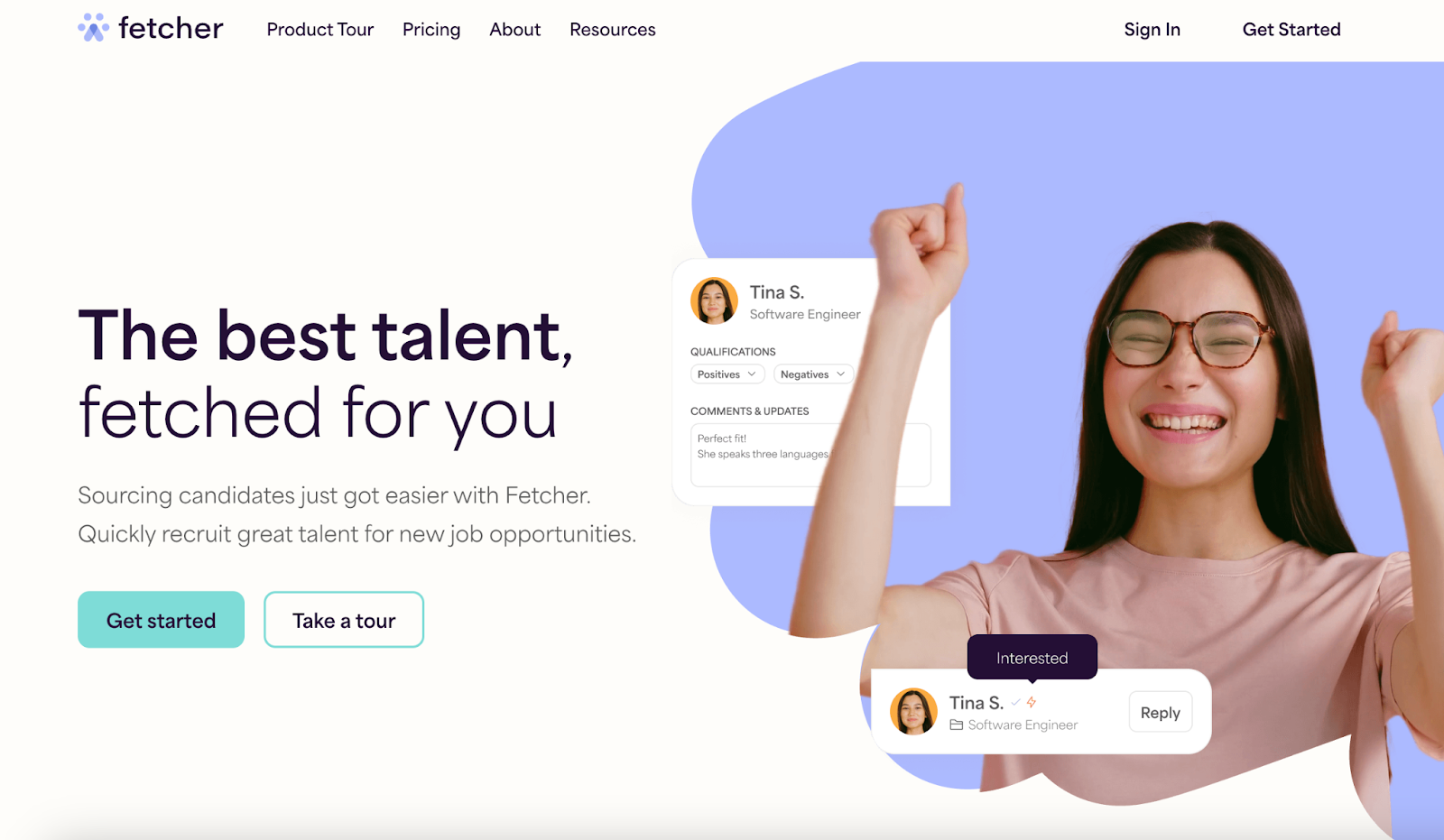
Source candidates with Fetcher
Fetcher automates outbound sourcing so recruiters spend less time searching and more time engaging. It combines AI shortlisting with human review, supports personalized email sequences, and tracks responses. Pipeline management and diversity-focused sourcing are built in.
Trade-off: Fetcher leans heavily on outbound email workflows, which works for proactive sourcing but offers less depth for teams that need technical evaluation or live interview workflows in the same tool.
2. HireEZ (formerly Hiretual)
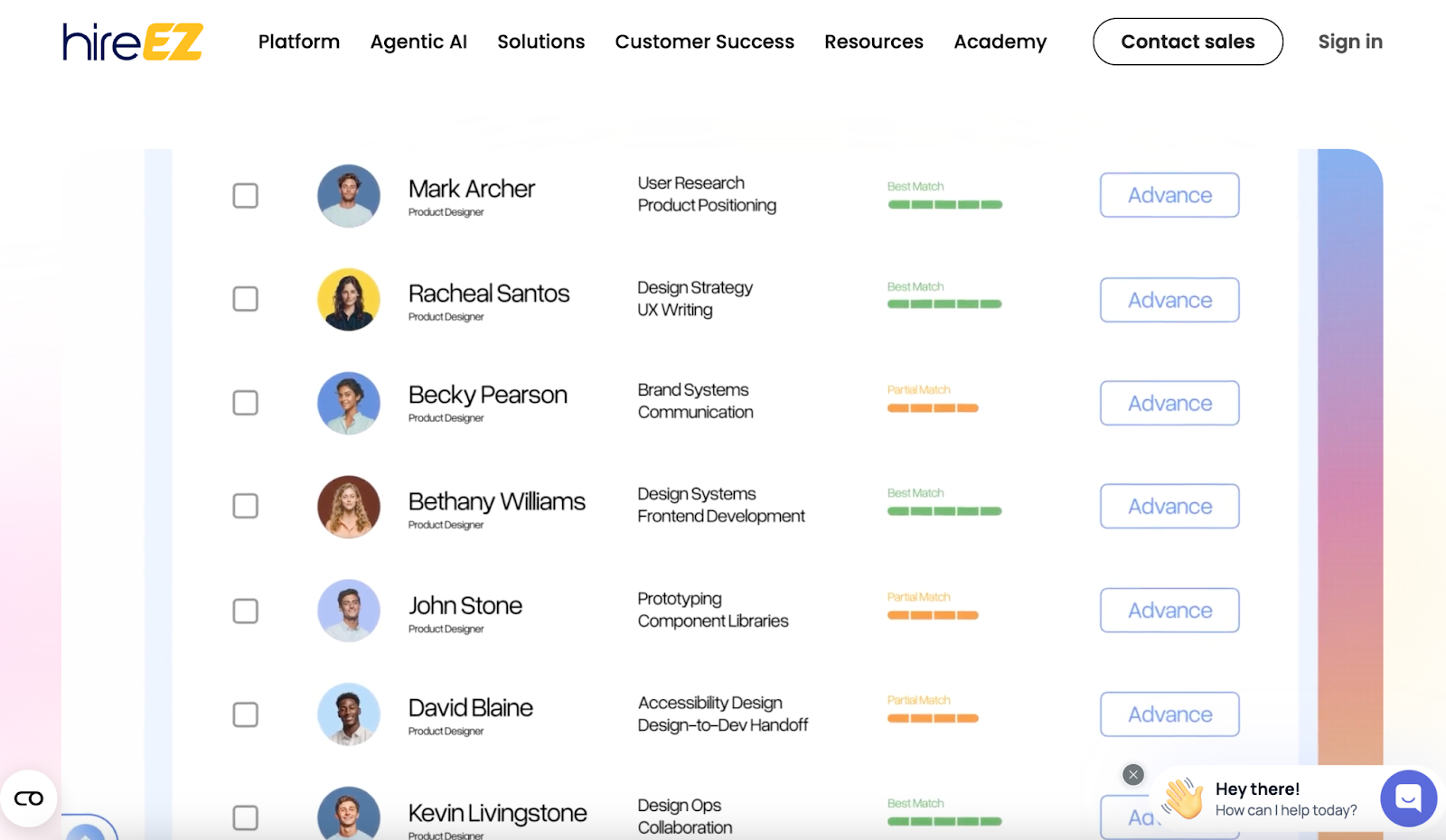
HireEZ talent discovery (vendor-supplied image)
HireEZ focuses on deep talent discovery across platforms. Its search combines a Boolean builder with machine-learning ranking trained on public profile data — it scans large talent databases, infers skill signals from project and employment history, and surfaces candidates that match a defined criteria set, though results still need recruiter review for context fit. It also enriches profiles from multiple sources and supports outreach from inside the platform. Market insights and talent-mapping help teams locate talent geographically.
Trade-off: HireEZ's depth rewards experienced sourcers who know Boolean syntax; newer recruiters may need ramp time before they get value out of advanced search.
3. SeekOut
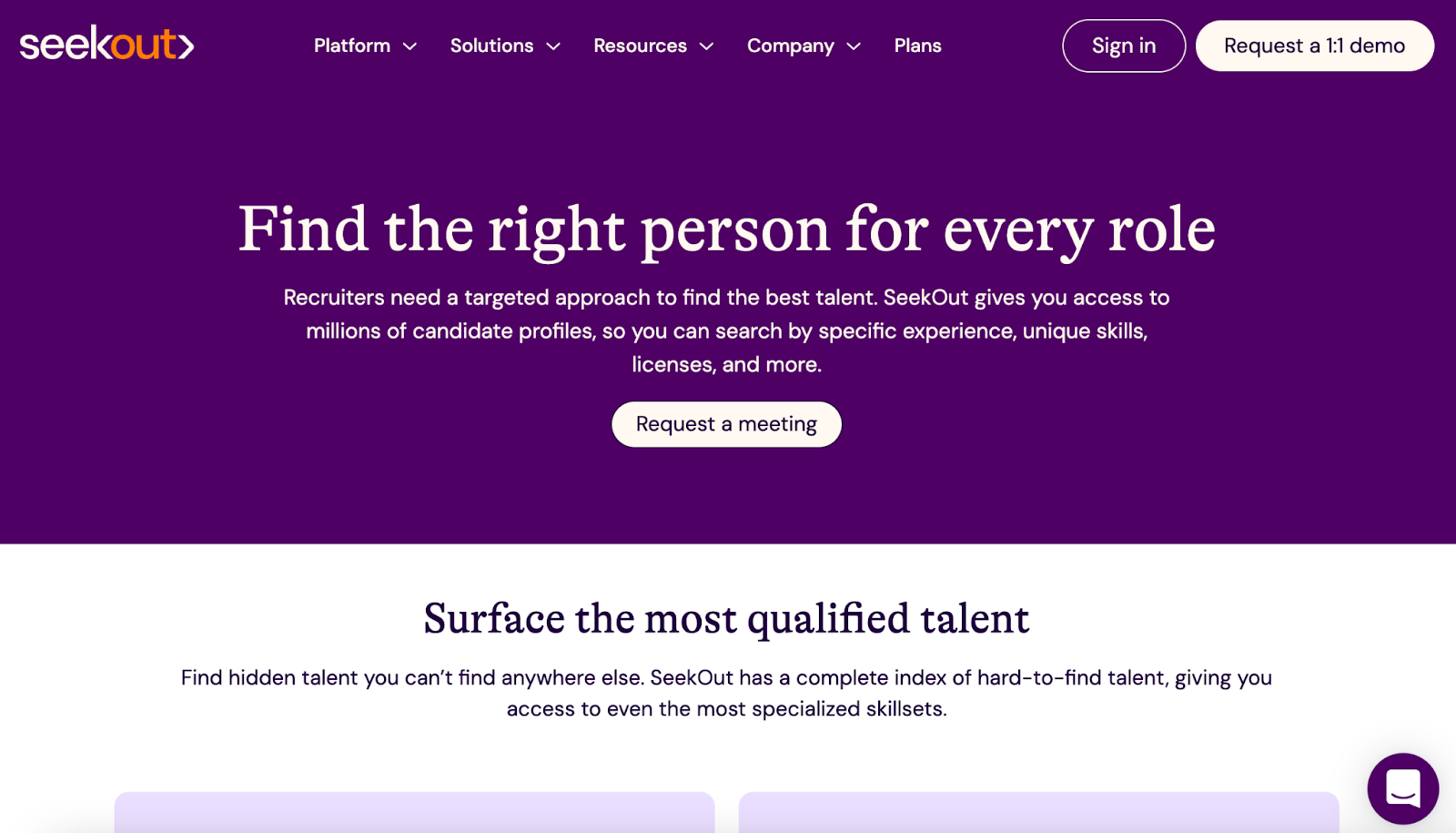
SeekOut targeted search
SeekOut helps recruiters find niche talent using Power Filters, Smart Matching, and Boolean search, with access to technical and hard-to-find profiles. SeekOut Assist turns a job description into search criteria and generates outreach drafts. Diversity Filters help mask identifying details during shortlisting.
Trade-off: SeekOut is positioned for niche and hard-to-find roles, which can be overkill (and over-priced) for high-volume generalist hiring.
Each tool serves a different purpose. Outbound sourcing, deep discovery, and technical evaluation have different center-of-gravity tools. Pick based on req type, team experience, and the systems you already run.
Note — disclosure: This guide is published by HackerEarth. For transparency, HackerEarth is a technical hiring platform with skill assessments, proctoring, FaceCode live-coding interviews, and an AI Interview Agent. Customers include Google, Microsoft, Elastic, Flipkart, and Brillio, with ATS integrations for Greenhouse, Lever, Workday, and SAP. We've kept HackerEarth out of the comparison above to avoid bias; if technical assessment depth is part of your evaluation criteria, see the dedicated callout later in this article.
How to choose the best sourcing tools for recruitment process
Choosing the right sourcing tool shapes how fast and how well you close reqs. Use the steps below to narrow the field when evaluating the best sourcing tools for recruitment process against your actual pipeline.
Map your reqs and pipeline shape
Look at your last two quarters of hiring. What share of reqs were technical vs. non-technical? How many were high-volume (50+ hires) vs. niche (1–5 hires)? What's your average time-to-fill by role family?
For high-volume hiring, prioritize automation, bulk outreach, and ATS sync. For niche hiring, prioritize deep search, Boolean, and profile enrichment. Asking these questions before a demo prevents you from buying a tool that's strong in the wrong direction. TechRadar, citing industry research, reports that 77% of hiring leaders consider active sourcing 'essential' or 'very important', yet only 27% source more than half their hires — editorial should verify the underlying primary study before publication. The gap usually traces back to weak tooling for the actual req mix.
Evaluate features against specific use cases
Don't review feature lists in the abstract. Take three reqs you're actively hiring for and walk through each tool's workflow for those reqs. Score on: how accurate the shortlist feels, how long the search takes, what data syncs to your ATS, and what's missing.
Specific demo questions worth asking:
- How does the tool handle a Boolean search with five must-have skills and two location filters?
- What happens when a candidate is already in our ATS — is it deduplicated?
- Can outreach templates pull role-specific variables, or are they static?
Match the tool to your team's working style
A guided AI workflow suits teams newer to sourcing; advanced Boolean tools suit experienced sourcers who want more control. Include your sourcers in the demo and watch where they hesitate. Friction in the demo predicts friction in production.
Run a real pilot, not a sandbox demo
Use a free trial or paid pilot to run live reqs through the tool for two to four weeks. Track response rate, time-to-shortlist, and ATS sync errors. A demo on canned data won't tell you any of this.
Plan for pipeline volume changes
If you expect headcount to grow 30% next year, ask the vendor what changes at higher volumes — pricing tiers, rate limits, ATS sync caps. Tools that work fine at 20 reqs can stall at 200. For a deeper walk-through of the evaluation process, our guide to building a technical hiring workflow covers how sourcing decisions interact with downstream assessment and interview choices.
Best practices for using sourcing tools effectively
Among the best sourcing tools for recruitment process, even the strongest only return value when the team uses them consistently. These practices help:
- Train your team for consistent usage: Run a 60-minute walkthrough per tool and document the workflow. When everyone follows the same steps, output stays comparable across recruiters.
- Write clear, structured job descriptions: AI matching is only as good as the input. Specific must-haves, nice-to-haves, and location/experience constraints reduce noise in the shortlist.
- Balance AI insights with human judgment: Use AI to narrow from 500 to 50, but have a recruiter review the top 50 before outreach. Context — team fit, hiring manager preferences — still needs a human.
- Use analytics to refine your approach: Review response rates, conversion to interview, and conversion to offer monthly. Adjust outreach copy and search filters based on what's converting.
- Keep data clean and close the feedback loop: Tag hires in the tool, deduplicate against your ATS regularly, and flag false-positive shortlists so the matching algorithm improves over time.
From sourcing to shortlist: what changes in practice
Closing the handoffs between sourcing, assessment, interview, and ATS is what shortens time-to-fill in measurable ways. Each handoff is where time leaks — exported CSVs, re-keyed candidate data, parallel email threads — and treating sourcing as part of an end-to-end workflow rather than a standalone search box is what separates teams that get value from teams that don't.
For technical reqs specifically, pairing sourcing with skills assessment earlier in the funnel reduces the volume of unqualified candidates reaching the interview stage. The assessment layer is also where capability gets validated against the role criteria the sourcing tool matched on.
HackerEarth: where assessments fit into the sourcing-to-shortlist handoff
HackerEarth is a technical hiring platform that connects skills assessment, live-coding interviews via FaceCode, and an AI Interview Agent into a single workflow. For teams sourcing technical talent, the platform closes the handoff between sourced candidate and validated shortlist: a recruiter can move a candidate from a sourcing tool into a skills assessment (covering 1,000+ skills and 40+ programming languages), then into a FaceCode live-coding round, without manual export/import between systems. ATS integrations include Greenhouse, Lever, Workday, and SAP.
Pricing for Skill Assessments starts at $99/month (Growth tier, 10 assessments) and $399/month (Scale tier, 25 assessments), with custom Enterprise pricing on request.
Schedule a HackerEarth demo to see how assessments and FaceCode interviews close the sourcing-to-shortlist handoff in one pipeline.
FAQs
What are sourcing tools for recruitment?
A common misconception is that sourcing tools replace recruiters or fully automate hiring. They don't — sourcing tools surface and enrich candidate profiles, but recruiter judgment is still needed for context fit, hiring-manager preferences, and final shortlist decisions. They also don't replace assessments or interviews; they feed candidates into those stages.
How do AI sourcing tools work?
AI sourcing tools parse a job description into structured criteria, match those criteria against profile data, and rank candidates by predicted fit. Most also generate outreach drafts and track replies. The matching quality depends on how clean the input JD and the candidate data are.
What should I look for when comparing sourcing tools?
Look at four things: how the tool handles the role types you actually hire for, whether it integrates cleanly with your ATS, what the response rate looks like in your pilot, and how it prices as your volume grows. Feature lists matter less than performance on live reqs.
How do sourcing tools improve candidate engagement?
They support personalized outreach at scale, automate follow-ups on a schedule, and track responses so candidates don't fall through the cracks between recruiter handoffs.
How long does it take to see ROI from a sourcing tool?
Most teams see measurable changes — faster shortlisting, higher response rates — within the first 30 to 60 days of consistent use, assuming the team is trained and the JDs are structured. ROI on time-to-fill typically shows up after one full hiring cycle for the role types you're sourcing for.