AI in recruitment: what it is and how to start
AI in recruitment is the use of machine learning, natural language processing, and predictive analytics to automate sourcing, screening, and candidate evaluation across the hiring funnel. As of 2026, it has moved from experimental pilots to core infrastructure inside talent acquisition teams — used to cut manual work in high-volume reqs, standardize screens, and surface skills-first signal earlier in the pipeline.
If you run a req-heavy pipeline or own workforce strategy, the practical question is no longer whether to use AI, but where it fits your funnel, how to keep it defensible under NYC Local Law 144 and the EU AI Act, and which use cases actually reduce time-to-fill versus adding tool sprawl.
This guide covers what AI in recruitment means for practitioners, how it maps to concrete stages of the hiring workflow, where it fails, and a phased roadmap for adoption.
What is artificial intelligence in a recruitment context?
For recruiters and CHROs, "AI" in a hiring stack almost always refers to narrow AI — systems trained to do one defined task well, such as parsing a resume, ranking a slate, or scoring a coding submission against a rubric. It is not general reasoning, and it should not be evaluated as if it were.
Three underlying technologies do most of the work in recruitment tools:
Machine learning (ML)
ML models learn from historical hiring data to rank or classify candidates. In practice, this is what powers slate ranking inside an ATS and pass/fail predictions on assessments. The output is only as good as the labeled data behind it — a point that matters for adverse impact testing.
Natural language processing (NLP)
NLP handles resume parsing, job description analysis (including flagging exclusionary language), and chatbot conversations with candidates. It is the reason "people management" on a resume can match "team leadership" in a req without exact keyword overlap.
Predictive analytics
Predictive analytics uses statistical models to forecast outcomes like time-to-fill or slate quality. Some platforms also claim to predict attrition risk, though these claims vary widely in rigor and are not a standard capability across AI recruitment tools — evaluate any such claim against the vendor's model documentation and validation data.
What is AI in recruitment?
AI in recruitment applies these technologies to specific stages of talent acquisition: sourcing, screening, interview scheduling, assessment, and hiring analytics. The point is not to remove recruiters from the loop — it is to move repetitive, high-volume work off the recruiter's desk so screens, slates, and structured interviews can move faster.
How AI changes recruiter workflows
AI shows up in three concrete places in a recruiter's day:
Sourcing and screening at the top of funnel. AI tools scan job boards, professional networks, and internal talent pools to identify qualified candidates, then screen resumes against req requirements. For teams building a durable pipeline, candidate sourcing strategies that layer AI on top of a defined ICP tend to outperform tool-only approaches.
Candidate engagement. Chatbots handle status updates, FAQs, and scheduling without a recruiter in the loop for every message. This matters most on high-volume reqs where response latency drives drop-off.
Predictive analytics for slate decisions. Models trained on historical performance data help prioritize candidates earlier in the funnel — the value is in decision support for the recruiter, not autonomous selection.
How AI works in a recruitment stack
Understanding the mechanics helps you evaluate vendors more critically and pass an internal audit later.
Resume parsing and matching
NLP-powered parsers extract structured data — skills, experience, education, certifications — from unstructured resumes so your ATS holds consistent profiles instead of PDFs. Matching algorithms then compare parsed profiles against req requirements using semantic analysis rather than raw keyword overlap.
Supervised vs. unsupervised models
Supervised models are trained on labeled data (e.g., past hires flagged as successful or not) to predict outcomes for new candidates. Unsupervised models cluster candidates by skill similarity without predefined labels — useful for building talent pools, less useful for direct hire/no-hire signal.
AI-based skill assessments
Skill assessment platforms — including HackerEarth Assessments — use rubric-based scoring on coding challenges to produce a skills-first signal that is more consistent across candidates than ad-hoc resume review. The differentiating detail worth checking with any vendor: whether rubrics are configurable per req, whether AI-assisted candidate behavior is flagged, and how outputs feed into your ATS for a defensible audit trail.
Benefits of AI in recruitment
The benefits fall into four categories. Where possible, evaluate each against your own funnel data before accepting vendor claims.
Faster time-to-fill
AI automates screening, scheduling, and initial outreach — the stages where recruiter time compounds. Some vendors and industry reports (see LinkedIn's Future of Recruiting and SHRM's talent acquisition research) cite significant time-to-hire improvements, but reported ranges vary widely by role type and starting baseline. Treat these as directional, not committed.
Improved candidate experience
Relevant communication at each stage. AI-driven messaging can tailor content to a candidate's stage, role, and prior interactions. Teams that improve the candidate experience with these tools often see higher offer acceptance rates.
Fewer application drop-offs. Chatbots and automated scheduling remove the back-and-forth that costs candidates in the funnel. When applicants can book interviews instantly and get real-time updates, engagement holds.
Better slate quality
Skills-first signal over credentials. AI can evaluate candidates on demonstrated skills rather than only titles and years of experience — the core premise of skills-based hiring. This surfaces high-potential candidates who might be filtered out by pedigree screens.
Decision support for long-term fit. ML models trained on internal performance data can flag which candidate attributes correlate with strong outcomes, reducing mis-hires when used alongside structured interviewing.
Cost efficiency
Automating repetitive screening reduces recruiter workload and per-hire cost. Standardized, rubric-based evaluations are also more consistent across candidates than human-led screens, which improves defensibility during adverse impact testing and OFCCP-style audits.
Where AI in recruitment falls short — and when to skip it
AI hiring tools are load-bearing in some scenarios and the wrong choice in others. A defensible adoption plan names both.
When AI is the wrong choice
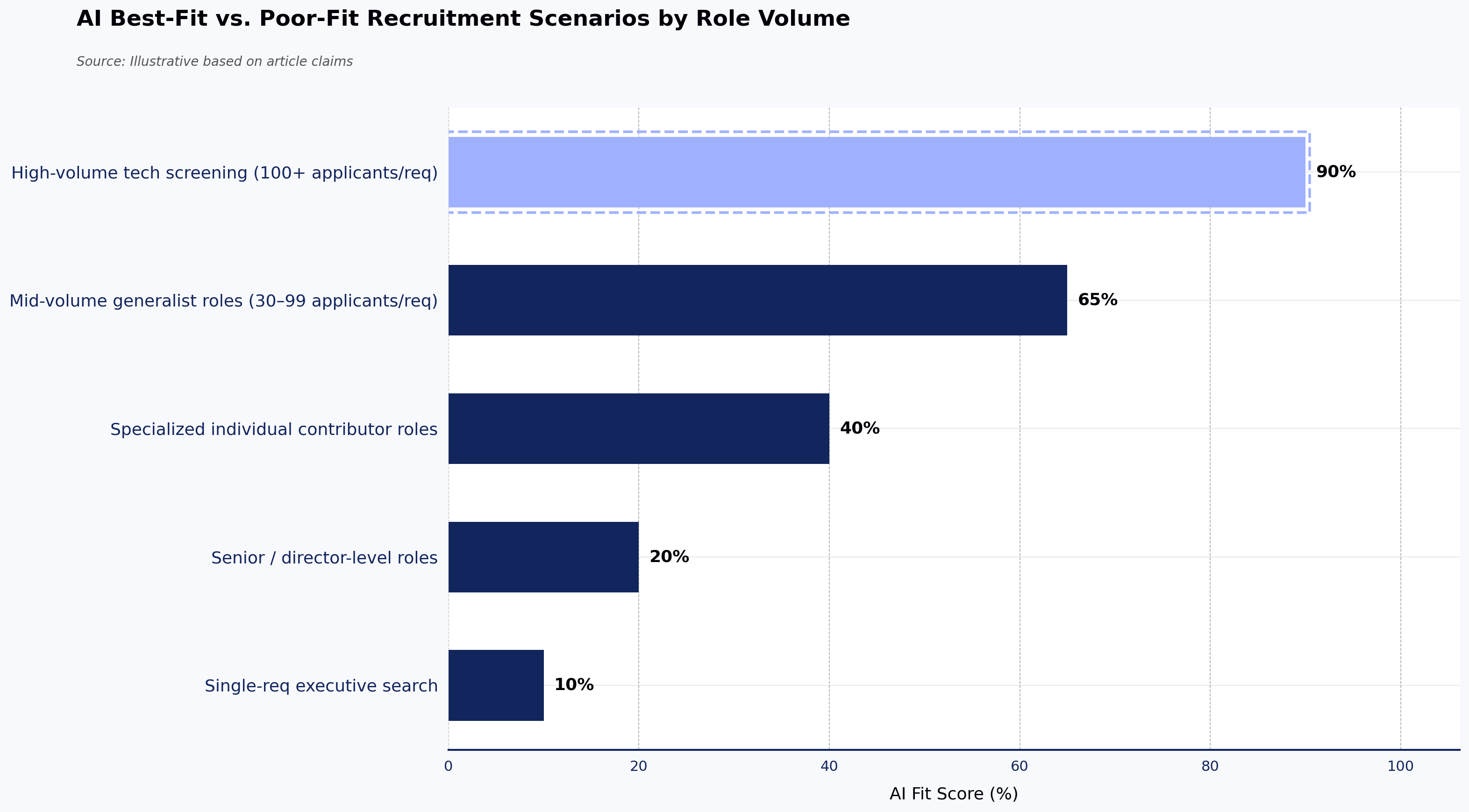
- Small-volume, highly specialized roles. For a director-level or single-req hire where context matters more than throughput, structured human interviewing produces better signal than AI screening. Resume screening AI is not meaningfully better than a well-designed structured human review for senior roles where keyword density is a poor proxy for capability.
- Jurisdictions with restrictive AI hiring laws. In New York City (Local Law 144) and Illinois (AI Video Interview Act), specific notice, consent, and bias-audit obligations attach to AI hiring tools. If you cannot meet those obligations for a given req, do not deploy AI on it.
- Roles where your historical data is thin or biased. ML trained on 20 past hires — or on a homogeneous hiring history — will not generalize. Fall back on rubric-driven human review.
Bias, fairness, and adverse impact testing
AI models learn from historical data. If that data reflects past patterns — favoring specific universities, tenure ranges, or demographic groups — the model will replicate them at scale.
Mitigation is not a single control. Different bias types need different fixes: selection bias (skewed training data) requires re-sampling or reweighting; measurement bias (proxy variables like ZIP code standing in for protected class) requires feature audits; label bias (biased outcome labels) requires re-examining what "successful hire" means in the training set. Run adverse impact testing on tool outputs quarterly, not annually, and keep human-in-the-loop review on any decision that affects candidate advancement.
Data privacy and regulation
AI recruitment tools collect and process personal data at volume. Under GDPR and similar frameworks, candidates have the right to know how their data is used and to request deletion. Assessment integrity tools — see the discussion in remote proctoring for online assessments — need to balance signal quality against candidate privacy expectations, especially for early-funnel screens.
Transparency and explainability
Candidates and regulators increasingly demand to know why an AI produced a specific decision. "Black box" scoring creates legal and reputational exposure. Choose tools that expose scoring rationale, document your AI decision-making process, and keep that documentation ready for audit.
AI technologies mapped to the hiring funnel
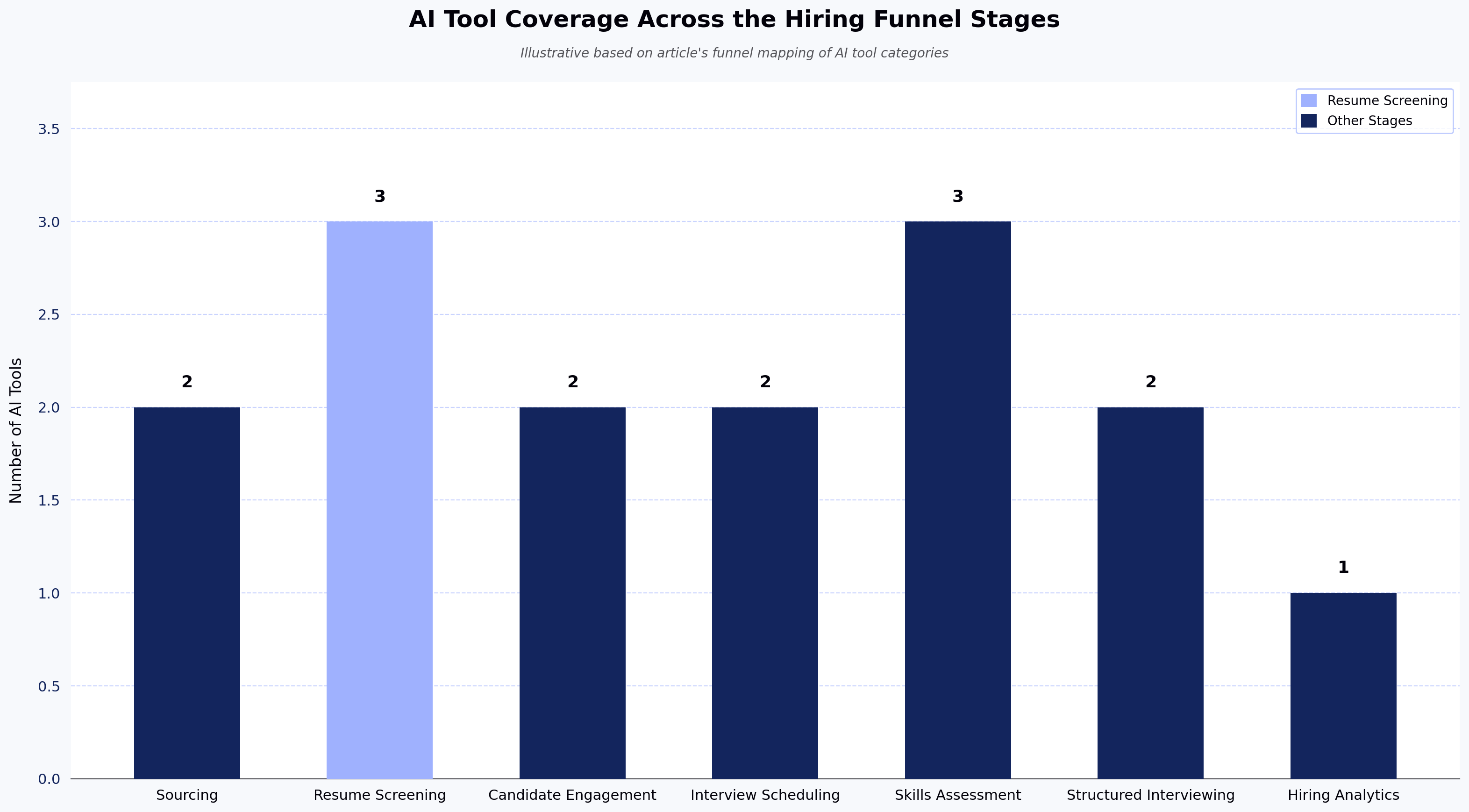
Not every tool fits every stage. A practitioner-level view of where each technology earns its place:
- AI-augmented ATS. Auto-ranks candidates on a slate and routes applications; useful when a recruiter is managing 10+ open reqs and needs prioritization.
- Resume screening and matching. Processes high volumes in minutes; strongest fit when you have hundreds of applicants per req.
- Interview scheduling. Coordinates availability across candidates, recruiters, and hiring managers; removes days of email overhead.
- Candidate chatbots. Handle FAQs and status updates 24/7. A well-chosen AI interview assistant can hold engagement between application and first screen.
- Structured technical interviewing. HackerEarth OnScreen runs structured interviews with lifelike avatars, a deterministic evaluation framework, KYC verification, and proctoring — targeted at high-volume technical screening where consistent structure and audit trail matter more than open-ended conversation.
The direction of travel
Two shifts are worth planning for.
AI integrating into the broader talent intelligence stack. Hiring data increasingly flows into onboarding, learning, and performance systems, letting teams measure quality-of-hire from day one against long-term outcomes.
Regulation catching up to deployment. The EU AI Act and NYC Local Law 144 already impose transparency, bias-audit, and candidate-notice obligations. More jurisdictions will follow. Teams that build compliance into their AI strategy now avoid costly retrofits later.
How to get started with AI in recruitment
You do not need to rebuild your hiring process. A phased approach reduces risk and builds internal defensibility.
1. Audit your current funnel
Map hiring end-to-end. For each stage, capture the current cycle time, drop-off rate, and recruiter hours consumed. The stages with the worst ratios are your first candidates for AI — not the stages where the technology is most impressive.
2. Match the tool to the specific bottleneck
- For high-volume initial screening, use structured skill assessments or an interview tool like OnScreen, both of which the catalog positions for early-funnel throughput.
- For senior technical hires and final-stage interviews, use collaborative coding tools like HackerEarth FaceCode — FaceCode is designed for depth, not top-of-funnel volume.
- For sourcing gaps, evaluate AI sourcing tools against your passive talent pool coverage, not against generic vendor promises.
3. Roll out in phases with defined metrics
Start with one use case — for example, automated resume screening on your two highest-volume reqs. Before rollout, define the metrics you will judge it on: time-to-fill (target: 20% reduction within 90 days), slate diversity at each funnel stage (target: no adverse impact ratio below 0.8), and hiring manager satisfaction (measured via post-hire survey). If the tool does not hit thresholds within one quarter, revisit.
4. Audit continuously, not annually
Schedule quarterly reviews of AI tool outputs for bias, accuracy, and compliance. Track candidate diversity at each funnel stage, time-to-fill deltas, and candidate satisfaction. Adjust configurations on real data, not vendor guidance.
Frequently asked questions
Is AI resume screening actually better than a well-run human review?
For high-volume reqs where hundreds of resumes arrive per role, yes — the throughput and consistency advantages are real. For senior or specialized roles where context, judgment, and non-obvious signal matter more than keyword density, a structured human review usually produces better outcomes. Do not deploy AI screening on reqs where your historical data is thin or where the role is unusual for your organization.
Can AI be biased in recruitment, and which mitigation applies to which bias type?
Yes. And the mitigations differ by bias type: selection bias needs re-sampling of training data; measurement bias needs proxy-variable audits (e.g., removing ZIP code as a feature); label bias needs re-examination of what your outcome labels actually measure. A well-known example: Amazon's internal AI recruiting tool, reportedly scrapped in 2018, learned to penalize resumes containing the word "women's" because it was trained on a decade of male-dominated hiring history — a textbook case of label and selection bias compounding. Regular adverse impact testing and human-in-the-loop review are the baseline, not the ceiling.
What are the ethical and regulatory concerns to plan for?
Algorithmic bias, transparency in decision-making, candidate data privacy, and compliance with GDPR, the EU AI Act, NYC Local Law 144, and the Illinois AI Video Interview Act. Explainability is not optional — if you cannot describe why the model produced a score, you cannot defend the decision in an audit.
How long does phased AI adoption typically take?
Plan for one quarter per use case before expanding. That gives enough time to collect meaningful outcome data (time-to-fill, adverse impact ratios, hiring manager feedback) without committing to a full-stack rollout based on early impressions.
What AI tools cover which parts of the funnel?
AI-augmented ATS platforms cover slate ranking; resume screening tools handle top-of-funnel volume; chatbots handle candidate engagement; structured skill assessments (e.g., HackerEarth Assessments) and structured interview tools (e.g., HackerEarth OnScreen) handle skills-first evaluation; collaborative coding tools like FaceCode handle final-stage senior technical interviews.