AI tools for HR managers in 2026: what works, what doesn't, and how to choose
Estimated read time: 7 minutes
AI tools for HR managers — the software platforms that use machine learning to assist with hiring, workforce planning, performance management, and employee engagement — have moved from novelty to necessity in 2026. But adoption alone isn't producing results. According to the SHRM State of AI in HR 2026 report, 88% of HR leaders say their organizations have not yet realized significant business value from AI, even as 91% of CHROs rank AI as their top priority. The gap is not a technology problem — it is an adoption and strategy problem. Most HR teams have added AI to their workflows in some form, but very few have moved past experimentation into measurable impact.
This guide is written for HR managers evaluating AI tools in 2026: where they are delivering results, what separates the tools that work from the ones that don't, and how to actually deploy them. If you're responsible for hiring decisions, workforce planning, or employee experience, the sections below map the current landscape and offer a framework for choosing tools that fit your team's real workflow rather than a vendor's demo.
The adoption gap that most HR leaders aren't talking about
AI is present but underutilized
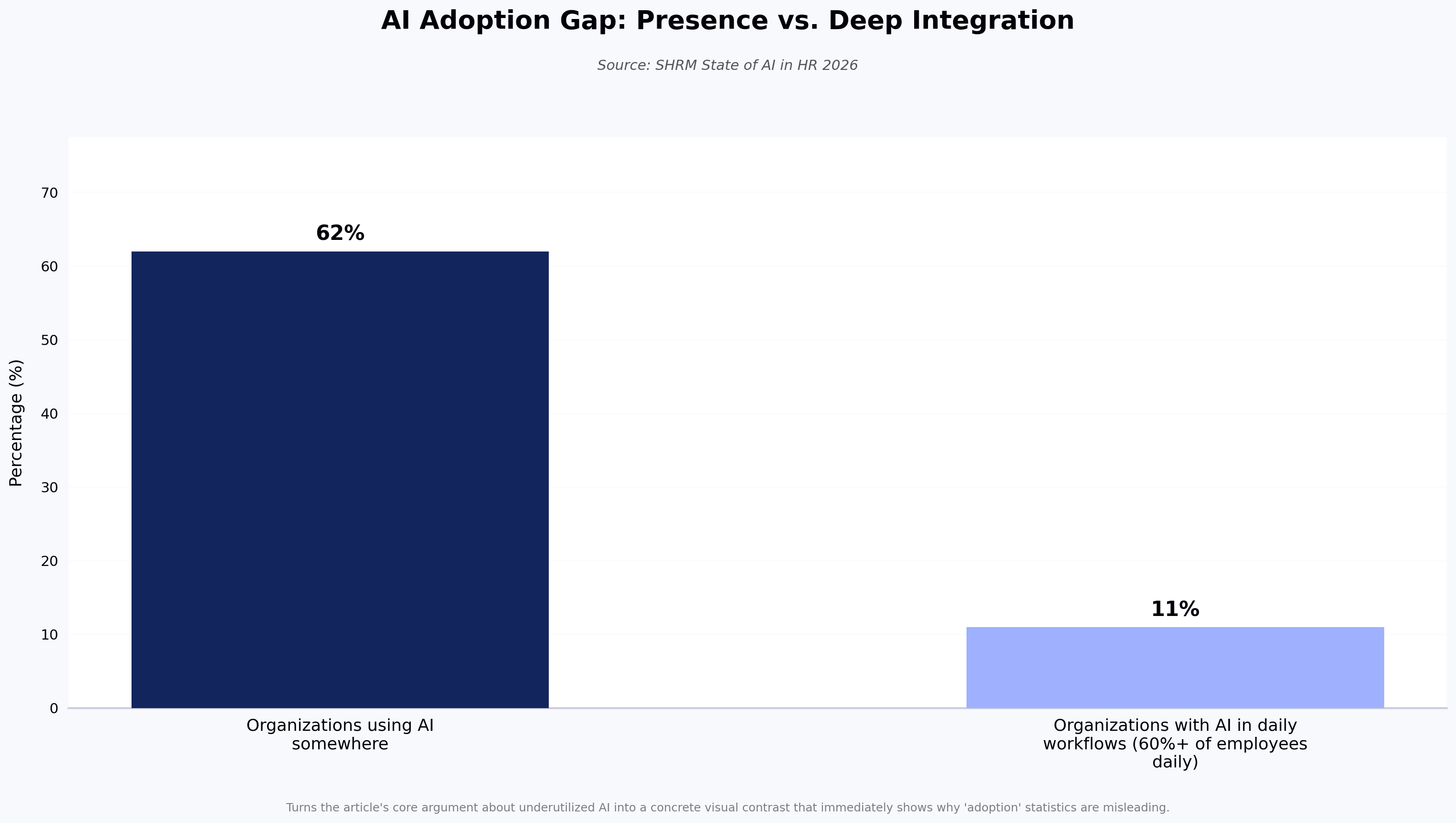
According to the SHRM State of AI in HR 2026 report, 62% of organizations use AI somewhere in their business. But only 11% have embedded AI into daily workflows, defined as more than 60% of employees using it daily. That is a significant divide and explains why so many AI investments feel underwhelming.
Managers experiment more than employees
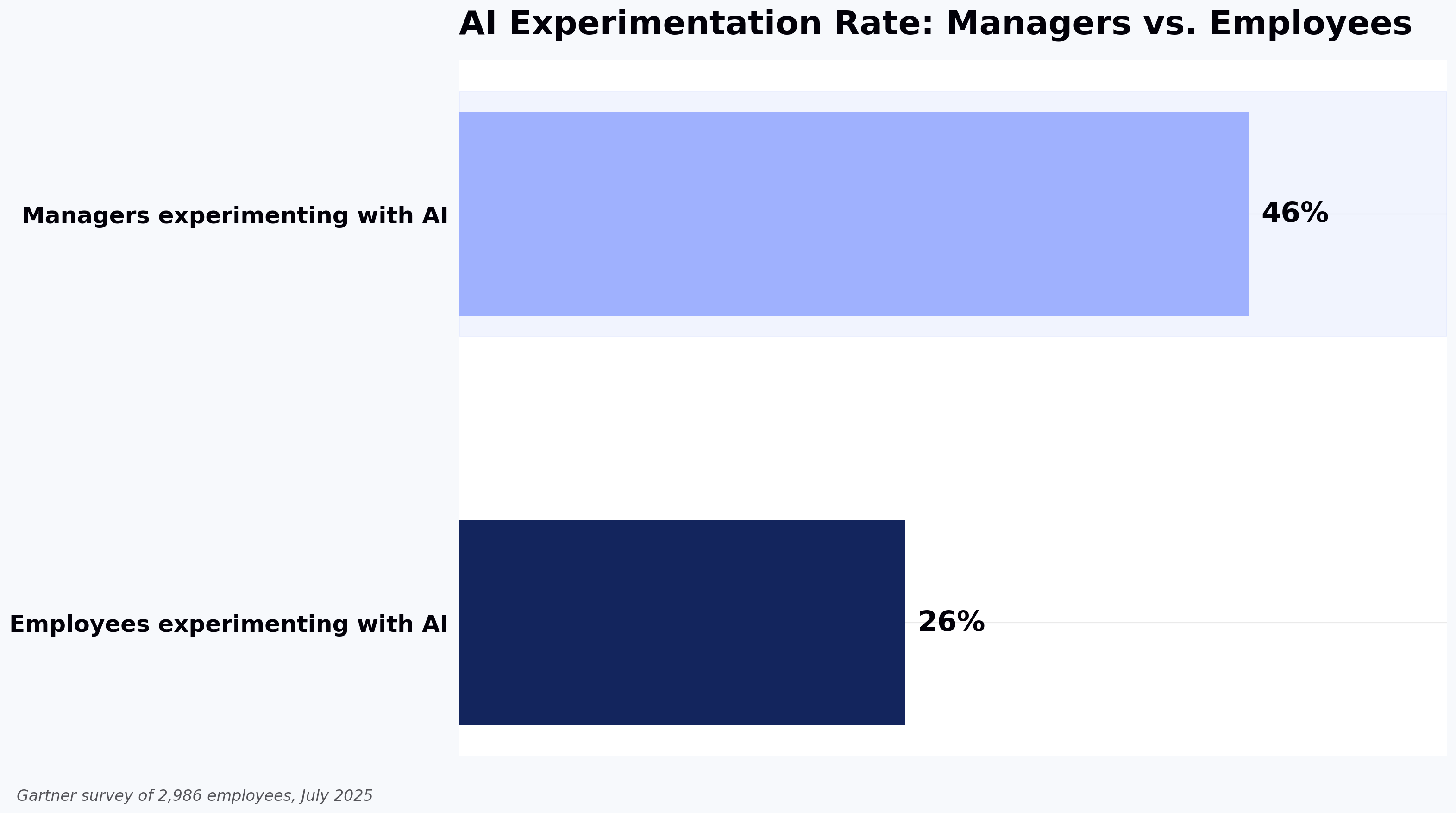
A July 2025 Gartner survey of 2,986 employees reportedly found that 46% of managers are experimenting with AI, compared to just 26% of employees. Most organizations encourage exploration but fail to provide the structure, expectations, or training needed to make AI stick. According to the same reporting, only about 7% of organizations give employees guidance on how to use the time AI saves them.
The result: wasted potential
Workforces have access to powerful tools but no framework for using them strategically. AI becomes another tab open in the browser, rather than a fundamental shift in how work gets done.
The opportunity is real
Organizations that have moved from experimentation to integration report tangible outcomes. Industry reporting suggests:
- Recruitment tools that use AI to screen resumes, rank candidates, and schedule interviews can reduce time-to-hire — some vendor-reported figures cite an average of roughly 30 days, though results vary by role and hiring volume.
- Some estimates indicate AI can automate a substantial share of routine HR tasks (up to 60% in vendor case studies), saving employees several hours per week.
- Research from analyst firms suggests predictive analytics can reduce voluntary turnover in the range of 22–28% in the first year of deployment, though outcomes depend heavily on data quality and manager follow-through.
Capturing this opportunity requires the right tools and the right strategy. For a broader view of how these tools fit together, see our guide to building a modern HR tech stack.
Why 2026 is different from every other year of AI in HR
1. Skills-based hiring has gone mainstream
The Josh Bersin 2026 Talent Report found that roughly 72% of companies are moving away from degree requirements in favor of skills-based evaluation, and Gartner reports that around 65% of enterprises are actively prioritizing this shift. The traditional resume is no longer the most reliable signal of candidate quality, especially in tech roles where analysts have observed that the effective half-life of technical skills has shortened considerably — often cited as around two years. For teams making the shift, our skills-based hiring guide walks through the operational changes required.
2. Agentic AI has arrived
Earlier generations of HR AI could automate tasks or analyze data. Agentic AI can plan, act, and iterate across entire workflows without constant human direction. Analyst estimates suggest roughly half of large companies have adopted some form of agentic AI in HR, with projections of substantial growth over the next few years. This is no longer experimental.
3. Regulatory pressure is real
The EU AI Act generally classifies AI systems used in employment and hiring decisions as high-risk, imposing transparency and record-keeping obligations. Any AI tool influencing hiring decisions must be explainable. Black-box systems are a compliance liability, and this is one reason technical assessments with transparent scoring rubrics have become central to defensible hiring processes.
What separates useful HR AI tools from the rest
They augment judgment rather than replace it
Useful HR AI tools make professionals better at their jobs. They surface the right information at the right moment, flag unnoticed patterns, and reduce cognitive load. Tools that try to remove humans entirely create legal risk and distrust. Where AI investments underdeliver, one recurring pattern — noted in analyst commentary on the SHRM findings — is that teams automate low-value administrative work rather than the decisions that actually shape hiring quality or retention.
Consider a mid-sized engineering team hiring 40 developers per quarter: automating interview scheduling saves recruiter hours, but automating structured technical evaluation is what actually changes the quality of who gets hired. The second is harder to buy and harder to implement, which is why fewer teams do it.
They generate actionable insight, not just output
Predictive models can flag at-risk employees months before they leave, skills-gap analyses shape hiring plans before a role opens, and candidate matching highlights transferable potential. This is the difference between AI that saves time and AI that changes decisions.
They are transparent and explainable
Some research suggests employees are more likely to trust AI-generated reviews when they understand the underlying criteria, and candidate acceptance of AI screening rises significantly when a human makes the final call and the process is explained. Transparency builds trust, drives adoption, and supports compliance.
Top AI tools for HR managers in 2026
The tools below occupy different parts of the HR stack. No single platform covers every use case well, and each has scenarios where it is a poor fit. Where possible, vendor-reported claims are noted as such.
HireVue
Best fit: High-volume hiring in regulated or geographically distributed industries where structured video interviews add capacity.
HireVue is widely used for video interviewing and structured candidate assessments. The vendor reports time-to-hire reductions, multilingual support, and interview guides developed with industrial-organizational psychologists.
Trade-offs and limitations: HireVue has faced public scrutiny and regulatory attention over its earlier use of facial analysis in video assessments, which the company discontinued in 2021 following an EPIC complaint to the FTC. It has also been named in complaints and litigation raising concerns about algorithmic bias in hiring assessments. Buyers in jurisdictions covered by the EU AI Act, NYC Local Law 144, or Illinois's AI Video Interview Act should evaluate documentation, bias-audit results, and candidate-notice workflows carefully. Small teams hiring for senior or highly specialized roles often find the platform's structured video format a poor fit.
Eightfold AI
Best fit: Large enterprises focused on internal mobility, redeployment, and long-horizon workforce planning.
Eightfold markets itself as a skills-first talent intelligence platform, and the vendor claims a very large underlying dataset of career profiles used to match candidates on potential rather than keywords. Vendor case studies report improvements in recruiter productivity and diversity sourcing.
Trade-offs and limitations: The platform requires significant data hygiene and integration work to deliver on its promise, and smaller organizations often lack the internal mobility volume to justify the cost. The "skills graph" is only as accurate as the profile data feeding it, and some customers report that inferred skills need substantial human curation.
Workday
Best fit: Enterprises that already run core HR on Workday and want AI features embedded in the same system of record.
Workday offers HR functionality spanning workforce planning, analytics, and employee lifecycle management, with agentic AI features layered in. Its 2024 acquisition of HiredScore added AI-driven recruiting orchestration.
Trade-offs and limitations: Workday is not a fit for teams that need best-of-breed technical assessment or specialized interviewing workflows. Implementation timelines are long, and organizations not already committed to Workday as a system of record rarely adopt it purely for its AI features.
Lattice
Best fit: Mid-market organizations prioritizing performance management, engagement, and manager enablement.
Lattice focuses on employee performance and engagement, using AI to surface growth patterns, aggregate feedback trends, and flag potential disengagement. The vendor markets predictive features intended to identify retention risk earlier in the cycle.
Trade-offs and limitations: Lattice is not a hiring platform, so it must be paired with sourcing and assessment tools. Predictive retention signals depend heavily on manager participation in check-ins; teams with inconsistent 1:1 practices will get inconsistent outputs.
HackerEarth
Best fit: Technical hiring teams that need defensible, skills-based evaluation across developer roles.
HackerEarth covers the technical hiring lifecycle, from sourcing developers through hackathons to live technical interviews and skills assessments. HackerEarth Assessments provide rubric-based, skills-first evaluation designed to produce more consistent scoring across candidates than unstructured human-led screens. The OnScreen AI interview agent conducts structured technical interviews where scoring rubrics are applied consistently regardless of interviewer mood or fatigue. Built-in enterprise-grade proctoring monitors for irregularities during assessments, and KYC-grade candidate identity verification supports integrity across remote hiring. HackerEarth's approved customer references include Google, Microsoft, Elastic, Flipkart, and Brillio.
Trade-offs and limitations: HackerEarth is purpose-built for technical hiring. Teams looking for a general-purpose HRIS, performance management suite, or non-technical assessment library will need to pair it with other systems. For non-engineering roles, the depth of the technical assessment library is not the primary value.
Moving from experimentation to impact: a practical framework
1. Start with one high-friction problem
Automate a workflow that costs the most time or produces the most inconsistency — typically initial candidate screening. "High-friction" here means measurable: a stage where recruiter time per candidate exceeds 15 minutes, where interviewer scoring disagreement exceeds 30%, or where drop-off between application and first interview exceeds 60%. Fix one of those before adding a second tool.
Operational example: A recruiter screening 300 applications per week for a backend engineer role might replace resume triage with a short, rubric-based skills assessment. Measure the change in shortlist quality (percentage advancing past the technical interview) before and after.
2. Define success before deployment
Analyst commentary suggests a large share of CHROs — often cited around 47% — have not established clear AI productivity metrics. Set baseline and target improvements: time-to-shortlist, quality-of-hire (measured as 90-day performance rating or first-year retention), recruiter hours per hire, and offer-acceptance rate. If you cannot state the metric and its current value in one sentence, the deployment is not ready.
3. Put managers in the loop
AI adoption gaps are often a manager problem, not a tool problem. Give managers specific use cases ("use this to draft the first version of the job description, then edit"), integrate AI outputs into existing workflows (ATS, calendar, review cycles), and provide language for talking about AI with their teams. Track manager-level adoption, not just organization-level license counts.
4. Run a structured pilot before rolling out
Pilot with one team or one role family for a full hiring cycle — typically 60 to 90 days. Compare outcomes against a matched control group where possible. Cancel or renegotiate contracts on tools that fail to move the metric defined in step two.
Frequently asked questions
What AI tools do HR managers actually use in 2026?
Most HR teams use a combination of tools rather than a single platform: an ATS or HRIS as the system of record (often Workday or a similar suite), a specialized assessment or interviewing tool for high-volume or technical roles (HackerEarth for engineering hiring, HireVue for structured video interviews), a talent intelligence platform for internal mobility and skills planning (Eightfold), and a performance and engagement tool (Lattice). The exact mix depends on hiring volume, industry, and whether the primary need is hiring, retention, or workforce planning.
Is HireVue worth it for small teams?
Usually not. HireVue is designed for high-volume, structured hiring across many locations or languages. Small teams hiring fewer than 50 people a year often find the setup effort and per-candidate cost outweigh the benefits, and senior or specialized roles are typically better served by direct conversations than by asynchronous video assessment. Small teams tend to get more value from a focused assessment tool plus a lightweight scheduling and note-taking assistant.
How do I measure ROI from HR AI tools?
Set the baseline before you deploy. The most defensible metrics are time-to-hire (calendar days from requisition open to offer accepted), quality-of-hire (90-day or one-year performance and retention), recruiter hours per hire, and offer-acceptance rate. For retention tools, measure voluntary turnover rate against a matched prior period. Avoid vendor-supplied ROI calculators as your primary source; build your own model using your baseline numbers.
Are AI hiring tools legal under the EU AI Act and US state laws?
AI systems used in hiring are generally classified as high-risk under the EU AI Act, which imposes transparency, documentation, and human-oversight obligations. In the US, jurisdictions including New York City (Local Law 144) and Illinois (AI Video Interview Act) impose bias-audit and candidate-notice requirements. Legal use is possible but requires explainable scoring, documented bias audits, candidate disclosure, and a human decision-maker in the loop. Ask vendors for their most recent independent bias-audit report before signing.
What is the difference between agentic AI and earlier HR AI?
Earlier HR AI mostly performed narrow tasks: parsing a resume, scoring an assessment, ranking a shortlist. Agentic AI plans and executes multi-step workflows — for example, opening a requisition, drafting the job description, sourcing candidates, scheduling screens, and updating the ATS — with limited human direction at each step. The practical implication is that oversight shifts from reviewing individual outputs to auditing the agent's overall behavior, which changes both the compliance and the manager-training requirements.
How should I decide between a general HR suite and a specialized tool?
Use the system of record for what it does well: employee data, payroll, headcount planning, and workflow orchestration. Use specialized tools where the decision quality matters most — typically hiring assessments, technical interviews, and retention analytics. The common mistake is buying an all-in-one suite and assuming its assessment or interviewing module is competitive with purpose-built tools. It usually is not.
The bottom line
AI will not change HR's fundamental nature — it remains a people function requiring judgment, empathy, and context. What AI can improve is:
- The quality of information available for every decision.
- The time HR teams spend on work that doesn't require judgment.
Organizations getting ahead in 2026 are those that select the right tools for the right problems and give teams structure to use them effectively.
Next steps
If technical hiring is where AI will have the largest impact on your team's outcomes, the fastest way to evaluate whether skills-based assessments change your shortlist quality is to run a structured pilot.
- See it in action: Schedule a demo of HackerEarth Assessments to walk through a live technical evaluation workflow.
- Read next: The complete guide to skills-based hiring for teams moving away from degree-first screening.
Editor's notes for production: - Featured image and at least one in-body visual (e.g., a framework diagram for the "experimentation to impact" section) required before publish; add descriptive alt text on both. - Confirm displayed read time matches final word count divided by 250. - Verify SHRM State of AI in HR 2026, Josh Bersin 2026 Talent Report, and July 2025 Gartner survey URLs against primary source documents before publish; several statistics currently hedged pending source confirmation. - Competitor product claims (HireVue, Eightfold, Workday, Lattice) route to Brand Guardian for approval per catalog policy before publish.