Simran Dhawan

Author
Simran Dhawan

Blogs
author’s Articles

Insights & Stories by Simran Dhawan

Clear all
Thank you! Your submission has been received!
Oops! Something went wrong while submitting the form.
Filter
Filter

AI Interviews for Technical Hiring | HackerEarth

5 Habits That Make You Stand Out at Work

Read time: 6 minutes

By the HackerEarth Editorial Team. This article draws on patterns observed across thousands of technical interviews and assessments run on HackerEarth's platform over the past decade, combined with named research where cited.

Summary: The habits that separate strong contributors from average ones are less about output volume and more about how people think, communicate, and respond under pressure. This article unpacks five habits that help people stand out at work — and how hiring teams can screen for them in structured interviews.

If you run technical hiring — as a recruiter, hiring manager, CHRO, or engineering manager building out a pipeline — the candidates who grow into senior contributors tend to share a small set of observable habits. They show up in interview transcripts, in calibration sessions, and in the way candidates handle ambiguity inside a structured rubric. This article unpacks those habits — what they look like in practice, where they break down, and how hiring teams can spot them during structured interviews.

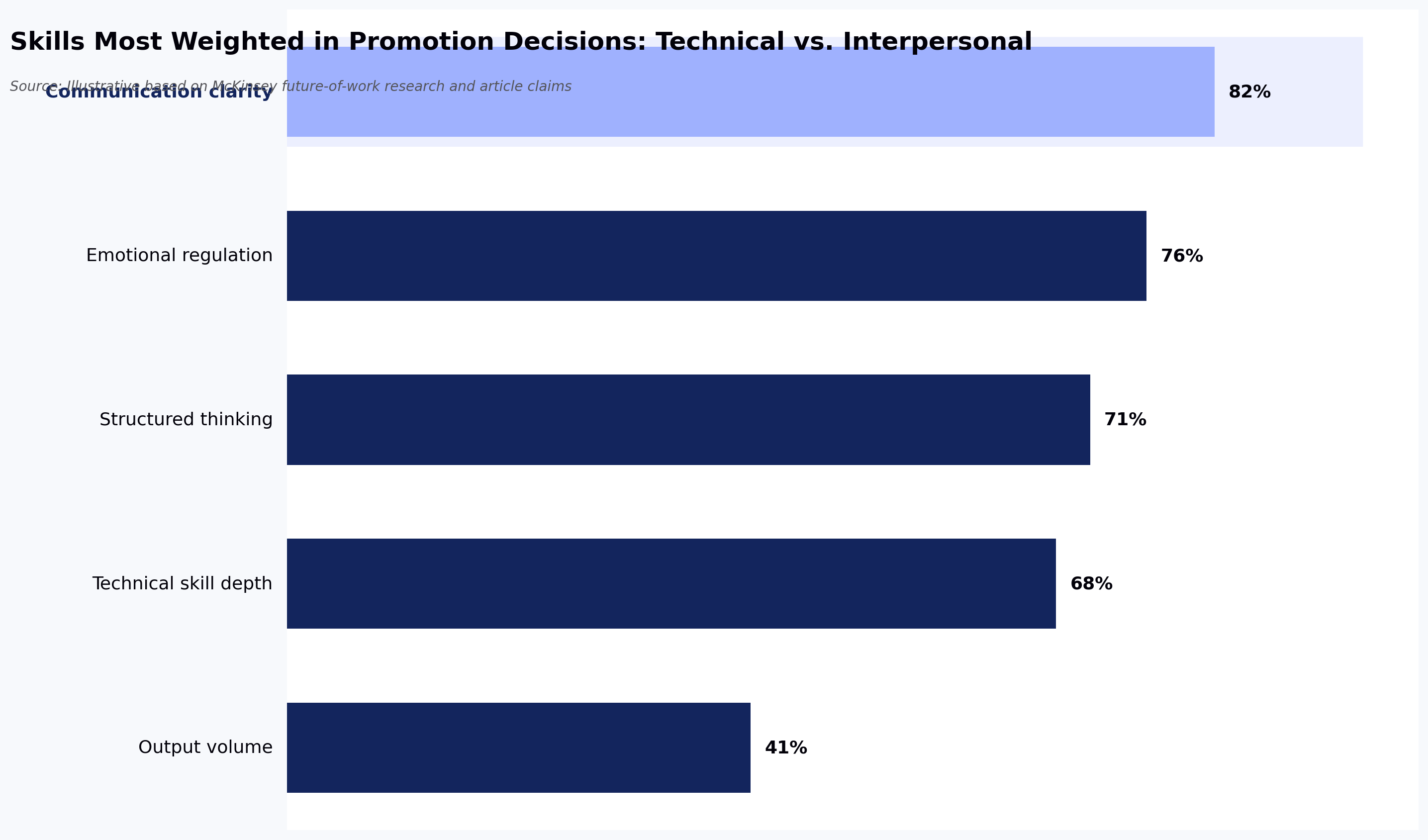
Daniel Goleman's foundational Harvard Business Review article on emotional intelligence argues that EI competencies are differentiators in leadership performance, and consulting research — including work published by McKinsey on the future of work and skills — suggests interpersonal and communication skills are increasingly weighted in promotion decisions across knowledge-work roles. For hiring teams, these are signals worth screening for deliberately inside a calibrated rubric.
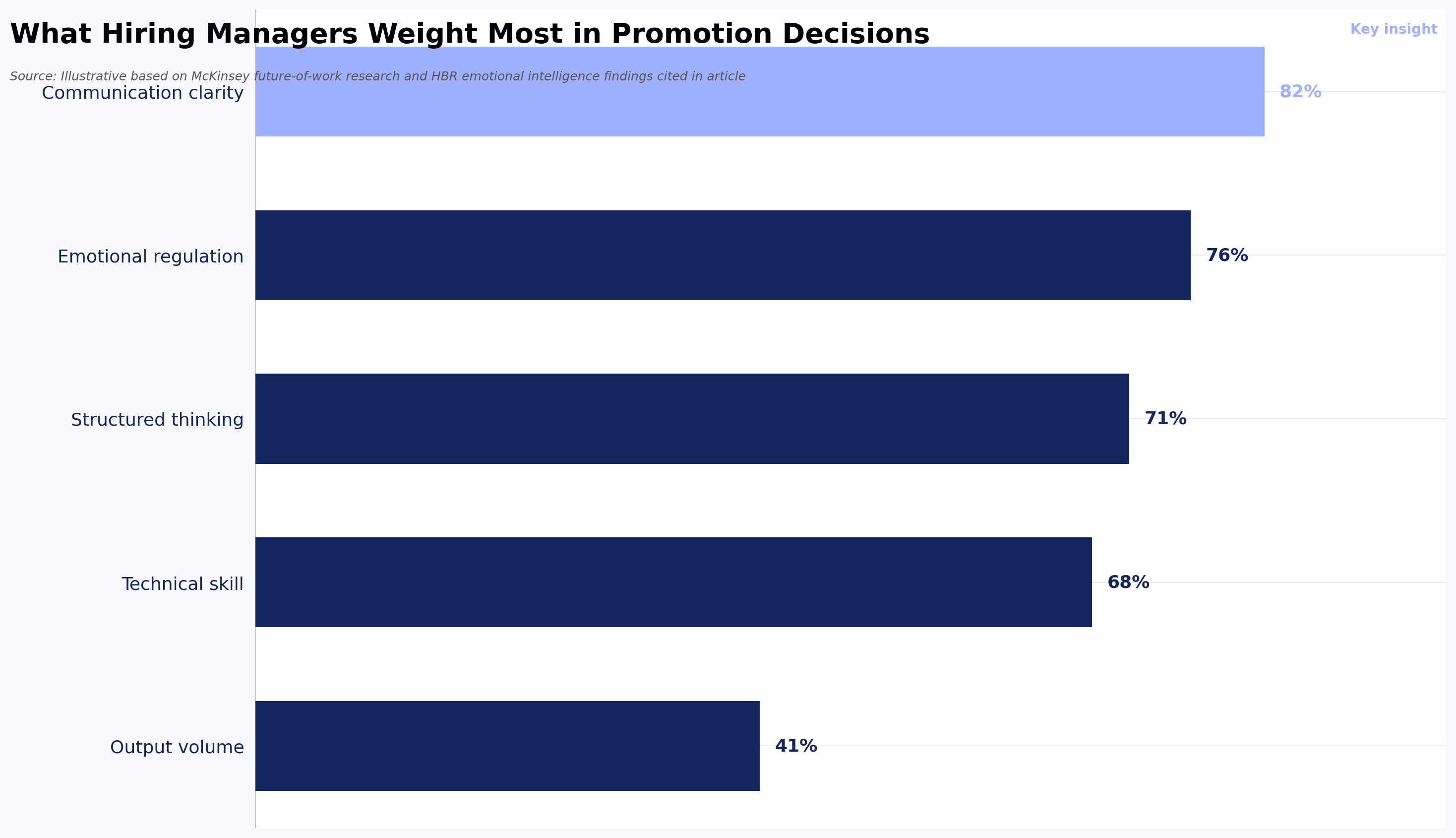
What Hiring Managers Weight Most in Promotion Decisions
Source: Illustrative based on McKinsey future-of-work research and HBR emotional intelligence findings cited in article
Skills Most Weighted in Promotion Decisions: Technical vs. Interpersonal
Source: Illustrative based on McKinsey future-of-work research and article claims

1. Pausing before you react is the first habit that helps candidates stand out at work

Pausing before you react reduces miscommunication and signals emotional regulation to colleagues and managers — a trait linked in HBR's work on emotional intelligence to higher leadership ratings.

When something goes wrong at work, the natural instinct is to answer immediately. Fast reactions, though, rarely produce the most accurate read on a situation. A two-to-five-second pause to understand the situation, gather context, process information, and frame a response often produces noticeably clearer communication and fewer follow-up corrections.

Anecdotally, across the hiring workflows we observe, the person who answers fastest is rarely the person remembered as the most thoughtful contributor a quarter later. Speed is mistaken for competence in the moment, but pattern recognition over time tends to reward the deliberate.

The trade-off: pausing is not universally rewarded. In high-urgency incident response — a production outage, a customer escalation in progress, a live client objection — a visible delay can be read as hesitation rather than thoughtfulness. The habit applies most cleanly in planning conversations, design reviews, and one-on-ones, less cleanly in real-time crises. Cultures that reward fast visible output (early-stage startups, sales floors) may also penalize the reflective pattern, at least in the short term.

2. Buying thinking time with a single phrase is a visible signal of rigor

Naming that you need a moment is an external signal of deliberation. Saying "Let me think about that for a second" or "I want to give that a careful answer — can I come back to you in ten minutes?" makes the pause visible and turns it into a credibility signal rather than a silence to be filled.

This is operationally distinct from Habit 1. Habit 1 is a sub-five-second internal beat before responding. This habit is a verbal handoff that buys minutes or hours — useful when the question is genuinely complex (a strategy call, a salary negotiation, a stakeholder pushback) and a fast answer would be worse than a slow one.

In team meetings, leadership discussions, job interviews, client conversations, and stakeholder presentations, this phrase shifts the dynamic: the asker now expects a considered response, and you've reset the clock. The risk is overuse — relying on the phrase for every question signals avoidance rather than rigor. A useful threshold: deploy it when the answer has downstream consequences you can't easily reverse.

For recruiters calibrating candidates, watch for this phrase under pressure. Candidates who deploy it appropriately in a structured screen often demonstrate the same restraint on the job.

3. Tolerating silence in conversations helps high performers stand out at work

Tolerating silence — rather than rushing to fill it — is a habit that distinguishes high performers in meetings, interviews, and negotiations. This habit is about tolerating silence that already exists in the room — particularly after you've finished speaking, or after someone else has asked you something.

The mechanism here is different from Habits 1 and 2. Those habits create silence intentionally. This habit is about not collapsing silence that the conversation produced on its own. Some sales analytics research suggests that top performers tolerate longer post-question pauses than average performers, and negotiation research often suggests that the side that breaks silence first concedes ground.

A concrete threshold: if you've answered a question and the other person hasn't responded within three seconds, resist the urge to add a qualifier, restate the point, or fill the gap. Let them respond first. This applies in performance reviews, salary discussions, and design critiques where the temptation to over-explain is highest.

Here's a debatable angle: asking one question in a meeting is often more memorable than making three points, because a question transfers ownership of the idea to the room. The same logic applies to silence — restraint is a form of presence.

4. Asking one load-bearing question is how thoughtful contributors stand out

Asking one well-framed question often creates more impact than a long explanation, because questions surface assumptions the group hadn't examined.

What makes a question load-bearing? It typically does one of three things: exposes a hidden constraint ("What happens if the volume doubles?"), reframes the problem ("Are we solving the right problem, or the visible one?"), or forces a prioritization ("If we could only ship one of these, which matters more?"). Generic questions like "What do you think?" don't qualify.

A useful framework here is the Pyramid Principle, developed by former McKinsey consultant Barbara Minto and published in her book The Pyramid Principle (1987), which structures communication by leading with the conclusion and supporting it with grouped, mutually exclusive arguments. Applied to questions, it suggests asking the question that, if answered, resolves the most downstream uncertainty.

For interview contexts specifically, the STAR method (Situation, Task, Action, Result) is the standard framework for structuring responses — and the best candidates often ask the interviewer one STAR-shaped question in return to demonstrate the same structured thinking. For hiring teams designing rubrics, the quality of candidate questions is often a more reliable leveling signal than the polish of their answers.

5. Clear and concise communication is a habit that helps people stand out at work

Clear, structured communication is the habit that ties the others together. Professionals who stand out communicate with structure and brevity, focusing on what matters, why it matters, and what action is needed — without adding qualifying clauses that dilute the point.

In practice, this means leading with the conclusion in written updates (a pattern the Pyramid Principle formalizes), capping verbal updates at the length that respects the listener's attention, and resisting the impulse to demonstrate effort through volume. In modern hybrid workplaces, where attention is fragmented across channels, communication clarity is often weighted as heavily as technical skill in promotion decisions.

The trade-off worth naming: brevity can read as curt in cultures or relationships where context-setting is the social norm. In cross-cultural teams, in early relationships with a new manager, or in sensitive feedback conversations, leading with the conclusion without sufficient framing can damage trust. Calibrate to audience.

How hiring teams can screen for these habits in their pipeline

Screening for these habits in a hiring pipeline requires designing the interview itself to surface them — not relying on interviewer instinct after the fact. The leverage for recruiters and engineering managers is in the rubric: which behaviors get scored, by which interviewer, against which benchmark.

The strongest screens we see across enterprise hiring workflows share a few traits. They use open-ended behavioral prompts that don't reward pattern-matched answers — a candidate who returns a polished response to a complex situational question in under two seconds is usually pulling from a script, not reasoning in the room. They include a structured summarization task — asking a candidate to summarize a complex project in under 90 seconds tells you more about how they think than the project itself does, because conclusion-first structure is hard to fake. And they leave deliberate room for candidate questions at the end, because the questions a candidate asks are a stronger leveling signal than the answers they give. A question that surfaces a real constraint about the role is a stronger signal than one that restates information already covered.

For teams running this at scale, the practical challenge is calibration: making sure two different interviewers score the same candidate response the same way. HackerEarth OnScreen — our recorded, structured interview platform — supports deterministic evaluation criteria, identity verification, and proctoring so that hiring teams can review responses on playback and calibrate scoring across interviewers. For deeper guidance on rubric design, see our resources on structured interviewing and skills assessments.

Frequently asked questions

How do I stand out at work without being pushy? Focus on visibility through quality of contribution rather than frequency. Asking one well-framed question in a meeting tends to be more memorable than making three statements, because it shifts the room's attention to a problem worth solving rather than to you.

Are these habits useful in every workplace culture? No. Reflective pausing and brevity are rewarded in cultures that value deliberation, but can be penalized in cultures that reward fast visible output or extensive context-setting. Calibrate to your environment.

Can these habits be developed, or are they innate? They are practiced behaviors. Most are developed through deliberate repetition in progressively higher-stakes settings, supported by feedback from managers or peers.

What's the single highest-leverage habit to start with? For most individual contributors, tolerating silence after you finish speaking is the lowest-cost habit to practice and the one that compounds fastest, because it forces the other four habits to develop alongside it.

Next steps

See it in action. If you're calibrating interview rubrics across a distributed hiring team, HackerEarth OnScreen records structured interview sessions so reviewers can score response structure and question quality consistently on playback. The platform uses AI to transcribe and structure interview responses against a hiring team's defined rubric — it is trained on interview-format data, scores against criteria the hiring team configures, and does not make autonomous hiring decisions; final calibration sits with the hiring team. Request a demo of HackerEarth OnScreen →


Featured image: [to be added by editorial — recommended visual: structured interview scoring rubric on screen, or hiring team calibration session]

Editorial note: HackerEarth OnScreen's general availability and feature scope should be confirmed against the latest product release notes before this article is published. The "pause pattern" review described in body content reflects general playback review capability and is not a named product feature.
Why Gender Diversity Fails After Mid-Level Roles

Why Gender Diversity Fails After Mid-Level Roles

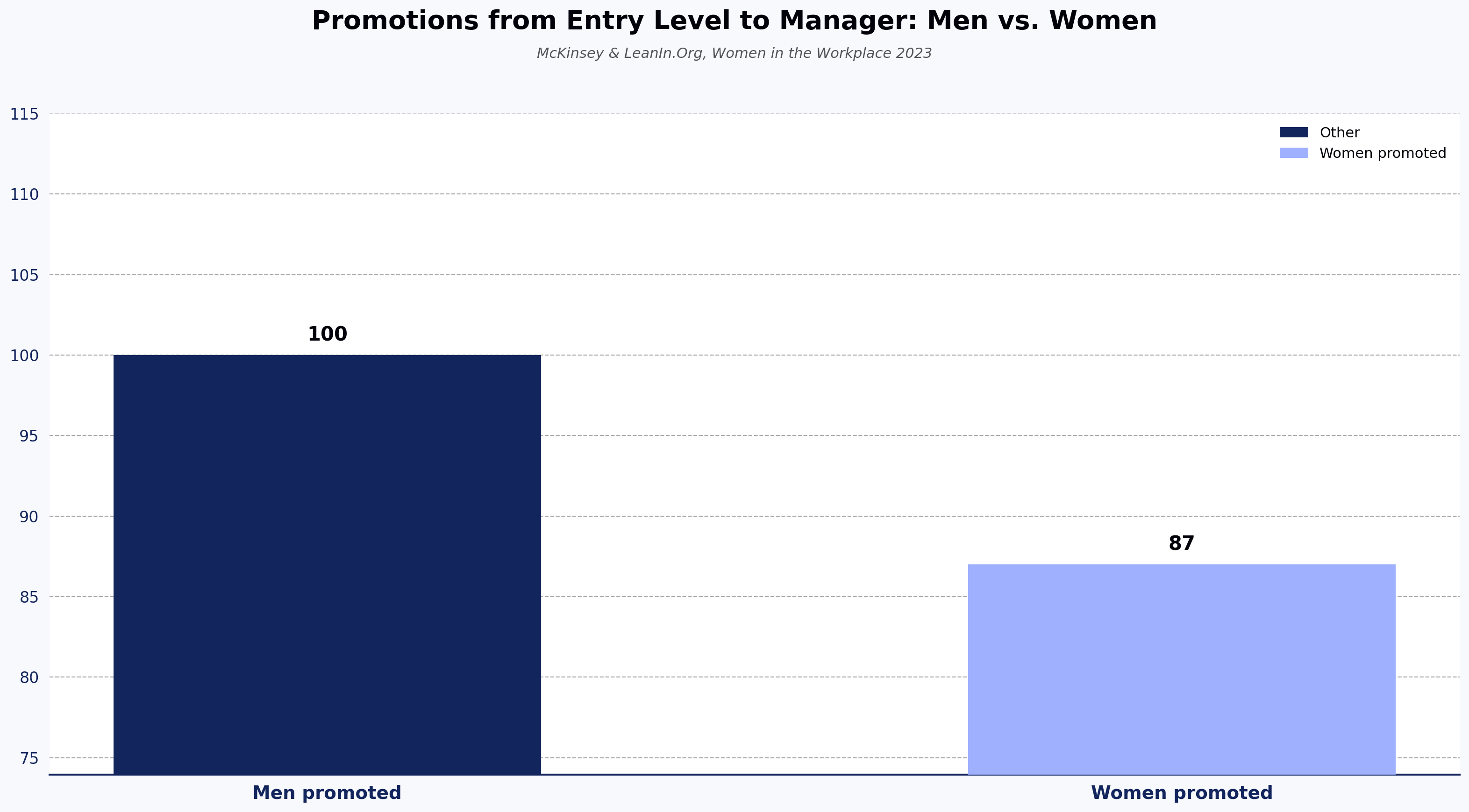
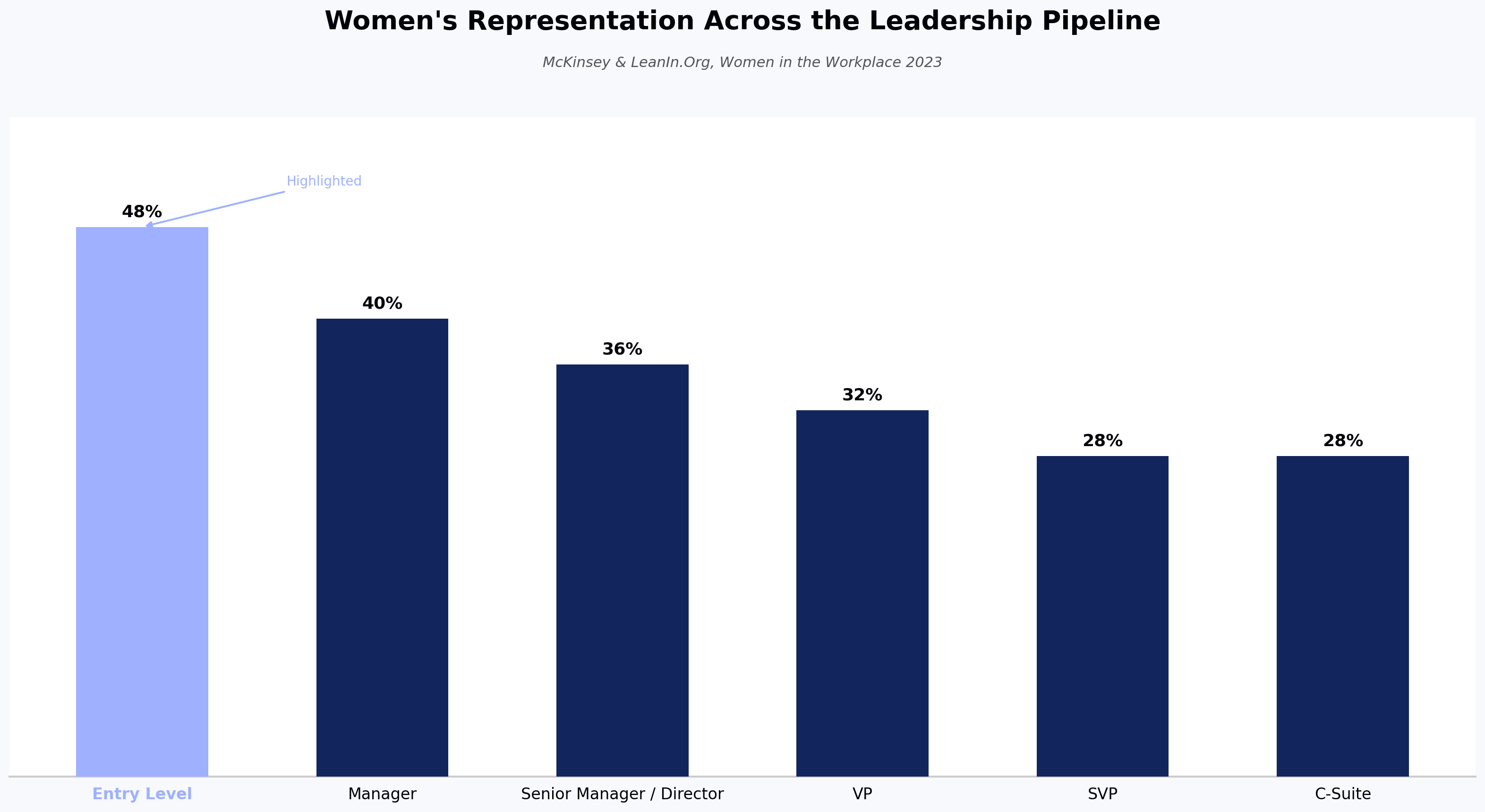
As of 2025 — gender diversity fails after mid-level roles because organizational systems are designed to hire and develop women, but not to promote them. The pipeline leaks at the exact point where informal sponsorship, opportunity allocation, and visibility become the deciding factors in advancement — and these mechanisms are applied less consistently to women than to their male peers. According to McKinsey & Company and LeanIn.Org's Women in the Workplace 2023 report, for every 100 men promoted from entry-level to manager, only 87 women are promoted — a gap known as the "broken rung" that compounds at every subsequent level. By the time you reach the C-suite, women hold roughly 28% of seats, down from 48% at entry level (per the same 2023 report; the entry-level share should be cross-verified against the source PDF before publication). The same report also documents compounding effects at the intersection of race and gender: women of color lose ground at every stage of the pipeline at a sharper rate than white women, and the broken rung is steepest for Black and Latina women in particular.

This isn't a commitment problem. It's a systems problem. And for technical hiring leaders — where women already represent a smaller share of the candidate pool — the leak after mid-level is where most of the diversity investment quietly disappears.

Intended primary reader: CHROs and Heads of Talent responsible for leadership pipeline design in technical and hybrid organizations.

Promotions from Entry Level to Manager: Men vs. Women
Source: McKinsey & LeanIn.Org, Women in the Workplace 2023

The drop-off in women's leadership is systemic, not accidental

Most organizations measure success at hiring. Fewer measure what happens after.

This is where the gap in the leadership pipeline becomes visible. Research across industries — including Catalyst's Women in Management research and the ILO's Women in Business and Management: A Global Survey of Enterprises (2019) — shows that organizations frequently lose high-performing women between mid-level management and senior leadership, not because of lack of capability, but because the system does not reliably convert potential into progression.

A consistent pattern across technical hiring teams is that companies that track promotion velocity and stretch-assignment allocation by gender close the gap faster than companies that only track representation. What gets measured at the hiring stage rarely gets measured at the progression stage.

From a workforce strategy perspective, this creates a silent but expensive issue: when mid-career women exit, organizations lose institutional knowledge that took years to build, become more dependent on external senior hiring (which is slower and more expensive than internal promotion), and narrow the range of perspectives shaping decisions at the executive level. Independent assessment data can help here — structured skills assessments surface capability that informal evaluation often misses, particularly at the first-promotion stage where the broken rung opens.

This is not a diversity gap. It is a structural leakage in leadership progression. And what is predictable in systems design is also preventable if addressed early.

What "structured sponsorship programs" actually look like operationally

Because the term "sponsorship program" is used loosely, it helps to be specific about what a structured program contains, distinct from informal mentoring or ad-hoc advocacy:

  • Named pairings with documented commitments. Each sponsor formally accepts responsibility for one to three mid-career professionals, with the relationship recorded by HR and reviewed annually.
  • Defined sponsor obligations. Sponsors are expected to nominate their assigned talent for stretch assignments, surface them in succession planning conversations, and advocate for them in promotion calibration meetings — not merely offer advice.
  • Tracked outcomes. Promotion velocity, stretch-assignment allocation, and lateral moves for sponsored individuals are measured against a control group and reviewed by the CHRO at least twice yearly.
  • Sponsor accountability tied to leader evaluation. Senior leaders' own performance reviews include a measure of how their sponsored talent has progressed.
  • Scope-limited eligibility. Programs typically target the layer one to two levels below the broken rung — usually senior individual contributors and first-line managers — where the leakage is sharpest.

This is meaningfully different from a mentorship circle or an ERG, both of which serve other purposes but do not move promotion outcomes on their own.

Sector-specific variation: tech vs. non-tech pipelines

The shape of the leak differs by sector, and interventions should follow.

In technical organizations (software, engineering, data, hardware), the entry-level female candidate share is already lower than the cross-industry average, which means the broken rung at the first promotion to manager has an outsized effect — there are fewer women in the funnel to begin with, so each missed promotion is felt more sharply at senior levels. Technical sectors also tend to weight visible output (commits, launches, on-call leadership) heavily in promotion decisions, which interacts with caregiving-driven flexibility uptake in ways that disadvantage women disproportionately.

In non-technical sectors (professional services, consumer goods, financial services back-office), the entry-level share is closer to parity, but the leak often happens slightly later — between senior manager and director — and is more often driven by client-facing travel expectations and informal partner-track sponsorship dynamics than by output-visibility issues.

The practical implication: a sponsorship program calibrated for a consulting firm's partner track will not transplant cleanly into an engineering organization, and vice versa. Interventions should be designed against the sector's specific promotion gate, not against a generic diversity playbook.

Self-selection: the contested barrier in career progression

Self-selection is a real but overstated barrier; the more important driver is that evaluation systems reward confident self-nomination over demonstrated competence.

A widely cited finding — often attributed to a frequently cited but unverified internal Hewlett-Packard review referenced secondhand in Tara Sophia Mohr's 2014 Harvard Business Review article, "Why women don't apply for jobs unless they're 100% qualified" — suggests women apply for roles only when they meet nearly all listed criteria, while men apply at around 60% qualification match. The original HP document has never been publicly released, and the 60% figure itself is widely treated as imprecise. Mohr's follow-up survey found the actual reason was less about confidence and more about a belief that hiring criteria are strictly enforced.

This framing is contested. Researchers including Tomas Chamorro-Premuzic, in Why Do So Many Incompetent Men Become Leaders? (Harvard Business Review Press, 2019), argue the causal direction runs the other way: the problem is not that women underapply, but that overconfident, less competent men overapply and are disproportionately promoted. Both framings have evidence behind them, and the honest answer is that self-selection is real but is itself a response to structural signals about who gets evaluated favorably.

Organizations often observe that less-prepared but more confident candidates step forward earlier. Over time, this creates a system that rewards visibility over demonstrated potential — meaning fewer women enter high-visibility roles early, are exposed later to leadership responsibilities, and progress more slowly into decision-making positions.

To correct this, HR teams can actively encourage early participation in stretch roles, signal that potential is valued alongside performance, and normalize imperfect readiness as part of leadership growth. Objective, skills-based evaluation can reduce reliance on self-nomination by surfacing capability that self-selection would otherwise hide.

Unstructured flexibility reduces visibility for women and slows promotion velocity

Flexible work has become a core part of how organizations operate post-2020 — and rightly so.

But compared with the pre-pandemic in-office model, flexibility without structured safeguards can unintentionally affect inclusion and leadership outcomes. When flexibility leads to reduced visibility, fewer high-impact assignments, or limited exposure to senior leadership networks, it stops being neutral. It becomes a factor in progression.

This is especially relevant for women. According to the U.S. Bureau of Labor Statistics' American Time Use Survey — Table A-1, time spent in primary activities by sex and the OECD's data on time spent in unpaid, paid, and total work, by sex, women perform a disproportionate share of unpaid caregiving globally, which correlates with higher uptake of flexible and part-time arrangements. McKinsey and LeanIn.Org's Women in the Workplace 2022 — a distinct earlier edition from the 2023 report cited above — similarly found women leaders are more likely than men to work flexibly to manage caregiving.

The solution is not to reduce flexibility. It is to redesign it. HR systems can support:

  • Equal access to strategic, high-visibility projects
  • Outcome-based performance evaluation
  • Structured visibility pathways for all working models

Flexibility should shape how work is done — not who gets ahead.

Mentorship supports growth. Sponsorship is what closes the mid-level leadership gap.

Most organizations invest in mentorship programs, and they are valuable for development. But development alone does not guarantee advancement.

A significant driver of leadership movement is sponsorship. The distinction was sharpened by Herminia Ibarra, Nancy M. Carter, and Christine Silva's 2010 Harvard Business Review article "Why men still get more promotions than women", which found that women receive more mentorship than men but less sponsorship — and that sponsorship, not mentorship, is what correlates with promotion. Sylvia Ann Hewlett's research at the Center for Talent Innovation (now Coqual) has reached similar conclusions.

Mentors offer advice. Sponsors advocate. Advocacy significantly shapes who enters the rooms where decisions are made.

To strengthen gender diversity in leadership, organizations can formalize sponsorship through frameworks such as Coqual's Sponsor Effect research or Catalyst's current inclusive leadership programming (Catalyst's MARC initiative was reintegrated into broader Catalyst programs in 2021 and is no longer offered as a standalone framework).

Questions HR teams can ask:

  • Are leaders accountable for actively sponsoring diverse talent?
  • Is sponsorship tracked and measured against promotion outcomes?
  • Are promotion decisions influenced by documented advocacy?

It's worth noting that sponsorship programs can fail when they are run as voluntary, unstructured efforts without leader accountability — Catalyst's evaluations of sponsorship initiatives have flagged this repeatedly. A program that exists on paper but is not measured is unlikely to move the needle.

Without structured sponsorship, progression remains informal and inconsistent.

Listening without action weakens trust

Employee listening mechanisms are widely adopted across organizations.

But listening alone is not enough to improve employee engagement and retention. Research on employee engagement — including Gallup's State of the Global Workplace: 2024 Report — consistently suggests that visible follow-through on feedback matters more than the act of listening itself. (This specific behavioral claim is most directly supported by Gallup's Q12 meta-analyses; the citation should be verified to the most recent edition of the report and the named researcher behind the underlying analysis before publication.)

For mid-career women especially, repeated input without visible change leads to disengagement — not because their voice is unheard, but because it does not translate into outcomes.

To close this gap, HR teams can:

  • Move from broad surveys to targeted listening groups
  • Implement faster intervention cycles
  • Communicate visible actions taken on feedback

Engagement, on the available evidence, is driven less by being heard and more by seeing change.

Where these recommendations may not apply

The interventions described here — formalized sponsorship, structured assessments, visibility audits — are most effective in organizations with the headcount and HR infrastructure to operate them consistently. They are not universal fixes.

  • Smaller organizations (under ~150 employees) often lack the senior bench to sustain a formal sponsorship program; informal but documented advocacy may be more realistic.
  • High-turnover sectors (frontline retail, hospitality) face a different pipeline problem — the mid-level retention question is reshaped by hourly-workforce dynamics that the leadership-pipeline framing does not fully address.
  • Highly specialized technical fields with very small female candidate pools at entry may see limited movement from progression-stage interventions alone; pipeline interventions further upstream (early-career programs, returnship pathways) are often the binding constraint.

Acknowledging these limits is not an argument against the interventions. It is an argument for calibrating them to the organization's size, sector, and stage.

Frequently asked questions

Why do women leave after mid-level management?

The counterintuitive finding here is that exit is often a downstream signal, not the root cause. Women at mid-level rarely cite "lack of opportunity" as the reason on the way out; exit interviews more often surface flexibility friction, manager-relationship issues, or a specific missed promotion. The structural cause — under-sponsorship at the promotion gate one or two cycles earlier — is usually invisible by the time someone resigns. This is why retention data alone is a lagging indicator and promotion-velocity tracking by gender is a leading one.

What causes the gender leadership gap?

The gender leadership gap is caused by a combination of structural and behavioral factors: unequal access to sponsorship, subjective promotion criteria, disproportionate caregiving responsibilities affecting flexible work uptake, and self-selection patterns that themselves respond to evaluation environments. No single factor explains the gap; it is cumulative, and the effects compound at the intersection of gender with race, particularly for Black and Latina women in U.S. data.

How can organizations fix gender diversity in senior leadership?

Organizations can address gender diversity at senior levels by formalizing and measuring sponsorship, using structured skills-based assessments at the promotion stage, designing flexibility policies that preserve visibility, and tracking promotion velocity by gender — not just hiring representation. The structural levers are: stretch-assignment allocation, sponsorship accountability, evaluation-criteria standardization, and visibility audits across working models.

Is the "women only apply when 100% qualified" claim accurate?

The claim originates from an unreleased internal Hewlett-Packard review cited secondhand in a 2014 Harvard Business Review article by Tara Sophia Mohr. The original document has never been published, and the specific 60% figure is widely treated as imprecise. Mohr's own follow-up research suggested the underlying reason is a belief that hiring criteria are strictly enforced, not a confidence deficit. Other researchers, notably Tomas Chamorro-Premuzic, argue the more important issue is that overconfident male candidates overapply. Both effects appear to be real; the original statistic should be treated with caution.

What is the difference between mentorship and sponsorship?

Mentorship is advisory — a mentor offers guidance, feedback, and perspective. Sponsorship is advocacy — a sponsor uses their own political capital to recommend someone for promotions, stretch roles, and visible projects. Ibarra, Carter, and Silva's HBR research found that sponsorship, not mentorship, correlates with promotion.

How does skills-based assessment reduce bias in leadership pipelines?

Skills-based assessment reduces bias by replacing subjective judgments about "readiness" with measurable evidence of capability at the specific evaluation stage where bias has the strongest effect — typically the first promotion to manager. When the evaluation gate is anchored to a standardized, scored exercise rather than to manager impression or self-nomination, the influence of informal sponsorship and confidence-gap effects narrows. (For technical first-line manager promotions specifically, structured assessment platforms such as HackerEarth's technical assessments are one available mechanism; broader internal mobility and senior leadership use cases sit outside the scope of standard technical assessment products and should be designed separately.)

Next steps

If you're responsible for closing the leadership gap in a technical or hybrid organization, the most actionable starting point is auditing where your pipeline leaks — not where it begins. Talk to our team about structured skills assessments for first-line technical manager evaluation, or explore our guide to skills-based hiring and internal mobility to see how structured evaluation reduces bias at the promotion stage.


Editor's notes for publishing: - Suggested meta title: "Why Gender Diversity Fails After Mid-Level Roles" (52 chars). Suggested meta description: "Gender diversity stalls after mid-level because systems that hire women don't promote them. Learn the structural causes and design-level fixes." (142 chars). Metadata must be locked before review passes. - Target word count was not specified in brief; this is a metadata constraint that must be locked before publishing. Current draft is approximately 2,400 words. - Featured image and at least one in-body visual required per style guide. Suggested in-body chart: a visualization of the McKinsey/LeanIn 2023 "broken rung" pipeline (entry-level → C-suite representation by gender). Suggested alt text: "Bar chart showing women's representation declining from 48% at entry level to 28% at C-suite, based on McKinsey & LeanIn.Org Women in the Workplace 2023." Caption should cite McKinsey & LeanIn.Org, Women in the Workplace 2023. - Estimated read time: 10 minutes at 250 wpm. To be displayed at publish. - Publication date to be added at publish; opening paragraph uses "As of 2025" as the temporal anchor and should be updated if the publish year differs. - Unresolved verification items flagged inline: (1) the 48% entry-level figure in the McKinsey 2023 report should be confirmed directly against the source PDF; (2) the "more than a decade" company-tenure claim was removed pending verification against approved brand messaging; (3) the FAQ reference to HackerEarth assessments has been scoped to technical hiring only, excluding senior leadership (VP/C-suite) and internal mobility framing per product catalog "Not a Fit For" guidance — escalate to product marketing if broader positioning is desired; (4) the Gallup follow-through claim should be tied to a specific named Gallup study and researcher before publish.

Women's Representation Across the Leadership Pipeline
Source: McKinsey & LeanIn.Org, Women in the Workplace 2023