5 Habits That Help Technical Candidates Stand Out at Work
Read time: 7 minutes (1,750 words ÷ 250 wpm)
Editorial methodology: This article is written by the HackerEarth Editorial Team and draws on patterns observed across technical interviews and assessments run on HackerEarth's platform, combined with named research where cited. Internal observations are flagged as editorial review, not controlled study.
Publisher notes (metadata to lock before publish): - Recommended meta title: 5 Habits That Help Technical Candidates Stand Out at Work (58 chars) - Recommended meta description: The candidates who grow into senior contributors share five observable habits. Here's how hiring teams can screen for them in a structured rubric. (148 chars) - Verify before publish: all internal HackerEarth links; McKinsey 2021 URL/year; Minto edition year; Voss 2016 publication year.
Summary: For recruiters and engineering managers, the candidates who grow into senior contributors share a small set of observable habits — how they pause, ask questions, and structure communication under pressure. This article unpacks five habits that help technical candidates stand out at work and shows how hiring teams can screen for them inside a structured interview rubric.
The most reliable way for a technical candidate to stand out at work is not technical depth — it is a set of five observable behavioral habits that show up before the first line of code is written. These habits surface in interview transcripts, in calibration sessions, and in how candidates handle ambiguity inside a structured rubric. For recruiters, hiring managers, CHROs, and engineering managers building out a pipeline, knowing which habits to screen for is the most reliable screening variable.
Daniel Goleman's foundational Harvard Business Review article on emotional intelligence argues that EI competencies are differentiators in leadership performance — a finding hiring teams can apply directly when deciding which behavioral signals to score in a rubric. We return to specific research findings inside each habit below, rather than treating citations as decoration.
1. Pausing before reacting
Pausing before you react is the habit of taking a two-to-five-second internal beat before responding to a question, comment, or unexpected event. It reduces miscommunication and signals emotional regulation to colleagues and managers — a trait that Goleman's HBR work on emotional intelligence links to higher leadership ratings, and one of the clearer behavioral markers of candidates who stand out at work.
When something goes wrong at work, the natural instinct is to answer immediately. Fast reactions, though, rarely produce the most accurate read on a situation. A brief pause to understand the situation, gather context, process information, and frame a response often produces noticeably clearer communication and fewer follow-up corrections.
In our editorial review of behavioral interview transcripts, the candidate who answers fastest in a behavioral round is rarely the candidate the panel later describes as the most thoughtful contributor in calibration. Speed gets mistaken for competence in the moment. Reviewing transcripts side by side tends to reward the deliberate.
The trade-off: pausing is not universally rewarded. In high-urgency incident response — a production outage, a customer escalation in progress, a live client objection — a visible delay can be read as hesitation rather than thoughtfulness. The habit applies most cleanly in planning conversations, design reviews, and one-on-ones, less cleanly in real-time crises. Cultures that reward fast visible output (early-stage startups, sales floors) may also penalize the reflective pattern, at least in the short term.
2. Buying thinking time with a single phrase
Buying thinking time is the habit of explicitly naming that you need a moment, rather than silently pausing. Saying "Let me think about that for a second" or "I want to give that a careful answer — can I come back to you in ten minutes?" makes the pause visible and turns it into a credibility signal rather than a silence to be filled.
This is operationally distinct from Habit 1. Habit 1 is a sub-five-second internal beat before responding. This habit is a verbal handoff that buys minutes or hours — useful when the question is genuinely complex (a strategy call, a salary negotiation, a stakeholder pushback) and a fast answer would be worse than a slow one.
In team meetings, leadership discussions, job interviews, client conversations, and stakeholder presentations, this phrase shifts the dynamic: the asker now expects a considered response, and you've reset the clock. The risk is overuse — relying on the phrase for every question signals avoidance rather than rigor. A useful threshold: deploy it when the answer has downstream consequences you can't easily reverse.
For recruiters calibrating candidates, watch for this phrase under pressure. Candidates who deploy it appropriately in a structured screen often demonstrate the same restraint on the job.
3. Tolerating silence in conversations
Tolerating silence is the habit of not rushing to fill pauses that already exist in a conversation — particularly after you've finished speaking, or after someone else has asked you something. It is one of the habits that most consistently separates candidates who stand out at work from those who blur together in panel debriefs.
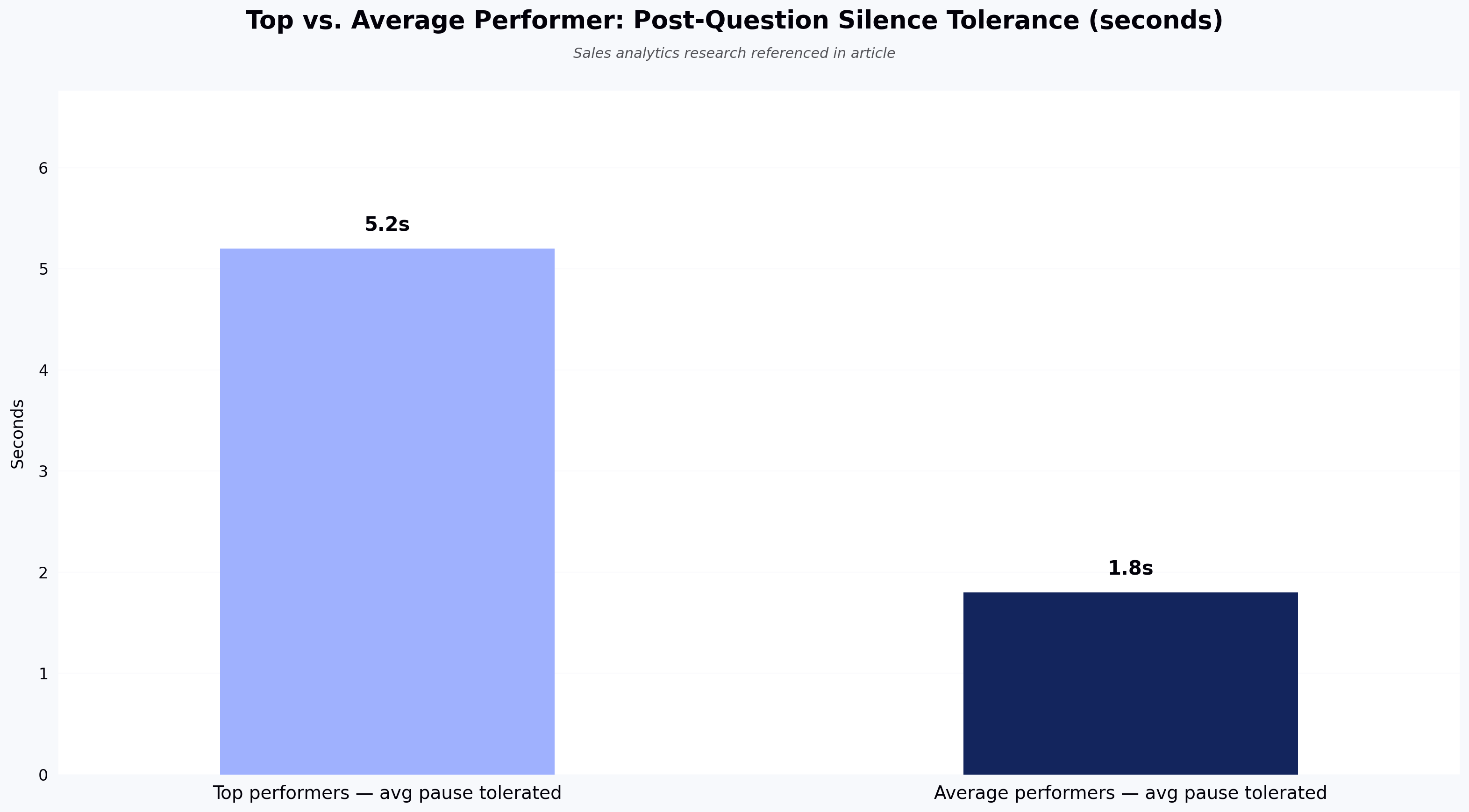
The mechanism here is different from Habits 1 and 2. Those habits create silence intentionally. This habit is about not collapsing silence that the conversation produced on its own. As an editorial observation — not a platform-derived finding — candidates who can sit with a three- to five-second post-answer pause in a behavioral round tend to come across as more composed and clearer than those who immediately add qualifiers. Chris Voss's practitioner framework in Never Split the Difference (2016) argues that the side that breaks silence first tends to concede ground; this is a practitioner observation rather than a peer-reviewed finding, and we cite it here as one framing among several.
A concrete threshold: if you've answered a question and the other person hasn't responded within three seconds, resist the urge to add a qualifier, restate the point, or fill the gap. Let them respond first. This applies in performance reviews, salary discussions, and design critiques where the temptation to over-explain is highest.
Here's a debatable angle: asking one question in a meeting is often more memorable than making three points, because a question transfers ownership of the idea to the room. The same logic applies to silence — restraint is a form of presence.

4. Asking one load-bearing question
Asking one load-bearing question is the habit of replacing a long explanation with a single, well-framed question that does more work than the explanation would. A well-framed question may surface assumptions the group hadn't examined.
What makes a question load-bearing? It typically does one of three things: exposes a hidden constraint ("What happens if the volume doubles?"), reframes the problem ("Are we solving the right problem, or the visible one?"), or forces a prioritization ("If we could only ship one of these, which matters more?"). Generic questions like "What do you think?" don't qualify.
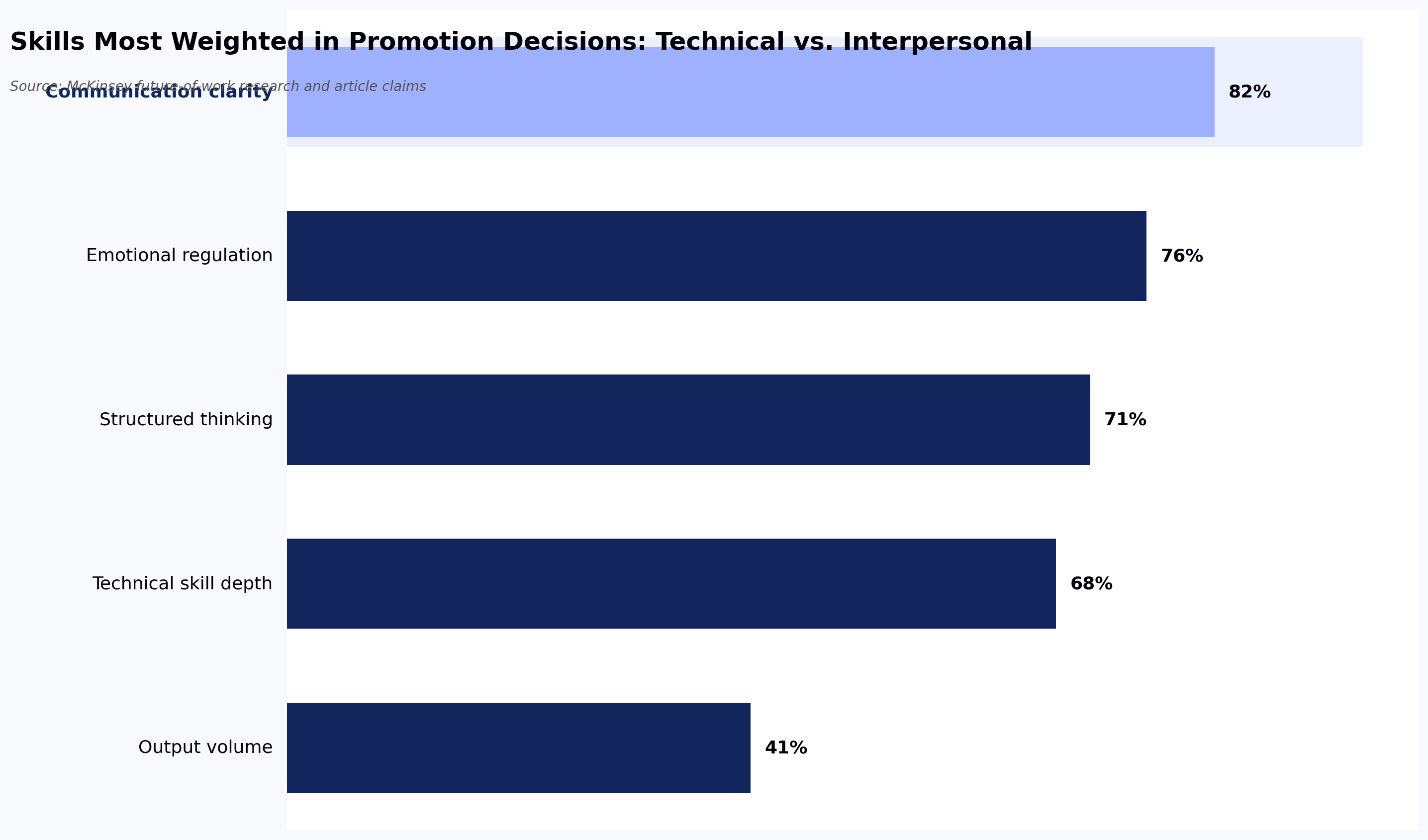
A useful framework here is the Pyramid Principle, developed by former McKinsey consultant Barbara Minto and originally published in 1978 (with revised editions since) in her book The Pyramid Principle, which structures communication by leading with the conclusion and supporting it with grouped, mutually exclusive arguments. McKinsey's Defining the skills citizens will need in the future world of work (2021) identifies communication and self-leadership as foundational skill categories employers increasingly screen for — a direct argument for scoring question quality, not just answer quality, in a rubric.
For interview contexts specifically, the STAR method (Situation, Task, Action, Result) is the standard framework for structuring responses — and the best candidates often ask the interviewer one STAR-shaped question in return to demonstrate the same structured thinking. In our view, when designing rubrics, the quality of candidate questions is often a more reliable leveling signal than the polish of their answers. For more on rubric design, see HackerEarth's guide to designing technical interview rubrics.
5. Communicating with structure and brevity
Communicating with structure and brevity is the habit that ties the others together — and it is often the most visible reason technical candidates stand out at work. High performers communicate by focusing on what matters, why it matters, and what action is needed — without adding qualifying clauses that dilute the point.
In practice, this means leading with the conclusion in written updates (a pattern the Pyramid Principle formalizes), capping verbal updates at the length that respects the listener's attention, and resisting the impulse to demonstrate effort through volume. This is the habit most directly tied to the communication and self-leadership skill categories named in the McKinsey 2021 future-of-work research cited above.
The trade-off worth naming: brevity can read as curt in cultures or relationships where context-setting is the social norm. In cross-cultural teams, in early relationships with a new manager, or in sensitive feedback conversations, leading with the conclusion without sufficient framing can damage trust. Calibrate to audience.
How hiring teams can screen for these habits
Screening for these habits in a hiring pipeline requires designing the interview itself to surface them — not relying on interviewer instinct after the fact. The point of control for recruiters and engineering managers is the rubric: which behaviors get scored, by which interviewer, against which benchmark. This is where teams decide whether they are actually screening for the habits that help technical candidates stand out at work, or just hoping to notice them.
The strongest screens share a few traits. They use open-ended behavioral prompts that don't reward pattern-matched answers — in our editorial review of behavioral transcripts on the platform, a candidate who returns a polished response to a complex situational question in under two seconds is often pulling from a script rather than reasoning in the moment. They include a structured summarization task: asking a candidate to summarize a complex project in under 90 seconds tells you more about how they think than the project itself, because conclusion-first structure is harder to replicate under time pressure than rehearsed answers. They also leave deliberate room for candidate questions at the end, because the questions a candidate asks are a stronger leveling signal than the answers they give.
The practical challenge for teams running this at scale is calibration: making sure two interviewers score the same candidate response the same way. Without recorded, standardized conditions, calibration drift compounds — interviewer A scores composure generously on Tuesday, interviewer B scores it strictly on Friday, and the same candidate behavior gets two different ratings. HackerEarth OnScreen addresses this specifically: it is an AI-led structured screening product with a deterministic evaluation framework, KYC-grade identity verification, and built-in enterprise-grade proctoring, so candidate responses are captured under comparable conditions across the pipeline. (For live multi-interviewer panel evaluation, HackerEarth's FaceCode is the companion product; OnScreen is the asynchronous structured-screening layer.)
Frequently asked questions
How should hiring teams weigh these habits against technical skill? Treat them as parallel signals, not substitutes. A common pattern in well-designed rubrics is to score communication and judgment criteria on a separate axis from technical depth, with explicit calibration anchors for each level. A senior hire who scores high on technical depth but low on these behavioral signals is often a sign the leveling band is wrong, not that the criteria should be dropped.
What interview formats best surface these habits? Structured behavioral rounds with open-ended prompts, a timed summarization task, and explicit space for candidate questions tend to surface these habits more reliably than unstructured conversations. Recording the session for calibration review reduces interviewer-to-interviewer variance, which is usually a larger source of scoring error than the rubric itself.
Which of these five habits is hardest to screen for in a 45-minute interview? Tolerating silence — because the format itself pressures both interviewer and candidate to keep the conversation moving. Most interview loops accidentally select against this habit by penalizing the candidate who pauses and rewarding the one who fills the air. If you want to actually screen for it, build a prompt that includes a deliberate silence after the candidate answers, and instruct interviewers not to break it for at least five seconds.
Next steps
For hiring teams looking to operationalize the habits that help technical candidates stand out at work, the practical step is tightening the rubric and the recording layer that supports it.
See it in action. If you're calibrating interview rubrics across a distributed hiring team, HackerEarth OnScreen captures structured screening sessions under comparable conditions so reviewers can score response structure and question quality against the same rubric anchors. Request a pilot of HackerEarth OnScreen →