Shruti Sarkar

Author
Shruti Sarkar

Blogs
Shruti writes at the crossroads of AI, ethics, and the future of hiring. With a background in both engineering and philosophy, they challenge assumptions in how we assess and select talent.
author’s Articles

Insights & Stories by Shruti Sarkar

Read Shruti Sarkar for deeply reflective takes on automation, AI interviews, and what fair, inclusive hiring could look like in tomorrow’s workplace.
Clear all
Thank you! Your submission has been received!
Oops! Something went wrong while submitting the form.
Filter
Filter

Top Employee Hiring Tools in 2026: Streamline Your Tech Recruitment Workflow

Top Employee Hiring Tools in 2026: Streamline Your Tech Recruitment Workflow

Introduction

Here is the uncomfortable truth about technical hiring in 2026. Sixty percent of companies saw their time-to-hire increase last year. Only one in nine managed to reduce it. And yet the tools to fix this problem have never been more capable or more accessible.

The issue is not a lack of options. It is that most hiring teams are using the wrong combination of tools for the job. A general-purpose ATS was never designed to evaluate whether a developer can actually write clean code. A video call tool was never meant to replace a structured technical interview. And a spreadsheet was never a hiring pipeline.

This guide is for tech recruiters and HR leaders who are ready to evaluate the tools that actually move the needle. Whether you are shortlisting platforms for the first time or replacing something that stopped scaling, here is what you need to know.

What Are Employee Hiring Tools and Why Generic Solutions Fall Short?

Defining the Modern Hiring Tool Stack

Employee hiring tools are software platforms that help organizations source, screen, evaluate, and hire candidates more efficiently. In practice, most companies use a combination: an ATS to manage the pipeline, a technical assessment platform to evaluate skills, a live interview tool, and analytics to measure what is working. The gaps between these tools are where mis-hires happen and good candidates quietly drop off.

Why Tech Recruitment Demands Specialized Tools

Hiring a software engineer is categorically different from hiring almost anyone else. You cannot evaluate coding ability from a resume. You cannot reliably assess system design thinking from a 30-minute competency interview. With 44% of job applicants admitting to some form of dishonesty in the hiring process according to a 2025 Resume Builder survey, actual skill verification has never mattered more. Companies using AI-powered assessments report 46% faster hiring cycles. That is not a marginal improvement. It is a fundamental shift in how technical teams get built.

Key Features to Look for in Employee Hiring Tools

Technical Skills Assessment and Coding Challenges

This is the feature most general-purpose ATS platforms lack and most technical hiring teams need most urgently. Look for a large regularly updated question library that covers the specific languages and frameworks your team actually uses, real-world work samples rather than abstract puzzles that have nothing to do with the role, and automated scoring that evaluates code quality rather than just whether the code runs.

AI-Powered Screening and Candidate Matching

With 60% of companies reporting increased time-to-hire, the ability to automatically filter unqualified candidates before they reach your engineering team is not a luxury. AI screening tools that rank candidates based on actual skill signals rather than keyword matches cut noise at the top of the funnel and protect the hours your engineers cannot afford to waste.

ATS Integration and Workflow Automation

Whatever platform you choose needs to connect to your existing stack without manual data transfer. Every hand-off between tools that requires a human to copy information is a place where candidates fall through the cracks and your hiring analytics break down. Check integrations before you commit.

Candidate Experience and Employer Branding

The best candidates have options and a clunky, confusing assessment process tells them exactly what working at your company might feel like. Platforms that deliver a clean, well-designed candidate experience with clear instructions and fast feedback directly affect whether your top choices accept the offer or take another one.

Analytics, Reporting and Compliance

You cannot improve what you cannot measure. Track the metrics that actually matter: assessment completion rates, candidate quality scores, time-to-hire by role, and post-hire performance correlation. GDPR compliance and bias audit documentation are baseline requirements for any platform processing candidate data at scale.

Top 10 Employee Hiring Tools for Tech Recruiters in 2026

1. HackerEarth - Best for End-to-End Technical Hiring and Skills Assessment

Most technical hiring teams end up managing three or four separate tools. HackerEarth is the only platform that handles the full technical hiring lifecycle natively, from sourcing developers through hackathons, to automated screening assessments, to live coding interviews through FaceCode, all in one place. If your team is currently stitching tools together to cover what HackerEarth does natively, the operational cost of that fragmentation is worth measuring before your next renewal.

The Assessments platform carries 40,000+ questions across 1,000+ skills covering everything from standard algorithms to GenAI and ML engineering. Tests are configurable by role, seniority, and programming language. Automated evaluation scores code quality, efficiency, and approach, not just whether the code compiles. This means your engineers only spend interview time with candidates who have already proven they can do the work.

FaceCode handles the live interview layer with a real-time collaborative code editor supporting 40+ languages, HD video, panel support for up to 5 interviewers, a diagram board for system design questions, and AI-powered summaries generated automatically after every session. Full session recording and playback means hiring decisions are made on evidence, not on what someone remembered from the call.

For sourcing, HackerEarth Hackathons engage a global developer community of 10 million+ across 133 countries. This is a fundamentally different talent pool than what comes through a job board, developers who are actively interested in solving hard problems at your company.

Key Features: 40,000+ question library across 1,000+ skills, 40+ programming language support, automated code quality scoring, FaceCode live coding interviews with AI summaries, hackathons for sourcing and employer branding, 15+ ATS integrations including Greenhouse, Lever, Workday, and SAP, GDPR compliance, ISO 27001 certification.

Best for: Engineering teams hiring developers at scale who need assessments, live interviews, and sourcing in one platform.

Pricing: Custom pricing. Free trial available.

Verdict: The most complete technical hiring platform available. For teams serious about fixing their developer hiring pipeline, this is the natural starting point.

Try HackerEarth Assessments Free at hackerearth.com.

2. Greenhouse - Best for Structured Hiring Workflows

Greenhouse is one of the most widely adopted ATS platforms for mid-to-enterprise companies and it earns that reputation. Its structured interviewing framework, configurable hiring stages, and 300+ integrations make it a reliable backbone for pipeline management. The honest limitation is that it has no native technical assessment capability. Engineering teams using Greenhouse still need a separate tool like HackerEarth to actually evaluate whether candidates can code.

Best for: Companies wanting a structured, well-documented hiring workflow with a dedicated technical assessment layer alongside it.

Pricing: Custom. Verdict: Excellent ATS that works best when paired with a purpose-built technical assessment platform.

3. Lever (LeverTRM) - Best for Recruiting CRM and ATS Combined

Lever blends applicant tracking with candidate relationship management, which makes it a genuinely useful tool for teams that want to build and nurture talent pipelines over time rather than just process whoever applies today. Its diversity analytics and candidate nurture features are well executed. Like Greenhouse, it has no native technical assessment capability and needs external support for developer hiring.

Best for: Recruiting teams focused on building long-term talent pipelines alongside managing active hiring workflows.

Pricing: Custom. Verdict: Strong CRM-ATS hybrid with a technical assessment gap that needs to be filled externally.

4. HackerRank - Best for Coding Assessments at Scale

HackerRank is the most direct competitor to HackerEarth in the technical assessment space. Its CodePair live interview product and large challenge library are well-regarded, and the platform carries strong brand recognition among developers who have used it independently for practice and certification. Where HackerEarth consistently has the edge is in breadth: hackathon capabilities, employer branding features, and enterprise customization options are all more developed. HackerRank's UX also draws more consistent complaints from both recruiters and candidates in public reviews.

Best for: Teams that want a well-known coding assessment platform and are comfortable working within a less flexible setup.

Pricing: Custom. Verdict: Covers the core technical assessment use case but offers fewer sourcing and branding features than HackerEarth.

5. Codility - Best for Automated Code Evaluation

Codility has built a solid reputation for automated code evaluation, particularly for campus and high-volume early-career hiring programs. Its task library includes real-world simulations and its anti-cheating features are reliable. The question library is smaller than HackerEarth's, the interface has not kept pace with newer platforms, and candidates frequently report frustration with rigid test environments. But for teams that need dependable volume screening at the top of the funnel, it does the job.

Best for: High-volume early-career or campus hiring programs that need reliable automated screening at scale.

Pricing: Custom. Verdict: Dependable for volume screening but limited in customization and employer branding compared to HackerEarth.

6. Workable - Best for SMB All-in-One Hiring

Workable is a well-rounded all-in-one hiring tool for smaller teams that do not have complex technical hiring needs. It covers job posting, AI-powered candidate sourcing, basic assessments, and interview scheduling in one place at a price point smaller companies can actually afford. The technical assessment features are too basic for rigorous developer evaluation, but for teams hiring across mixed roles without deep engineering requirements, it covers the essentials cleanly.

Best for: Small to mid-sized teams with mixed hiring needs and low technical hiring volume.

Pricing: From approximately $189 per month. Verdict: Good value for SMBs. Not the right fit for teams hiring engineers at any meaningful scale.

7. SmartRecruiters - Best for Enterprise Talent Acquisition

SmartRecruiters is built for the hiring complexity that comes with operating at enterprise scale across multiple regions. Its marketplace model gives large organizations access to a wide ecosystem of third-party integrations and its global compliance features are genuinely strong. It is a solid choice for centralized hiring governance across global teams. Technical assessment capability requires external integration.

Best for: Large global organizations needing centralized hiring governance across multiple regions and functions.

Pricing: Custom enterprise. Verdict: Strong at enterprise scale but needs a dedicated technical assessment layer for developer hiring.

8. iCIMS - Best for High-Volume Enterprise Hiring

iCIMS is a well-established enterprise talent cloud that covers the full hiring lifecycle reliably at very high volumes. Its career site builder is particularly strong for employer branding at scale and its onboarding tools are more developed than most ATS platforms. Technical assessment capability is limited and developer-specific hiring workflows need to be supplemented externally.

Best for: Large enterprises running very high-volume hiring programs across multiple functions who need a centralized talent cloud.

Pricing: Custom enterprise. Verdict: A reliable enterprise workhorse that needs a dedicated technical assessment layer for developer roles.

9. BambooHR - Best for Hiring and Onboarding Combined

BambooHR is genuinely better known for what happens after you hire someone than for how you hire them. Its employee management and onboarding tools are strong. Its ATS is functional for general hiring but noticeably thin for technical roles. If your team manages a mix of generalist and light technical hiring and values a smooth onboarding experience as much as structured recruiting, it covers both reasonably well in one platform.

Best for: Mid-market companies where hiring and onboarding are managed together and technical hiring volume is low.

Pricing: Custom. Verdict: Better as an HR management platform than a technical recruiting tool. Pair with a technical assessment tool for engineering roles.

10. Zoho Recruit - Best Budget-Friendly Recruitment Tool

Zoho Recruit is the most affordable option on this list and delivers a surprisingly solid feature set for the price. It covers ATS basics, job board posting, resume parsing, and candidate management with good customization options. Technical assessment capability is limited but for startups or small teams hiring across mixed roles on a tight budget, it delivers genuine value.

Best for: Startups and small teams that need an affordable, customizable recruitment tool for mixed hiring needs.

Pricing: Free plan available. Paid plans from approximately $25 per user per month.

Verdict: Excellent value for budget-conscious teams. Not equipped for technical hiring depth but a strong starting ATS for early-stage companies.

Employee Hiring Tools Comparison Table

For teams prioritizing technical skill validation, HackerEarth and HackerRank lead the pack. But HackerEarth's hackathon and employer branding capabilities give it a meaningful edge for companies that want to attract developers, not just evaluate them.

How to Choose the Right Hiring Tool for Your Tech Team

Map Your Hiring Workflow First

Before looking at any vendor, write down your actual process from the moment a role opens to the moment an offer is accepted. Where does time get wasted? Where do candidates drop off? Where are your engineers pulled into the process when they should not be? The answers tell you which part of the stack to fix first, and which features matter most for your specific situation.

Prioritize Integration Over Feature Bloat

A platform with 50 features that does not connect to your ATS will create more problems than it solves. Every disconnected system is a place where data gets lost and hiring decisions get made without the full picture. Confirm integrations with your existing tools before anything else.

Evaluate Based on Role Complexity

A recruiting tool built for general hiring is not the same as one built for technical roles. If your team is hiring engineers or data scientists, technical assessment depth matters more than any other feature on the list. Do not let a polished demo of sourcing features distract you from the question that actually matters: can this platform tell me whether a candidate can actually do the job?

Calculate Total Cost of Ownership

The monthly fee is rarely the real cost. Factor in implementation time, team onboarding, integration costs, and ongoing admin burden. A more expensive platform that saves 10 hours of engineering time per hire almost always delivers better ROI than a cheaper one that creates manual work at every stage.

Real-World Impact: How Companies Use HackerEarth to Transform Tech Hiring

Case Study Snapshot

The results teams report after adopting HackerEarth tend to cluster around the same themes: fewer unqualified candidates reaching the interview stage, faster hiring cycles, and better use of engineering time. Apisero identified top-tier tech talent 60% faster after implementing HackerEarth Assessments. MoEngage saw a 50% improvement in the quality of candidates reaching the technical interview round after adding HackerEarth as a screening step. Trimble maximized recruiter bandwidth by 66%. HSC reduced resource utilization by 50% during screening and cut the time to identify top candidates down to 15 minutes per review.

The common thread is that these teams stopped spending engineer hours reviewing candidates who should never have made it to interview in the first place.

From Hackathons to Hires

One of the less obvious advantages of HackerEarth is its Hackathons product. Most hiring tools help you process candidates who found your job posting. HackerEarth helps you attract developers who might never have applied at all. Companies running HackerEarth hackathons engage a global community of 10 million+ developers, surface candidates who actively want to solve hard problems, and build employer brand awareness in the developer community simultaneously. For engineering teams struggling to fill specialized roles, that sourcing advantage is often where the real ROI lives.

Conclusion

The employee hiring tools market is not short of options. The challenge is finding the combination that actually works for technical hiring, where the stakes of a bad hire are higher, the skills are harder to evaluate without structured assessment, and the best candidates move faster than most hiring processes can keep up with.

For teams serious about fixing their technical hiring workflow, the approach the data consistently supports is the same: standardize the assessment process, automate what can be automated, and protect your engineers' time for the evaluations that actually require human judgment.

HackerEarth was built to deliver exactly that. It handles the full technical hiring lifecycle in one platform, gives your engineering team the tools to evaluate real skills in real time, and gets sharper as you collect more performance data from successful hires.

Start a free trial or book a demo at https://www.hackerearth.com/.

12 Best Online Interview Platforms for Technical Hiring in 2026

12 Best Online Interview Platforms for Technical Hiring in 2026

Introduction

If you have ever tried to run a technical interview over a standard video call, you already know how it goes. The candidate is screen-sharing an IDE that keeps lagging, you are copying code snippets into a Google Doc, and by the end of it you are not really sure whether they can actually do the job or just talk about it convincingly.

Generic video tools were not built for this. And given that nearly 7 in 10 employers struggled to fill technical roles in 2025, while only 24% of candidates said they were happy with the interview process, the cost of using the wrong tool is higher than most teams realize.

This guide cuts through the noise. Here are the 12 best online interview platforms for technical hiring in 2026, compared honestly so you can make a confident decision without sitting through a dozen vendor demos.

Quick-Pick Summary: Best Online Interview Platforms at a Glance

Best overall for technical hiring: HackerEarth

Best for real-time pair programming: CoderPad

Best enterprise video interview platform: HireVue

Best for standardized technical assessments: CodeSignal

Best for high-volume developer screening: Codility

Best for structured multi-stage workflows: VidCruiter

Best budget-friendly video interview software: Spark Hire

Best for AI-powered async screening: myInterview

Best for one-way asynchronous interviews: Willo

Best for coding challenges combined with interviews: HackerRank

Best for anonymous technical interviews: Interviewing.io

Best for interview intelligence and note-taking: BrightHire

The 12 Best Online Interview Platforms for Technical Hiring in 2026

1. HackerEarth - Best Overall Online Interview Platform for Technical Hiring

Most teams end up stitching together a video call tool, a separate coding environment, and a third platform for assessments. HackerEarth is the only platform that handles all three natively, which is a bigger deal than it sounds when you are running 50 technical interviews a month.

Its FaceCode product gives interviewers and candidates a real-time collaborative code editor supporting 40+ programming languages. Up to 5 interviewers can join a single session without multiplying the candidate's time commitment. A built-in diagram board handles system design questions without anyone navigating away from the session. After every interview, AI-powered summaries are generated automatically covering both technical performance and behavioral signals, so your hiring managers are working from data rather than whatever they remember from the call. Full session recording and playback means you can review exactly how a candidate approached a problem, days after the fact.

Paired with HackerEarth Assessments, which carries 40,000+ questions across 1,000+ skills, you get end-to-end coverage from first-round screening to final-stage live interviews in one place. It connects with 15+ ATS platforms including Greenhouse, Lever, Workday, and SAP, and holds GDPR compliance and ISO 27001 certification.

Key Features: Real-time collaborative code editor, HD video with panel support for up to 5 interviewers, AI interview summaries, diagram board for system design, session recording and playback, candidate PII masking, 15+ ATS integrations.

Pros: The only platform combining live coding and pre-screening assessments natively. Scales from a five-person startup to Fortune 500 hiring volume. Strong candidate experience with minimal setup friction. Trusted by 4,000+ enterprises including Walmart and Amazon.

Cons: Primarily built for technical roles so it is less suited for non-technical hiring workflows. Admin setup has a learning curve for first-time users.

Pricing: Custom pricing. Free trial available.

Best for: Engineering teams hiring developers at scale who need live coding and assessments in one platform.

Start a free trial at hackerearth.com.

2. CoderPad - Best for Real-Time Pair Programming

CoderPad does one thing and does it well: it creates a clean, focused environment for live coding interviews. Its collaborative IDE supports 30+ languages, the drawing board handles architecture discussions, and session playback lets interviewers revisit how a candidate thought through a problem after the call ends. Engineering teams tend to like it because it feels close to how they actually work.

Pros: Excellent pair programming workflow. Easy for candidates to use with minimal setup. Good language coverage for most technical roles.

Cons: No built-in pre-screening assessment library, so you will need a separate tool for top-of-funnel screening. Limited analytics and reporting compared to full-stack platforms.

Pricing: From approximately $150 per month.

Best for: Teams that want a clean, dedicated live coding environment for final-stage interviews and are happy to handle screening elsewhere.

3. HireVue - Best Enterprise Video Interview Platform with AI

HireVue is the name most large enterprise HR teams already know. It covers async video interviews, AI-driven assessments, and game-based evaluations at scale, and it is widely used across multiple role types, not just technical ones. If you are running tens of thousands of interviews a year across many functions, it has the infrastructure to handle it.

Pros: Proven at enterprise scale. Broad role coverage beyond technical hiring. Deep ATS integration ecosystem.

Cons: HireVue discontinued its facial expression analysis feature after public backlash over bias concerns, a history worth knowing before you deploy AI scoring at scale. High price point puts it out of reach for smaller teams. Live coding is not a core capability.

Pricing: Custom enterprise pricing.

Best for: Large enterprises running high-volume, multi-role hiring programs where async video is the primary screening format.

4. CodeSignal - Best for Standardized Technical Assessments

CodeSignal's best-known feature is its Coding Score, a standardized benchmark that gives you a consistent, comparable signal across every candidate regardless of which company's test they took. If your team is frustrated by the subjectivity of comparing candidates across different assessments, that standardization is genuinely useful.

Pros: Standardized scoring reduces early-stage bias. Clean and straightforward candidate experience. Good coverage of common programming languages.

Cons: Live interview features are noticeably weaker than dedicated tools like FaceCode or CoderPad. Less flexibility for teams that want to build highly customized assessments.

Pricing: Custom pricing.

Best for: Teams that want a standardized, comparable technical benchmark across all candidates rather than custom-built role-specific assessments.

5. Codility - Best for High-Volume Developer Screening

Codility has been around long enough to build a solid reputation in developer screening, particularly for campus and early-career programs. Its CodeCheck product handles automated top-of-funnel screening and CodeLive handles live technical interviews when candidates make it through.

Pros: Large question library built up over years. Good for processing high screening volumes. Reasonable ATS integrations.

Cons: Candidates have consistently complained about rigid test environments that feel disconnected from real development workflows. The interface feels dated next to newer platforms.

Pricing: Custom pricing.

Best for: High-volume early-career or campus hiring programs that need reliable automated screening at scale and can live with a less modern candidate experience.

6. VidCruiter - Best for Structured Multi-Stage Interview Workflows

VidCruiter is less about coding and more about bringing structure and consistency to multi-stage hiring processes. If your team runs complex interview workflows across large panels and needs standardized scorecards and compliance-friendly documentation, it does that well. Just do not expect it to handle live coding.

Pros: Strong structured interview workflow features. Well suited for regulated industries. Good at bringing consistency across large interview panels.

Cons: No live coding or technical assessment capability at all.

Pricing: Custom pricing.

Best for: HR teams in regulated industries managing structured, multi-stage interview workflows across mixed or non-technical role types.

7. Spark Hire - Best Budget-Friendly Video Interview Software

Spark Hire is the tool you reach for when the budget is tight and the need is straightforward. One-way async video and live video interviews, easy setup, and pricing that does not require a procurement conversation. It handles the basics reliably. It just does not go anywhere near technical assessment.

Pros: Very affordable for small and mid-sized teams. Easy to set up with minimal onboarding. Clean async video experience for candidates.

Cons: No live coding capability. Not built for technical interview workflows in any meaningful way.

Pricing: From approximately $149 per month.

Best for: Small teams or startups needing simple, affordable async video screening for non-technical or mixed roles.

8. myInterview - Best for AI-Powered Async Candidate Screening

myInterview is built for speed at the top of the funnel. Candidates record async video responses and the AI shortlists them based on communication style and fit signals. Useful for teams drowning in early-stage applicants who need a faster way to identify who is worth a conversation. Not useful for anyone who needs to evaluate actual technical skills.

Pros: Handles very large application volumes efficiently. AI shortlisting meaningfully reduces early-stage review time.

Cons: Not designed for technical assessment in any form. AI personality scoring carries documented bias risks that are worth taking seriously.

Pricing: Custom pricing with a free trial available.

Best for: High-volume teams screening entry-level or non-technical candidates where speed of shortlisting matters more than technical depth.

9. Willo - Best for Asynchronous One-Way Interviews

Willo keeps things simple and that is the point. Candidates record video responses on their own time, no app download required, and you review them when it suits you. It is GDPR compliant, easy to use, and does exactly what it says. Just do not expect anything more than async video.

Pros: Genuinely simple experience for both recruiters and candidates. Strong GDPR compliance posture. No friction from app downloads.

Cons: No real-time interaction. No technical assessment capability.

Pricing: From approximately $83 per month.

Best for: Small and mid-sized teams that need a clean, compliant async video tool for non-technical roles on a modest budget.

10. HackerRank - Best for Coding Challenges Combined with Interviews

HackerRank has strong name recognition among developers and a large library of coding challenges through its CodePair live interview product. Its certification ecosystem is something candidates actually use independently to validate their skills, which gives it some credibility in the developer community. The consistent criticisms around UX and pricing transparency are worth factoring in though.

Pros: Large and well-known developer community. Extensive coding challenge library built over many years. Developer-recognized certifications add credibility.

Cons: UX complaints from both recruiters and candidates appear consistently in public reviews. Pricing lacks transparency compared to most competitors. Less flexible than HackerEarth for enterprise-level customization.

Pricing: Custom pricing.

Best for: Teams that want access to a large developer challenge library and community recognition, and are comfortable working within a less flexible platform.

11. Interviewing.io - Best for Anonymous Technical Interviews

Interviewing.io takes a different approach entirely. Rather than running your own screening, you tap into a pool of candidates who have already cleared anonymous technical interviews on the platform. For senior or specialist roles where top-of-funnel effort is high and bias in early screening is a real concern, that is a genuinely useful model.

Pros: Anonymous interview format meaningfully reduces bias at the early evaluation stage. Pre-vetted candidate pool eliminates a significant chunk of top-of-funnel work.

Cons: Limited customization makes it difficult to fit into complex enterprise hiring workflows. Not suited for high-volume or campus-scale hiring programs.

Pricing: Per-hire pricing model.

Best for: Companies hiring senior or specialized engineers who want pre-vetted talent and a demonstrably bias-reduced interview format.

12. BrightHire - Best for Interview Intelligence and Note-Taking

BrightHire is not really a standalone interview platform. It is an intelligence layer that sits on top of Zoom, Google Meet, or Teams and adds AI note-taking, structured highlights, and searchable recordings to your existing interview process. If your interviewers are spending too much time on documentation and not enough time actually evaluating the candidate, it solves that problem well.

Pros: Dramatically reduces the documentation burden on interviewers. Makes session recordings searchable and reviewable by the whole team.

Cons: Entirely dependent on your existing video conferencing setup. No live coding, no assessment capability, no standalone functionality.

Pricing: Custom pricing.

Best for: Teams that want to improve the quality and consistency of interview notes and decisions without overhauling their existing setup.

Feature Comparison Table

Note: Features and pricing change regularly. Verify current details with each vendor before finalizing decisions.

Conclusion

The online interview platform you choose has a direct impact on the quality of candidates you hire, how quickly you hire them, and what every developer who goes through your process thinks of your company afterward.

For technical hiring, using a generic video tool is a bit like using a screwdriver when you need a drill. It sort of works until it does not. The right platform gives interviewers a real environment to evaluate real skills, takes the subjectivity out of early-stage decisions, and creates a candidate experience that reflects well on your engineering team.

HackerEarth brings live coding interviews and pre-screening assessments together in one platform, with AI-powered summaries, advanced proctoring, and 15+ ATS integrations. If you are building or scaling a technical hiring program in 2026, it is the most complete starting point available.

Start a free trial or book a demo at hackerearth.com.

Choosing the Right AI Hiring Software: Why a Skills-Based Approach Matters

Rethinking Recruitment: Building AI-Driven, Skills-First Hiring Architectures for Strategic HR Leadership

Hiring has always been an exercise in predicting potential. Yet, for decades, organisations have relied on imperfect proxies, such as resumes, academic credentials, and prior job titles, to make those decisions.

These signals are convenient. But they rarely capture real capability or accurately predict future job performance.

Today, that recruitment paradigm is undergoing a fundamental shift.

As artificial intelligence in recruitment becomes deeply embedded in talent acquisition strategies, HR leaders and talent acquisition teams are moving beyond transactional hiring processes. The focus is shifting toward building intelligent, data-driven, and evidence-based hiring systems.

At the centre of this transformation is skills-based hiring, an approach that prioritises demonstrated ability over inferred potential and aligns hiring decisions with real-world job performance.

But adopting a skills-first hiring model requires more than intent. It requires choosing AI hiring platforms that do not just automate recruitment workflows but actively improve hiring accuracy, fairness, and predictive performance.

From Process Efficiency to Talent Intelligence in AI Recruitment

AI in recruitment is often positioned as an efficiency driver, reducing time to hire and automating repetitive hiring tasks.

These benefits are real. But they are only the surface.

The real transformation lies in talent intelligence and data-driven hiring.

Modern AI hiring platforms enable organisations to:

  • Analyze candidate performance through skill-based assessments at scale
  • Identify patterns that correlate with high performance in specific job roles
  • Continuously refine hiring models using real outcome and performance data
  • Reduce subjectivity by anchoring hiring decisions in structured evaluation frameworks

Research by Frank L. Schmidt and John E. Hunter reinforces this shift. Work sample tests have a validity of approximately 0.54, significantly outperforming unstructured interviews in predicting job performance.

The takeaway is clear:
Hiring accuracy improves when decisions are based on demonstrated skills and real capability, not assumptions.

Reframing Candidate Evaluation: What Strategic HR Leaders Should Prioritize

1. High Fidelity Skill Assessment in Hiring

At the core of skills-based hiring is the ability to evaluate candidates in environments that reflect real job conditions.

This means moving beyond theoretical assessments toward the following:

  • Real-world coding challenges
  • Project-based candidate evaluations
  • Role-specific job simulations

These approaches shift hiring from assumption-driven screening to evidence-based talent validation.

Instead of asking, “Can this candidate do the job?”
You observe, “How well do they actually perform in real scenarios?”

2. Structured and Defensible Hiring Decisions

Inconsistency is one of the biggest risks in traditional recruitment.

Different interviewers. Different evaluation criteria. Different interpretations.

AI-driven hiring systems address this by introducing the following:

  • Standardized candidate scoring frameworks
  • Consistent benchmarking across applicants
  • Comparable, data-driven insights across all hiring stages

This does not just improve hiring efficiency. It creates auditability and compliance.

In today’s hiring environment, decisions need to be not just effective, but also transparent and defensible.

3. Bias Reduction Through AI System Design

Bias in hiring remains a critical concern, especially when AI systems rely on historical hiring data.

To address this, HR leaders must prioritise AI recruitment platforms that:

  • Focus on candidate skills and performance, not pedigree
  • Provide transparency in evaluation criteria and scoring
  • Allow for human oversight and intervention in hiring decisions

Structured and data-driven hiring processes have been shown to significantly reduce hiring bias compared to intuition-led recruitment approaches.

When implemented correctly, AI becomes a bias reduction tool, not a risk factor.

The goal is not to remove humans from hiring.
It is to augment human judgment with consistent, data-backed insights.

4. Candidate Experience as a Strategic Hiring KPI

In the push for recruitment efficiency, candidate experience is often overlooked.

That is a mistake.

Candidate experience directly impacts:

  • Employer branding and reputation
  • Offer acceptance rates
  • Long term talent perception

High-performing organizations treat candidate experience as a core hiring metric, not a side effect.

Effective AI hiring platforms:

  • Deliver relevant and engaging skill assessments
  • Provide timely communication and feedback
  • Reflect the actual nature of the job role

Even candidates who are not selected should leave with a strong sense of fairness and transparency.

That perception builds long term employer brand equity.

5. Integration as a Value Multiplier in HR Tech

AI hiring tools do not create value in isolation.

Their true impact comes from integration with existing HR technology systems such as ATS platforms and HRIS software.

This enables:

  • End to end recruitment data continuity
  • Reduced manual hiring effort
  • Unified visibility across hiring teams

For HR leaders, integration is not just a technical feature. It is a strategic enabler for scalable hiring.

Without proper integration, even the most advanced recruitment tools risk becoming siloed systems.

Operationalizing Skills Based Hiring with AI Platforms

Platforms like HackerEarth demonstrate how skills-based hiring can be embedded into real recruitment workflows.

By enabling:

  • Real world coding assessments
  • Simulation based hiring evaluations
  • Performance driven candidate benchmarking

They align hiring processes with actual job requirements.

This is especially critical in technical hiring, where:

  • Problem solving ability
  • Adaptability in real scenarios
  • Execution of tasks

matter far more than historical credentials or degrees.

Managing the Transition to AI Driven Hiring

The case for AI-driven and skills-based hiring is strong.

But implementation comes with challenges.

Common barriers include:

  • Resistance from hiring managers accustomed to traditional hiring signals
  • Limited familiarity with AI-powered recruitment tools
  • Concerns around AI transparency and explainability

To successfully transition, organizations need to focus on:

  • Clearly communicating business impact and hiring ROI
  • Training and enabling hiring teams on AI tools
  • Rolling out changes in phased and manageable steps

AI should be positioned as an augmentation layer in recruitment, not a replacement for human decision-making.

The Future of Hiring: Skills as the Core Talent Currency

The direction of modern hiring is clear.

Degrees and job titles are becoming less reliable indicators of candidate success.

Skills, on the other hand, offer a more:

  • Dynamic
  • Measurable
  • Contextual
  • Future-ready

view of talent.

According to the World Economic Forum, nearly half of core job skills are expected to change by 2027.

This means static hiring models will continue to fall behind in a rapidly evolving job market.

Conclusion: From Hiring Processes to Talent Intelligence Systems

Choosing AI hiring software is no longer a tactical HR decision.

It is a strategic business decision.

The most forward-looking HR leaders will:

  • Replace proxy-based hiring with evidence-based talent evaluation
  • Embed structure, fairness, and consistency into every hiring decision
  • Use AI to generate actionable talent intelligence insights
  • Design hiring experiences that reflect real job performance

Because hiring is not just about filling open roles.

It is about building intelligent talent systems that can consistently identify, evaluate, and unlock human potential in a skills-driven economy.

Top 10 Automated Online Exam Proctoring Tools for Secure Hiring in 2026

Top 10 Automated Online Exam Proctoring Tools for Secure Hiring in 2026

Introduction

If you are running technical hiring at any kind of scale right now, you already know the problem. A candidate submits a near-perfect coding test. But did they actually write that code, or did they have three browser tabs open and a generous AI assistant doing the heavy lifting?

This is not a hypothetical concern anymore. It is something recruiters deal with every hiring cycle. The global online exam proctoring market was valued at $868 million in 2024 and is on track to hit $2.3 billion by 2031, growing at a CAGR of 15.5%. By 2024, 45% of corporate firms had already adopted remote proctoring for recruitment. The demand is real and growing fast.

This guide is for HR teams and tech recruiters who want a straight answer on which automated proctoring tools are worth their time, which ones are not, and how to make a smart buying decision without getting lost in vendor demos.

What Is Automated Online Exam Proctoring?

Automated proctoring is software that monitors candidates during an online assessment using webcam monitoring, audio analysis, browser lockdown, and behavioral analytics, so a human does not have to. Unlike live proctoring (expensive, hard to scale) or record-and-review (still requires manual hours), automated proctoring lets AI handle monitoring in real time. For teams hiring at volume, it is the only option that makes practical sense.

Key Features to Look for

Not every proctoring tool was built with tech hiring in mind, and the difference matters. Here is what to check before you commit to any platform.

Code plagiarism detection should be at the top of your list. A lot of proctoring tools were built for academic use and simply do not have this. For coding assessments, you need a platform that compares submissions against known online solutions and across the candidate pool, not just checks for copied paragraphs.

Browser lockdown needs to go further than blocking tab switches. For developer assessments, it should block virtual machines, developer consoles, and screen sharing tools as well.

AI identity verification using photo ID matching and liveness detection ensures the person sitting the test is actually the person who registered.

Adjustable proctoring intensity is more useful than it sounds. You do not need the same level of scrutiny on an initial screening round as you do on a final-stage technical test.

ATS integrations save your team real hours. If proctoring data does not flow directly into your existing workflow, someone is copying it manually.

GDPR and SOC 2 compliance are not optional. Any vendor that cannot clearly explain where candidate data is stored, who can access it, and when it gets deleted should not make it to your shortlist.

One thing that often gets overlooked: candidate experience. A 2023 survey found that 48% of test-takers were uncomfortable with invasive webcam monitoring. The candidates most likely to drop off mid-assessment are often the best ones, because they have other options. A clunky, over-engineered proctoring setup can quietly kill your pipeline quality.

Top 10 Automated Online Exam Proctoring Tools in 2026

1. HackerEarth

HackerEarth is the standout choice for tech hiring because proctoring is not an add-on here. It is baked directly into the coding environment where candidates actually work.

Its SmartBrowser is a dedicated desktop application that locks down the testing environment completely. It blocks tab switching, copy-pasting, screen sharing, virtual machines, developer tools, and even generative AI tools like ChatGPT. Webcam snapshots, eyeball-tracking, audio monitoring, and code plagiarism detection all run simultaneously throughout the test. Recruiters can adjust the proctoring intensity depending on the role and the stage of hiring.

Beyond proctoring, the platform supports 40+ programming languages, Jupyter Notebooks for data science roles, and real-world project-based assessments. It connects with 15+ ATS platforms including Greenhouse, Lever, Workday, and SAP. It is GDPR compliant and ISO 27001 certified, rated a G2 Leader in technical assessments, and used by 4,000+ enterprises worldwide. Teams using HackerEarth report up to 75% reduction in interviewer time and a hiring cycle that drops from the typical 29 to 44 days down to under 10.

Pricing is custom and enterprise-grade. Book a demo at hackerearth.com.

2. Mercer Mettl

Mercer Mettl gives you three proctoring modes in one platform: automated, live, and record-and-review. That flexibility is genuinely useful if your team runs a mix of assessment types across technical and non-technical roles. The question library is broad and includes psychometric tests alongside technical ones. The downside is that the interface has not aged particularly well, and pricing can be a stretch for smaller hiring teams. A solid choice for large enterprises that need to cover a lot of ground with one vendor.

3. Talview

Talview is one of the few platforms that brings AI behavioral analysis together across both skill assessments and video interviews. If your team wants a single vendor covering the full interview lifecycle rather than stitching together separate tools, it is worth a look. The setup is more involved than most competitors though, and you will need your IT team engaged from the start. Better suited to larger organizations with the internal bandwidth to get it properly configured.

4. Proctorio

Proctorio runs as a browser extension, which means candidates do not need to download a separate application. That frictionless start genuinely reduces drop-off rates. It integrates well with LMS platforms like Canvas and Blackboard. The gaps for tech hiring are significant though. There is no native code plagiarism detection, and Proctorio has faced candidate privacy complaints in the past that are worth disclosing upfront in your hiring communications. Best fit for teams already embedded in an LMS ecosystem.

5. ExamSoft (Examplify)

ExamSoft was purpose-built for high-stakes certification testing in fields like law, medicine, and accounting. Its offline capability is a real differentiator for unreliable connectivity environments. For everyday tech recruitment though, it is the wrong tool. The desktop client is heavy, setup is complex, and it lacks the developer-specific features that coding assessments need. Stick to ExamSoft if you are running professional certification programs, not general hiring.

6. ProctorU (Meazure Learning)

ProctorU offers a hybrid model where AI automated proctoring is backed up by live human oversight when things get flagged. Identity verification is among the strongest available. The catch is cost. Per-session pricing adds up quickly when you are running assessments at volume, which makes it hard to justify for routine hiring. The right fit for high-stakes exams where the cost of a bad outcome is high enough to warrant the premium.

7. Honorlock

Honorlock is browser-based, requires no application download, and has a clever feature that detects candidates using a separate phone to photograph questions and look up answers. Solid for what it does. It was built for education though, and the absence of code-specific detection features means it leaves a meaningful gap for tech recruitment use cases. Reasonable starting point for teams moving from university proctoring contracts into corporate assessments.

8. HireVue (with Proctoring Add-on)

HireVue is a respected name in video interviewing and the proctoring add-on covers identity verification and behavioral analysis during recorded video responses. The important limitation to flag is that it is interview proctoring, not coding environment proctoring. It cannot monitor a candidate writing actual code. If your team is already using HireVue for video interviews and wants a basic proctoring layer on top of that, it fills the gap. For coding assessments, it does not.

9. Auto Proctor

Auto Proctor connects directly to Google Forms and is about as lightweight as proctoring tools get. Setup takes minutes and the pricing is genuinely accessible for early-stage teams. You are trading depth for simplicity though. There is no enterprise-grade identity verification, no code plagiarism detection, no ATS integration, and no protection against GenAI tool usage during a test. Fine for low-stakes internal assessments or small teams with a limited budget.

10. Conduct Exam

Conduct Exam supports multiple regional languages and offers white-label customization, which makes it a practical option in South Asian and Southeast Asian markets where localization is a real hiring need. It is affordable and well-localized. The ecosystem is thinner than larger competitors though, with fewer integrations and a smaller support network. Best used for regional hiring programs where language support and local pricing are the primary decision criteria.

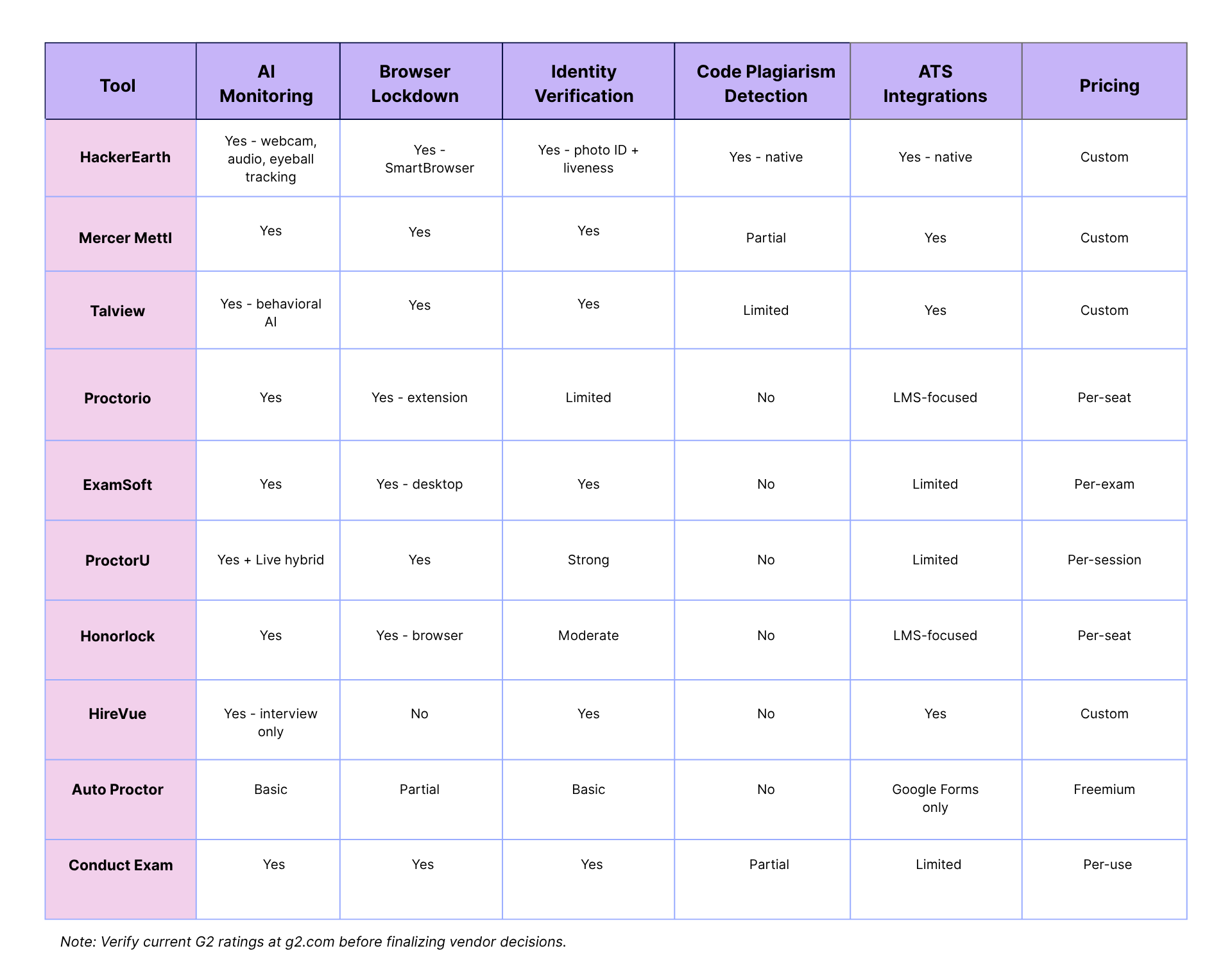
Feature Comparison Table

Note: Verify current G2 ratings at g2.com before finalizing vendor decisions.

How to Choose the Right Tool - A 5-Step Checklist

Most vendors will tell you they do everything. Here is a quick framework to cut through that.

Define your assessment type before looking at any vendor. A coding test needs completely different proctoring than a video interview or an MCQ round.

Ask for false-positive data. Every vendor claims their AI is accurate. Make them back it up with numbers.

Run an internal pilot. Have a few employees take the test cold before you go live. If it feels clunky to them, it will feel worse to a developer fielding three other offers.

Check your ATS integration. Proctoring data needs to flow into your existing workflow, not sit in a separate dashboard your team has to manually check.

Get compliance in writing. GDPR, SOC 2, data residency, retention periods. Vague answers here are a red flag.

Key questions to ask in every vendor demo: How do you handle code-specific plagiarism detection? What is your documented false-positive rate? Can proctoring intensity be adjusted per role or test stage?

HackerEarth gives clear answers to all of these. Book a demo at hackerearth.com.

Conclusion

Proctoring is not a nice-to-have anymore. For any team running remote technical assessments at scale, it is a fundamental part of getting reliable signal from your hiring process.

The key distinction to keep in mind when choosing a tool is whether it was built for developers or borrowed from education. Academic proctoring tools do a reasonable job of monitoring essay submissions and multiple choice tests. They were not designed for live coding environments, code plagiarism detection, or the kind of developer workflow that technical assessments require. Using one for tech hiring is a bit like using a general-purpose hiring platform for a very specialized role. It kind of works, but you are always fighting the gap.

HackerEarth was built for this specific use case. Start a free trial or book a demo at hackerearth.com.

Topic - AI Skills Gap in HR: Skills Companies Need in 2026

AI Skills Gap in HR: Skills Companies Need in 2026

The Talent Intelligence Gap: Why HR Must Rethink AI Skills Before 2026

HR Is Scaling AI But Not Capability

AI is no longer experimental in HR. It is embedded in AI-powered recruitment, hiring pipelines, talent analytics, workforce planning, and HR automation tools. Yet most HR teams are not failing because of a lack of AI tools. They are failing because they lack the AI skills, data literacy, and talent intelligence capabilities needed to operationalize them effectively.

According to recent research, only 50% of HR teams believe they have the right skills to deliver measurable business impact through AI adoption and data-driven hiring.

This is the real crisis:
HR is becoming AI-enabled, but not AI-capable.

For platforms like HackerEarth, where technical hiring, developer assessment, skills validation, and coding evaluations are core, this gap is not theoretical. It directly affects how companies identify, evaluate, and hire top tech talent in 2026 using AI-driven hiring solutions.

The Shift: From Talent Acquisition to Talent Intelligence

Traditional HR has primarily focused on recruitment efficiency, hiring speed, applicant tracking systems (ATS), and process optimization. With the rise of AI, the focus is shifting toward talent intelligence platforms and data-driven recruitment strategies, where organizations aim to predict candidate success, map skills to business outcomes, and make more informed hiring decisions using AI analytics.

However, most HR teams are still stuck in process automation and basic recruitment software rather than true intelligence creation. While they are using AI to streamline tasks like resume screening and candidate shortlisting, they are not fully leveraging it to generate deeper insights through predictive analytics and skill-based hiring models.

Companies are automating hiring, but not improving quality of hire, candidate experience, or hiring accuracy.

The Real AI Skills Gap in HR and Why It Matters for Tech Hiring

The AI skills gap in HR is not about technical proficiency in coding or machine learning. It is a strategic and operational disconnect in AI adoption, HR tech utilization, and decision intelligence systems between the availability of AI tools and the ability to translate them into better talent decisions.

As defined by AIHR, this gap represents the inability of HR professionals to confidently, responsibly, and effectively integrate AI-powered recruitment tools into core HR workflows, limiting its potential to enhance hiring precision, workforce planning, talent analytics, and decision intelligence.

Why this is critical for tech hiring:

When AI is used poorly, it can:

  • Generate false positives in candidate screening software
  • Incorrectly rank candidates due to keyword-based filtering and ATS limitations
  • Miss high-potential developers who demonstrate strong problem-solving skills but lack keyword alignment

Without proper technical skill validation, coding assessments, and human oversight, this leads to large-scale skill mismatches in hiring, where hired talent does not align with actual role requirements.

Research also suggests that AI adoption is 5.7x more likely to transform jobs than replace them, reinforcing the need for AI-augmented HR decision-making and smarter hiring strategies.

The 2026 Reality: Three Critical Gaps HR Leaders Must Solve

In 2026, HR teams are widely adopting AI, but the real challenge is not access to tools. It is the gap between recruitment automation and true talent intelligence platforms. Despite rising AI investments, most organizations still struggle to translate these tools into better hiring decisions, especially in high-skill areas like technical hiring and developer recruitment.

1. The Capability Gap

AI tools are available but poorly applied. As highlighted in the Avature 2026 report, AI is often limited to surface-level use cases like resume screening and ATS filtering, without deeper skill assessment platforms and coding evaluations.

This leads to hiring decisions based on incomplete candidate data and weak skill signals, increasing the risk of misalignment between what candidates appear to know and what they can actually do.

2. The Confidence vs Competence Gap

Many HR professionals feel confident using HR analytics, recruitment dashboards, and AI hiring tools, but a significant number still struggle to apply them effectively in real-world hiring decisions.

In technical hiring, this results in:

  • Over-reliance on AI-generated candidate rankings and automation tools
  • Lack of scrutiny around algorithmic bias and data gaps
  • Poor validation of real-world technical skills and coding ability

3. The Strategy Gap

AI is often used to speed up hiring rather than improve its quality. Instead of becoming a decision intelligence layer for recruitment, AI is reduced to an efficiency and automation tool, limiting its impact on:

  • Predictive hiring and candidate success modeling
  • Hiring accuracy and quality of hire metrics
  • Skill-based workforce planning and talent intelligence

Platforms like HackerEarth help close this gap by enabling real-world coding assessments, developer skill validation, and structured hiring workflows, ensuring hiring decisions are based on demonstrated ability, not just algorithmic signals.

The Skills HR Teams Need in 2026 (HackerEarth Perspective)

1. Skills-Based Hiring Expertise

The traditional reliance on degrees and job titles is rapidly declining, with skills becoming the primary hiring currency in modern recruitment. HR teams must be able to design skills-first hiring frameworks and competency-based recruitment strategies that accurately reflect real job requirements.

This includes selecting and interpreting technical assessments, coding tests, and skill evaluation platforms that measure applied, real-world competencies rather than theoretical knowledge.

Platforms like HackerEarth play a critical role by enabling scalable developer assessments, coding challenges, and real-world problem-solving evaluations.

2. AI-Augmented Decision Making

In 2026, AI is not a replacement for human judgment but an augmentation layer in recruitment technology.

HR professionals must develop the ability to:

  • Interpret AI-generated hiring insights and candidate analytics
  • Validate them using structured assessments and skill-based evaluations
  • Combine them with contextual human judgment

Research indicates that nearly 78% of AI applications are designed to augment human capability in the workplace.

3. Data Literacy for Talent Intelligence

Modern HR functions must move beyond passive dashboard consumption to active data-driven decision making in recruitment.

This means:

  • Translating recruitment metrics and hiring analytics into strategy
  • Connecting hiring data to business outcomes and workforce planning
  • Identifying patterns that influence long-term employee performance and retention

Data literacy is not just analytical. It is a core strategic HR capability.

4. Structured Assessment Design

Hiring accuracy in 2026 is increasingly determined by the quality of candidate assessment methods and evaluation frameworks.

Organizations must move toward:

  • Simulation-based hiring assessments
  • Real-world coding challenges and technical interviews
  • Scenario-driven evaluation models

Without this layer, AI-driven hiring risks becoming a keyword-matching system instead of a skill validation platform.

5. AI Ethics and Bias Detection

As AI becomes embedded in recruitment workflows and hiring software, it introduces risks around fairness, transparency, and compliance.

HR leaders must ensure:

  • Ethical AI in recruitment processes
  • Detection of algorithmic bias in hiring tools
  • Fair and inclusive candidate screening practices

Ethical integrity is now a core requirement in AI-driven hiring.

6. Human-Centric Hiring in an AI-Driven World

Despite rapid AI adoption, human judgment remains the ultimate differentiator in modern hiring strategies.

HR teams must strengthen their ability to evaluate:

  • Behavioral traits and soft skills
  • Cultural fit and team alignment
  • Candidate potential beyond resumes and algorithms

The most successful hires will combine technical expertise with organizational alignment.

The Hidden Risk: AI-Driven Mis-Hiring

One of the most significant risks in 2026 is not under-hiring, but AI-driven mis-hiring at scale due to over-reliance on recruitment automation tools.

While AI improves hiring speed and efficiency, it can unintentionally optimize for candidates who perform well in algorithmic evaluations and ATS systems, rather than those with real-world capability.

This creates a bias toward resume-optimized, keyword-heavy, model-friendly profiles, instead of depth of skill and problem-solving ability.

As a result, organizations may increase hiring speed while seeing a gradual decline in talent quality, engineering performance, and employee productivity.

This risk is especially critical in technical hiring and developer recruitment, where a strong resume does not always translate into strong coding ability or engineering capability.

Why HackerEarth’s Model Becomes Critical in 2026

In an AI-driven hiring landscape, success will not come from simply using more AI, but from using it more intelligently, especially for technical skill validation and developer hiring.

This is where HackerEarth becomes critical.

By operating at the intersection of:

  • AI-powered recruitment insights
  • Developer assessment platforms
  • Technical hiring automation tools

It ensures that hiring decisions are grounded in:

  • Demonstrated coding ability
  • Real-world problem-solving skills
  • Not just AI-generated candidate scores or resume data

This approach improves hiring accuracy, reduces bias, and strengthens technical teams in a competitive talent market.

The Future of HR Is Not AI. It Is Intelligent HR

AI will not replace HR, but it will reshape the function by exposing gaps in how teams understand skills, talent intelligence, and recruitment technology.

The real risk is not automation itself, but the inability to use it intelligently.

HR teams that rely on AI without developing deeper capability in skill evaluation, hiring analytics, and contextual decision-making will struggle to deliver high-quality hiring outcomes.

In 2026, the real competitive advantage will not come from access to AI tools, but from building HR teams that can:

  • Think critically
  • Validate talent rigorously
  • Use AI-powered hiring tools intelligently

In this evolving landscape, platforms like HackerEarth move beyond being tools.
They become foundational infrastructure for modern technical hiring and talent intelligence.

Data-Driven Tools for Technical Screening: Make Smarter Hiring Decisions

What Are Data-Driven Recruiting Tools?

Defining Data-Driven Hiring Software

If your technical hiring still relies on resume reviews and interview gut feel, you are not alone. But you are also leaving a lot of money on the table. Data-driven hiring software replaces subjective screening with objective, measurable signals collected at every stage of the funnel, from assessment scores and code quality to comparative benchmarks, and uses that data to surface the candidates most likely to actually succeed in the role.

For Talent Acquisition managers building a business case for leadership, the numbers are hard to ignore. The U.S. Department of Labor puts the cost of a bad hire at a minimum of 30% of first-year earnings. For senior technical roles, that climbs to 150% of annual salary. A SHRM and CareerBuilder study puts total damage for some roles at up to $240,000 per mistake. A structured, data-driven screening process is not a nice-to-have. It is a financial risk management decision.

Why Technical Screening Specifically Needs a Data-Driven Approach

Technical hiring is uniquely difficult to evaluate without data. A developer can interview confidently and still write unmaintainable code. With 53% of new hires reportedly using generative AI in their job search in 2024, a polished resume tells you almost nothing about real ability.

Skills-based, data-driven screening closes this gap directly. According to Toggl Hire's 2025 report, companies using skills-focused hiring reduce time-to-hire by up to 86% and achieve 93% predictive confidence in their assessment results. That is the difference between hoping your instincts are right and actually knowing.

Key Features to Look for in a Data-Driven Technical Screening Platform

Standardized, Skill-Based Coding Assessments

Most teams waste interview time on candidates who looked good on paper but cannot do the actual work. The fix starts with assessments built around real job-relevant problems, not abstract puzzles. Look for tests configurable by role, seniority, and programming language, with work samples like debugging tasks and code reviews that reflect actual day-to-day responsibilities.

Real-Time Analytics Dashboards and Recruitment Analytics

A score out of 100 tells you almost nothing without context. A strong hr analytics tool shows how each candidate ranks against others who took the same assessment, where their skill gaps are, and how your entire pipeline is performing at every stage. This is what turns screening from an administrative task into something hiring managers actually trust.

AI-Powered Proctoring and Plagiarism Detection

If candidates can freely use AI tools or copy solutions during your assessment, the data you collect is worthless. AI-powered proctoring that detects tab switching, copy-paste behavior, and unauthorized tool usage is not a premium add-on. It is what makes your screening data trustworthy enough to act on.

Predictive Scoring and Candidate Ranking Models

Good predictive hiring tools go beyond raw scores by factoring in code quality, problem-solving approach, and patterns from prior successful hires to rank candidates by likely job performance. The goal is not to find the best test-taker. It is to find the person most likely to thrive six months after joining.

Integration with Existing HR Tech Stack

Your hiring data tools need to push candidate information directly into your ATS without anyone copying data manually between systems. A disconnected stack does not just create admin overhead. It means insights never reach the people making hiring decisions.

Critical Metrics Data-Driven Hiring Tools Should Track

Time-to-hire is the baseline. The 2025 average sits at 44 days. Data-driven recruiting tools cut this by removing unqualified candidates earlier and automatically.

Assessment completion rate is your early warning signal. A low rate usually means the test is too long or poorly calibrated for the target seniority, and it is quietly costing you candidates before you even know they dropped off.

Candidate quality score tracks how many people passing your screening actually succeed in live interviews. If this is consistently low, your assessment is measuring the wrong things and your engineers are sitting in interviews they did not need to be in.

Cost-per-qualified-candidate tells you whether your sourcing channels are generating volume or genuine quality, which matters when you are justifying budget to leadership.

Post-hire performance correlation closes the loop by comparing assessment scores to six or twelve month performance reviews, telling you whether your screening tool is genuinely predictive or just creating the appearance of rigor.

The ROI of Data-Driven Technical Screening

Quantifying Cost-per-Hire Reduction

Teams using AI to automate screening and scheduling report 20 to 40% lower cost-per-hire, according to 2025 data from Greenhouse and GoodTime. Technical roles frequently cost between $10,000 and $20,000 to fill. A 30% reduction across 50 hires a year is a number that is easy to put in front of leadership. For TA managers building a business case, pair this with your current average cost-per-hire and the math does most of the work for you.

Reducing Mis-Hires and Turnover Costs

This is where the real money is. A 2025 Toggl Hire report found that 48% of businesses spend between $5,000 and $10,000 in direct replacement costs alone when a hire does not work out, and that is before accounting for the hidden losses: delayed projects, team morale damage, and the engineering manager hours that quietly disappear into supporting a struggling employee. Structured, skills-based assessments that measure actual job-relevant ability reduce how often this happens. That is the core value proposition of data-driven talent acquisition.

Scaling Hiring Without Scaling Headcount

Recruiter headcounts have dropped from an average of 31 to 24 per team since 2022 while the number of open positions has grown by 56% and application volumes have increased 2.7 times. People analytics tools and data-driven hr software are what allow smaller teams to maintain quality at higher volume without burning out. The ROI here is not just cost savings. It is giving your team back the capacity to actually do their jobs well.

How HackerEarth Powers Data-Driven Technical Screening

End-to-End Assessment Platform with Built-In Analytics

HackerEarth is built specifically for technical hiring, which means the analytics are designed around what engineering teams actually care about, not repurposed from a generic HR dashboard. The platform combines a library of 40,000+ questions across 1,000+ skills with automated scoring that evaluates not just whether code works but how efficiently and cleanly it was written. Detailed candidate reports show hiring managers how a candidate approached the problem, not just whether they got the answer right.

The real-time analytics dashboard gives recruiters a clear view of the entire pipeline: completion rates, score distributions, global skill benchmarks, and comparative candidate rankings. Every data point flows directly into your ATS through integrations with Greenhouse, Lever, Workday, SAP, and 15+ other platforms, so nothing lives in a silo.

Real Customer Results

Teams using HackerEarth report up to 75% reduction in interviewer time costs, with hiring cycles dropping from over a month to under 10 days. Its AI screening agents filter out up to 80% of unqualified applicants early in the funnel, so your engineers spend their limited interview time with candidates who have already proven they can do the work, not candidates who simply look good on paper.

Enterprise-Grade Customization and Support

HackerEarth supports role-specific assessment customization, adjustable difficulty levels, project-based work samples, and Jupyter Notebook integration for data science roles. It is GDPR compliant and ISO 27001 certified. It is rated a G2 Leader in technical assessments and trusted by 4,000+ global enterprises for both campus and lateral hiring at scale. And if something goes wrong during a high-stakes hiring cycle, you are not waiting on a ticket queue. Enterprise accounts get dedicated support from a team that understands technical recruitment, not just software.

Request a demo at hackerearth.com.

How to Choose the Right Data-Driven Hiring Tool: A Decision Framework

Assess Your Hiring Volume and Complexity

Start here before looking at any vendor. Higher volume hiring demands stronger automation and tighter ATS integration. Smaller teams often care more about assessment customization and role-specific benchmarking. Getting this wrong means paying for features you will never use.

Evaluate Data Granularity and Reporting Capabilities

Ask every vendor to show you an actual candidate report, not a demo slide. Does it show code quality or just pass and fail? Does it benchmark against a global pool? If the answers are vague, it is not a real recruitment analytics platform.

Prioritize Candidate Experience

The candidates most likely to abandon a clunky or overly long assessment are exactly the ones with other options. Ask every vendor for their average assessment completion rate. A low number tells you more about the real candidate experience than any sales demo will.

Check for Compliance and Fairness Auditing

Ask for documented bias audits, GDPR compliance, SOC 2 certification, and clear data retention policies. Any platform making predictions about candidates needs to demonstrate its models do not systematically disadvantage protected groups. This is not just a legal requirement. It is what makes your hiring process defensible.

Conclusion

Gut-feel hiring in technical roles is an expensive habit and the data makes that case clearly. Companies that invest in structured, data-driven technical screening make better hires, faster, with less wasted interviewer time and fewer costly mis-hires to recover from.

For TA managers building a business case for leadership, the numbers are concrete: lower cost-per-hire, fewer replacement cycles, and a smaller team that can handle more volume without burning out. For recruiters frustrated with subjective screening, the shift to data gives you something solid to stand behind when a hiring decision gets questioned.

The right platform gives you a clear, defensible view of candidate ability based on real work and gets sharper over time as you collect more data from successful hires. HackerEarth was built to deliver exactly that for technical hiring teams.

Start a free trial or book a demo at hackerearth.com.

FAQs

What are data-driven tools in the context of technical hiring? Platforms that replace subjective screening with structured assessments and measurable signals, using data like code quality scores, assessment benchmarks, and post-hire performance to guide hiring decisions rather than gut feel.

How do predictive hiring tools reduce time-to-hire for engineering roles? By automatically filtering out unqualified candidates at the top of the funnel using objective assessment scores, so engineering managers only spend interview time on pre-vetted candidates who have already demonstrated real ability.

What recruitment analytics metrics should HR teams track? Time-to-hire, cost-per-qualified-candidate, assessment completion rate, candidate quality score, offer acceptance rate, and post-hire performance correlation. Together these give you a complete picture of whether your screening process is actually working.

Can data-driven hiring software eliminate unconscious bias in screening? It significantly reduces it by standardizing how every candidate is evaluated against the same criteria. Bias audits of assessment content and scoring models are still necessary to ensure the tool itself does not carry embedded bias.

How does HackerEarth use data to improve technical screening outcomes? HackerEarth collects structured performance data at every assessment stage including code quality, problem-solving approach, and time management, benchmarks candidates against a global pool, and surfaces actionable insights through direct ATS integrations so the right information reaches the right decision-makers without manual effort.