Arpit Mishra

Author
Arpit Mishra

Blogs
From dorm rooms to boardrooms, Arpit has built a career connecting young talent to opportunity. Their writing brings fresh, student-centric views on tech hiring and early careers.
author’s Articles

Insights & Stories by Arpit Mishra

Arpit Mishra explores what today’s grads want from work—and how recruiters can meet them halfway. Expect a mix of optimism, strategy, and sharp tips.
Clear all
Thank you! Your submission has been received!
Oops! Something went wrong while submitting the form.
Filter
Filter

Kruskal’s algorithm (Minimum spanning tree) with real-life examples

Most of the cable network companies use the Disjoint Set Union data structure in Kruskal’s algorithm to find the shortest path to lay cables across a city or group of cities.

Which leads us to this post onthe properties of Disjoint sets union and minimum spanning tree along with their example.

Before we proceed with an example of Kruskal’s algorithm, let’s first understand what disjoint sets are.

What are Disjoint Sets?

A disjoint set is a data structure which keeps track of all elements thatare separated by a number of disjoint (not connected) subsets.

With the help of disjoints sets, you can keep a track of the existence of elements in a particular group.

Let’s say there are 6 elements A, B, C, D, E, and F. B, C, and D are connected and Eand F arepaired together.

This gives us 3 subsets that haveelements (A), (B, C, D), and (E, F).

Disjoint sets help us quickly determine which elements are connected and close and tounite twocomponents into asingle entity.

A disjoint set data structure consists of twoimportant functions:

Find() – It helps to determine which subset a particular element belongs to.

It also helps determine if the element is in more than one subset.

Union() – It helps to check whether a graph is cyclic or not. And helps connect or join two subsets.

Implementation of Disjoint Set

For the previous example, we assumethat for the set (B, C, D), B is a parent node.

For the disjoint set, we keep a single representative for each node.

If we search for an element in a particular node, it leads us to the parent of that particular node.

Therefore, when you search for D, the answer would be B.

Similarly, we can connect the subset (A) to (E, F ) which would result in node Aas the parent node.

Now we have twosubsets, but both B and A don’t have any parent node.

Each tree is an independent disjoint set, that is if twoor more elements are in the same tree, they are part of the same disjoint set, else they are independent.

So if for a particular tree B is a representative, then Parent[i]=B.

If B is not a representative, we can move up the tree to find the parent or representative for the tree.

You can read more here about Basics of Disjoint sets.

What is Kruskal’s algorithm?

Spanning tree is the sum of weights of all the edges in a tree.

A minimum spanning tree (MST) is one which costs the least amongall spanning trees.

Here is an example of aminimum spanning tree.

minimum spanning tree, kruskal's algorithm, spanning tree, kruskal algroithm, kruskal

Kruskal’s Algorithm and Prim’s minimum spanning tree algorithm are two popular algorithms to find the minimum spanning trees.

Kruskal’s algorithm uses the greedy approach for finding a minimum spanning tree.

Kruskal’s algorithm treats every node as an independent tree and connects one with another only if it has the lowest cost compared to all other options available.

Step to Kruskal’s algorithm:

  • Sort the graph edges with respect to their weights.
  • Start adding edges to the minimum spanning tree from the edge with the smallest weight until the edge of the largest weight.
  • Only add edges which don’t form a cycle—edges which connect only disconnected components.

Or as a simpler explanation,

Step 1 – Remove all loops and parallel edges

Step 2 – Arrange all the edges in ascending order of cost

Step 3 – Add edges with least weight

But how do you check whether twovertices are connected or not? That’s where the real-life example of Disjoint Sets come into use.

Kruskal’s algorithm example in detail

I am sure very few of you would be working for acable network company, so let’s make the Kruskal’s minimum spanning tree algorithm problem more relatable.

On your trip to Venice, you plan to visit all the important world heritage sites but are short on time. To make your itinerary work,you decide to use Kruskal’s algorithm using disjoint sets.

Here is amap of Venice.

Kruskal’s algorithm,Disjoint set union, Minimum spanning tree, Kruskal’s algorithm real world application, Disjoint set application, Minimum spanning tree real life application, Kruskal’s algorithm explained, Minimum spanning tree vs travelling salesman problem, Difference between kruskal’s algorithm and traveling salesman problem, Implementation of Disjoint set union

Let’s simplify the map by converting it into a graph as below and naming important locations on the map with lettersand distance in meters (x 100).

Cannaregio Ponte Scalzi Santa Corce Dell ‘Orto Ferrovia Piazzale Roma San Polo Dorso Duro San Marco St. Mark Basilica Castello Arsenale
A B C D E F G H I J K L

Let’s understand how Kruskal’s algorithm is used in the real-world example using the above map.

Step 1- Remove all loops and parallel edges

So for the given map, we have a parallel edge running between Madonna dell’Orto (D) to St. Mark Basilica (J), which is of length 2.4kms(2400mts).

We will remove the parallel road and keep the 1.8km (1800m) length for representation.

Kruskal's algorithm,minimum spanning tree algorithm, Kruskal’s algorithm,Disjoint set union, Minimum spanning tree, Kruskal’s algorithm real world application, Disjoint set application, Minimum spanning tree real life application, Kruskal’s algorithm explained, Minimum spanning tree vs travelling salesman problem, Difference between kruskal’s algorithm and traveling salesman problem, Implementation of Disjoint set union

Step 2 – Arrange all the edges on the graph in ascending order. Kruskal’s algorithm considers each group as a tree and applies disjoint sets to check how many of the vertices arepart of other trees.

Kruskal's algorithm,minimum spanning tree algorithm, Kruskal’s algorithm,Disjoint set union, Minimum spanning tree, Kruskal’s algorithm real world application, Disjoint set application, Minimum spanning tree real life application, Kruskal’s algorithm explained, Minimum spanning tree vs travelling salesman problem, Difference between kruskal’s algorithm and traveling salesman problem, Implementation of Disjoint set union

Step 3 –Add edges with least weight; we begin with the edges with least weight/cost. Hence, B, C is connected first considering their edge cost only 1.
Kruskal's algorithm,minimum spanning tree algorithm, Kruskal’s algorithm,Disjoint set union, Minimum spanning tree, Kruskal’s algorithm real world application, Disjoint set application, Minimum spanning tree real life application, Kruskal’s algorithm explained, Minimum spanning tree vs travelling salesman problem, Difference between kruskal’s algorithm and traveling salesman problem, Implementation of Disjoint set union
I, J has cost 1; it is the edge connected next.

Kruskal's algorithm,minimum spanning tree algorithm, Kruskal’s algorithm,Disjoint set union, Minimum spanning tree, Kruskal’s algorithm real world application, Disjoint set application, Minimum spanning tree real life application, Kruskal’s algorithm explained, Minimum spanning tree vs travelling salesman problem, Difference between kruskal’s algorithm and traveling salesman problem, Implementation of Disjoint set union

Then, we connect edges with weight = 2.

Kruskal's algorithm,minimum spanning tree algorithm, Kruskal’s algorithm,Disjoint set union, Minimum spanning tree, Kruskal’s algorithm real world application, Disjoint set application, Minimum spanning tree real life application, Kruskal’s algorithm explained, Minimum spanning tree vs travelling salesman problem, Difference between kruskal’s algorithm and traveling salesman problem, Implementation of Disjoint set union

Similarly, we connect node K, Lwhich has an edge with weight = 3.

Kruskal's algorithm,minimum spanning tree algorithm, Kruskal’s algorithm,Disjoint set union, Minimum spanning tree, Kruskal’s algorithm real world application, Disjoint set application, Minimum spanning tree real life application, Kruskal’s algorithm explained, Minimum spanning tree vs travelling salesman problem, Difference between kruskal’s algorithm and traveling salesman problem, Implementation of Disjoint set union

As given in the table above, all the edges are connected in ascending order, ensuring no loop or cycle is formed between 2 vertices.

Thisgives us the following graph, which is the minimum spanning tree forthe given problem.

Kruskal's algorithm,minimum spanning tree algorithm, Kruskal’s algorithm,Disjoint set union, Minimum spanning tree, Kruskal’s algorithm real world application, Disjoint set application, Minimum spanning tree real life application, Kruskal’s algorithm explained, Minimum spanning tree vs travelling salesman problem, Difference between kruskal’s algorithm and traveling salesman problem, Implementation of Disjoint set union

Here Kruskal’s algorithm using C++

#include <iostream>
#include <vector>
#include <utility>
#include <algorithm>

using namespace std;
const int MAX = 1e4 + 5;
int id[MAX], nodes, edges;
pair <long long, pair<int, int> > p[MAX];

void initialize()
{
    for(int i = 0;i < MAX;++i)
        id[i] = i;
}

int root(int x)
{
    while(id[x] != x)
    {
        id[x] = id[id[x]];
        x = id[x];
    }
    return x;
}

void union1(int x, int y)
{
    int p = root(x);
    int q = root(y);
    id[p] = id[q];
}

long long kruskal(pair<long long, pair<int, int> > p[])
{
    int x, y;
    long long cost, minimumCost = 0;
    for(int i = 0;i < edges;++i)
    {
        // Selecting edges one by one in increasing order from the beginning
        x = p[i].second.first;
        y = p[i].second.second;
        cost = p[i].first;
        // Check if the selected edge is creating a cycle or not
        if(root(x) != root(y))
        {
            minimumCost += cost;
            union1(x, y);
        }    
    }
    return minimumCost;
}

int main()
{
    int x, y;
    long long weight, cost, minimumCost;
    initialize();
    cin >> nodes >> edges;
    for(int i = 0;i < edges;++i)
    {
        cin >> x >> y >> weight;
        p[i] = make_pair(weight, make_pair(x, y));
    }
    // Sort the edges in the ascending order
    sort(p, p + edges);
    minimumCost = kruskal(p);
    cout << minimumCost << endl;
    return 0;
}

After understanding how Kruskal’s algorithm works, it’s important to understand the difference between MST and TSP.

Minimum Spanning Tree vs. Traveling Salesman problem

A minimum spanning tree helps you build a tree which connects all nodes, or as in the case above, all the places/cities with minimum total weight.

Whereas, a traveling salesman problem (TSP) requires you to visit all the places while coming back to your starting node with minimum total weight.

Following are some of the other real-life applications ofKruskal’s algorithm:

  1. Landing Cables
  2. TV Network
  3. Tour Operations

If you understood the example and working with disjoint sets, you are all set to join the CodeMonk challenge on the Disjoint Sets Union.

15 best computer programming languages for beginners

Computer programming languages are often confusing for beginners, each with its own dialect and vernacular.

And every programming language has its own set of syntax and code to write. So how to chose a programming language to learn?

With computer programming languages ranging from 67-year-old Assembly language to the young Ruby language.

And you know what? Every language has its own presence in the computer programming world.

Even a brief glance at the list of programming languages available gives one a nightmare. But for now, knowing the top programming languages to learn will help.

But then which is the best computer programming languages for beginners? or which programming language to learn first?

I decided to shortlist the most commonly used computer programming languages for beginners and make a complete guide to it.

Hope the list helps you.

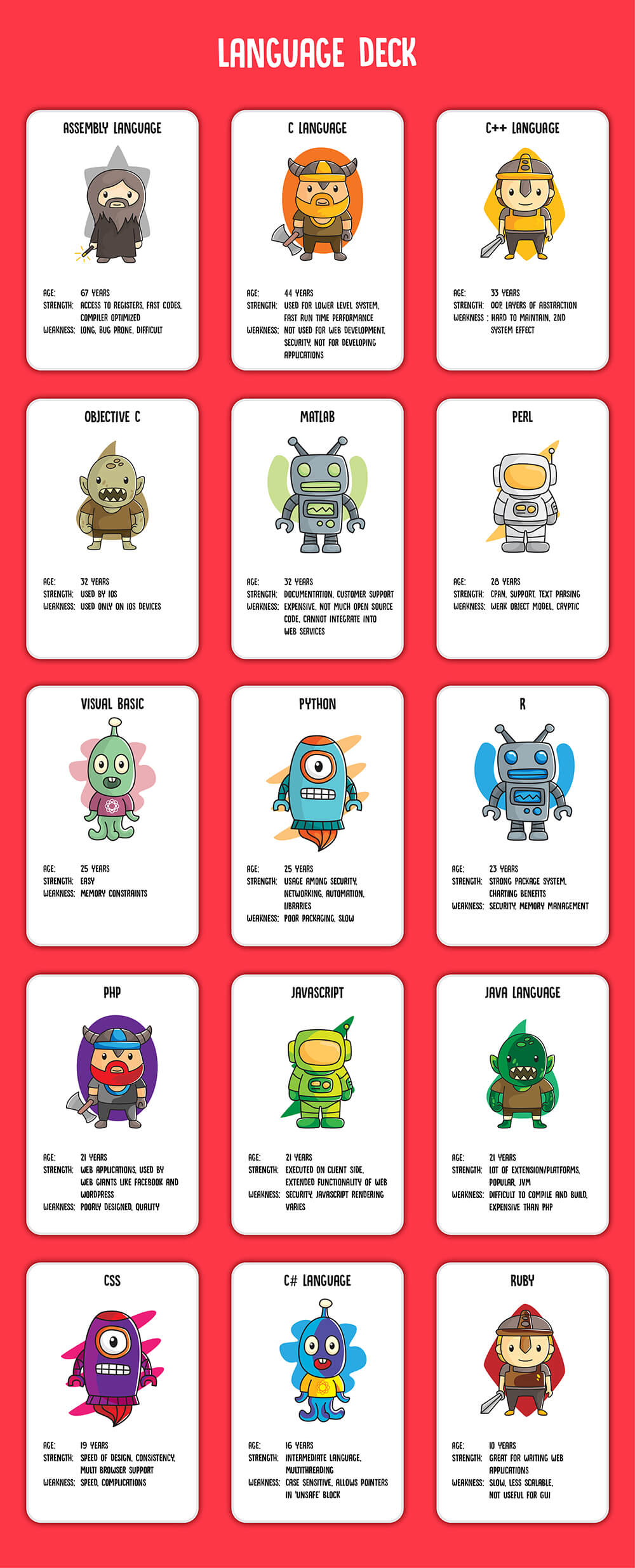
Check this computer programming deck for dummies before you read further about each of them in detail.

This will help you with a quick glance over each programming language.

Programming language infographic, computer programming infographic, infographic programming, computer programming languages for beginners, Guide to computer programming languages, Programming languages guide, Dummies guide to programming languages, Dummies guide to computer programming languages, Learn C, Learn computer programming languages, How to begin with computer programming languages, which programming languages should I begin with, Which is the best programming languages, 15 Best programming languages to learn for beginners, programming languages to learn for beginners, 15 programming languages to learn first

  • Assembly Language

    Learn more

    It was developed as a shorthand to machine language so that you don’t only have to remember 0’s and 1’s while coding.

    Today, Assembly languages are used to access a specialized processor or address critical performance issues by direct hardware manipulation.

    Typically, they are used in low-level embedded and real-time systems.

    If you want to program a processor, the assembly language may not be necessary, but it is invaluable.

    Major Organization Users: IBM, Apple

  • C++ Language

    Learn more

    It is a middle-level, general purpose language. C++ brings in the feature of being object-oriented compared with its predecessor C.

    C++ is popular in areas where graphical representation is required like that for Windows and Macintosh.

    C++ has a rich function library and is a highly portable language.

    Here is beginners guide to C++ - C++ language tutorial

    Major Organization Users: Google, Mozilla, Firefox, Winamp, Adobe Software, Amazon, Lockheed Martin

  • C Language

    Learn more

    It is a general-purpose programming language.

    C provides a construct to map assembly language to C and has been most popularly used for operations which had been previously coded in assembly languages, including operating systems.

    C is one of the most widely used languages and has been a great influence on its successors.

    Major Organization Users: Microsoft, Apple, Oracle, Cisco, Raytheon

  • Objective C

    Learn more

    It is a general-purpose, object-oriented programming language that adds Smalltalk-style messaging in C language.

    Objective-C is one of the basic language used by Apple products and had been used in the development of iOS and OSX operating systems.

    Major Organization Users: Apple

  • MATLAB

    Learn more

    It integrates computation and programming in an easy-to-use environment where most of the objectives are represented by mathematical notation.

    Matlab is a high-performance language and is typically used for mathematical computation and algorithm development.

    Major Organization Users: GE, Continental, Robert Bosch, Honeywell, Mercedes-Benz

  • PERL

    Learn more

    It is a scripting language with syntax similar to C and has many features of UNIX. Programs written in Perl are called Perl script.

    Perl is an interpreted (not compiled) language that can optionally be compiled just before execution into either C code or cross-platform bytecode.

    Major Organizations Users: Apple, Yahoo, BBC, IMDB

  • R

    Learn more

    It is a dialect of S language. R language is used for statistical computing and graphics.

    R is commonly used by statisticians and data miners for statistical and analysis.

    R comes as a free software package and is available under GNU General public license.

    Major Organizations Users: Google, GE, Dropbox

  • Visual Basic

    Learn more

    It is a high-level language implemented on the .NET framework. VB was derived from BASIC, a user-friendly language designed for beginners.

    It enables the rapid application development (RAD) of graphical user interface (GUI) applications and access to databases using objects.

    Major Organizations Users: Microsoft

  • PYTHON

    Learn more

    It is another interpreted language on this list. Developed as a general purpose language.

    Python design emphasizes code readability and helps the user express in fewer lines of codes.

    Major Organizations Users: Google, Pinterest, Instagram, YouTube, DropBox, NASA, ESRI

  • PHP

    Learn more

    It is a scripting language used by users to create dynamic pages, which can be used further for transferring and submitting information on the web.

    You can connect with servers, databases, and external websites based on IP address or information available.

    PHP is one of the most commonly used scripting languages by web developers.

    Major Organizations Users: Facebook, Google, GE, Wordpress

  • Javascript

    Learn more

    It is a high-level programming language. Along with HTML and CSS, Javascript is one of the core languages in the development of World Wide Web content production.

    Most of the websites support javascript without needing plugins.

    Javascript is also used in the non-web-based application like PDF and desktop widgets.

    Major Organizations Users: WordPress, Soundcloud, Linkedin, Groupon, Yahoo

  • C#

    Learn more

    It is another language in the list of C languages. C# (pronounced as C-Sharp) is an object-oriented and component-oriented programming language.

    C# is one of the programming languages developed for common language infrastructure.

    Developers working on Windows prefer C# for developing applications and it turns out that C# is a big competitor to Java.

    Major Organizations Users: Any company dealing extensively with Windows

  • CSS

    Learn more

    CSS or Cascading style sheet is a style sheet language used for describing the presentation of documentation written in a markup language. Though often used for visual style up and user interface for HTML. CSS is a technology used by the most website to create visually engaging pages.

    Major Organizations Users: Apple, CyberCoders, Apex Systems

  • Java

    Learn more

    It is often called the best programming language, amidst much debate. Java is a high-level language. It was intended to be “write once, run anywhere (WORA),” i.e., once the code is written, it could be used on any platform that uses Java. Java is used for client-server applications with more than 9 million developers using the platform.

    Major Organizations Users: V2COM, Eclipse Information Technologies, eBay, Eurotech

  • Ruby

    Learn more

    It is one of the younger programming languages.

    Developed to increase productivity, Ruby is a server interpreted, non-compiled programming language.

    Ruby is used with Ruby on Rails for framework development.

    Major Organizations Users: Cybercoders, Amazon, EMC, Bloomberg

  • SQL

    Learn more

    Though not considered a programming language listed under Alan Turing test of programming language, for now, SQL is one of the recruiter's favorite programming language.

    SQL, or Structured Query Language, is a special-purpose, domain-specific programming language used in programming and managing the database (DBMS).

    Often described as a declarative language, SQL also includes procedural elements.

    Despite being a standard in ANSI since 1986, most SQL code is not portable to among different database systems.

    Major Organizations Users: Facebook, Google, Adobe, Alcatel-Lucent

You can also read about these 13 rare and underrated programming skills to learn here

Breadth First Search example (BFS) - How GPS navigation works

There are differences in the route which I usually take and the one which GPS shows as the shortest, probably due to the algorithms used. I learned from my graph theory data structure classes that (BFS) Breadth First search example is GPS navigation and digital maps. I tried looking for the possible use of Algorithms (Breadth First Search example or A* application) used in GPS navigation on the web, but I couldn’t find a lot of details. So here is how Breadth First Search is used in real life application like GPS.

Let’s first understand working of GPS navigation

Digital maps, unlike humans, see streets as a bunch of nodes. The 2.6-mile road from the Columbus Circle station (59 st) to Cathedral Pkwy (110 st) is called Central Park West. We (humans) consider this road a single entity (You may divide it into few more segments based on metro stations or intersections, but not more than that).

Central Park West Map

But a GPS navigation or any other digital map divides it into hundreds of segments, with some only 24 meters long. A GPS looks at this street as a graph divided into vertices and edges.

Graph Representation of Streets

Considering this, there is a lot of data to be covered and calculated while finding the shortest path.

What is a graph?

A graph usually looks like the image below and is made up of vertices and edges (represented by lines and circles, respectively).

Graph Nodes and Edges

The objective of a graph is to represent a problem as a set of points that are connected in various ways using edges. With the help of such graphs, we tend to solve our problems by applying various algorithms.

Let’s take an example to understand better.

Facebook is a good example to understand graph theory.

Facebook has millions of users. If a person needs to find a friend, he can use an array and search. But that would take a lot of time and memory to search for so many people, making the problem quite complex.

But if the same scenario is represented using a graph, the problems tend to get solved easily. With a graph, you know that these two people are actually friends (Though real-life scenarios are not exactly that simple!). Check this video on how graph theory is used in social networks:

Graph theories are frequently used in various other fields, such as maps, e-commerce, and computer games.

Before we go further down this road, read this detailed article about graph theory, which explains other important aspects of Graphs such as Directed, Undirected, Cycle or Loop, and Matrix.

What’s the difference between a Graph and a Tree?

A tree is a special type of graph, i.e., a minimal graph, where there is only one path between two vertices.

So what is Breadth First Search and how does it work?

Depth First Search (DFS) and Breadth First Search (BFS) are algorithms, or in simple terms, they are methods to traverse a graph.

Before I explain Breadth First Search, consider this example.

Take a graph with 13 nodes. When Breadth First Search is applied to this graph, the algorithm traverses from node 1 to node 2 and then to nodes 3, 4, 5, 6 (in green) and so on in the given order.

If you consider 1 (in red) as the first node, you observe that Breadth First Search gradually moves outward, considering each neighboring node first.

BFS Example on Graph

This eventually brings us to the accepted definition of the Breadth First Search algorithm:

“Breadth First search (BFS) is an algorithm for traversing or searching tree or graph data structures. It starts at the tree root (or some arbitrary node of a graph, sometimes referred to as a "search key") and explores the neighbor nodes first, before moving to the next level neighbors.”

Graph Traversal in Maps

Take a look at this simple “Gridworld” which is used for various graph traversal algorithms. Your digital map considers your world a similar grid, which is made up of intersections connected to each other.

Grid World

Now for the grid shown, there could be N number of ways to traverse from point A to point P.

Following are two of these N ways in which one can travel from point A to point P.

Multiple Gridworld Paths

So how does an algorithm decide which the shortest way to reach a destination is? Graph Traversal Algorithms!

The Breadth First Search algorithm looks at the map as we do; it just can’t perceive it completely. When you have to travel from one destination to another, you draw a line from point A to point B, and then chose the road closest to that line. Algorithms repeat the same method choosing the node nearest to the intersection points, eventually selecting the route with the shortest length.

Let’s take a simple example of GridWorld given above and try solving it using Breadth First Search. Assume you need to travel from location A to location P.

Note: Every vertex in the image is given a number, which is the total distance from the source and an alphabet which represents the previous node.

Breadth First Search for GridWorld

Step 1 - Visit neighboring nodes to A, i.e, B, E, and F. The vertex to B would become 1-A and since E and F are also at an equal distance as B, hence vertices to both E and F from A, could be denoted as 1-A too.

BFS Step 1

Step 2 - Mark "A" as visited. Use B as the source node. Visit adjacent nodes to B: C (2B) and G (2B). Node F is already considered.

BFS Step 2

Step 3 - Visit neighboring nodes of E: I (2E) and J (2E), and mark E as visited.

Step 4 - Visit neighbors of F: K (2F). F is marked as visited.

Step 5 - Repeat until all nodes are visited.

Step 6 - The shortest route from A to P is diagonal with distance 3.

Shortest BFS Path

Removing unused vertices creates a minimum spanning tree, where each node is connected to at least one vertex.

But in real scenarios, diagonal movement isn't always possible. Let's analyze GridWorld again, this time disallowing diagonal moves.

Step 1 - Source node A: visit B(1A), E (1A). Mark A as visited.

BFS No Diagonal Step 1

Step 2 - Node B: visit C (2B) and F (2B), mark B as visited.

Step 3 - Node E: visit I (2E), mark E as visited.

BFS No Diagonal Step 3

Step 4 - Continue visiting all nodes and marking visited.

Step 5 - Remove unconnected vertices, and build the minimum spanning tree.

Step 6 - Highlight shortest path A to P with a distance of 6.

Shortest BFS Path Without Diagonal

You now understand why GPS navigation didn't suggest the path A, E, I, M, N, O, P or A,B,C, D, H, L, P though they were equidistant.

Once you've understood the way GPS works, you’d wish the world could be a simple Grid! But to a programmer's disappointment, it isn’t. Hence, for a GPS, distance is not the only factor in choosing a route, rather elapsed time, the speed limit on a route, live traffic update, the number of stop signals all has to be taken into consideration. That’s why you would find your GPS occasionally suggesting winding state highways to travel instead of the usual national highways.

Most of the GPS or digital maps have evolved over Breadth First Search to A* algorithm (You can read more about A* algorithm - Here) due to better complexity over a period of time.

Yet, GPS is one of the most amazing devices. Connected to satellites 12,000 miles above the planet, it calculates your position in real time with more than 50,00,000 possibilities for a particular route.

Watch the video explaining the Use of Breadth first search in GPS navigation here:

Tower of Hanoi Recursion: Algorithm, C++ Code & Complexity

---
**Meta title:** Tower of Hanoi recursion algorithm explained (with C++ code & complexity)
**Meta description:** Tower of Hanoi is a classic recursion puzzle. Learn the algorithm, recurrence relation, time complexity O(2^N), and see a working C++ implementation.
**Estimated read time:** 9 minutes
**Primary persona:** Engineering Manager / Technical hiring lead evaluating recursion fundamentals as part of candidate assessment design.
---

Tower of Hanoi is a mathematical recursion puzzle invented by French mathematician Édouard Lucas in 1883, in which N disks must be moved across three pegs in the minimum number of moves. For engineering managers and technical hiring leads, the Tower of Hanoi recursion algorithm is one of the cleanest ways to evaluate whether a candidate can decompose a problem, reason about base cases, and analyze exponential time complexity — all skills that surface repeatedly in real engineering work. This article explains the algorithm, the math behind it, and how it maps to the kinds of problem-solving signals you may want to assess in technical interviews.

## History of Tower of Hanoi

While Lucas is credited with introducing — and popularizing — the puzzle in the Western world in 1883, its mythological backstory predates that publication.

According to legend, an ancient temple (some accounts place it in India, others in Vietnam, which is sometimes cited as the origin of the "Hanoi" name) has a large room with three towers surrounded by 64 golden disks. According to the same legend, these disks are continuously moved by priests in the temple, and when the last move of the puzzle is completed, the world will end.

According to the legend, the priests follow an immutable rule by Lord Brahma of moving these disks one at a time. Hence this puzzle is often called the Tower of Brahma puzzle.

Tower of Hanoi is one of the classic problems to look at when learning recursion. It is useful for understanding how recursive solutions are arrived at and how parameters for recursion are structured.

## What is the game of Tower of Hanoi?

Tower of Hanoi consists of three pegs or towers with *n* disks placed one over the other. The objective of the puzzle is to move the stack to another peg following these simple rules:

1. Only one disk can be moved at a time.
2. No larger disk can be placed on top of a smaller disk.

[![Animated GIF showing disks being moved across three pegs in a Tower of Hanoi puzzle](https://media.hackerearth.com/blog/wp-content/uploads/2016/11/ezgif.com-optimize.gif)](https://www.hackerearth.com/challenges/?utm_source=blog&utm_medium=strip)

Before we proceed, let's understand recursion.

### What is recursion?

Recursion is when a function calls itself to solve a smaller instance of the same problem until it reaches a base case.

An informal way to picture it: in the movie *Inception*, Leonardo has a dream, in that dream he has another dream, in that dream he has yet another dream, and so on — each layer is the same kind of experience nested inside the previous one. In code terms, that's a function `dream()` that calls itself.

**Pseudocode (illustrative, not runnable):**

// pseudocode function dream() print "Dreaming" dream()


Recursion is useful for solving problems that can be broken down into smaller problems of the **same kind**.

When solving problems using recursion, several things must be considered. Here is the pseudo code for finding the factorial of a given number X using recursion.

**Pseudocode (illustrative, not runnable):**

// pseudocode function factorial(x) if x is 0 // base case return 1 return x*factorial(x-1) // break into smaller problem(s)


A more detailed explanation of recursion is available in this [recursion and backtracking tutorial](https://www.hackerearth.com/practice/basic-programming/recursion/recursion-and-backtracking/tutorial/). For a foundational overview, see also the [Wikipedia entry on recursion in computer science](https://en.wikipedia.org/wiki/Recursion_(computer_science)).

## Tower of Hanoi recursion algorithm explained

The Tower of Hanoi recursion algorithm solves the puzzle by reducing each N-disk problem into two (N-1)-disk subproblems plus one single move.

Take an example with 2 disks: Disk 1 on top of Disk 2 at peg A. The target is to move both these disks to peg B.

![Two-disk Tower of Hanoi starting position with both disks on peg A](https://media.hackerearth.com/blog/wp-content/uploads/2016/12/tower-01-1.jpg)

The steps are: move Disk 1 from peg A to peg C, then move Disk 2 from peg A to peg B, and finally move Disk 1 from peg C to peg B. This solution takes 3 steps.

The same 3-step pattern can be used to move the stack from peg B to any other peg.

Now consider 3 disks — 1, 2, and 3 — stacked on peg A. To move the stack to peg B, disk 3 must be exposed, which means disks 1 and 2 have to be moved to peg C first.

By applying the previous 3-step subset without breaking the rules, you can move disks 1 and 2 to peg C, leaving disk 3 exposed.

[![Three-disk Tower of Hanoi configuration showing disks moved to expose the largest disk](https://media.hackerearth.com/blog/wp-content/uploads/2016/12/tower-02-1.jpg)](https://media.hackerearth.com/blog/wp-content/uploads/2016/12/tower-02-1.jpg)

Now, recursively move disk 3 from peg A to peg B. Then move disk 1 from peg C to peg A. After that, disk 2 can be moved on top of disk 3 at peg B. The puzzle is finally completed by moving disk 1 from peg A on top of disks 2 and 3 at peg B.

**What if you have 4 disks?**

* Recursively solve the problem of moving disks 1, 2, and 3 from peg A to peg C
* Move disk 4 from A to B
* Recursively solve the problem of moving disks 1, 2, and 3 from peg C to peg B

A pattern emerges: with each additional disk, the same recursive structure applies. While the 3-disk puzzle requires 7 steps, the 4-disk puzzle requires 7 + 1 + 7 = 15 steps.

**4-disk visualization**

![Animated GIF showing the recursive solution sequence for a 4-disk Tower of Hanoi puzzle](https://media.hackerearth.com/blog/wp-content/uploads/2016/12/Tower-of-hanoi.gif)

The algorithm in plain terms:

* Create a function `tower` with `int a` (number of disks), `char from` (source peg), `char aux` (auxiliary peg), and `char to` (destination peg).
* If `a == 1`, move the disk directly from the source peg to the destination peg (base case).
* Otherwise, recursively move `a-1` disks from `from` to `aux`, move disk `a` from `from` to `to`, and then recursively move the `a-1` disks from `aux` to `to`.

```cpp
void tower(int a, char from, char aux, char to) {
    if (a == 1) {
        std::cout << "\t\tMove disc 1 from " << from << " to " << to << "\n";
        return;
    }
    tower(a - 1, from, to, aux);
    std::cout << "\t\tMove disc " << a << " from " << from << " to " << to << "\n";
    tower(a - 1, aux, from, to);
}

Calling the function from main:

#include <iostream>

int main() {
    int n;
    std::cout << "\n\t\t*****Tower of Hanoi*****\n";
    std::cout << "\t\tEnter number of discs : ";
    std::cin >> n;
    std::cout << "\n\n";
    tower(n, 'A', 'B', 'C');
    return 0;
}

Tower of Hanoi maths and complexity analysis explained

The minimum number of moves required to solve a Tower of Hanoi puzzle with N disks is 2^N − 1, which means the number of moves roughly doubles each time a disk is added.

The sequence of minimum moves (1, 3, 7, 15, 31, …) is catalogued as OEIS sequence A000225.

Proving the move count

The question is: what is the minimum number of moves (aN) required to move all N disks to another peg?

One can already see that a1 = 1, a2 = 3, a3 = 7, and so on.

For a given N, the minimum-step procedure is:

  1. Move the top N−1 disks to an intermediate peg.
  2. Move the bottom disk to the destination peg.
  3. Move the N−1 disks from the intermediate peg to the destination peg.

Therefore, the recurrence relation is:

a1 = 1; aN = 2 * a(N−1) + 1; N ≥ 2

Recurrence relation for Tower of Hanoi minimum moves rendered in LaTeX

Solving the recurrence iteratively yields aN = 2^N − 1.

Iterative derivation of the closed-form solution 2^N minus 1 for the Tower of Hanoi recurrence

Time and space complexity

  • Time complexity: O(2^N). Each recursive call generates two more calls until the base case, producing 2^N − 1 total moves.
  • Space complexity: O(N). The recursion stack reaches a depth equal to the number of disks.

Trade-offs: when recursion may not be the right choice

Although recursion expresses the Tower of Hanoi solution very cleanly, it is not always the optimal implementation choice. For large N, recursive call stacks can hit language- or platform-specific stack-depth limits and cause overflow before exhaustive enumeration finishes. An iterative implementation using an explicit stack data structure produces the same sequence of moves with more predictable memory behavior and is often preferred in production code or when N is large. In interview settings, candidates who can articulate both approaches — and explain when to pick which — tend to demonstrate stronger problem-solving signal than those who can only recite the recursive form.

The 64-disk prophecy

Suppose the priests can move one disk per second, continuously, 24 hours a day. At that rate, completing 2^64 − 1 moves — that is, 18,446,744,073,709,551,615 moves — would take approximately 585 billion years. (This figure is a direct arithmetic consequence of 2^64 − 1 seconds; see the Wikipedia entry on the Tower of Hanoi for the standard formulation.)

For reference, the Milky Way is estimated to be around 13.6 billion years old, and Earth is approximately 4.54 billion years old — so the prophecy has a generous timeline.

Tower of Hanoi practice problem in C++

Note: The classic Tower of Hanoi is a recursion problem, not a dynamic programming problem. The sample below comes from a related HackerEarth challenge that uses a variant of the puzzle's framing — stacking disks under radius and height constraints — and is solved with a dynamic programming approach similar to the Longest Increasing Subsequence. It is included here as a worked example of how puzzle framings can be adapted into different algorithmic problems, not as an implementation of the standard Tower of Hanoi recursion.

Here is the practice question from HackerEarth.

Q. Bob and Alice like to play the game Tower of Hanoi. One day Alice challenges Bob to build the tallest tower from a set of disks of different heights and radii. The tower can be built by stacking disks on top of each other. To put disk A on top of disk B, the radius and height of A must be strictly smaller than those of B. Help Bob win the challenge.

C++ solution (DP variant):

#include <bits/stdc++.h>
#define lli long long
using namespace std;
lli dp[202];
int main()
{
    int t, n;
    lli x, y;
    cin >> t;
    assert(t <= 10);
    while (t--) {
        cin >> n;
        assert(n <= 200);
        vector<pair<lli, lli>> v;
        for (int i = 0; i < n; i++) {
            cin >> x >> y;
            assert(x <= 1000000000);
            assert(y <= 1000000000);
            v.push_back(make_pair(x, y));
        }
        sort(v.begin(), v.end());
        dp[0] = v[0].second;
        lli ans = v[0].second;
        for (int i = 1; i < n; i++) {
            dp[i] = v[i].second;
            for (int j = 0; j < i; j++) {
                if (v[i].second > v[j].second && v[i].first > v[j].first)
                    dp[i] = max(dp[i], dp[j] + v[i].second);
            }
            ans = max(ans, dp[i]);
        }
        cout << ans << endl;
    }
    return 0;
}

Key takeaways

  • Tower of Hanoi recursion solves N disks in a minimum of 2^N − 1 moves.
  • The recurrence relation is aN = 2 · a(N−1) + 1, with base case a1 = 1.
  • Time complexity is O(2^N); space complexity is O(N) (recursion stack depth).
  • The problem is a canonical teaching example for recursion, base cases, and recurrence-relation analysis — common signals to evaluate in technical screens.
  • Iterative implementations can avoid stack-depth limitations for large N and are worth knowing alongside the recursive form.

FAQs

What is the time complexity of Tower of Hanoi recursion? The time complexity is O(2^N), because each recursive call produces two further calls and the total number of moves required to solve the puzzle with N disks is 2^N − 1.

What is the space complexity of Tower of Hanoi recursion? The space complexity is O(N) due to the depth of the recursion call stack, which equals the number of disks.

How does recursion work in Tower of Hanoi? Each N-disk problem is decomposed into two (N−1)-disk subproblems and one move of the largest disk: move N−1 disks to the auxiliary peg, move the largest disk to the destination, then move the N−1 disks onto the destination.

What is the minimum number of moves for N disks? The minimum number of moves is 2^N − 1. For example, 3 disks require 7 moves and 4 disks require 15 moves.

What is the base case in Tower of Hanoi recursion? The base case is when N = 1 — a single disk is simply moved from the source peg directly to the destination peg without further recursion.

Is Tower of Hanoi a dynamic programming problem? No. The classic Tower of Hanoi is solved with recursion (or equivalently, an iterative algorithm), not dynamic programming. There are no overlapping subproblems being memoized in the standard solution.

Minimum Moves Required by Number of Disks (2^N − 1)
Source: Derived from article formula: 2^N − 1 (OEIS A000225)

Next steps

If you're evaluating candidates on recursion and algorithmic problem-solving, consider running a structured technical assessment that surfaces these signals at scale. Explore HackerEarth Assessments to design role-aligned coding tests, or browse HackerEarth Challenges to see how recursion problems are presented in competitive settings. For self-paced practice, CodeMonk offers structured algorithm tracks.


Want more algorithm explainers and technical hiring insights? Subscribe to The HackerEarth Blog. ```

Dijkstra's Banker's algorithm detailed explanation

Even after reading many articles on Banker’s algorithm and Europe’s deadlock several times, I couldn’t get what they were about.

I didn’t understand how an algorithm could have solved with the debt crisis.

I realized I would have to go back to the basics of banking and figure out answers to these:

How do banks work? How do banks decide the loan amount? What is the Banker’s algorithm?

We will begin with the Banker’s algorithm, which will help you understand banking and “Deadlock.”

What is banker’s algorithm?

The Banker’s algorithm sometimes referred to as avoidance algorithm or Deadlock algorithm was developed by Edsger Dijkstra (another of Dijkstra’s algorithms!).

It tests the safety of allocation of predetermined maximum possible resources and then makes states to check the deadlock condition. (Wikipedia)

Banker’s algorithm explained

Let’s say you’ve got three friends (Chandler, Ross, and Joey) who need a loan to tide them over for a bit.

You have $24 with you.

Chandler needs $8 dollars, Ross needs $13, and Joey needs $10.

You already lent $6 to Chandler, $8 to Ross, and $7 to Joey.

So you are left with $24 – $21 (6+8+7) = $3

Even after giving $6 to Chandler, he still needs $2.Similarly, Ross needs $5 more and Joey $3.

Until they get the amount they need, they can neither do whatever tasks they have to nor return the amount they borrowed. (Like a true friend!)

You can pay $2 to Chandler, and wait for him to get his work done and then get back the entire $8.

Or, you can pay $3 to Joey and wait for him to pay you back after his task is done.deadlock, Banker's algorithm, Dijkstra's algorithm

You can’t pay Ross because he needs $5 and you don’t have enough.

You can pay him once Chandler or Joey returns the borrowed amount after their work is done.

This state is termed as the safe state, where everyone’s task is completed and, eventually, you get all your money back.

The second scenario –Deadlock explained

Knowing Ross needs $10 urgently, instead of giving $8, you end up giving him $10.

And you are left with only $1.

In this state, Chandler still needs $2 more, Ross needs $3 more, and Joey still needs $3 more, but now you don’t have enough money to give them and until they complete the tasks they need the money for, no money will be transferred back to you.

This kind of situation is called the Unsafe state or Deadlock state, which is solved using Banker’s Algorithm.

Let’s get back to the previous safe state.

You give $2 to Chandler and let him complete his work.

He returns your $8 which leaves you with $9. Out of this $9, you can give $5 to Ross and let him finish his task with total $13 and then return the amount to you, which can be forwarded to Joey to eventually let him complete his task.

(Once all the tasks are done, you can take Ross and Joey to Central Perk for not giving them a priority.)

The goal of the Banker’s algorithm is to handle all requests without entering into the unsafe state, also called a deadlock.

The moneylender is left with not enough money to pay the borrower and none of the jobs are complete due to insufficient funds, leaving incomplete tasks and cash stuck as bad debt.

It’s called the Banker’s algorithm because it could be used in the banking system so that banks never run out of resources and always stay in a safe state.

Banker’s Algorithm

For the banker’s algorithm to work, it should know three things:

  1. How much of each resource each person could maximum request [MAX]
  2. How much of each resource each person currently holds [Allocated]
  3. How much of each resource is available in the system for each person [Available]

So we need MAX and REQUEST.

If REQUEST is given MAX = ALLOCATED + REQUEST

NEED = MAX – ALLOCATED

A resource can be allocated only for a condition.

REQUEST<= AVAILABLE or else it waits until resources are available.

Let ‘n’ be the number of processes in the system and ‘mbe the number of resource types.

  • Available – It is a 1D array of size’m’. Available [j] = k means there are k occurrences of resource type Rj.
  • Maximum – It is a 2D array of size ‘m*n’ which represents maximum demand of a section. Max[i,j] = k means that a process i can maximum demand ‘k’ amount of resources.
  • Allocated – It is a 2D array of size ‘m*n’ which represents the number of resources allocated to each process. Allocation [i,j] =k means that a process is allocated ‘k’ amount of resources.
  • Need – 2D array of size ‘m*n’. Need [i,j] = k means a maximum resource that could be allocated.
    • Need [i,j] = Max [i,j] – Allocation[i,j]

Take another Banker’s Algorithm example in the form of the table below

Where you have 4 processes, and 3 resources (A, B, C) to be allocated.

Process
Allocated Maximum Available Need (Maximum Allocated)
A B C A B C A B C A B C
P1 0 1 0 7 5 3 3 3 2 7 4 3
P2 2 0 0 3 2 2 1 2 2
P3 4 0 1 9 0 4 5 0 3
P4 2 1 1 2 2 2 0 1 1

Need P2<Available, so we allocate resources to P2 first.

After P2 completion the table would look as

Process
Allocated Maximum Available Need (Maximum Allocated)
A B C A B C A B C A B C
P1 0 1 0 7 5 3 5 3 2 7 4 3
P3 4 0 1 9 0 4 5 0 3
P4 2 1 1 2 2 2 0 1 1

Need P4<Available, so we allocate resources to P4.

After P4 completion

Process
Allocated Maximum Available Need (Maximum Allocated)
A B C A B C A B C A B C
P1 0 1 0 7 5 3 7 4 3 7 4 3
P3 4 0 1 9 0 4 5 0 3

And P3 will be allocated before P1, which gives us the sequence P2, P4, P3, and P1 without getting into deadlock.

A state is considered safe if it is able to finish all processing tasks.

Banker’s algorithm using C++

#include <iostream>
#define MAX 20
using namespace std;

class bankers
{
    private:
        int al[MAX][MAX],m[MAX][MAX],n[MAX][MAX],avail[MAX];
        int nop,nor,k,result[MAX],pnum,work[MAX],finish[MAX];

    public:
        bankers();
        void input();
        void method();
        int search(int);
        void display();
};

bankers::bankers()
{
    k=0;
    for(int i=0;i<MAX;i++)
    {
        for(int j=0;j<MAX;j++)
        {
            al[i][j]=0;
            m[i][j]=0;
            n[i][j]=0;
        }
        avail[i]=0;
        result[i]=0;
        finish[i]=0;
    }
}

void bankers::input()
{
    int i,j;
    cout << "Enter the number of processes:";
    cin >> nop;
    cout << "Enter the number of resources:";
    cin >> nor;
    cout << "Enter the allocated resources for each process: " << endl;
    for(i=0;i<nop;i++)
    {
        cout<<"\nProcess "<<i;
        for(j=0;j<nor;j++)
        {
            cout<<"\nResource "<<j<<":";
            cin>>al[i][j];
        }
    }
    cout<<"Enter the maximum resources that are needed for each process: "<<endl;
    for(i=0;i<nop;i++)
    {
        cout<<"\nProcess "<<i;
        for(j=0;j<nor;j++)
        {
            cout<<"\nResouce "<<j<<":";
            cin>>m[i][j];
            n[i][j]=m[i][j]-al[i][j];
        }
    }
    cout << "Enter the currently available resources in the system: ";
    for(j=0;j<nor;j++)
    {
        cout<<"Resource "<<j<<":";
        cin>>avail[j];
        work[j]=-1;
    }
    for(i=0;i<nop;i++)
        finish[i]=0;
}

void bankers::method()
{
    int i=0,j,flag;
    while(1)
    {
        if(finish[i]==0)
        {
            pnum =search(i);
            if(pnum!=-1)
            {
                result[k++]=i;
                finish[i]=1;
                for(j=0;j<nor;j++)
                {
                    avail[j]=avail[j]+al[i][j];
                }
            }
        }
        i++;
        if(i==nop)
        {
            flag=0;
            for(j=0;j<nor;j++)
                if(avail[j]!=work[j])

            flag=1;
            for(j=0;j<nor;j++)
                work[j]=avail[j];

            if(flag==0)
                break;
            else
                i=0;
        }
    }
}

int bankers::search(int i)
{
    int j;
    for(j=0;j<nor;j++)
        if(n[i][j]>avail[j])
            return -1;
    return 0;
}

void bankers::display()
{
    int i,j;
    cout<<endl<<"OUTPUT:";
    cout<<endl<<"========";
    cout<<endl<<"PROCESS\t     ALLOTED\t     MAXIMUM\t     NEED";
    for(i=0;i<nop;i++)
    {
        cout<<"\nP"<<i+1<<"\t     ";
        for(j=0;j<nor;j++)
        {
            cout<<al[i][j]<<"  ";
        }
        cout<<"\t     ";
        for (j=0;j<nor;j++)
        {
            cout<<m[i][j]<<"  ";
        }
        cout<<"\t     ";
        for(j=0;j<nor;j++ )
        {
            cout<<n[i][j]<<"  ";
        }
    }
    cout<<"\nThe sequence of the safe processes are: \n";
    for(i=0;i<k;i++)
    {
        int temp = result[i]+1 ;
        cout<<"P"<<temp<<" ";
    }
    cout<<"\nThe sequence of unsafe processes are: \n";
    int flg=0;
    for (i=0;i<nop;i++)
    {
        if(finish[i]==0)
        {
        flg=1;
        }
        cout<<"P"<<i<<" ";
    }
    cout<<endl<<"RESULT:";
    cout<<endl<<"=======";
    if(flg==1)
        cout<<endl<<"The system is not in safe state and deadlock may occur!!";
    else
        cout<<endl<<"The system is in safe state and deadlock will not occur!!";
}

int main()
{
    cout<<" DEADLOCK BANKER’S ALGORITHM "<<endl;
    bankers B;
    B.input ( );
    B.method ( );
    B.display ( );
}

If you understood the process, congratulations on being a non-certified banker of the nation!

How football betting odds work using Poisson distribution

Toward the end of the 19th century, Russia-born Polish economist, Ladislaus Bortkiewicz came up with a strategy to predict the incidence of deaths among Prussian soldiers from horse kicks.

And he did this how? He applied the Poisson distribution. It ended becoming a famous example by the way.

Fast forward a bit...

Poisson distribution can be used in many scenarios—importantly and interestingly in betting.

Sports betting is a global phenomenon, and it is estimated that this industry is worth between $700bn and $1tn globally.

And football betting is most popular among all sports.

But how does football betting odds work? how are football betting odds calculated?

It's difficult to believe that a simple mathematical equation - Poisson distribution is used to calculate the odds for a football match.

Betting on a team winning or losing is done based on the calculation explaining the sports betting across a globe.

What is 'Football betting odds' and how they define bets?

[caption id="attachment_5252" align="aligncenter" width="911"]Football betting odds, How are football betting odds calculated, Football betting explained using Poisson distribution, How football betting works ,Poisson distribution, How football betting is done, how is poisson equation used in football betting, Manchester united vs Manchester city, How do I bet on football, What are football odds Image Source: Bet365[/caption]

If you've ever tried placing a few pounds on your favorite team, you would have noticed these confusing numbers in front of you.

These numbers are called 'odds' and they define the probabilities of each possible outcome in an event.

The higher the value of these numbers, the less probable that particular event is.

Take the Real Madrid vs Roma match above as an example.

Since the probability of Madrid winning is higher, the odds against them winning is just 1.40. A draw, which is more unlikely, has odds of 4.75.

And the odds of a highly unlikely Roma win in 7.00.


How do these numbers impact your bet amount and their returns?

Simple. In the above example, if you bet 1 pound on a Real Madrid win and win the bet, you get back a total of 1.40 pounds (inclusive of the 1 pound that you originally bet).

Which is why winning bets on more unlikely events (like a Roma victory) gets you bigger returns.

In this case, you would have got back 7 pounds for every pound you bet on Roma if they ended up winning.

Let us now see how do bookmakers calculate football betting odds using a simple Poisson Distribution equation.

What is Poisson distribution?

“Poisson distribution is the probability of the number of events that occur in a given interval when the expected number of events is known and the events occur independently of one another.

For instance, suppose you sit in a park for a few days and count the number of people who come to the park in a black T-shirt.

Using Poisson distribution, you can guess if the number of people coming to the park on a specific day in a black t-shirt will be 10, 11, etc.

But how does it relate to football betting odds prediction?

If you are able to calculate the average attack and defense strength of the teams in a match over a certain period and calculate the Poisson distribution, you will be able to predict the odds of one team performing over other.

But if the data is too long the data would be irrelevant, and if it's short, outliers might skew the data.

This means that not only external factors like transfers, home, and away from ground affect the odds, but also the duration of events which need to be taken into consideration for calculation.

Let’s see how football betting odds work using Poisson distribution

Before we apply Poisson, we need to get some mathematical figures.

Let’s use this method to calculate the odds for the Manchester United vs. Manchester City matches to be played on February 26, 2017.

First, we need to find the attack and defense strength of these teams.

Calculating Average Attack and Defense for prediction

Before we identify a particular team strength and weakness, we need to find the average strength and weakness of all teams in the last playing season.

This can be calculated by dividing the total goals scored in particular season by a total number of games played in a particular season.
  • Number of Goals Scored at Home / Number of Games = 203/380 = 0.534
  • Number of Goals Scored Away / Number of Games = 158/380 = 0.415
The difference from the values above gives the “Attack intensity” of a team.

We will also need an average of goals conceded to know the weakness, which is simply the inverse of goals scored.

The average number of goals conceded at Home = 0.415

The average number of goals conceded away = 0.534

This gives us the “ Defense intensity” of a team.

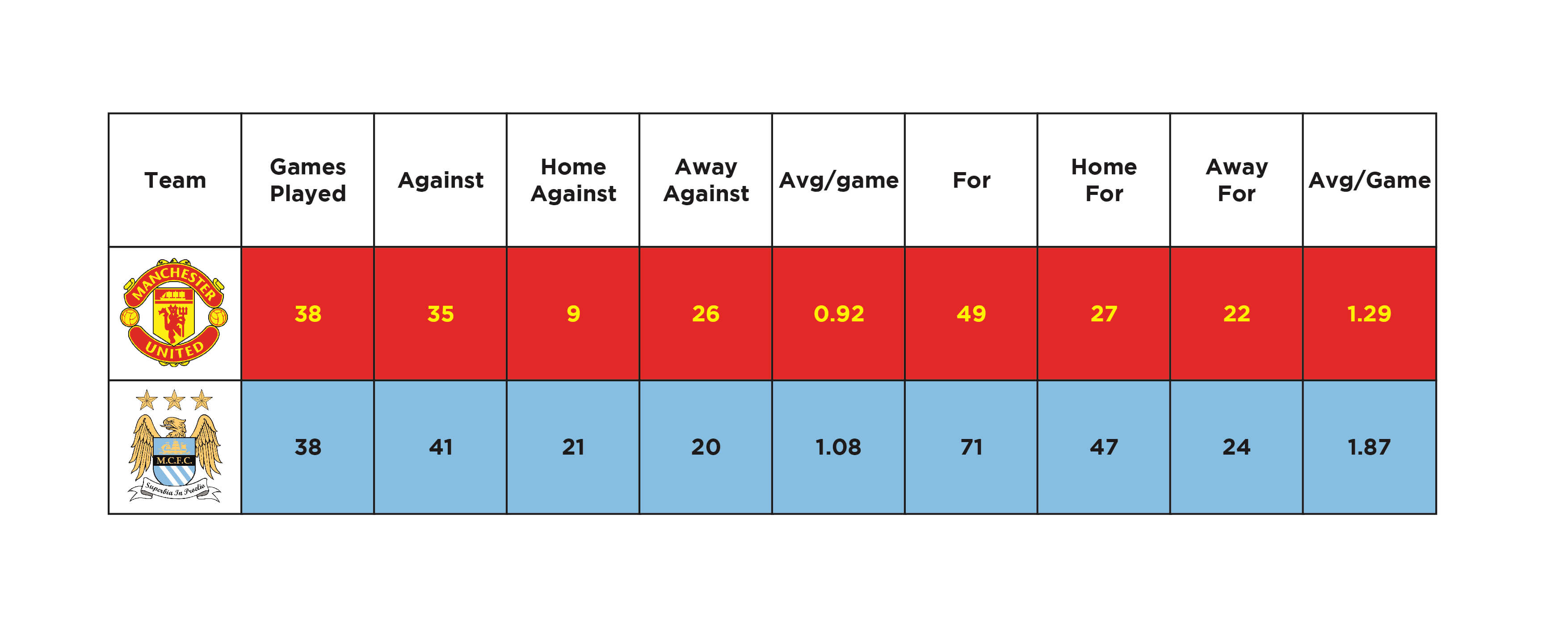
Now that we have the average strength and weakness of the teams, let's take a look at the stats for Manchester United and Manchester City in 2015.

Based on these stats, we can calculate the Poisson distribution for the teams playing in February 2017, where Manchester United is the away team and Manchester City is the home team.

[caption id="attachment_5249" align="aligncenter" width="3509"]Football betting odds, How are football betting odds calculated, Football betting explained using Poisson distribution, How football betting works ,Poisson distribution, How football betting is done, how is poisson equation used in football betting, Manchester united vs Manchester city, How do I bet on football, What are football odds 2015 Statistics - Manchester United vs Manchester City[/caption]

Predicting Manchester United Goals

Let’s see the possibility of Manchester United scoring at Manchester City’s home ground.

Number of Goals scored away = 22/19 = 1.15

Manchester United Goals = Number of goals scored/Season’s average goals scored away = 1.36/0.415 = 2.77

Manchester City Defense at home

This is calculated by dividing the number of goals conceded at home in the last season by the home team by the number of away games, which is 1.105 ( (21/19).

Manchester City Goals = Number of goals conceded/ Season’s average goals conceded = 1.105/0.415 = 2.66

Manchester United’s Goals = Manchester United’s Attack? Manchester City Defense? Average Number of Goals = 3.05

Predicting Manchester City Goals

Manchester City Attack at Home

Manchester City = Number of Goals scored home - 47/19 = 2.47

Manchester City Goals = Number of goals scored/Average goals scored in the last season =2.47/0.534 = 4.62

Manchester United Defense away

Take the number of goals conceded away last season by the away team and divide by the number of away games, which is equal to 1.05 ((20/19).

Manchester United Goals = Number of goals conceded/Average goals conceded in the last season =1.05/0.534 =1.966

Manchester City’s Goals = Manchester City’s Attack? Manchester United’s Defense? Average No. Goals = 1.10

Once we have the averages of Manchester United’s goals and Manchester City’s goals, we can use them to calculate the Poisson distribution for a number of goals scored by a particular team . (various goals possibilities).

Poisson Distribution betting – Predicting multiple match outcomes

The formula for Poisson distribution is:

P(x; ?) = (e-?) (?x) / x!

e = Euler’s constant = 2.718

! = Factorial

x = number of successes of the event

µ = mean distribution of the event

It can be coded as follows
#include <stdio.h>

#include <math.h>
double factorial(int n) {
int fact = 1;
for (int i = 1; i<=n; i++) fact *= i;
return fact;
}
float poisson(int r, float mean) {
return (exp((-1) * mean) * pow(mean,r))/factorial(r);
}
int main(int argc, char const *argv[])
{
printf("%f\n", poisson(1, 1.10));
return 0;
}

You can also use the Poisson Distribution Calculator for such equations.

Poisson Distribution prediction for match the between Manchester United and Manchester City

Goals 0 1 2 3 4 5
Manchester United 4.73% 14.44% 22.02% 22.39% 17.07% 10.41%
Manchester City 33.28% 36.61% 20.13% 7.38% 2.03% 0.44%
Probability 1.5 5.28 4.43 1.65 0.34 0.23

The possibility that Manchester United and Manchester City would score 1 goal each is 14.44% and 36.61% respectively.


From the above distribution table we can see that the possibility of Manchester city scoring no goal is 4.73 and that of Manchester United is 33.28.

Scoring 2 goals, each for Manchester United and Manchester City is 22.02% and 20.13% respectively.

The possibilities decrease as the number of goals increases to 4 and 5 goals by the individual team.

Taking these number into consideration, the odds of Manchester City winning is high if the number of goals in a match is 0 or 1. But if Manchester United is able to score 2 goals it’s the probability of winning the match increases.

So how is football betting odds made?

Based on the number by distribution table and the probability of these goals in a match, it is clear that a 1-1 draw has the highest possibility of 5.28, followed by 4.43 for a 2-2 draw. But the possibility of Manchester City winning with 1-0 or 2-1 also looks great.

Based on the previous match at Old Trafford, which is the home ground to Manchester United, Manchester City won by 2-1.

Not taking any sides (I support Algorithm), I would put my bet on 1-0 or 1-1 draw in favor of Manchester City.

The disadvantage of using the Poisson equation is that it doesn’t take into consideration external factors like the players/coach changed in transfer windows, the home ground factor, and injured players.

It helps you calculate the distribution only based on the averages of previous occurrences.

But then Elihu Feustel is one such person who makes a million dollars by betting using mathematical algorithms.