Top 6 online technical interview platforms and tools to use in 2026
Estimated read time: 8 min read
Technical interview platforms are software tools that let hiring teams run, score, and standardize coding interviews — either through live human-led sessions in a shared IDE or through AI agents that conduct structured screens on their own. For recruiters running high-volume technical pipelines in 2026, choosing the right one has become a core operational decision. This guide compares six platforms plus one candidate-prep tool — a mix of live coding platforms (human-led interviews in a shared IDE) and AI interview agents (automated, AI-conducted screens) — so recruiters can match the right category to their workflow. We use "technical interview platforms" as the umbrella term throughout, and call out AI interview agents specifically when a tool falls into that narrower category. This guide is written primarily for recruiters and talent acquisition leaders, with engineering-manager considerations noted where relevant.
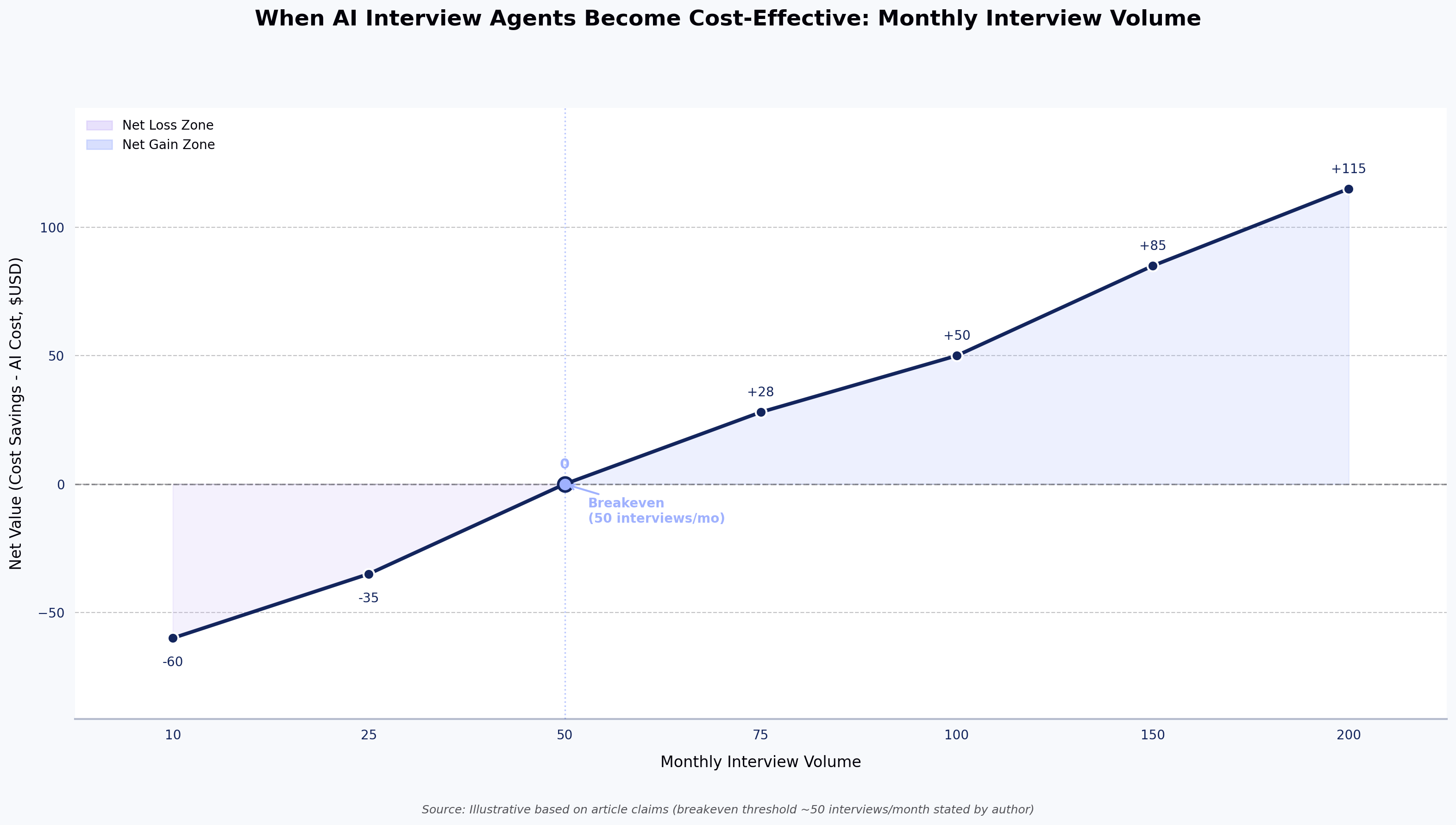
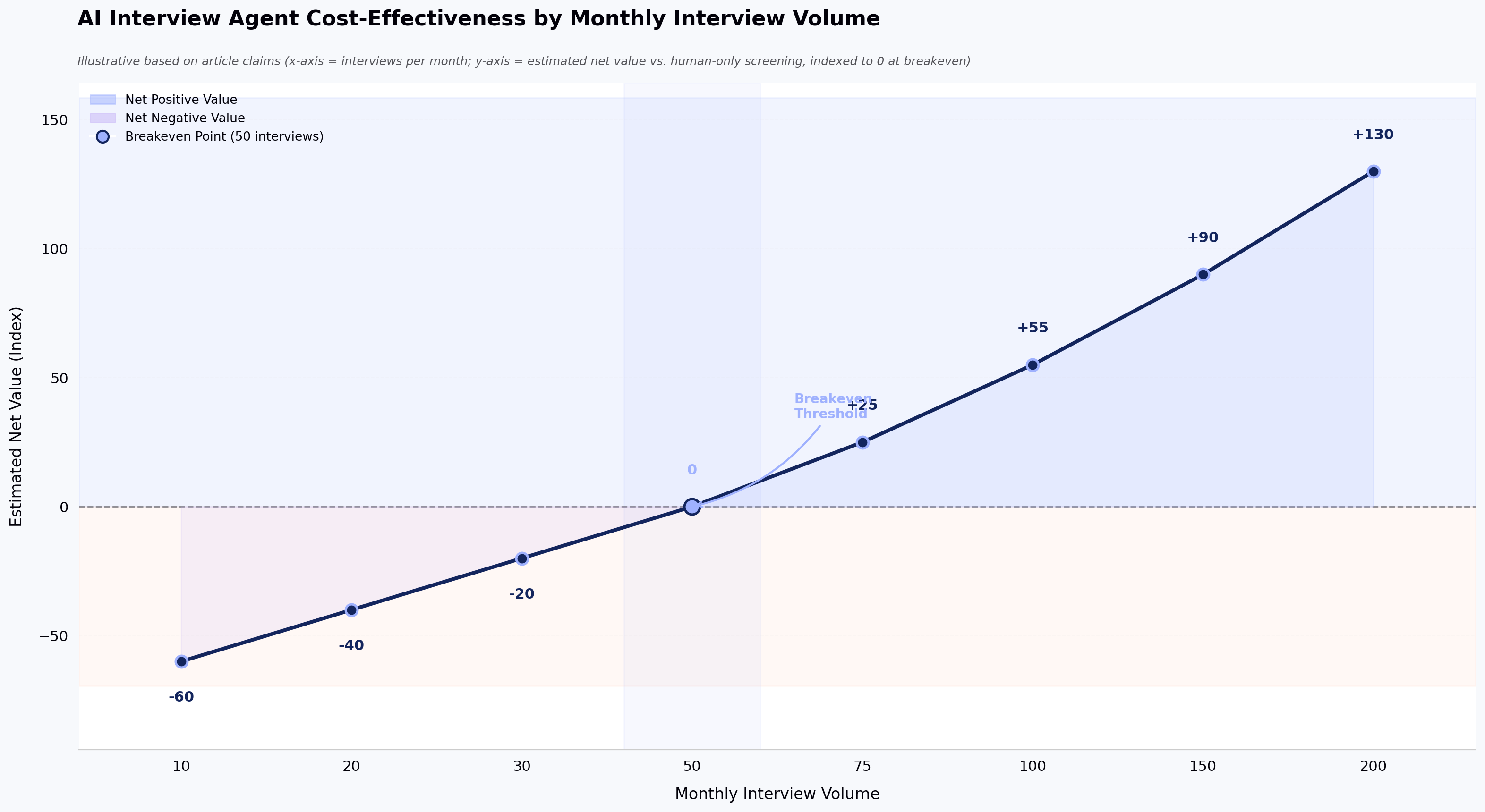
Here is one opinion worth stating up front: AI interview agents add net value mainly above roughly 50 interviews per month. Below that threshold, a well-designed coding test plus a human interviewer usually outperforms any of these platforms on cost and candidate experience.
Hiring teams are adopting these tools quickly. The Society for Human Resource Management's 2024 Talent Trends research reports a growing share of HR functions now use AI at some stage of recruitment, and reporting from the Wall Street Journal has documented the same shift inside large enterprises. The real question for buyers is no longer whether to automate parts of hiring, but which platform fits which team.
Overview
Live coding platforms vs. AI interview agents
Technical interview platforms fall into two broad categories. Live coding platforms (like FaceCode, HackerRank, Qualified.io) support human interviewers running real-time coding sessions. AI interview agents (like CodeSignal's AI Interviewer, HackerEarth's OnScreen) conduct structured interviews without a human interviewer present. Some vendors offer both.
Where these tools help — and where they don't
They can reduce screening effort and, on the dimensions they measure, apply the same rubric to every candidate. They are less suitable when roles require deep behavioral judgment, when candidate pools are very small, or when candidate experience concerns outweigh throughput gains. AI scoring systems also carry their own bias profiles and can produce false positives and negatives, so most teams keep humans in the final decision loop.
Top online technical interview platforms in 2026
- HackerEarth FaceCode: Live interviewer-led coding interview platform
- HackerEarth OnScreen: AI interview tool that runs structured technical interviews 24/7 using video-avatar interviewers, with KYC-grade identity verification and a deterministic evaluation framework
- Codility: Structured assessments and skill mapping
- HackerRank: Real-world coding interviews
- Qualified.io: Project-based assessments with automated scoring
- CodeSignal: AI interviewer with scoring reports
Interviewing.io is discussed later in this article as candidate-prep context, not as a hiring-side platform.
What are AI interview agents?
AI interview agents are systems that conduct and evaluate a technical interview without constant human involvement. These agents simulate structured interview scenarios, ask coding or system design questions, and assess responses using predefined benchmarks and machine learning (ML) models.
They perform several key tasks:
- Present coding challenges based on role requirements
- Analyze code quality, logic, and efficiency
- In some products (such as CodeSignal's AI Interviewer and HackerEarth's OnScreen), ask adaptive follow-up questions based on responses
- Generate structured feedback reports
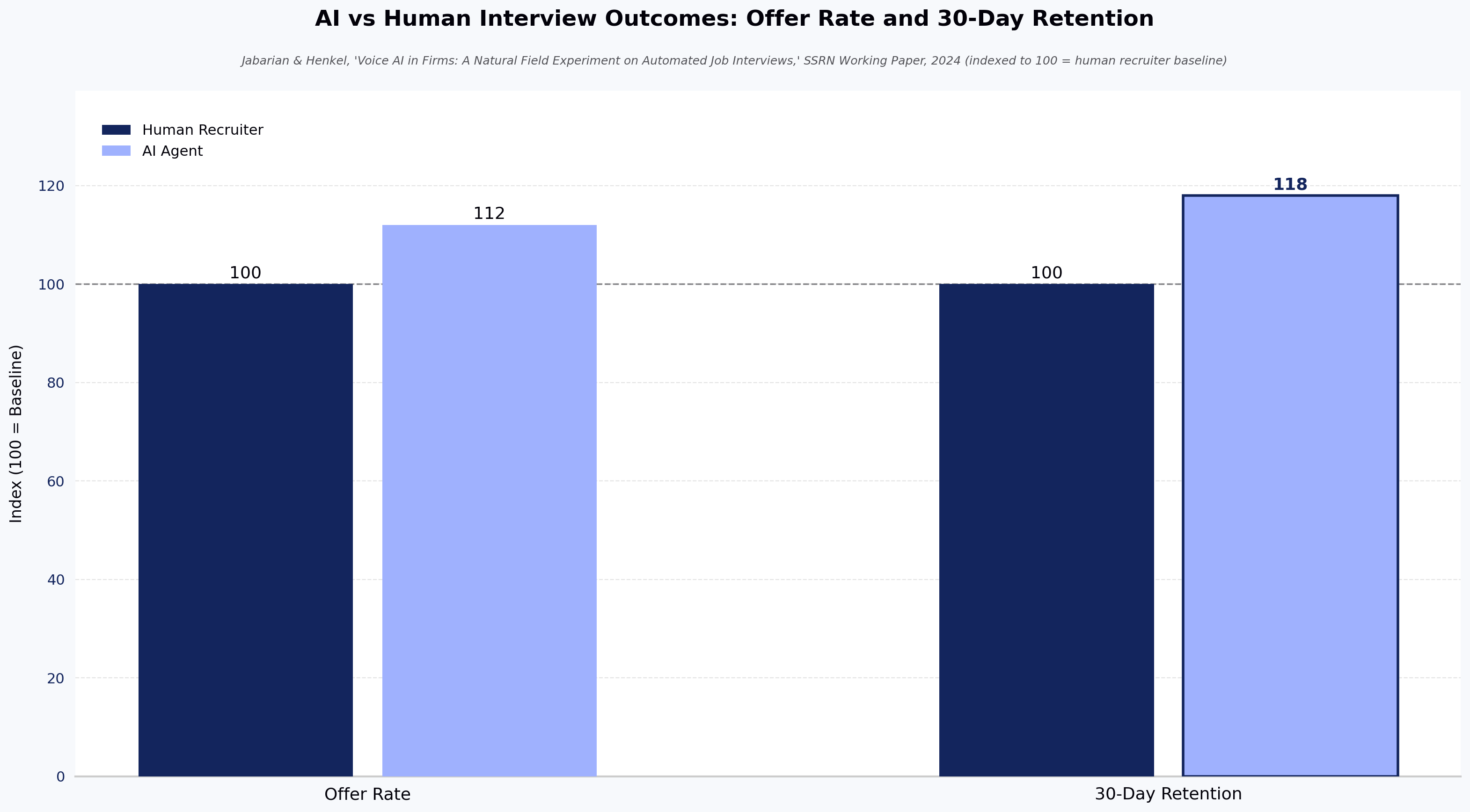
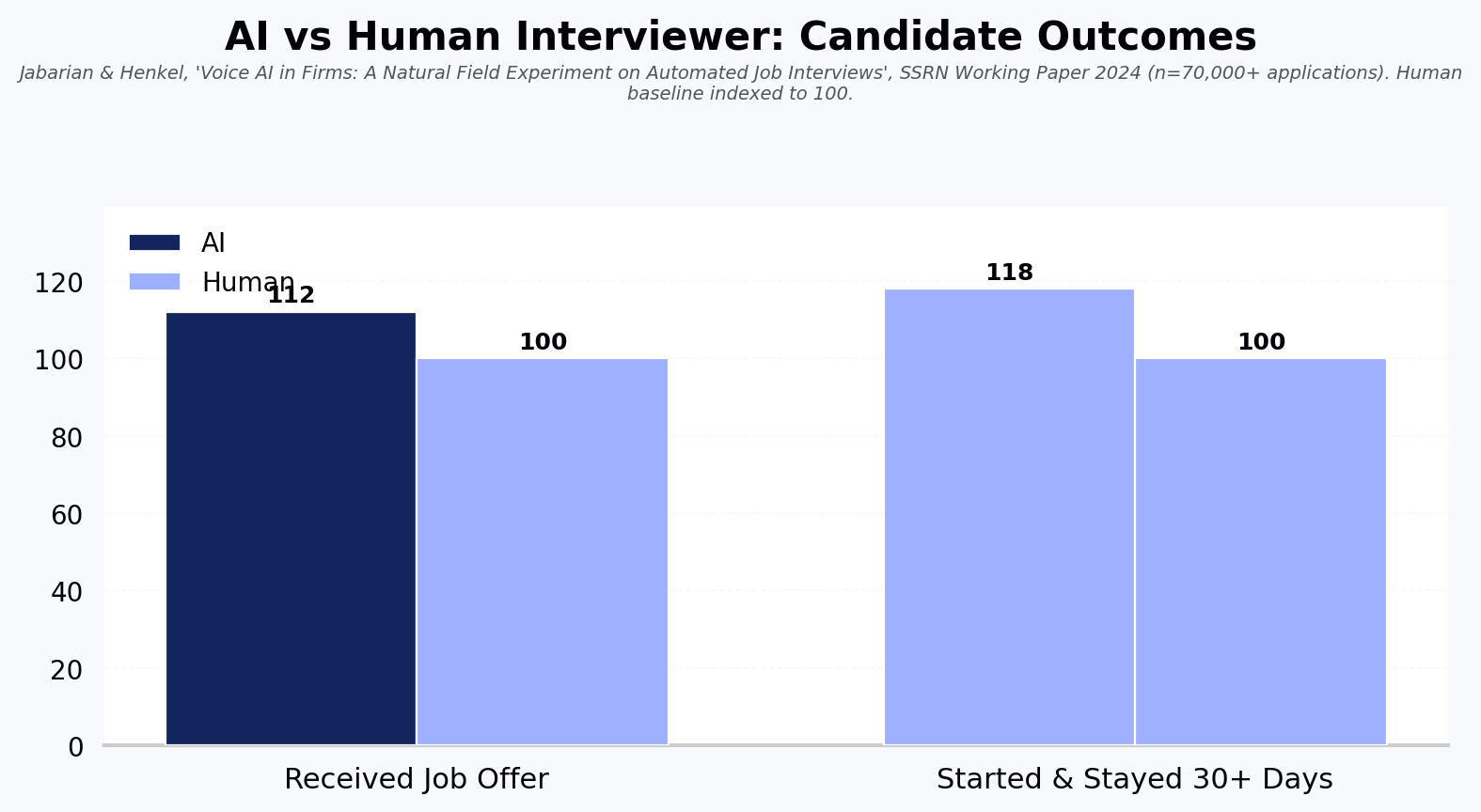
A 2024 working paper, "Voice AI in Firms: A Natural Field Experiment on Automated Job Interviews" by economists Brian Jabarian (University of Chicago Booth) and Luca Henkel (Erasmus University Rotterdam), analyzed over 70,000 job applications to test whether AI can effectively conduct job interviews. The preliminary findings — this is a working paper and not peer-reviewed — suggest candidates interviewed by AI agents were about 12% more likely to receive a job offer than those interviewed by human recruiters, and 18% more likely to start the job and stay for at least 30 days after joining.
The same working paper reports AI agents produced more consistent scoring across candidates than the human recruiters in the study. Beyond that specific finding, AI agents in this category generally rely on data-driven scoring and focus on measurable technical performance before handing the decision to a hiring manager.
Why hiring teams use technical interview platforms
Both companies and candidates gain from structured technical interview platforms, though the trade-offs differ by role and volume.
Benefits for hiring managers and recruiters
AI interview agents can shorten early rounds. Recruiters report meaningful time savings. Reporting from SHRM and vendor case studies suggests HR teams using AI tools see efficiency gains in screening, though self-reported survey numbers should be read as directional rather than precise. Claims of specific time-to-hire reductions also vary widely by company, role, and baseline, so treat single-number benchmarks cautiously.
The upshot is simple. Recruiting teams spend less time scheduling and screening, and more time on role-specific evaluation.
Benefits for candidates
Candidates also feel the impact. Coverage from Analytics India Magazine, citing a Canva-commissioned survey, reported that a majority of surveyed job seekers believe they have a better chance in AI-led interviews. That is a perception, not a measured hiring outcome. Still, it matters. These tools let candidates practice at their own pace, which can reduce anxiety and help sharpen responses.
Some vendor and industry surveys also report that job seekers find AI feedback useful and actionable, but the methodology behind those figures is often thin. Treat them as directional signals, not hard evidence.
Where these platforms are not the right fit
Fully automated screening is not always the right choice. Cost per seat can be significant at enterprise tiers, candidate experience can suffer if a video-avatar interview is the only touchpoint, and AI scoring can systematically over- or under-rate certain groups if training data is skewed. For small teams hiring a handful of engineers, a lightweight coding test plus a human interview may deliver better results than a full AI stack.
Comparing the top online technical interview platforms in 2026
Below are six of the platforms most commonly considered by technical hiring teams. Recruiters evaluating online technical interview platforms usually shortlist across two axes — live vs. AI-led, and depth of skills intelligence — so we call out both for each tool.
1. HackerEarth FaceCode
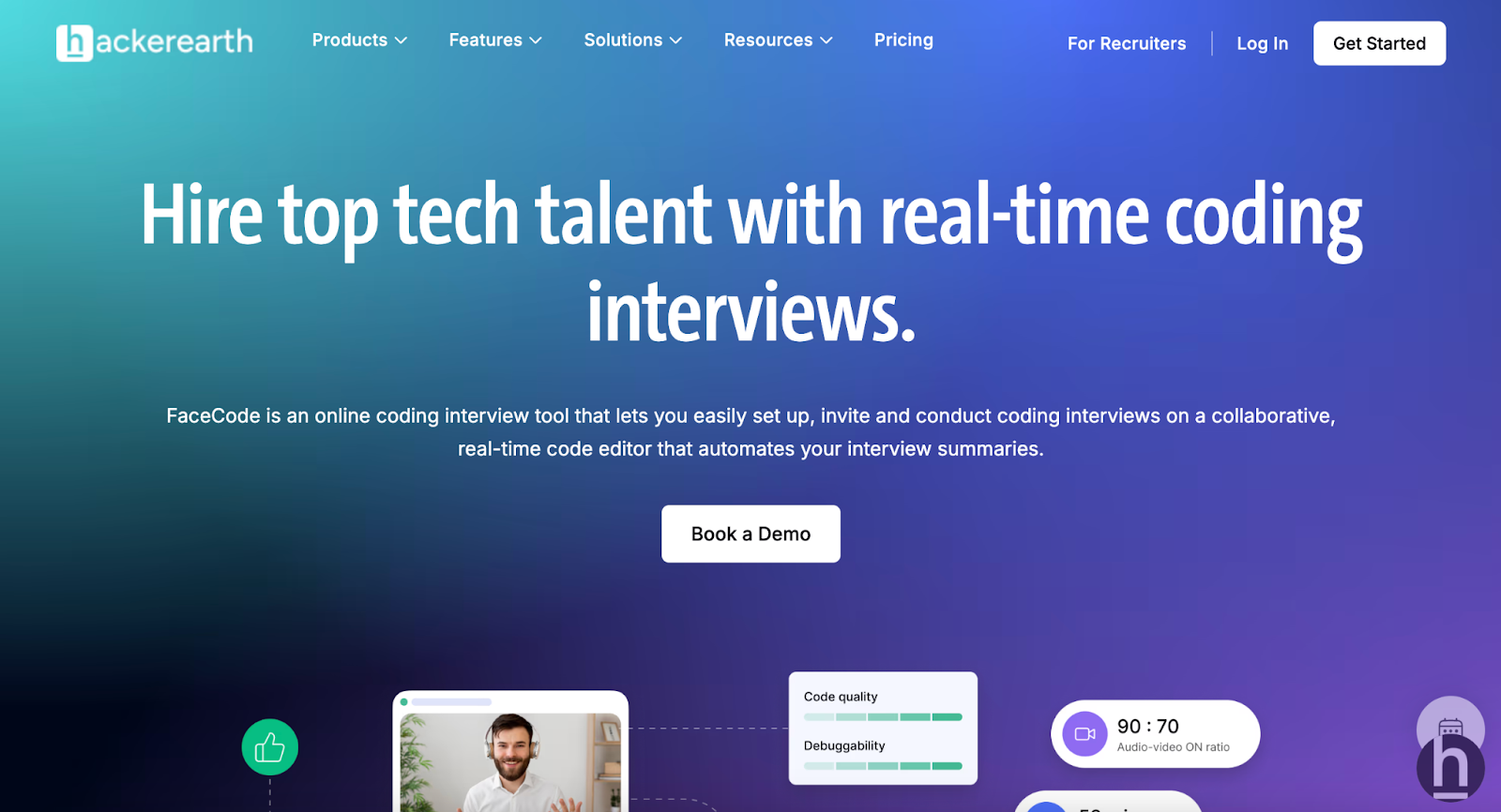
FaceCode is HackerEarth's live interviewer-led coding interview platform, designed for recruiters and engineering managers running real-time technical rounds. HackerEarth supports technical hiring through assessments, live coding interviews, and AI interview tools.
The FaceCode environment supports live coding with video, a collaborative editor, a diagram board, and a multi-interviewer panel format. Interviewers can review structured performance summaries during or after the session, which helps keep feedback consistent across interviewers. HackerEarth's assessment library covers 1,000+ skills and 40+ programming languages. Proctoring capabilities such as Smart Browser controls, AI snapshots, audio monitoring, and plagiarism detection sit within HackerEarth's Skill Assessments product and help maintain assessment integrity for coding tests taken alongside a FaceCode round.
For teams that want AI to conduct the interview itself, HackerEarth's separate product OnScreen conducts structured technical interviews 24/7 using video-avatar interviewers, with KYC-grade identity verification and a deterministic evaluation framework — this is distinct from FaceCode, which is human-led. Between the two, HackerEarth covers both live human-led interviews and asynchronous AI-conducted screens. In FaceCode specifically, AI assists interviewers by summarizing candidate responses; the AI here supports the human interviewer rather than replacing them.
Key features
- Assessment library covering 1,000+ skills and 40+ programming languages
- Live collaborative coding with HD video via FaceCode
- Multi-interviewer panel format
- Structured performance summaries generated during and after the interview
Where FaceCode fits best
FaceCode is a strong fit for teams that want to standardize live technical interviews across multiple interviewers and hiring managers. Teams that need fully automated, no-human-in-the-loop screening should look at OnScreen or CodeSignal's AI Interviewer instead.
2. Codility
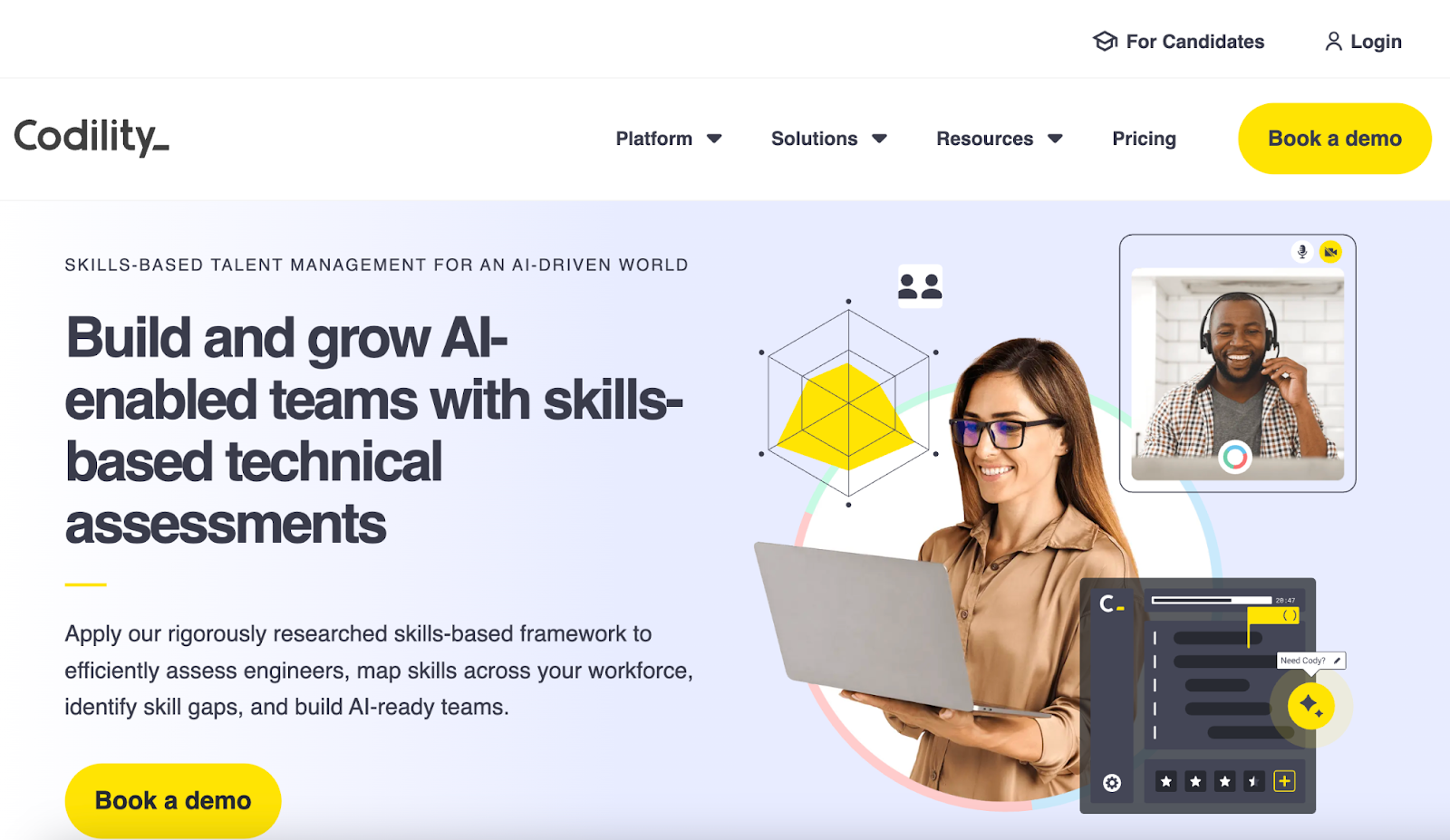
From early stage screening to in-depth technical interviews, Codility supports every step with data-backed insights. It offers tools like Screen for asynchronous skills testing, Interview for structured live technical interviews, and Skills Intelligence for mapping team capabilities.
Its Engineering Skills Model 2.0 connects assessments to job requirements, while built-in workflows guide interviewers through consistent evaluations. The platform also supports hiring for AI-related roles and skills like prompt engineering.
Key features
- Role-specific technical assessments
- Structured technical interviews with standardized workflows
- Engineering Skills Model 2.0 for skill mapping and benchmarking
- Asynchronous screening
Where Codility fits best
Codility wins on structured skills mapping. Teams building longer-term engineering capability plans — not just filling reqs — often prefer it for its benchmarking depth.
3. HackerRank
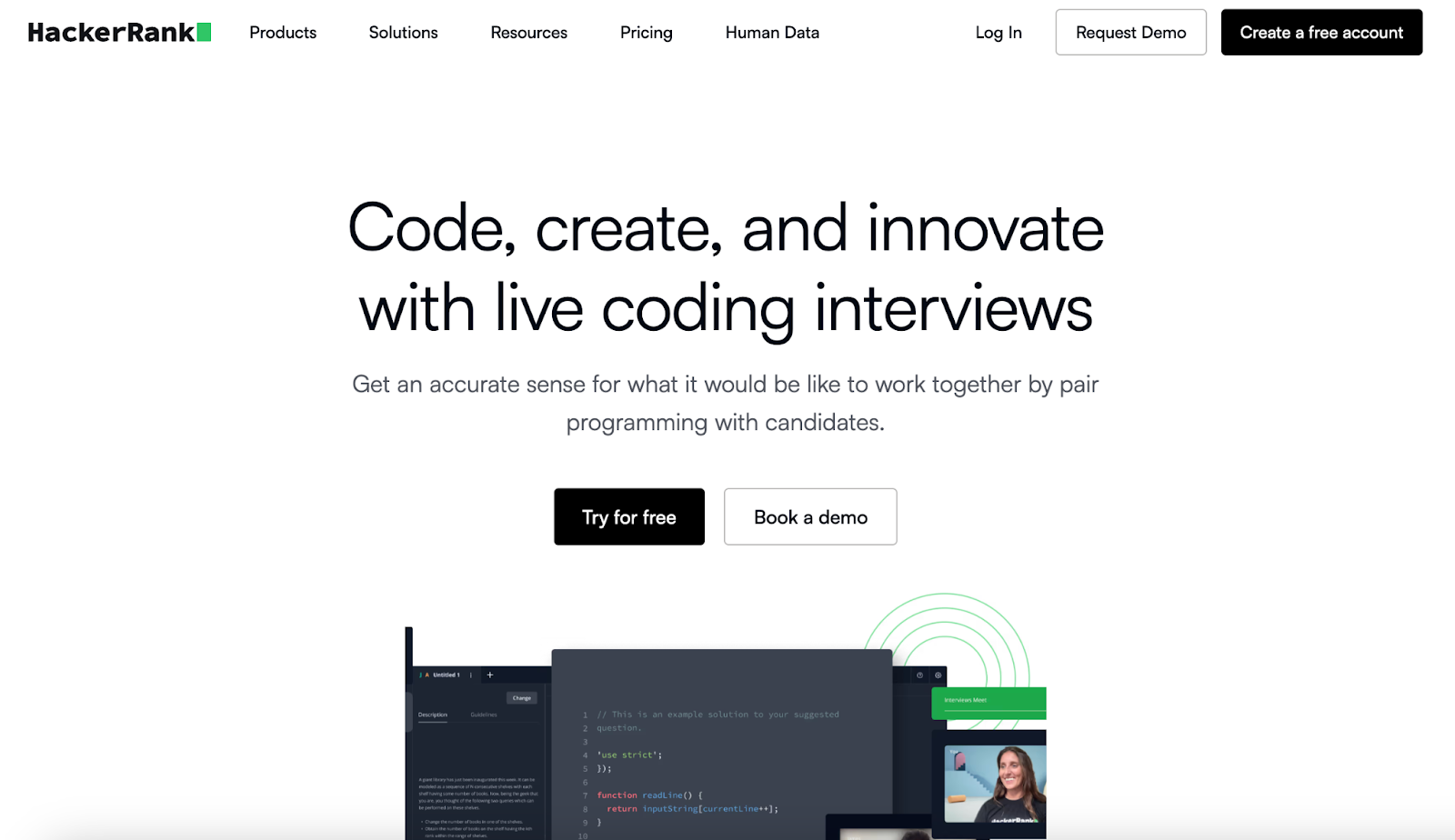
HackerRank helps teams run realistic technical interviews through its Interview platform, where candidates and interviewers pair program in a shared IDE. Teams can use Code Repository Questions to test real-world problem-solving, while built-in AI Assistants show how candidates work with modern tools.
Features like tab switch detection, multi-monitor tracking, and identity checks help maintain trust in every session.
Key features
- Live collaborative coding with shared IDE
- Code Repository Questions for real-world problem solving
- Built-in AI assistants to evaluate AI tool usage
- Tab switching and multi-monitor detection
Where HackerRank fits best
HackerRank wins for teams that specifically want to observe how candidates use AI tooling during coding — its AI Assistant tracking is one of the most developed in this category.
4. Qualified.io
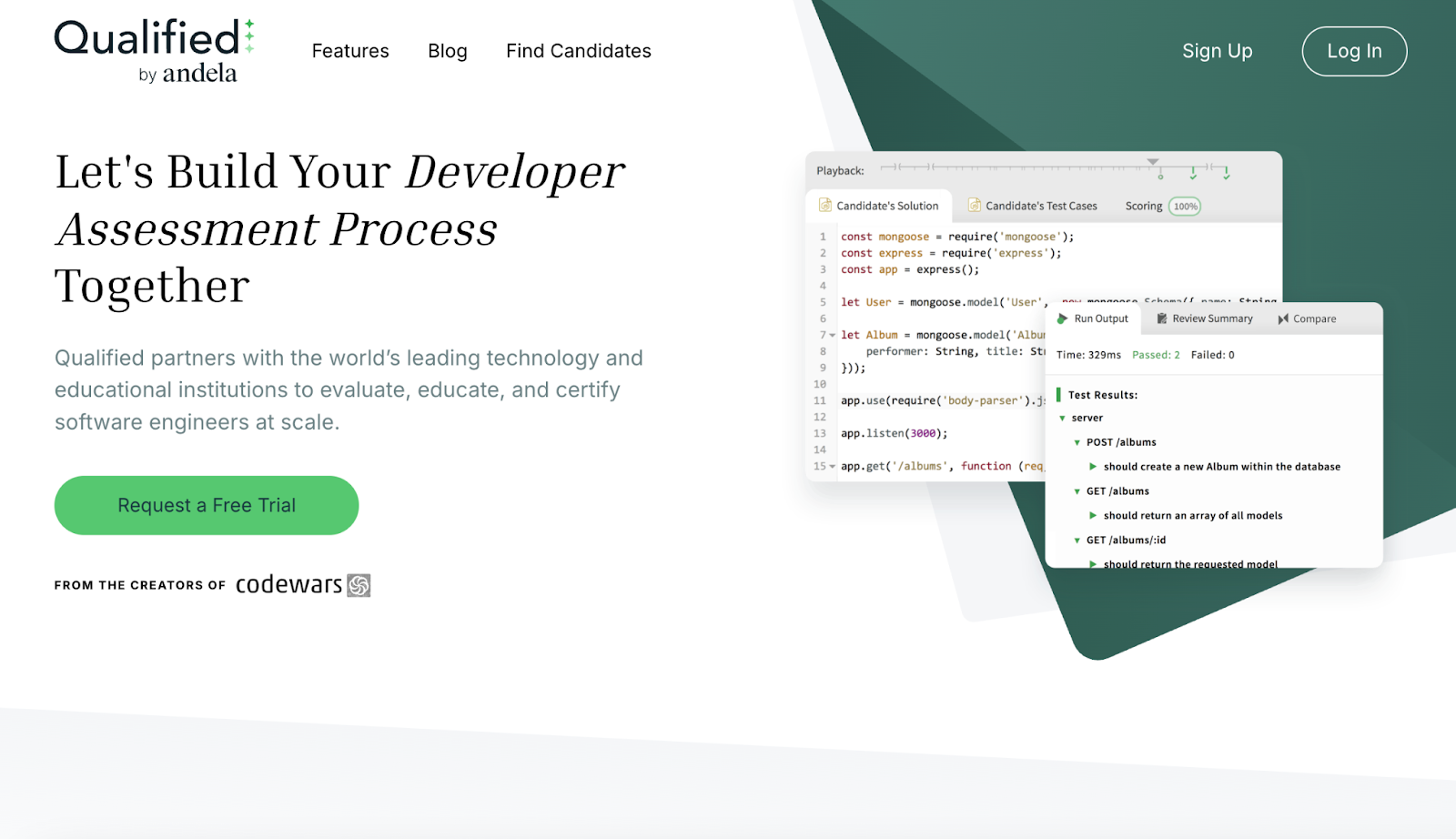
Qualified.io focuses on real-world coding assessments through its Web IDE, where developers work with modern frameworks and unit testing tools like Mocha, JUnit, and RSpec. Teams can choose from a library of ready-made assessments or build custom projects that reflect actual job tasks.
Automated scoring powered by unit tests gives fast, rule-based evaluation, while code playback and pair programming mode help teams understand how candidates think.
Key features
- Web IDE with real-world frameworks and environments
- Automated scoring using integrated unit testing frameworks
- Custom and pre-built coding assessments
- Code playback to review the candidate's thought process
Where Qualified.io fits best
Qualified.io wins for teams hiring web and full-stack developers who want project-based tasks that closely mirror day-to-day work, rather than algorithmic puzzles.
5. CodeSignal
CodeSignal's AI Interviewer conducts structured first-round interviews in which agents listen, ask follow-ups, and score candidates against defined rubrics. Teams can choose role-specific agents or customize their own based on job requirements, seniority, and focus areas.
The platform adapts in real time, probing deeper when answers lack detail, and generates reports with scores, transcripts, and skill insights. It integrates with common ATS workflows.
Key features
- AI Interviewer with real-time follow-up questioning
- Role-specific and customizable interview agents
- Structured scoring with defined evaluation rubrics
- Reports with transcripts and skill insights
Where CodeSignal fits best
CodeSignal wins as a pure-play AI interview agent for teams that want to automate the first round entirely and only bring in humans for later stages.
6. HackerEarth OnScreen
HackerEarth OnScreen is an AI interview agent that runs structured technical interviews 24/7 using video-avatar interviewers. It is designed for recruiters who need to screen large volumes of technical candidates without scheduling constraints.
OnScreen conducts role-calibrated conversations that adapt to candidate responses, uses KYC-grade identity verification to confirm candidates are who they say they are, and applies a deterministic evaluation framework so scoring stays consistent across candidates and hiring rounds. Recruiters receive structured reports at the end of each interview.
Key features
- Video-avatar interviewers available 24/7
- Role-calibrated conversations that adapt to candidate responses
- KYC-grade identity verification
- Deterministic evaluation framework for consistent scoring
Where OnScreen fits best
OnScreen fits recruiters running high-volume first-round screening who want a no-human-in-the-loop AI interview, paired with strong identity verification and consistent scoring.
A note on Interviewing.io
Interviewing.io is primarily a candidate-side mock interview platform, offering anonymous mock interviews with engineers from companies like Meta, Google, OpenAI, and Amazon. It is worth noting for recruiters mainly as context: candidates who use it arrive at your interviews better-prepared, which can shift how your own interviews calibrate. It is not a hiring-side platform, so it is not counted in the six above. Treat it as a candidate-prep tool your applicants may already be using, not as a purchase for your team.
How teams roll out a technical interview platform
Rolling out any of these online technical interview platforms — not just FaceCode — tends to follow a similar pattern. Below is a general playbook. For a broader view of technical hiring workflows, see resources from SHRM's talent acquisition coverage and vendor documentation.
- Calibrate on role requirements. Start by defining the role's must-have skills and rubric before turning on any platform. Without this, automated scoring will just reflect defaults that may not fit your team.
- Pilot on a single req. Run one requisition end-to-end on the new platform before rolling it out broadly. Compare outcomes (offer rate, first-90-day performance) against your previous process.
- Review AI scoring for edge cases. Whatever tool you choose, spot-check the AI's scoring against a sample of human-reviewed transcripts. This helps surface systematic bias or blind spots before they affect hiring decisions at scale.
Which technical interview platform should you choose?
The best technical interview platform depends on what your team needs most.
- Need to standardize live human-led interviews across a growing team? Look at HackerEarth FaceCode or HackerRank.
- Want to automate the first round entirely with no human interviewer? Look at CodeSignal's AI Interviewer or HackerEarth OnScreen.
- Hiring web and full-stack developers with realistic project tasks? Qualified.io is worth a close look.
- Building longer-term skills intelligence, not just filling roles? Codility's benchmarking is a differentiator.
- Looking at candidate-prep context? Interviewing.io is where many of your candidates already practice.
If you want to consolidate live coding interviews, AI-led screening (via OnScreen), and role-based assessments under one vendor, HackerEarth's FaceCode is worth evaluating.
Schedule a demo of HackerEarth FaceCode to see how live coding interviews and AI-assisted candidate summaries work on a single req.
FAQs
How do AI interview agents compare on cost versus human-only screening?
Public pricing is limited across this category — most vendors quote per-seat or per-interview at enterprise tiers. As a general rule of thumb (not sourced from vendor data), AI interview agents tend to make financial sense above roughly 50–100 interviews per month; below that, the per-seat cost often exceeds the recruiter hours saved. Ask each vendor for total cost per completed interview, not list price per seat.
When is a human-led interview still better than an AI one?
For senior engineering hires, staff-plus roles, and any interview where behavioral judgment matters more than measurable coding output, human interviewers still outperform AI agents. AI is strongest at high-volume first-round screening; human interviewers remain the standard for final rounds.
What bias risks exist in AI technical interviews?
AI scoring systems can encode bias from their training data — for example, penalizing candidates with non-native accents in voice-based interviews, or under-scoring unconventional problem-solving approaches. These systems can apply a consistent rubric across candidates on the dimensions they measure, but they are not bias-free. Most teams mitigate this by keeping humans in the final decision loop and periodically auditing AI scores against human review.
Do these platforms integrate with our ATS?
Most vendors in this category advertise integrations with common ATS platforms, but supported systems and depth of integration (one-way data push vs. two-way sync) vary significantly by vendor. Ask each vendor for a written list of supported ATS integrations and which fields sync in each direction rather than relying on general marketing claims.
How should candidates prepare for AI-led coding interviews?
The preparation looks similar to preparing for a live human interview: practice common data structures and algorithms, and rehearse thinking out loud. The main difference is that AI interviewers weight what you say about your approach heavily, so candidates who narrate their reasoning tend to score better than those who code silently.