Remote vs hybrid vs office: what actually works in 2026?
The short answer: there is no single best work model
Remote, hybrid, or office work each produce different outcomes depending on the role, team maturity, and what an organization is optimizing for — talent reach, retention, collaboration, or cost. For technical hiring teams in 2026, the choice of work model is no longer a culture statement; it is a hiring lever that directly shapes candidate pipelines, assessment design, and onboarding outcomes.
This guide is written for talent acquisition leaders and hiring managers evaluating remote, hybrid, or office structures for engineering and technical roles. It compares the three models, summarizes what current research suggests, and outlines specific operating practices — including how skills-based assessment tools like HackerEarth Assessments help teams hire consistently regardless of location.
Key takeaways
- Fully remote roles widen candidate pools but, according to Stanford research by Nicholas Bloom, can weaken mentorship and informal knowledge transfer.
- Hybrid is the most common model in 2025 but the hardest to execute; Gallup's 2024 hybrid work indicators report proximity bias as a recurring issue.
- Office-first models can support structured onboarding for early-career hires but often reduce reported employee satisfaction, according to McKinsey's American Opportunity Survey.
- The right model depends on whether the role's output is measurable asynchronously.
- Standardized skills-based hiring assessments reduce evaluation inconsistency across distributed pipelines.
The myth of the perfect work model
No single work model outperforms the others across every metric — productivity, retention, collaboration, and cost each respond differently to remote, hybrid, and office structures.
Over the last few years, companies have learned that no single workplace model works for everyone.
Many organizations that embraced fully remote work reported wider talent pools and improved flexibility. According to Stanford SIEPR research, fully remote arrangements can also reduce mentorship density and informal knowledge transfer, and several companies have reported collaboration gaps and communication fatigue.
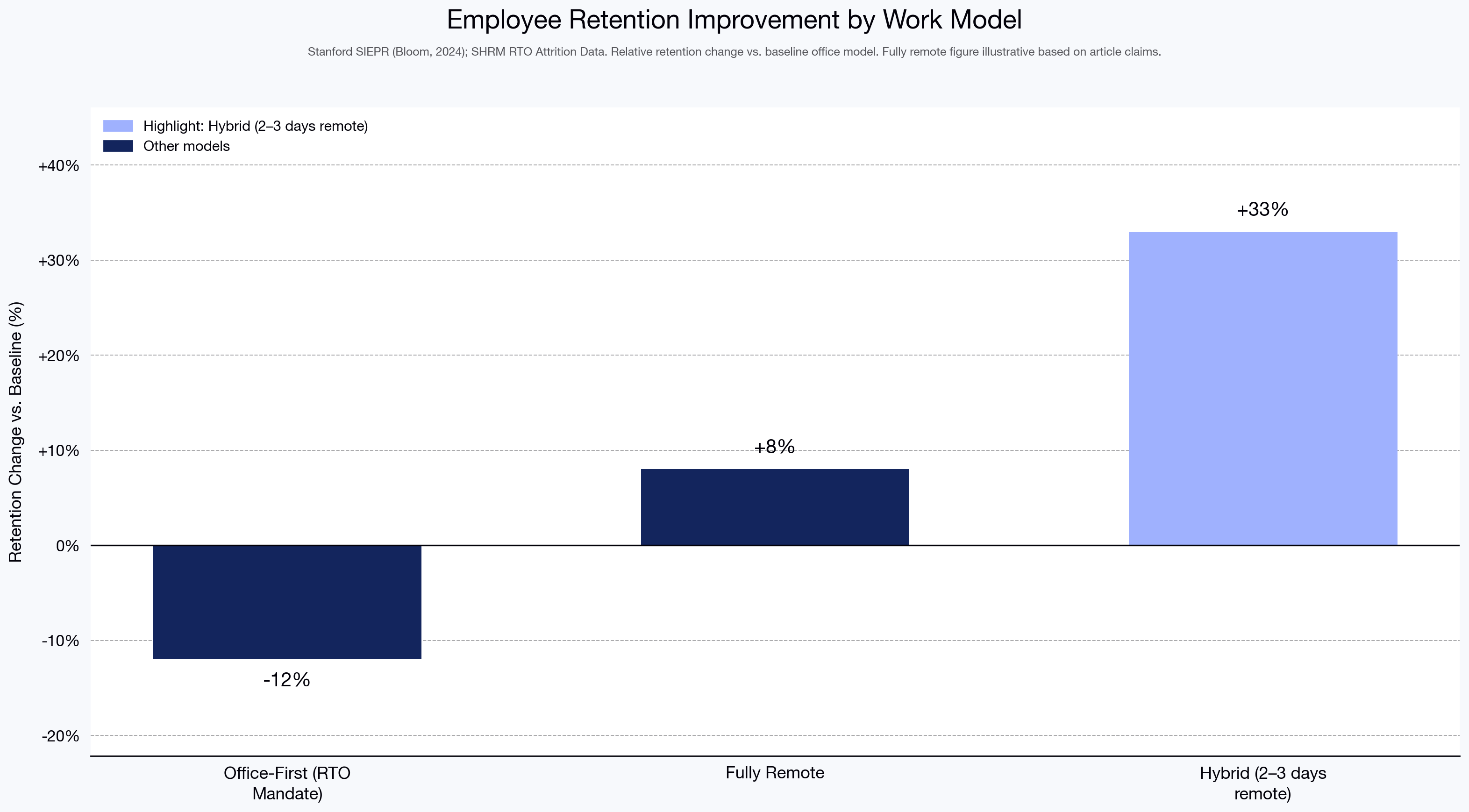
Meanwhile, strict return-to-office policies were intended to restore structure and in-person collaboration. In many cases this came at the cost of employee satisfaction and retention — SHRM has reported that strict RTO mandates correlate with elevated voluntary attrition, particularly among high performers.
Hybrid work quickly became the middle ground. Yet in practice, hybrid is often the hardest model to execute well because it demands balance, consistency, and explicit operating rules — anchor days, async-default communication norms, and clear in-office purpose.
The real question isn't whether remote, hybrid, or office is better.
It's: what outcome is the organization trying to optimize for?
What HR leaders are seeing in remote, hybrid, and office models
HR leaders in 2026 report that work model decisions are now hiring strategy decisions, not facilities decisions. The model an organization commits to directly shapes which candidates apply, how onboarding works, and how performance is evaluated.
Talent reach has expanded — but with caveats
Remote hiring can support faster access to specialized talent beyond geographical boundaries. According to a McKinsey survey, 58% of Americans report having the option to work from home at least part of the week. That said, expanded reach also intensifies screening volume, which is why standardized technical assessments have become more important to maintain hiring bar consistency across geographies.
Office environments still anchor early-career development
Office environments continue to play a role in onboarding, mentorship, and early-career learning. Informal conversations, quick collaboration, and day-to-day exposure remain difficult to replicate virtually.
Hybrid introduces proximity bias
Hybrid models try to combine both advantages, but they also introduce challenges like proximity bias — the tendency for employees who spend more time physically near leadership to receive greater visibility, project assignments, and promotion opportunities than equally performing remote peers. Research from Gallup and the SHRM workplace flexibility studies suggests this effect is most pronounced in companies without structured performance review frameworks such as OKRs or outcome-based scorecards.
This raises an important question for HR leaders: are workplace policies rewarding performance, or simply physical presence?
What candidates actually want in 2026
Candidates in 2026 evaluate work models as part of total compensation, not as an operational detail. Surveys from Gallup and McKinsey consistently show flexibility ranking among the top three factors in job acceptance decisions.
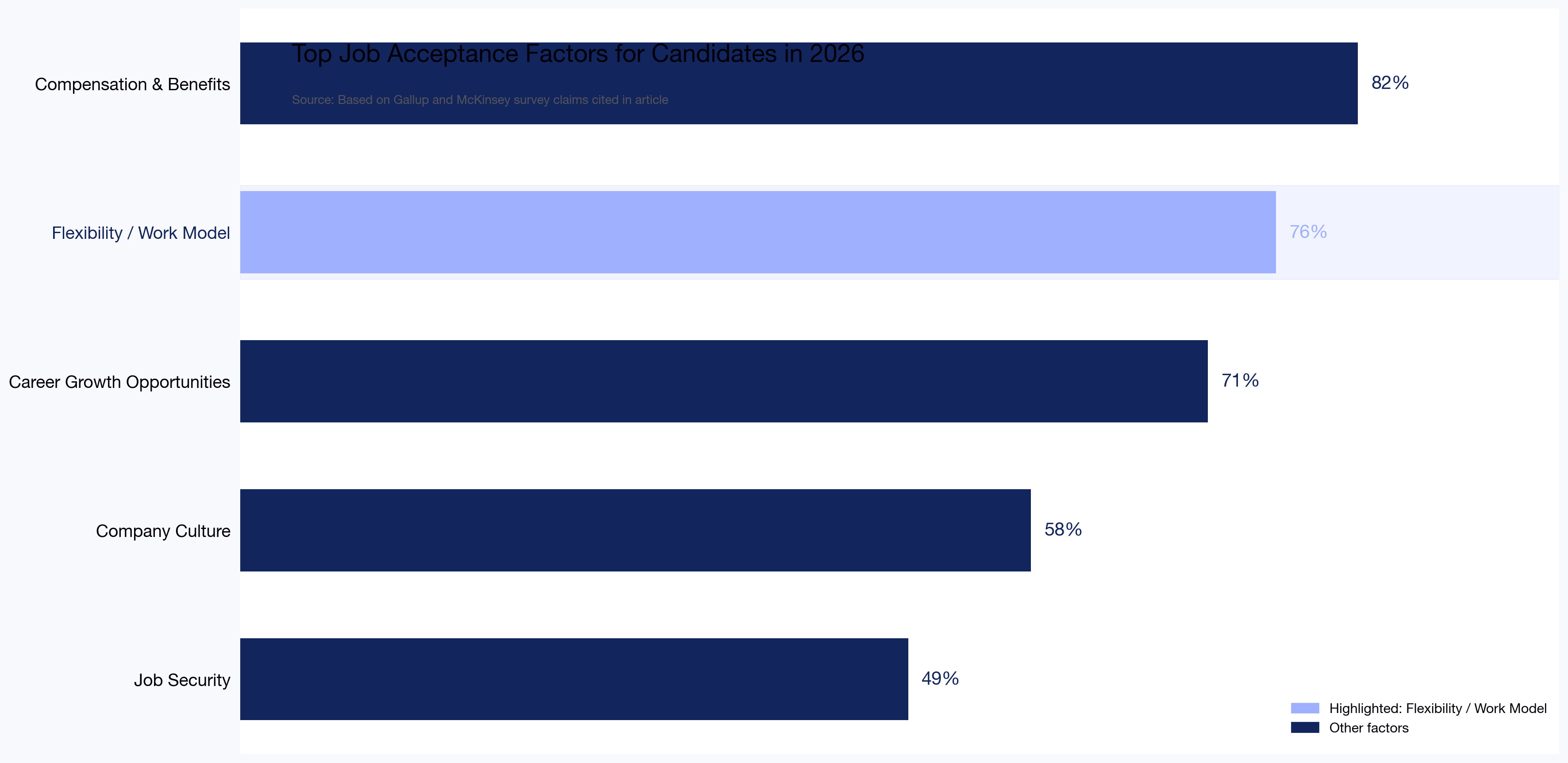
Flexibility is now a value proposition
For many professionals, remote work represents flexibility, autonomy, and better work-life balance. Some research suggests younger professionals, particularly those in their first three years of work, more often report valuing in-office structure, mentorship, and human connection — though this is far from uniform.
Preferences are more nuanced than "remote vs office"
Candidate preferences are becoming more nuanced. A candidate may prefer remote work but still accept a hybrid role if it offers stronger career growth. Another may prioritize flexibility over compensation altogether.
For talent acquisition teams, this changes the playbook. Work models are no longer operational policies — they are part of the employer value proposition and should be communicated explicitly in employer branding and job descriptions.
Culture is more than a workplace
Culture is produced by communication patterns, leadership behavior, and shared rituals — not by physical proximity. Organizations that succeed with remote work typically rely on clear written communication, strong documentation practices, and outcome-based performance management rather than constant visibility.
Companies succeeding with office-first models are redefining what offices are for: collaboration, creativity, and connection rather than desk attendance. If employees commute only to spend the day on virtual meetings, the office experience loses its purpose.
A defensible position: organizations that cannot articulate, in writing, what their office is for should not mandate office attendance. Vague "collaboration" justifications produce attendance without outcomes.
What actually works: operating practices for each model
The organizations getting workplace strategy right are not debating which model is superior — they are defining specific operating rules, measurement systems, and tooling for whichever model they choose.
For remote teams
- Adopt async-first communication protocols (written updates default, meetings exception).
- Use outcome-based performance frameworks such as OKRs rather than activity tracking.
- Standardize hiring with structured coding assessments and AI-powered interviews to reduce evaluator variance across time zones.
- Document onboarding paths explicitly; do not assume osmosis.
For hybrid teams
- Define anchor days (e.g., Tuesday–Thursday in office) so collaboration is concentrated.
- Audit promotion and project-assignment data quarterly for proximity bias.
- Make in-office time purpose-driven — workshops, design reviews, planning — not heads-down work.
For office-first teams
- Publish a written rationale for in-office requirements tied to specific outcomes.
- Invest in mentorship structures that justify the in-person premium.
- Track retention by tenure and role; if attrition spikes after RTO mandates, revisit.
A note on limitations
These practices assume a dedicated HR or people-ops function. Smaller organizations without specialized HR may find "intentional" workplace design harder to operationalize and may need to lean more heavily on standardized tooling — for example, HackerEarth's skills intelligence platform — to maintain consistency without large process overhead. Outcome-based management also works less cleanly for roles where output is hard to quantify (e.g., early-career support functions); in those cases, periodic in-person review remains useful.
Connecting work model to technical hiring
Whichever model an organization adopts, the underlying hiring challenge is the same: evaluate candidates consistently regardless of where they (or the interviewer) sit. HackerEarth Assessments provide standardized skill evaluation that produces comparable scores across distributed pipelines, reducing the proximity-bias risk that often shows up in hybrid promotion data as well. For teams scaling technical hiring across remote, hybrid, and office models simultaneously, skills-based evaluation is one of the few controls that travels well across all three.
Frequently asked questions
Is hybrid work more productive than remote?
Evidence is mixed. Stanford research by Nicholas Bloom found that hybrid arrangements produced no measurable drop in performance compared with fully in-office work, while improving retention by roughly 33%. Fully remote productivity varies more widely by role and management quality.
Which work model has the best employee retention?
Stanford's 2024 hybrid study reported the strongest retention effect for hybrid (two to three days remote). SHRM data suggests strict RTO mandates correlate with higher voluntary attrition, particularly among senior and high-performing employees.
How do we hire fairly across remote, hybrid, and office candidates?
Use standardized, role-relevant skills assessments rather than relying on interview impressions, which are more vulnerable to proximity and affinity bias. Platforms such as HackerEarth Assessments generate comparable scores across candidates regardless of location.
What is proximity bias?
Proximity bias is the tendency for employees physically closer to leadership to receive more visibility, recognition, and advancement than equally performing remote peers. Gallup's hybrid work research identifies it as one of the most common hybrid-model failure modes.
Do candidates prefer remote, hybrid, or office work in 2026?
McKinsey's American Opportunity Survey found that when offered, 87% of workers take some form of flexible work. Preferences vary by career stage: early-career candidates more frequently report valuing in-person mentorship, while mid- and senior-career professionals more often prioritize flexibility.

Is fully remote work bad for company culture?
Not inherently. Culture depends on communication norms, leadership behavior, and shared rituals rather than location. Remote organizations that invest in documentation, async communication, and intentional team rituals report culture outcomes comparable to in-office peers.
Final thoughts
The future of work in 2026 is not remote, hybrid, or office-first as a universal answer. It is a deliberate match between work model, role type, and measurable business outcomes. Organizations that define their model explicitly — and back it with consistent hiring and evaluation practices — outperform those that mandate a model without operating rules.
Build a hiring process that works in any model
If your team is hiring across remote, hybrid, or office setups, evaluation consistency is the single biggest risk to fair, fast hiring. Explore HackerEarth Assessments to standardize technical evaluation across your pipeline, or request a demo to see how skills intelligence supports distributed hiring decisions.