As we move into 2026, recruitment is no longer just about cutting costs or filling roles quickly. Companies now see that metrics like cost-per-hire and time-to-fill only measure efficiency, not the real value employees bring to business goals. As a result, Quality of Hire has become the most important metric in hiring, reflecting productivity, innovation, and long-term success. In a time of workforce changes and rapid AI growth, finding and keeping top talent is what sets leading companies apart.
The strategic framework of quality of hire
Quality of Hire is more than a single metric. It combines multiple key indicators to give leaders a clear view of hiring return on investment. This approach links what a candidate shows before being hired to how they perform after joining, ensuring hiring supports business growth, profits, and company culture.
Multidimensional definitions and stakeholder perspectives
The definition of a "quality hire" is inherently subjective and varies by organizational context and the specific stakeholder evaluating performance. For recruiters, quality is often defined by the predictive validity of assessment scores and the alignment of the candidate's skills with the initial job requisition. Hiring managers, however, tend to view quality through the lens of immediate operational impact, focusing on ramp-up time and the employee's ability to integrate into team dynamics without disrupting established workflows. At the executive level, the focus shifts to long-term value, where quality is measured by revenue per employee, internal mobility, and the reduction of turnover-related costs.
To measure Quality of Hire effectively, companies need to bring these different views together into a single standard. This means creating success profiles that describe what top performers look like. These profiles help set clear expectations and make it easier to judge if new hires meet, exceed, or fall short of what was hoped for.
The evolution of the talent market
The job market now favors employers, but hiring is still tough. Even with more candidates, 70% of hiring professionals say there’s still a shortage of people with the right technical skills and soft skills like critical thinking. Quality of Hire helps prevent quick, short-term hires that don’t last. More companies are focusing on long-term value, knowing that one great hire can be up to four times more productive than an average one.
Theoretical and practical challenges in measurement
Despite consensus on its importance, Quality of Hire remains one of the most difficult metrics to track precisely. Only 25% of talent acquisition professionals report high confidence in their organization’s ability to measure it effectively, citing a variety of structural and temporal barriers.
The time lag phenomenon
The primary challenge in measuring Quality of Hire is the inherent delay between hiring and the emergence of measurable outcomes. While efficiency metrics like cost-per-hire are finalized the moment a candidate signs an offer, effectiveness metrics like productivity and performance require months or years of observation. This lag often results in a "measurement gap" in which recruitment teams lack the immediate feedback needed to calibrate their sourcing and screening processes in real time.
Subjectivity and qualitative fragmentation
It’s hard to connect things like a manager’s opinion on cultural fit to actual performance data. These kinds of feedback often aren’t measured in the same way, so the data can be inconsistent and hard to compare. Also, if cultural fit is seen as less important, companies may hire people who interview well but don’t work well with the team, leading to early turnover.
Data silos and structural misalignment
Measurement efforts are frequently hampered by the fragmentation of data across disparate systems. Applicant Tracking Systems (ATS) hold pre-hire data, while Human Resource Information Systems (HRIS) and performance management platforms contain post-hire outcomes. Without integrated infrastructure, organizations struggle to identify the causal relationships between specific recruitment tactics and long-term success. This structural misalignment is often exacerbated by a lack of a clear owner for the metric, with accountability shifting between talent acquisition, HR, and business unit leadership.
The business case for measuring quality of hire
The financial implications of high-quality hiring are profound and quantifiable. Organizations that have mastered measuring Quality of Hire see 30% better overall business performance than those relying on traditional, speed-based approaches.
Revenue growth and productivity gains
Long-term studies of Fortune 500 companies show that those with high Quality of Hire scores grow revenue 2.5% faster than others. This is because top hires not only do their own work well but also help their teams perform better. They often improve processes, generate new ideas, and drive innovation, delivering more value than their hiring cost.
Mitigating the financial impact of turnover
A bad hire can be very expensive for a company. Replacing someone usually costs between 33% and 75% of their yearly salary, depending on the role. This includes not just hiring and training, but also lost productivity and the time it takes for a new person to get up to speed. Companies that focus on Quality of Hire cut turnover costs by 25% and are three times more likely to keep new hires for at least a year.
Opportunity costs of vacant roles
Many companies overlook the cost of leaving important jobs unfilled. When a key role is vacant, it can lead to lost revenue, delayed projects, and overworked teams. For instance, if a senior sales leader who brings in $5 million a year isn’t hired on time, the company loses about $416,000 each month. Delays in hiring specialized engineers can also push back product launches and cost the company millions in future revenue.
Core metrics: leading and lagging indicators
To measure Quality of Hire well, companies need to use both leading indicators (before hiring) and lagging indicators (after hiring). Leading indicators help predict future success, while lagging indicators show the real impact of a hire.
Pre-hire metrics
Leading indicators give quick feedback during hiring and can predict future success. These metrics help hiring teams spot problems in the process and make screening more efficient.
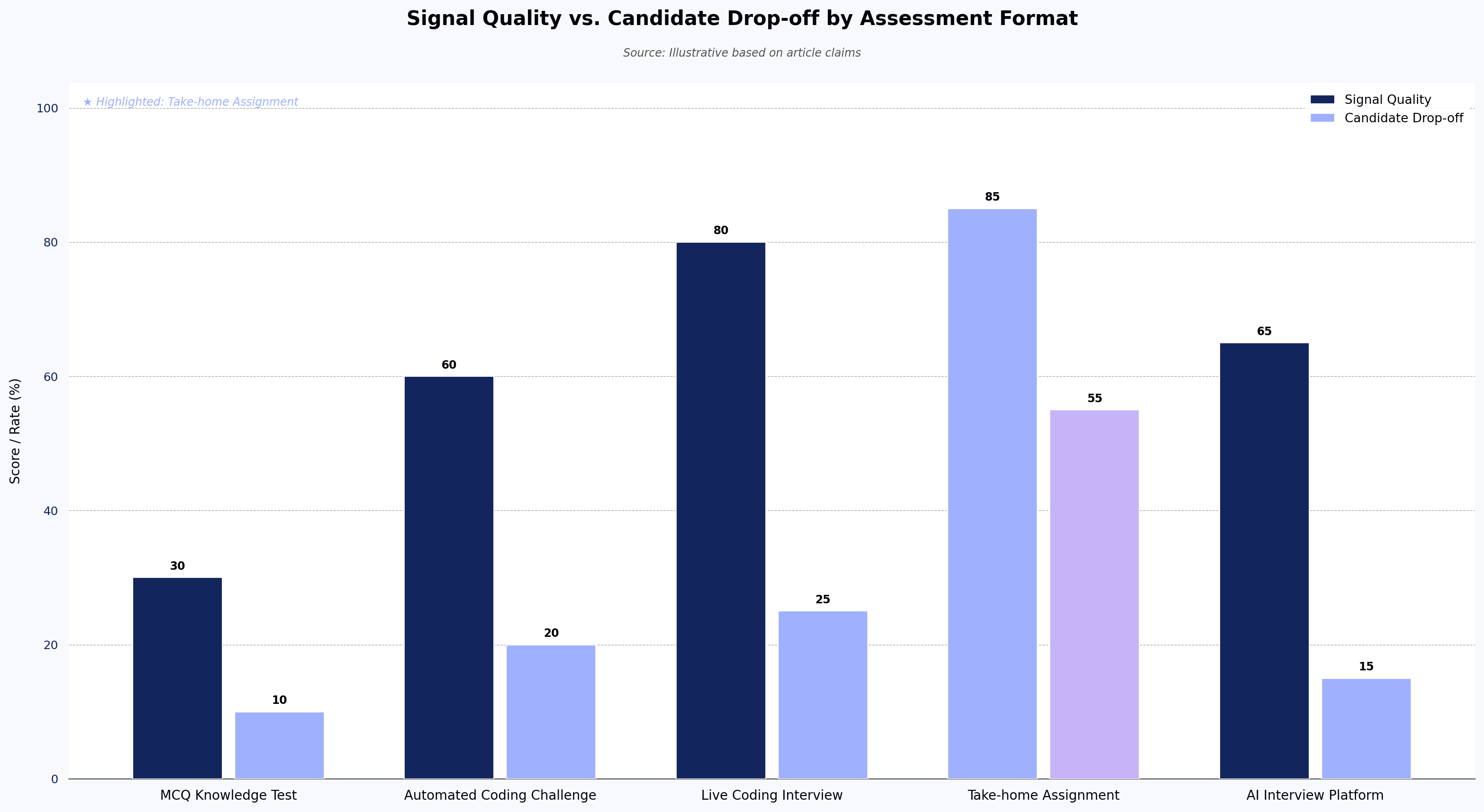
- Assessment scores: Objective evaluations of technical and cognitive skills are among the most reliable predictors of job performance. High scores on skill assessments, coding challenges, and work samples often correlate with superior output and reduced training time.
- Structured interview results: Using the same interview questions and scoring for every candidate helps reduce bias and improve hiring accuracy. Companies that use structured interviews make better hiring decisions and see a 41% increase in successful hires.
- Hiring manager satisfaction (Pre-hire): Collecting satisfaction scores at the offer stage allows organizations to measure the alignment between recruiter efforts and manager expectations. This metric identifies if the candidate pool presented is of sufficient quality before the final decision is made.
- Candidate source quality: Not all ways of finding candidates are equally effective. By tracking how well hires from different sources perform—like referrals, internal moves, or job boards—teams can spend their recruiting budget more wisely. Employee referrals usually lead to better hires who stay longer and fit in faster.
- Culture fit surveys (Pre-hire): Early checks on whether a candidate shares the company’s values and mission help avoid hiring people who have the right skills but might not work well with the team.
Post-hire metrics (Lagging Indicators)
Lagging indicators measure how a new hire performs after joining the company. These are usually checked at 30, 90, 180, and 360 days.
- Time to productivity (Ramp-up Time): This measures how long it takes a new hire to reach full productivity, such as meeting sales targets or completing engineering tasks independently. Improving this helps the company run better and get more value from new hires.
- Job performance reviews: Standard performance ratings, usually done after three to six months, are the clearest way to measure a new hire’s quality. These reviews check how well the person does their specific job tasks.
- Employee retention and attrition: If many new hires leave within the first year, it often means the hiring or onboarding process needs work. Checking retention at points like 90 days and one year helps show if hiring is adding long-term value.
- Manager and team feedback: Surveys from managers and coworkers after hiring give a full picture of how well a new employee fits in and contributes. 360-degree feedback is especially useful for spotting top talent and those who might need more support.
- Promotion and mobility rates: How often new hires are promoted or move into new roles within their first 12 to 18 months reflects their potential and the company's ability to find top talent.
Building and operationalizing a quality of hire scorecard
A scorecard helps turn scattered hiring data into useful insights. It lets companies track their hiring and spot what leads to the best hires.
Step 1: Strategic alignment and goal definition
The process begins by identifying the specific business goals that the hiring process is intended to support. For a sales-driven organization, this might be revenue growth; for a research-intensive firm, it may be innovation and product development. Defining what "success" looks like for each department ensures that the scorecard measures the outcomes that actually matter to leadership.
Step 2: Selecting and weighting indicators
After setting goals, choose the right metrics and decide how important each is to the role. For example, 'time to productivity' might matter most in retail, while 'code quality' and 'innovation' are key for engineers.
Step 3: Calculation and indexing
To get a Quality of Hire score, rate each metric on a scale (like 1 to 100) and then average them using a set formula. This gives a clear overall score.

Companies can also use a Quality of Hire Index to show how well their hiring process works over a year. This index includes average Quality of Hire scores and retention rates.

Step 4: Iteration and process refinement
The scorecard should be updated regularly. By comparing current scores to past results, hiring teams can see if changes like new assessment tools or different sourcing methods are really improving the quality of new hires.
Interpreting data to drive business action
The value of Quality of Hire metrics lies in their ability to inform strategic decisions and process improvements. Data must be analyzed. Quality of Hire metrics are valuable because they help guide business decisions and improve hiring processes. It’s important to look at this data alongside other key company goals. For example, the average Quality of Hire score across competitive organizations in 2025 is approximately 73.0, while top-tier companies achieve scores above 81.0. Benchmarking allows organizations to determine if they are attracting talent of a similar or superior caliber to their competitors. Furthermore, analyzing the top 20% of performers within the company helps identify common traits and competencies to prioritize in future searches.
Identifying sourcing and screening inefficiencies
Quality of Hire data helps hiring teams assess which sources deliver the best candidates. If people from a certain agency perform worse than those from referrals, the company can spend more on the better source. If test scores don’t match real job performance, it may be time to update the tests to better fit the job.
Linking talent to financial outcomes
The main goal is to show how better Quality of Hire leads to real business results. This means linking Quality of Hire scores to things like revenue per employee, customer satisfaction, and lower turnover costs. For example, a cloud computing company that improved both hiring speed and quality saw a clear increase in market share.
The technological future: AI and predictive intelligence
In the future, measuring Quality of Hire will rely on AI and machine learning at every step of hiring. These tools are no longer optional—they are essential parts of the process.
Agentic AI and autonomous orchestration
Unlike traditional AI that merely provides recommendations, "Agentic AI" acts as an autonomous collaborator. It can execute complex tasks such as building talent pools, personalized candidate outreach, and Agentic AI is different from older AI because it works on its own, not just giving advice. It can build talent pools, reach out to candidates, and schedule interviews, freeing up recruiters for more important work. These systems also learn from hiring outcomes and continue to improve at matching candidates to jobs. Organizations to map candidates’ actual competencies by evaluating real-world outputs, portfolios, and simulations rather than relying solely on degrees or job titles. This approach not only improves match quality but also broadens the candidate pool to include high-potential individuals who might have been overlooked in a credential-heavy process.
Blockchain and verified credentials
The emergence of blockchain-based digital credentials has made qualification verification more precise and efficient. This technology allows recruiters to verify a candidate’s skills through proven achievements, reducing the risk of fraud and ensuring that every hire possesses the necessary foundational knowledge.
Conclusion
Measuring Quality of Hire is now essential for staying competitive and financially healthy. By moving from tracking efficiency alone to using a full set of before-and-after hiring metrics, talent teams can demonstrate how they drive business success.
Using a data-driven scorecard tailored to each role, supported by AI and assessment tools, helps companies shift from reactive to proactive hiring. In the fast-moving, skills-focused economy of 2026, companies that understand the importance of their hiring decisions will stand out. Measuring the quality of hires is the best way to keep a competitive edge in a changing market.