Best diversity recruiting software for DEI hiring in 2026
12 min read
The best diversity recruiting software for DEI hiring in 2026 is defined less by feature checklists and more by algorithmic transparency, integration depth, and demonstrable impact on hiring outcomes. This guide is written for talent acquisition leaders and recruiters evaluating platforms that can support structured, skills-first hiring while reducing bias at each stage of the funnel.
The strategic evolution of inclusive talent acquisition in 2026
Diversity, equity, and inclusion have shifted from peripheral corporate initiatives to core hiring infrastructure. As organizations navigate a "low-hire, low-fire" economic cycle, characterized by high competition for talent and cautious headcount expansion, an inclusive workforce is treated as a hiring performance lever rather than a compliance line item.
Candidate expectations have solidified around transparency and authenticity. Some research suggests a majority of candidates now weigh diversity signals heavily when evaluating offers, and companies that build a sense of belonging report meaningfully lower turnover (see McKinsey's Diversity Wins and Deloitte's inclusion research for underlying data). The trend many analysts describe as "quiet commitment" reflects companies stripping back marketing language while deepening the operational work of equity — from how feedback is gathered to how projects are staffed.
Technology plays a central role in this shift. AI and specialized recruiting software have moved from efficiency tools to bias-mitigation infrastructure. The question for HR leaders in 2026 is not whether to use DEI tools, but how to govern them so they are inclusive by design. These platforms help recruiters manage regulatory requirements such as the EU Pay Transparency Directive while auditing their own algorithms for historical bias.
Why the best diversity recruiting software for DEI hiring in 2026 matters in a polarized environment
Direct answer: Specialized diversity recruiting software matters because traditional recruitment methods — resume screens, unstructured interviews, and pattern-matching on prestige — reproduce the biases of the people running them. Structured software forces objective, competency-based evaluation at each hiring stage.
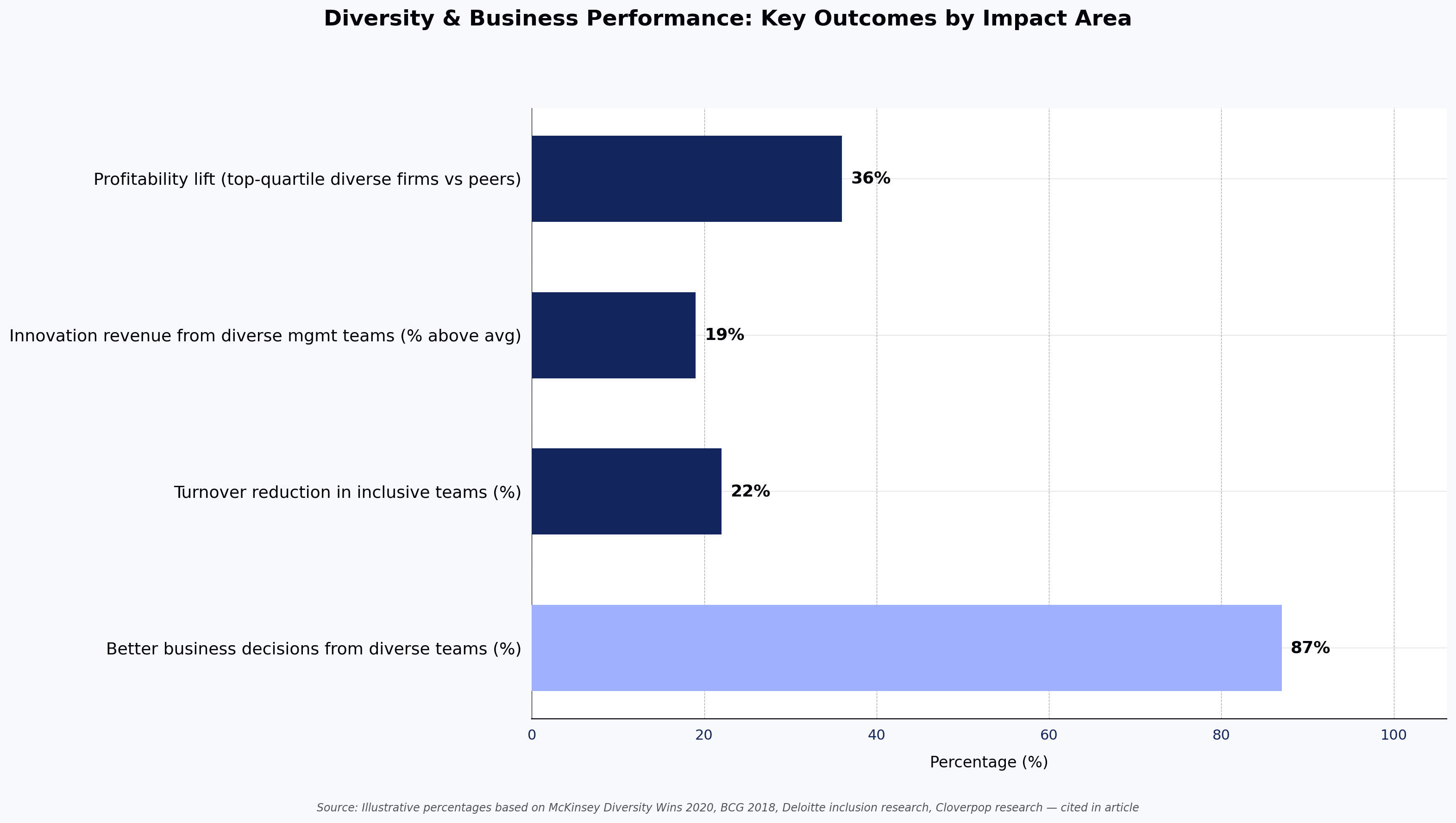
This is especially relevant in 2026, as the working definition of DEI has expanded to include neurodiversity, disability inclusion, and socio-economic geography. The business case is supported by consultancy research: McKinsey's Diversity Wins study found that organizations in the top quartile for gender and ethnic diversity were meaningfully more likely to achieve above-average profitability than more homogenous competitors. Representation alone is not enough — inclusion has to be built into the system so diverse talent feels safe enough to contribute.
| Impact Area | Reported Outcome | Source |
|---|---|---|
| Profitability | Top-quartile diverse companies more likely to outperform peers on profitability | McKinsey, Diversity Wins (2020) |
| Innovation | Higher innovation revenue from diverse management teams | BCG, How Diverse Leadership Teams Boost Innovation (2018) |
| Retention | Lower turnover reported in inclusive teams | Deloitte inclusion research |
| Decision quality | Better business decisions attributed to diverse teams | Cloverpop research |
Defining the diversity recruiting software ecosystem
Direct answer: Diversity recruiting software in 2026 falls into four categories — sourcing platforms, screening and assessment tools, language optimization software, and structured interviewing systems — each addressing a specific stage of the hiring funnel.
Sourcing and pipeline expansion
Sourcing tools surface candidates who are invisible to traditional keyword searches or restricted professional networks. Vendors in this space aggregate data from sources such as GitHub, Stack Overflow, and academic publications, and allow recruiters to apply filters for demographic groups including military veterans, LGBTQ+ candidates, and women in technical roles. By identifying "likely open" candidates through AI models trained on public profile data and engagement signals, these tools help build proactive rather than reactive pipelines.
Screening and objective assessment
Screening software removes subjective triggers that lead to bias. This includes PII masking, which hides names, photos, and graduation dates so evaluators can focus on skills. Skills-first hiring has become a common approach, with candidates evaluated through standardized coding challenges, logic tests, and structured assessments. These provide a richer talent signal than a GPA or employer brand name, allowing candidates with non-traditional backgrounds to demonstrate capability. HackerEarth's assessment platform, for example, uses skills-based evaluations across 1,000+ skills to reduce reliance on resume proxies.
Language optimization and bias interruption
Language in job descriptions and outreach emails is often a barrier to diverse applications. Augmented writing tools use AI trained on historical HR records to identify gendered phrasing, age-restrictive language, and subtle biases. These tools provide real-time scores that predict how a post is likely to perform with underrepresented groups.
Structured interviewing and conversational AI
The interview stage is the most susceptible to affinity bias, where interviewers favor candidates similar to themselves. Structured interviewing tools mandate consistent scorecards and pre-defined question kits for every applicant. Asynchronous video and conversational AI provide flexibility for candidates and reduce logistical hurdles that disproportionately affect underrepresented candidates.
How to choose the best diversity recruiting software for DEI hiring in 2026
Direct answer: Choose diversity recruiting software based on four criteria: algorithmic transparency, integration depth with your ATS/HRIS, candidate experience and accessibility, and scalability aligned to your hiring volume and budget.
Algorithmic transparency and governance
Ask vendors for evidence that scoring logic is transparent and has been audited for adverse impact. Because hiring algorithms often learn from historical data that may be biased, the software should include mechanisms for bias-detection protocols and clear rules for human review. A "black box" AI that ranks candidates without explainable criteria is a systemic risk. See the EEOC's guidance on AI in employment decisions for the current regulatory frame.
Integration and workflow fit
A diversity tool that exists in a silo will eventually fail. Strong platforms integrate natively with existing Applicant Tracking Systems (ATS) and Human Resource Information Systems (HRIS), so inclusive processes do not add administrative burden. Look for bi-directional messaging and CRM-style candidate nurturing that supports a cohesive experience from sourcing to onboarding.
Candidate experience and accessibility
The candidate is the primary stakeholder in any recruiting software. A mobile-first, low-friction experience is important to accommodate candidates across all socio-economic levels. Software should support name pronunciation, pronoun selection, and accessible assessment environments. For technical roles, the IDE must be accessible and provide practice environments to level the playing field for self-taught developers. HackerEarth's candidate experience feature set is one example of how these considerations show up in product.
Scalability and ROI indicators
Evaluate whether a tool scales with hiring volume. Enterprises processing tens of thousands of applications need automated pre-filtering and conversational AI. Startups are usually better served by lightweight solutions with transparent, pay-as-you-grow pricing. Either way, analytics should link team composition to KPIs such as innovation rate and retention.
Top diversity recruiting tools for 2026: a side-by-side comparison
The following tools are widely used in the 2026 DEI landscape. Each addresses a specific niche, and each has documented limitations worth reviewing before purchase.
Pricing note: All third-party pricing figures below are based on publicly listed information or vendor marketplaces and change frequently. Confirm current pricing with each vendor before committing budget. HackerEarth pricing is not published here; contact sales for a quote.
| Software | Best for | Key DEI-relevant features | Known limitations |
|---|---|---|---|
| HackerEarth | Technical hiring at scale | Skills-based assessments across 1,000+ skills; global developer community; hackathons; multi-language programming support | Better suited to organizations with meaningful technical hiring volume; smaller teams should evaluate fit against use case |
| Greenhouse | Process governance | Structured interview scorecards; candidate name pronunciation; pronouns; ATS integrations | Setup and configuration effort is significant; pricing scales quickly with headcount |
| Textio | Job description language | Augmented writing; predictive language scoring; bias interruption prompts | Focused on top-of-funnel language, not full-funnel evaluation |
| SeekOut | Precision sourcing | Diversity filters; public code and patent aggregation; developer scoring | Sourcing tool only — does not manage downstream evaluation |
| HireVue | Structured video interviewing at scale | Standardized video templates; structured question kits; adverse impact reporting | Has faced scrutiny from the EEOC and under the Illinois Artificial Intelligence Video Interview Act; discontinued its facial-analysis scoring in 2021 |
| Pymetrics | Behavioral assessment | Neuroscience-based games designed to reduce cultural bias | Acquired by Harver in 2022; buyers should verify current product roadmap and continuity |
| Manatal | Budget-friendly ATS with AI | AI-driven candidate scoring; global reach | Lighter-weight tool; less depth in structured assessment |
HackerEarth: technical hiring, evaluated on skills
HackerEarth's platform is built around skills-based technical evaluation, which reduces reliance on resume proxies such as school name or prior employer. The assessment library covers 1,000+ skills, and hiring teams can configure structured evaluations that separate candidate capability from pedigree signals.
For campus and early-career hiring, HackerEarth's hackathon and coding-challenge formats extend reach to developers who may not appear in traditional on-campus recruiting pools, including those in geographies underserved by conventional sourcing. For a deeper look at how these formats are being used, see future trends in campus recruiting for 2026.
Greenhouse: structured hiring, well integrated
Greenhouse's structured hiring methodology is designed to minimize unconscious bias by ensuring every candidate for a role is evaluated against the same criteria. Its integration ecosystem — connecting with hundreds of HR tools — is one of its strongest assets. DEI tracking allows teams to audit their funnel for demographic drop-offs; if data shows women dropping off after the initial phone screen, Greenhouse provides the analytics to investigate whether the cause is biased interviewer feedback or a flaw in role definition.
Textio: inclusive language at the top of the funnel
Textio is a predictive engine for job-post language, flagging phrasing that research and its internal models correlate with narrower applicant pools — including terms drawn from a body of research on gendered and exclusionary vocabulary in job ads. Textio Lift extends the same approach to performance feedback, addressing the retention side of DEI where biased evaluations can push out underrepresented hires. Independent verification of vendor-reported customer statistics is recommended before citing them internally.
SeekOut: sourcing beyond LinkedIn
SeekOut is designed for specialized sourcing in competitive fields such as AI engineering or aerospace. It aggregates data from public sources including GitHub, Stack Overflow, and patent filings to surface talent that is less visible on LinkedIn. Its bias-reducer mode hides names and photos during search to keep the focus on qualifications.
HireVue: standardized structured video
HireVue is used by organizations hiring at large volume that want consistent interview format. Asynchronous video interviews present the same questions to every candidate in the same format. Buyers should be aware that HireVue has been the subject of regulatory attention — including EEOC scrutiny and coverage under the Illinois Artificial Intelligence Video Interview Act — and that it discontinued its facial-analysis scoring in 2021. Most teams now treat HireVue's AI scoring as one supportive signal rather than a decision, keeping a human in the loop.
Pymetrics: gamified behavioral assessment
Pymetrics uses gamified assessments intended to measure cognitive and emotional traits with less dependency on language or cultural context. Buyers should note that Pymetrics was acquired by Harver in 2022; evaluate the current product roadmap and continuity before committing to a multi-year contract.
Direct comparison of technical assessment platforms
For organizations focused on technical hiring, several specialized platforms compete in this space. Under HackerEarth's editorial policy, competitor capabilities listed below reflect commonly cited positioning; verify specifics directly with each vendor.
| Platform | DEI-relevant angle | Common strengths | Common limitations |
|---|---|---|---|
| HackerEarth | Skills-based assessments; hackathons; global developer reach | Skills coverage across 1,000+ skills; developer community; structured proctoring | Best fit when technical hiring volume justifies the platform |
| CodeSignal | Realistic coding simulations | High-fidelity environment | Setup can be complex |
| HackerRank | Algorithmic assessments | Widely adopted; large question library | Algorithm focus can feel abstract relative to real engineering work |
| TestGorilla | Mixed technical and non-technical roles | Broad skill evaluation across role types | Less depth for advanced coding assessment |
| Codility | Automated screening | Efficient for large-scale algorithm testing | Limited interactive interview support |
HackerEarth's differentiator in 2026 is the combination of skills-based assessments with hackathon formats, which supports evaluation of collaborative problem-solving in addition to individual coding ability.
Strategic implementation of DEI technology
Implementation of diversity recruiting software should be treated as an operational change, not just a technical installation. Even a well-chosen platform will underperform without a supporting inclusive culture.
A 15-step diversity audit framework
- Review funnel data by demographic group to identify where candidates drop off.
- Analyze the language in interviewer feedback for coded bias (for example, "culture fit").
- Ensure diverse representation on interview panels to reduce individual bias.
- Train panelists on bias awareness before every major hiring cycle.
- Set clear diversity metrics that include geography and socio-economic dimensions.
- Implement blind resume reviews as a default setting.
- Require unconscious-bias refreshers for hiring managers on a regular cadence.
- Share DEI commitments through authentic employee storytelling.
- Expand outreach through partnerships with groups such as NSBE or Out in Tech.
- Offer reasonable accommodations — captioning, flexible scheduling — during interviews.
- Benchmark progress against comparable organizations in your industry using published DEI reports.
- Collect and analyze feedback from both hired and rejected candidates.
- Establish a protocol for algorithmic bias checks with IT and legal teams.
- Review vendor audits and model documentation on a scheduled cadence.
- Link diversity goals to broader business resilience and risk management outcomes, and report them to leadership alongside other operating metrics.
Building authentic employer branding
Employer branding in 2026 is less about social media marketing and more about proof of culture. Candidates look for evidence that leadership is committed to DEI through action, not statements. Share honest feedback from employees, including constructive criticism, to demonstrate continuous improvement. Tokenistic branding — showing a diverse group of employees only during recruiting season — tends to backfire and drive higher attrition.
Economic modeling and the ROI of diversity recruiting software
The ROI for diversity hiring software is calculated by comparing the gain from better hiring decisions against the total cost of ownership.
The recruitment ROI formula
Recruitment ROI = (Value of Hires − Total Recruitment Cost) / Total Recruitment Cost
To calculate total recruitment cost, include internal labor (recruiter hours × loaded hourly rate), external spend (software licenses, job ads), and leadership time spent on panels.
Quality of hire
Quality of Hire = (Job Performance + Ramp Speed + Retention + Cultural Contribution) / Number of Indicators
High-quality hires contribute directly to productivity and revenue impact, especially in roles tied to creative problem-solving or sales.
Hard cost savings and value gains
| Cost factor | Without a structured DEI tool | With a structured DEI tool |
|---|---|---|
| Cost per hire | Heavier reliance on external agencies | Reduced agency spend through internal rediscovery and better pipelines |
| Time-to-hire | Manual screening and scheduling | Automation of screening and scheduling via conversational AI |
| Attrition cost | Higher turnover in non-inclusive environments | Lower turnover reported in inclusive environments (see Deloitte research) |
| Innovation | Slower iteration in homogenous teams | Broader problem-solving from diverse teams (see BCG innovation research) |
Replacement costs for a mis-hire vary by role and seniority; SHRM and other HR bodies publish current benchmarks that buyers can use for internal modeling.
Where HackerEarth fits in a DEI stack
HackerEarth's platform is built for organizations that treat technical hiring as a place where DEI outcomes are made or lost. Rather than positioning as a general-purpose recruiting suite, the platform focuses on structured, skills-based evaluation for developer and technical roles.
Candidate experience for technical assessments
HackerEarth's assessments are designed to let candidates work in the programming language they know best, with an IDE built for structured technical evaluation. Reducing incidental friction — environment setup, tooling confusion — lets a candidate's core problem-solving ability show up more clearly, which supports skills-first hiring practices.
Reach into a global developer community
Through virtual hackathons and coding challenges, HackerEarth supports outreach to a global developer community. This is relevant for organizations aiming to expand geographic and socio-economic representation, since virtual formats let developers in underserved regions compete on the same task as candidates from traditional talent hubs.
Skills-based validation
HackerEarth's assessment library covers 1,000+ skills, supporting evaluation of candidates on the specific skills a role requires rather than on prior employer or degree. Performance analytics and reporting let hiring teams track their funnel and identify where bias may be entering technical evaluation.
Synthesis and recommendations
The recruitment landscape in 2026 treats diversity as a driver of business performance, and the tools discussed — HackerEarth, Greenhouse, Textio, and others — provide the infrastructure needed to move from intent to measurable outcomes. The teams that get the most from these tools redesign their operating models around inclusion by design, so technology supports human judgment rather than replacing it.
Organizations looking to improve DEI hiring outcomes in 2026 should consider:
- Adopting skills-first hiring by replacing at least one resume-based screening stage with a structured skills assessment within the next hiring cycle.
- Requiring algorithmic governance evidence — model documentation and adverse-impact audit results — from every vendor before purchase.
- Tracking belonging and retention alongside representation, using employee survey data reviewed quarterly.
- Publishing pay bands in job posts to align with pay-transparency regulations and improve trust.
- Linking hiring diversity metrics to business KPIs such as innovation rate and retention, and reporting them on the same cadence as other operating metrics.
Frequently asked questions
What is the best diversity recruiting software for DEI hiring in 2026? There is no single best diversity recruiting software for DEI hiring in 2026 — the right choice depends on which stage of the funnel is weakest. Teams strong on sourcing but weak on evaluation should prioritize structured assessment tools; teams with biased job language should prioritize language optimization tools. Evaluate vendors on algorithmic transparency, integration depth, and candidate experience.
How does AI reduce bias in hiring? AI can reduce bias when it is used to standardize the evaluation process — for example, by masking PII, applying the same structured questions to every candidate, or scoring skills-based assessments against defined rubrics. AI can also introduce bias when it is trained on historical hiring data that reflects past discrimination. The EEOC has issued guidance on evaluating AI tools for adverse impact.
What is skills-first hiring? Skills-first hiring is the practice of evaluating candidates primarily on their demonstrated skills — through assessments, work samples, or structured tasks — rather than on proxies such as degrees or prior employers. This approach tends to widen the qualified applicant pool and is associated with lower bias against candidates from non-traditional backgrounds.
How do I measure the ROI of diversity recruiting software? Measure ROI by tracking cost per hire, time-to-hire, quality of hire, and retention before and after implementation, and comparing the delta to the total cost of the platform. Include both hard savings (reduced agency fees, faster fills) and value gains (higher retention, better team performance).
Is HireVue safe to use given regulatory scrutiny? HireVue has faced EEOC scrutiny and operates under laws such as the Illinois AI Video Interview Act. It discontinued its facial-analysis scoring in 2021. Organizations using HireVue should treat its AI scoring as a supporting signal, keep humans in the loop for decisions, and confirm compliance with local jurisdiction laws.
What happened to Pymetrics? Pymetrics was acquired by Harver in 2022. Its neuroscience-based games are still offered as part of Harver's assessment portfolio. Buyers should review the current product roadmap and continuity guarantees before committing to multi-year contracts.
See it in action
If you are evaluating platforms for technical hiring with DEI outcomes in mind, book a demo of HackerEarth Assessments to see how skills-based evaluation and structured assessments work against your current hiring process.
Editorial note: Third-party product capabilities, pricing, and customer statistics described in this article are based on publicly available vendor and research sources at the time of writing and change frequently. Verify current details directly with each vendor before purchase decisions. Statistics attributed to McKinsey, BCG, Deloitte, and other named research bodies are linked to their original publications.