As a beginner in programming, you might feel confident building projects or solving problems on your own. However, proving those skills during a technical interview is a completely different challenge. Coding interview questions are structured problems that test how well you think, write code, and explain your approach under pressure.
These questions often focus on algorithms, data structures, and real-world problem-solving. In fact, 73.7% of technical interviews included live coding challenges in 2024, which shows how central these questions have become in developer hiring.
That’s why consistent practice matters more than raw talent. You need a clear strategy to recognize patterns, structure solutions, and communicate your thinking with confidence.
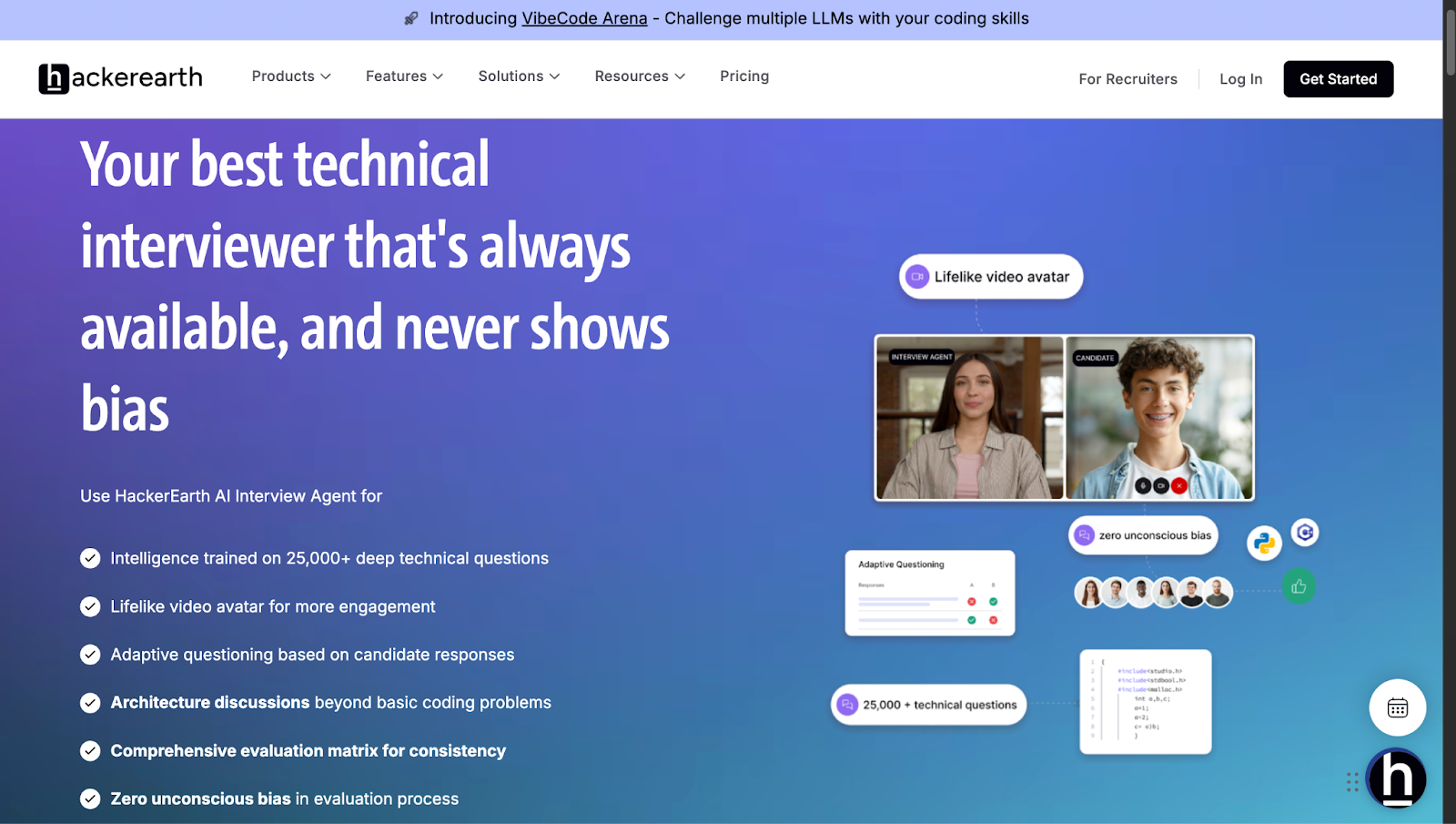
An all-in-one AI-based interview and assessment platform like HackerEarth accelerates this process by offering real interview-style challenges. In fact, a total of 6,000 companies have created 43,000 coding tests, and over 5.5 million developers have already been assessed on HackerEarth, making it one of the most widely used platforms for coding practice and technical hiring.
This guide will help you understand coding interview questions, approach them effectively, and practice them strategically using HackerEarth.
How to Approach Coding Interview Questions
Many candidates jump straight into coding the moment they see a technical question. That instinct feels natural, but it often leads to mistakes. Experienced developers pause first, study the problem carefully, and build a clear plan before writing a single line of code.
Here’s how:
1. Understand the problem first
Read the problem carefully. Then reread to confirm understanding.
Look for three things right away. Identify the input, determine the expected output, and note any constraints.
For example, an interviewer might ask you to reverse a string or detect duplicates in an array. These tasks look simple at first, but constraints often change the solution. Large input sizes or strict time limits can turn a basic idea into a performance challenge.
Before coding, ask a few clarifying questions.
- What input size should the algorithm support?
- Should the solution handle negative values?
- Does the interviewer expect an optimized solution?
This short discussion shows the interviewer that you think carefully before jumping into implementation.
2. Break the problem into steps
Once you understand the problem, turn it into smaller tasks.
Large problems often feel overwhelming when you look at them as a single challenge. However, the moment you divide the problem into clear steps, the solution becomes much easier to manage.
Consider this example problem: Find the first non-repeating character in a string.
Instead of coding immediately, outline the logic first.
You might approach the solution like this:
- Traverse the string
- Store the frequency of each character
- Identify the first character that appears only once
At this point, the problem becomes much easier to approach because you already have a clear roadmap.
3. Write readable code
After you create a plan, start writing the solution using clean, readable code.
Interviewers rarely reward clever tricks that are hard to understand. They prefer code that communicates logic clearly and quickly.
Here is a simple Python example.
def first_unique_char(text):
    counts = {}
    for ch in text:
        counts[ch] = counts.get(ch, 0) + 1
    for ch in text:
        if counts[ch] == 1:
            return ch
    return None
Notice how each step follows the earlier outline. This structure makes your reasoning easy to follow.
4. Test edge cases
Once your solution works, pause and test it with unusual inputs.
Many candidates lose points because they only test normal scenarios. Interviews often include tricky cases that expose weak logic.
Always test scenarios such as:
- Empty arrays or empty strings
- Duplicate values
- Large datasets
Testing edge cases shows that you think like a real engineer who writes reliable software.
5. Optimize after correctness
Finally, focus on improving performance.
A correct solution should always come before optimization. Once the logic works, you can refine the algorithm to improve time or space complexity.
This reflects real engineering workflows: correctness first, optimization later.
Once you understand the core approach, use this quick checklist during the interview to stay organized and avoid common mistakes.
Essential Coding Interview Questions by Language
Most interview questions revolve around arrays, strings, recursion, sorting, and data structures. These fundamentals appear repeatedly because they reveal how well a developer understands algorithmic thinking and logical problem-solving.
The sections below walk through common coding interview questions by language. Each group highlights the kinds of problems you are likely to encounter and explains why interviewers ask them.
A] Python coding interview questions
Python appears frequently in coding interviews, as it allows developers to focus on logic instead of syntax. Its simple structure makes it easier to demonstrate algorithmic thinking during timed interviews.
Let’s look at a few Python coding interview questions and answers that candidates face.
#Q1. Reverse a string
This problem looks simple, yet interviewers use it to test your understanding of string manipulation and iteration.
Example question: Write a function that reverses a string.
Example solution:
def reverse_string(text):
    return text[::-1]
Interviewers often follow up by asking you to avoid built-in functions. This forces you to show loop logic and memory awareness.
#Q2. Two sum problem
The Two Sum problem is one of the most common interview questions because it combines arrays with hash maps.
Problem: Given an array of integers and a target number, return the indices of two numbers that add up to the target.
Example solution:
def two_sum(nums, target):
    seen = {}
    for i, num in enumerate(nums):
        complement = target - num
        if complement in seen:
            return [seen[complement], i]
        seen[num] = i
return None # Explicitly handle case where no solution exists
Interviewers like this problem because it shows whether you understand time complexity and how to handle dictionary lookups.
#Q3. Check if a string is a palindrome
This question evaluates how well you handle string operations and edge cases.
Example problem: Determine whether a string reads the same forward and backward.
Example solution:
def is_palindrome(text):
cleaned = ''.join(ch.lower() for ch in text if ch.isalnum())
return cleaned == cleaned[::-1]
Interviewers may extend this problem by asking you to ignore spaces and punctuation.
B] Java coding interview questions
Java is another common language in enterprise systems and backend services. Because of this, many companies still conduct Java-based coding interviews.
Java questions often emphasize data structures and object-oriented thinking. You will also see questions related to arrays, linked lists, and sorting algorithms.
Let’s explore a few Java interview coding questions.
#Q1. Reverse an array
Array manipulation appears in almost every coding interview because arrays form the foundation of many algorithms.
Example problem: Reverse an array without using additional memory.
Example solution:
public static void reverseArray(int[] arr) {
    int left = 0;
    int right = arr.length - 1;

    while (left < right) {
        int temp = arr[left];
        arr[left] = arr[right];
        arr[right] = temp;

        left++;
        right--;
    }
}
Interviewers ask this question to evaluate indexing, loops, and in-place operations.
#Q2. Implement binary search
Binary search frequently appears in Java interviews because it demonstrates algorithmic efficiency.
Example solution:
public static int binarySearch(int[] arr, int target) {
    int left = 0;
    int right = arr.length - 1;

    while (left <= right) {
        int mid = (left + right) / 2;

        if (arr[mid] == target) {
            return mid;
        }

        if (arr[mid] < target) {
            left = mid + 1;
        } else {
            right = mid - 1;
        }
    }

    return -1;
}
This problem shows whether you understand divide-and-conquer strategies.
C] SQL coding interview questions
Many backend and data roles include SQL problems that test your ability to work with databases.
These questions focus on data retrieval, filtering, and aggregation.
#Q1. Find duplicate records
Example problem: Find duplicate email addresses in a user table.
Example query:
SELECT email, COUNT(*)
FROM users
GROUP BY email
HAVING COUNT(*) > 1;
This question tests your understanding of grouping and aggregation.
#Q2. Get the second-highest salary
This is a classic SQL interview question.
Example query:
SELECT MAX(salary)
FROM employees
WHERE salary < (
    SELECT MAX(salary)
    FROM employees
);
Interviewers ask this question to see if you understand subqueries.
#Q3. Rank employees by salary
Ranking problems often appear in SQL interviews.
Example query:
SELECT name, salary,
RANK() OVER (ORDER BY salary DESC) AS salary_rank
FROM employees;
This question evaluates your understanding of window functions.
D] React coding interview questions
Front-end interviews often include React-based coding challenges. These questions focus on component logic, state management, and DOM behavior.
#Q1. Create a counter component
Example question: Build a button that increases a number when clicked.
Example solution:
import { useState } from "react";

function Counter() {
  const [count, setCount] = useState(0);

  return (
    <div>
      <p>{count}</p>
      <button onClick={() => setCount(count + 1)}>
        Increase
      </button>
    </div>
  );
}
Interviewers use this problem to test your understanding of React hooks.
#Q2. Fetch data from an API
Example question: Display a list of users from an API.
Example solution:
import { useEffect, useState } from "react";

function Users() {
  const [users, setUsers] = useState([]);

  useEffect(() => {
    fetch("https://api.example.com/users")
      .then(res => res.json())
      .then(data => setUsers(data));
  }, []);

  return (
    <ul>
      {users.map(user => (
        <li key={user.id}>{user.name}</li>
      ))}
    </ul>
  );
}
This question checks whether you understand asynchronous data fetching.
E] OpenAI coding interview questions
As AI tools become more common in development workflows, companies increasingly test candidates on API integration.
These questions usually focus on HTTP requests, data parsing, and error handling.
#Q1. Call an AI API
Example question: Send a prompt to an AI API and display the response.
Example solution:
import requests
url = "https://api.example.com/generate"
data = {
  "prompt": "Explain recursion in simple terms"
}
response = requests.post(url, json=data)
print(response.json())
This question evaluates how well you handle API requests and JSON responses.
#Q2. Build a simple chat interface
Example question: Create a small interface that sends user messages to an API and displays replies.
This type of question tests several skills at once.
Developers must handle user input, send requests to an API, process the response, and update the interface.
#Q3. Handle API errors
Interviewers also want to see how you handle failure scenarios.
For example:
try:
    response = requests.get(url)
    response.raise_for_status()
except requests.exceptions.RequestException:
    print("API request failed")
Handling errors properly shows that you understand real-world production environments.
Common Problem Types & How to Master Them
When you prepare for coding interviews, certain problem types keep showing up again and again. Below, we’ll break down each common problem type, what to focus on, a simple strategy snippet, and a HackerEarth-style problem to practice.
Arrays & strings
Focus on understanding how to traverse elements using loops, two pointers, and simple transformations. Arrays and strings form the foundation of most interview problems because they let interviewers test basic logic without a complicated setup.
To check if a string is a palindrome, normalize the text and compare characters from both ends, moving inward.
def is_palindrome(s):
    s = ''.join(ch.lower() for ch in s if ch.isalnum())
    return s == s[::-1]
Practice on HackerEarth: Look for problems like “Check Anagrams” or “Subarrays with Sum K” that use sliding window and two-pointer patterns.
Linked lists
Linked lists test your understanding of pointers or references and how nodes link together. You often need to reverse lists, detect cycles, and merge sorted lists.
So, focus on breaking and reconnecting nodes without losing track of your position.
Strategy snippet (reverse list):
def reverse_list(head):
    prev = None
    while head:
        nxt = head.next
        head.next = prev
        prev = head
        head = nxt
    return prev
Practice on HackerEarth: Search for problems like “Reverse a Linked List” or “Detect and Remove Loop in a Linked List.”
Trees & graphs
Trees and graphs push you beyond linear structures and introduce relationships and hierarchy. You should be comfortable with traversal algorithms like BFS (breadth-first search) and DFS (depth-first search).
Here, you must focus on traversing levels, recursion patterns, and visited tracking.
Strategy snippet (BFS skeleton):
from collections import deque

def bfs(root):
    queue = deque([root])
    while queue:
        node = queue.popleft()
        # process node
        if node.left: queue.append(node.left)
        if node.right: queue.append(node.right)
Practice on HackerEarth: Look for “Reverse level order traversal” or “Shortest path in Graph.”
Dynamic programming
Dynamic programming appears less often than arrays or lists, but it’s a strong differentiator in interviews. DP helps you break down problems with overlapping subproblems into manageable pieces.
In DP, you must identify subproblem overlap and choose between tabulation and memoization.
Strategy snippet (Fibonacci with memo):
def fib(n, memo={}):
    if n < 2: return n
    if n in memo: return memo[n]
    memo[n] = fib(n-1, memo) + fib(n-2, memo)
    return memo[n]
Practice on HackerEarth: Try problems like “Minimum path sum” or “Longest Increasing Subsequence.”
Recursion & backtracking
These problems test how you break problems into base cases and smaller paths. Backtracking adds exploration and choice management.
Here, think in terms of the choices you make and undo them to explore alternatives.
Strategy snippet (permutations):
def permute(nums):
    result = []
    def backtrack(path):
        if len(path) == len(nums):
            result.append(path[:])
            return
        for n in nums:
            if n in path: continue
            path.append(n)
            backtrack(path)
            path.pop()
    backtrack([])
    return result
Practice on HackerEarth: Search for “Generate permutations” or “Sum problem” problems.
SQL joins & grouping
SQL questions often test your ability to combine tables, filter data, and aggregate results. These skills matter a lot for backend and data roles.
Practice on HackerEarth: Look for problems involving joins between tables, like “Serve all customers.”
Front-end logic patterns (React)
Front-end interviews often focus less on algorithms and more on UI logic, component state, and DOM behavior. React problems test your understanding of component lifecycles and state management.
Strategy snippet (Counter with state):
import { useState } from 'react';

function Counter() {
  const [count, setCount] = useState(0);
  return (
    <div>
      <button onClick={() => setCount(count+1)}>
        Count {count}
      </button>
    </div>
  );
}
Practice on HackerEarth: Try problems like “Patterns” or “Toggle UI state.”
Practice Workflow on HackerEarth
Preparing for coding interviews becomes much easier when you follow a consistent practice workflow. Instead of solving random problems each day, structured practice helps you build skills gradually and measure improvement over time.
As an all-in-one coding assessment and hiring platform, HackerEarth combines coding challenges, assessments, and real interview-style environments in one place. Companies also use the platform to evaluate candidates during hiring, which means practicing here helps simulate real technical interview environments. Today, the platform connects developers with a global community of more than 10 million programmers, making it one of the largest developer ecosystems for coding practice and hiring challenges.
Let’s walk through a simple workflow you can follow when practicing coding interview questions on HackerEarth.
Start with structured practice
The first step is to focus on structured problem-solving rather than random exercises. HackerEarth organizes coding challenges by difficulty level, programming language, and topic, such as arrays, recursion, or graphs.
This structure helps you move from easier problems to more advanced ones without feeling overwhelmed. Instead of jumping between unrelated questions, you build skills layer by layer. Over time, this consistent exposure helps you recognize patterns that appear repeatedly in interviews.
Many companies also use similar structured assessments during the hiring process. In fact, more than 6,000 companies have created over 43,000 coding tests on HackerEarth, which shows how closely the platform reflects real interview environments.
Track progress and build consistency
Once you start practicing regularly, the next step is tracking your progress. HackerEarth allows developers to monitor problem attempts, completion rates, and performance across different topics.
These insights help you quickly identify weak areas. For example, you might notice that you solve array problems easily but struggle with dynamic programming or graphs.
Consistency matters even more than speed. When you practice daily, you begin to develop coding instincts. Many developers also maintain streaks or weekly practice goals to stay motivated and keep improving.
Learn from test cases and editor feedback
One of the biggest advantages of practicing on HackerEarth is immediate feedback. The platform automatically runs your code against multiple test cases and highlights errors when the output does not match the expected result.
This process teaches you how to debug efficiently and improve your logic. Instead of guessing what went wrong, you can analyze failing test cases and adjust your solution step by step.
HackerEarth also provides a built-in coding editor (The Monaco Editor) and evaluation system that simulates real coding assessments. The editor lets you write, test, and refine your code in a clean, structured interface similar to what you encounter in technical interviews.
The platform also draws from a large technical assessment ecosystem that includes more than 40,000 coding problems across 1,000+ technical skills and 40+ programming languages. This extensive problem library exposes you to interview-style challenges across multiple domains and difficulty levels. As a result, you not only fix errors faster but also develop the habit of writing clean, reliable code under time constraints. Over time, this type of practice makes technical interviews feel much more familiar and manageable.
Participate in community challenges and timed mocks
Once you feel comfortable solving individual problems, the next step is testing your skills in competitive environments. HackerEarth frequently hosts coding challenges, hackathons, and timed contests in which developers solve problems under strict deadlines.
These events simulate the pressure of real coding interviews while exposing you to creative problem-solving approaches used by other developers. The platform has hosted thousands of such events, allowing developers to collaborate, compete, and showcase their skills to potential employers.
Real Interview Tips from Industry
In coding interviews, tech recruiters evaluate how you approach the problem, communicate your reasoning, and handle edge cases.
These practical strategies used by experienced engineers can significantly improve your performance.
- Communicate your thought process: Explain how you understand the problem and walk through your approach before coding. Even if your first attempt is not perfect, explaining your reasoning shows strong problem-solving skills and makes it easier for the interviewer to guide you if needed.
- Ask clarifying questions: Many candidates jump straight into coding without fully understanding the problem. Don’t do it. Confirm key details, including input constraints, expected outputs, and performance requirements. This prevents unnecessary mistakes and shows careful thinking.
- Write readable code first: During interviews, readability matters more than clever tricks. Write clean, well-structured code with meaningful variable names and clear logic. Start with a straightforward solution that works correctly. Once the code is understandable and functional, you can discuss potential optimizations.
- Test edge cases while coding: Think through scenarios like empty inputs, single values, duplicates, or large datasets. Talking through these cases helps catch bugs early.
- Optimize after correctness: A common mistake is trying to produce the most optimized solution immediately. Start with a working solution, then explain how you would improve its time or space complexity if needed.
Integrations & Hiring Workflows
HackerEarth integrates easily with existing hiring systems, helping teams manage technical recruitment without adding extra steps. Many companies already use applicant tracking systems (ATS) to manage their candidate pipelines. HackerEarth connects with these ATS and HRIS platforms so recruiters can move candidates from application to technical assessment without switching tools.
Some of the popular ATS platforms supported include:
- Greenhouse
- LinkedIn Talent Hub
- Lever
- iCIMS
- Workable
- JazzHR
- SmartRecruiters
- Zoho Recruit
- Recruiterbox
- Eightfold
These integrations allow teams to create coding tests, invite candidates, and view detailed reports from a single interface.
For added flexibility, HackerEarth offers a Recruit API. Teams can automate tasks such as sending invitations, scheduling tests, collecting results, and embedding assessments into broader HRIS workflows. Webhook‑style event flows let organizations seamlessly sync both assessments and live interviews into existing hiring operations.
Security and access control remain a top priority. HackerEarth supports single sign-on (SSO) using modern standards such as SAML, along with API-key-based authentication. These features let your team manage user access consistently and protect candidate data throughout the hiring lifecycle.
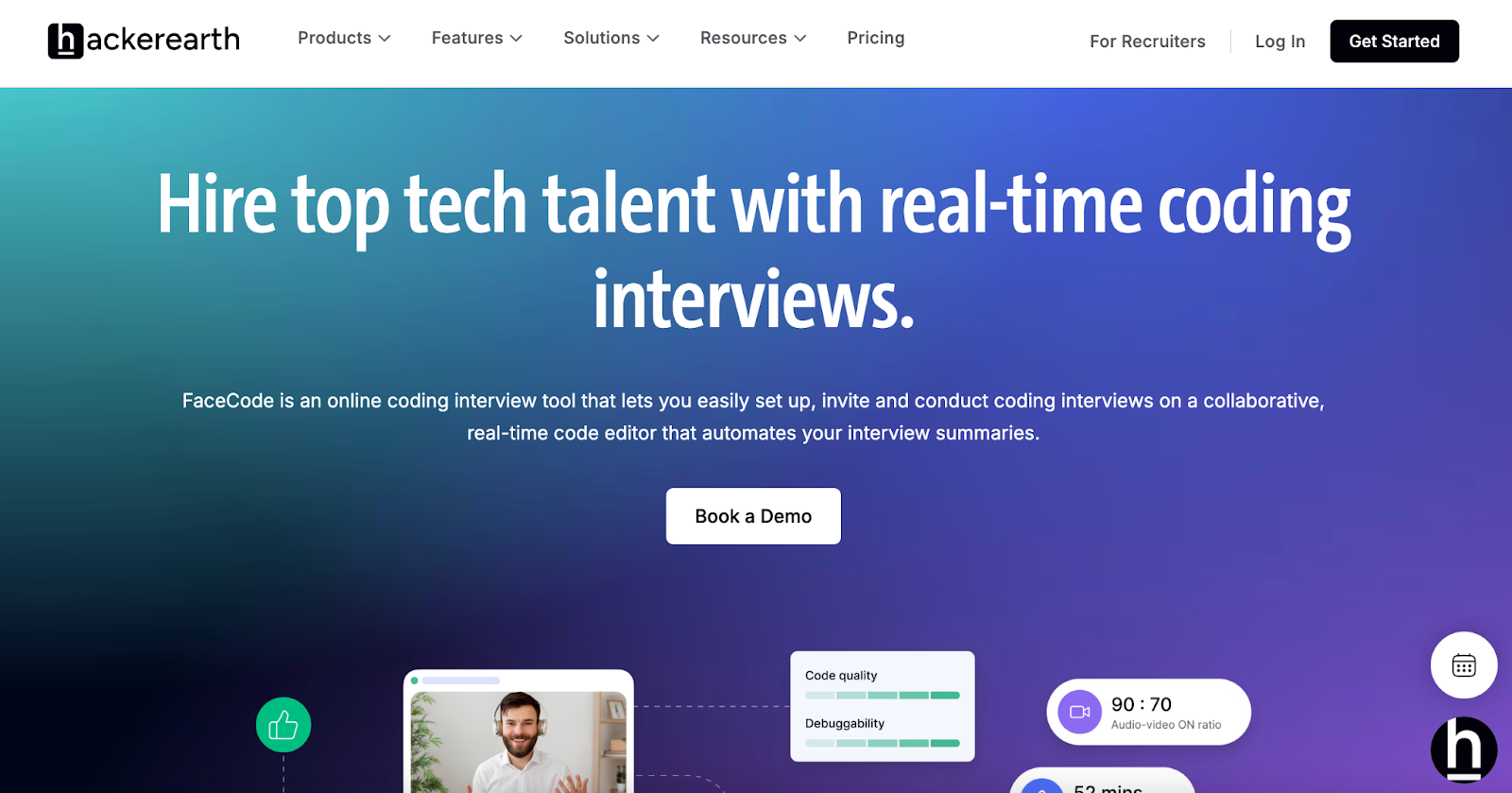
When candidates reach the interview stage, the Interview FaceCode tool enables live coding interviews in a collaborative environment. Interviewers can watch candidates solve problems in real time, discuss approaches, and provide structured feedback. FaceCode also supports HD video, interactive whiteboards, and panels for up to 5 interviewers. AI‑powered summaries highlight both technical and soft skills, making feedback actionable and clear.
Together, these features allow you to orchestrate the entire hiring funnel, from assessments to interviews to evaluation, without missing a step.
Pricing Signals & Packaging
HackerEarth publishes clear, tiered pricing, making it easy for teams to plan their hiring budgets. Here’s a simple breakdown:
- Skill Assessments
- Growth ($99/month): Starter tier with basic assessment credits, coding questions, and plagiarism detection
- Scale ($399/month): Access 20,000+ questions, advanced analytics, video responses, and ATS integrations
- Enterprise (custom pricing): Full 40,000+ question library, API/SSO, professional services, global benchmarking, and premium support
- AI Interviewer
- Growth ($99/month): AI-driven interviews, real-time code evaluation, automated candidate screening, custom templates, and detailed analytics
- Enterprise (custom pricing): SSO integration, custom roles and permissions, professional services
- Talent Engagement & Hackathons: Custom pricing for hackathons, community challenges, and brand engagement
- Learning & Development: Free developer practice content, or the Business tier (~$15/month per user) for upskilling, competency mapping, and analytics
Yearly billing provides roughly 2 months of free service, making long-term hiring plans more cost-effective. This tiered structure lets smaller teams start lean while providing enterprise-grade tools for large-scale recruitment, all without hidden surprises.
Master Coding Interviews and Land Your Dream Job
Coding interviews can be challenging, but the right preparation makes a big difference. With the right mix of problem-solving practice, timed challenges, and mock interview exposure, you can build both skill and confidence.
HackerEarth helps you practice with structured coding challenges, test cases, and interview-style environments that make preparation more focused and practical.
If you want to improve your interview readiness, start practicing coding challenges on HackerEarth today.
Take charge of your success. Try our coding challenges to get interview-ready today.
FAQs
What are coding interview questions?
Coding interview questions test your problem-solving, logic, and programming skills. They range from arrays and strings to data structures, algorithms, and system design. Employers use them to see how you approach real-world problems, write clean code, and optimize solutions under constraints.
How many questions should I practice?
Practice consistently, not just a set number of times. Start with easier problems to build confidence and gradually move to advanced ones. Many candidates solve 50–100 questions per topic before feeling interview-ready. The key is understanding patterns and adapting solutions, rather than memorizing answers.
What are the best languages to prepare?
Choose a language you are most comfortable with. Python, Java, and JavaScript are widely used in interviews. If you are preparing for front-end roles, include React or TypeScript. Focus on writing clean, readable, and efficient code in your chosen language.
How do I use HackerEarth to track progress?
HackerEarth lets you monitor problem attempts, completion rates, and performance across topics. You can view streaks, identify weak areas, and measure improvement over time. This helps you focus practice on areas that need the most attention.
How to study daily for interviews?
Set aside consistent time each day for coding practice. Follow a structured workflow:
- Understand problems
- Plan solutions
- Code cleanly
- Test edge cases
- Review mistakes
You can also add to it timed mocks or community challenges to simulate real interview pressure. Then, gradually increase the difficulty to build confidence and speed.