Tharika writes at the crossroads of AI, ethics, and the future of hiring. With a background in both engineering and philosophy, they challenge assumptions in how we assess and select talent.
author’s Articles
Insights & Stories by Tharika Tellicherry
Read Tharika Tellicherry for deeply reflective takes on automation, AI interviews, and what fair, inclusive hiring could look like in tomorrow’s workplace.
Thank you! Your submission has been received!
Oops! Something went wrong while submitting the form.
Simple technology-based solutions have the power to revolutionize the lives of millions. Countries worldwide have benefited from the active involvement of citizens in the conceptualization and implementation of developmental solutions. All you need is a platform that enables people to collaborate and contribute ideas. Hackathon is a great way to crowd-source innovation.
Hackocracy is the first in the series of social hackathons by HackerEarth. The online hackathon conducted in partnership with prominent NGOs such as Janagraha, Umang, and the /Nudge foundation received an overwhelming response with 6200+ participants from all over India. Aimed to drive innovation for India, Hackocracy had five major themes that addressed prominent issues like democracy, free press, corruption, social welfare, and NGOs.
The event generated innovative ideas from developers across the country. By the end of the online hackathon, over 140 innovative submissions were received. Here are some of the impactful solutions generated from the Hackathon:
1) Sarkaar Salahkar
An app that lets Government and municipal organizations crowdsource solutions for civic issues faced by the public.
2) Hackocracy – A helping hand for the needy
This application aims to bridge the distance between NGOs and the less-fortunate people on the streets of India.
3) Manifesto
This is a GPS-based application that lets users pin the issues in a locality, gain support from the public, escalate the issues, and track the response of the appropriate government/municipal body.
4) Umang Smiles
This is an app to manage the end-to-end aspects of Umang’s day-to-day activities starting from creating events, to tracking volunteer contributions, accepting donations, etc.
Through active participation in social initiatives like social hackathons, citizens can now actively contribute solutions to build a better world.
When it comes to landing a high-paying job, the thing that counts the most is the practical skills you possess. In a dynamic and global industry like software, mastering the right skills at the right time is crucial. Here is a list of the most highly paid tech skills that you can pick up this New Year to boost your resume and your bank balance:
1) Data science skills
The demand for talented professionals in data science is on the rise. From the banking sector to retail, companies across sectors are vying to recruit candidates with talent in data science. Learning programming languages, like R, and SAS in data science is must-do. R language is the most in-demand data science skill that is useful for advanced statistical analysis and visualization. According to Glassdoor, Data Scientists earn close to $110,000 a year.
2) Mobile application development skills
You can make big money with your ideas for mobile apps. Don’t worry if you are new to the field. For those with a passion to build new products, app development projects are a great way to learn and build the skill portfolio. To be successful in the field, developers need to master programming languages like Java, Python, Swift, C++, C#, and, Objective C. Experience in UI and UX will give you an added edge.
With languages like C++, C#, and Objective C, you can create all types of mobile apps. Swift is more popular for building iOS apps. Additionally, learning programming languages like Java and Python can also help in automation and data crawling. As a language that can be run on any platform, Java is one of the most sought-after programming language used by more than 90% of Fortune 500 companies to build apps. If you know basic Java programming, you can quite easily create Android-based apps. The best way to find highly paid jobs in Java is by participating in hackathons and challenges conducted by recruiting companies. Find out recruiters hire Java developers here.
3) Data visualization skills
With the growth of machine learning and big data, the demand for skills in data analysis is expected to grow. This includes expertise in languages like SQL. Structured Query Language (SQL) is a specialized programming language designed for managing enterprise database. Knowledge of SQL can land you a high paid job as a business analyst or data analyst. Moreover, you can easily create summarize large volumes of business data. Learn more about SQL here.
4) SaaS and cloud computing skills
As more companies shift to cloud, the demand for professionals with skills in cloud computing and software as a service (SaaS) will grow. With SaaS programming skills, you can make over $50 an hour as a freelancer. To profit from the reap the benefits, add specific skills like Amazon Web Services, Microsoft Hyper-V, and VMware to your list for the year. Also, you can gain experience with DevOps, containers, cloud stack, and IPv6 to find well-paid software projects.
5) Cybersecurity skills
Protecting the database, networks, and applications from cyber attacks is not an easy job. Every company strives for a robust system to prevent costly security breaches. Skills in secure software development, intrusion detection, and attack mitigation are quite coveted. To become an expert, you can study about firewalls and scripting languages, and get a deep understanding of networks and operating systems. As a specialist in cybersecurity, you not only make big bucks, you also contribute effectively to building a safer world.
These 5 tech skills can make you richer this New Year. The key to a successful career in IT is to adapt to new technology and make learning new skills, a habit.
Want to add new programming skills to your resume? Get started with our practice section to learn the latest programming languages and practice your skills with interesting problem sets:
Every great product starts with a spark. Facebook's Like button, Twitter's retweet feature, and GroupMe's entire business model all originated as hackathon ideas. The challenge for most participants isn't a lack of skill. It's choosing what to build.
Whether you're entering your first hackathon or looking for a project that stands out to judges (and future employers), the right idea makes the difference between a forgettable demo and a project that opens doors.
This guide covers 50+ hackathon project ideas organized by category and difficulty level. You'll find specific tech stack suggestions, scope guidance for 24 to 48-hour builds, and real examples of hackathon projects that became million-dollar startups. You'll also learn how to pick an idea that matches judging criteria, your skill level, and real-world impact.
Use this as your starting point. Adapt, combine, or remix these hackathon ideas to fit your team's strengths and the problem you want to solve.
Why Hackathon Ideas Matter More in 2026
The hackathon landscape has shifted significantly. Corporate hackathons now drive real product innovation at companies like Google, Amazon, and Microsoft. Open hackathons have become talent pipelines where recruiters actively source candidates based on hackathon performance.
Three trends are shaping hackathon ideas in 2026:
AI and LLMs are the default toolkit. Judges expect teams to leverage AI capabilities, not just build basic CRUD apps. Projects that use agentic AI, multimodal models, or retrieval-augmented generation (RAG) consistently rank higher.
Sustainability and social impact themes dominate. Organizers increasingly set challenges around climate, healthcare access, and financial inclusion. Ideas that solve tangible problems for underserved communities score well on impact criteria.
Portfolio value matters. Hackathon projects serve as living proof of your technical skills. Recruiters evaluating candidates through technical assessments often look for hackathon experience as a signal of creativity and execution speed.
The takeaway: your hackathon idea should be timely, technically impressive, and demonstrably useful.
How to Choose the Right Hackathon Idea
Before diving into the ideas list, here's a framework for picking one that fits your team and maximizes your chances of winning.
Match the Theme and Judging Criteria
Most hackathons publish themes and rubrics in advance. Read them carefully. A technically brilliant project that ignores the theme will score lower than a simpler project that nails it.
Common judging criteria include:
Innovation: Is the idea novel, or a fresh take on an existing problem?
Technical complexity: Does the project demonstrate real engineering skill?
Completeness: Does the demo actually work?
Impact: Does it solve a meaningful problem?
Presentation: Can you explain it clearly in 3 minutes?
Scope for the Time Limit
The biggest mistake in hackathons is overscoping. A 24-hour hackathon demands a focused MVP, not a full product. Pick an idea where you can demonstrate core functionality with a polished demo.
A good rule: if you can't explain the core feature in one sentence, the scope is too broad.
Play to Your Team's Strengths
A machine learning idea won't work if nobody on your team knows Python. Choose ideas that let each member contribute meaningfully based on their existing skills, then stretch slightly into new territory.
Solve a Problem You Understand
The hackathon ideas that turn into real products almost always come from personal frustration. If you've experienced the problem yourself, you'll build something more authentic and present it more convincingly.
50+ Hackathon Project Ideas by Category
Here's a curated list of hackathon ideas organized by theme. Each includes a difficulty level, suggested tech stack, and scope for a weekend build.
AI and Machine Learning Hackathon Ideas
#
Idea
Difficulty
Suggested Stack
Scope
1
AI-powered resume reviewer that scores resumes against job descriptions
Beginner
PythonOpenAI APIStreamlit
Upload resume + JD, get match score and suggestions
2
Agentic AI meeting assistant that summarizes and assigns action items
Intermediate
LangChainGPT-4Whisper API
Record meeting → auto-summary → task creation
3
Multimodal accessibility tool that describes images for visually impaired users
Intermediate
GPT-4VReact NativeTTS API
Capture photo → generate description → read aloud
4
AI code review bot for GitHub pull requests
Intermediate
GitHub APIOpenAINode.js
Auto-comment on PRs with suggestions and bug flags
5
Personalized learning path generator using RAG
Advanced
LangChainPineconeNext.js
Analyze skill gaps → recommend courses and projects
6
AI-driven fake news detector for social media posts
Intermediate
NLP modelsPythonFlask
Input URL or text → credibility score + source verification
7
Voice-controlled smart home dashboard with natural language commands
Natural language search across docs → cited answers
43
Meeting cost calculator that tracks time in meetings
Beginner
Google Calendar APIReact
Pull meeting data → calculate cost by attendee salary band
44
Employee pulse survey tool with anonymous sentiment analysis
Intermediate
ReactNLP modelPostgreSQL
Weekly micro-surveys → sentiment trends → team dashboards
45
Automated deployment status dashboard
Intermediate
GitHub Actions APIReactWebSocket
Real-time build and deploy status across all repositories
Beginner-Friendly Quick-Build Hackathon Ideas
These ideas work well for first-time participants or solo builders. Each can be scoped to a working demo within 12 hours.
#
Idea
Suggested Stack
Scope
46
URL shortener with click analytics
Node.jsMongoDBReact
Shorten URLs → track clicks by location and time
47
Pomodoro timer with Spotify integration
ReactSpotify API
Timer → auto-play focus playlist → break alerts
48
Weather-based outfit recommender
OpenWeather APIReact
Fetch forecast → suggest outfits → save favorites
49
Daily journal with AI writing prompts
GPT-4ReactLocalStorage
AI generates prompts → save entries → mood tags
50
QR code generator for event check-ins
Reactqrcode.jsFirebase
Create event → generate QR → scan to check in
51
Bookmark manager with auto-tagging
Chrome Extension APIGPT-4
Save page → AI categorizes → searchable library
52
Habit tracker with streak visualization
React NativeAsyncStorage
Log habits → streak counter → visual calendar
Hackathon Ideas That Became Million-Dollar Startups
Need proof that hackathon projects create real value? These six companies all started as weekend hackathon ideas.
Carousell ($70-80M Series C)
Lucas Ngoo and Quek Siu Rui won their very first hackathon at Startup Weekend Singapore in 2012. Their idea: an app to simplify selling unwanted household items. That weekend project became Carousell, one of Southeast Asia's largest consumer-to-consumer marketplaces. They closed a Series C round at $70 to $80 million.
GroupMe (Acquired for $80M)
Jared Hecht and Steve Martocci built GroupMe at TechCrunch Disrupt in 2010. The group messaging app raised $10.6 million in funding before Skype acquired it for $80 million, just one year after launch.
Docracy ($650K Seed Funding)
Matt Hall and John Watkinson created Docracy at a TechCrunch hackathon. The platform helps businesses locate and share legal documents safely. Seven months after winning, the founders raised $650,000 in seed funding.
Zaarly ($15.1M Funding)
Born at LA Startup Weekend 2011, Zaarly helps users hire and schedule local services. Founders Bo Fishback, Eric Koester, and Ian Hunter raised $15.1 million from investors including Ashton Kutcher, Felicis Ventures, and Lightbank.
Appetas (Acquired by Google)
This restaurant website builder won AngelHack in 2012. Founders Keller Smith and Curtis Fonger raised $120,000 in initial funding before Google acquired the startup in 2014.
EasyTaxi ($75M Funding)
EasyTaxy emerged from Startup Weekend Rio in 2011. Creators Tallis Gomes and Dennis Wang initially pitched a bus monitoring app, then pivoted to ride-hailing. The app expanded to 30 countries and over 420 cities, raising $75 million from investors.
The common thread across these stories: each team solved a real, specific problem and built a working prototype in a matter of hours. The hackathon format forced them to focus on what mattered most.
Tips to Build a Winning Hackathon Project
Winning hackathon ideas share a few consistent traits. Here's how to maximize your chances.
Build Something You Would Actually Use
Start with a problem you've personally experienced. When you understand the frustration firsthand, your solution will be more authentic, your demo more compelling, and your pitch will resonate with judges who've likely felt the same pain.
Validate Before You Build
Use the first hour of the hackathon to test your assumptions. Talk to other participants, mentors, and organizers. Ask: "Would you use this? What would make it better?" Early feedback prevents you from spending 20 hours building something nobody wants.
Nail the Demo
Judges see dozens of projects. The ones that stick have a clear, working demo. Focus on making one core feature work flawlessly rather than shipping five features that are half-broken. Polish the interface enough that the demo feels intentional, not rushed.
Know Your Market
Even in a hackathon context, understanding who your solution serves makes your project stronger. Define your target user in one sentence. If you can't, your scope is too broad.
Present with Confidence
Allocate at least two hours for your pitch deck and rehearsal. Structure your presentation around the problem, the solution, the demo, the impact, and the next steps. Teams that practice their pitch consistently outperform those with better code but weaker storytelling.
Hackathon experience also strengthens your profile for technical roles. If you're preparing for coding interviews alongside hackathons, explore resources for mastering coding interview questions to sharpen both your competitive and interview skills.
Free Resources to Start Building
You don't need expensive tools to build a winning hackathon project. These free resources cover most of what you'll need.
APIs and Data:
OpenAI API (free tier for prototyping)
Google Cloud free tier (Vision, NLP, Maps)
Public datasets on Kaggle and data.gov
RapidAPI marketplace for pre-built integrations
Development Tools:
Vercel or Netlify for instant frontend deployment
Firebase for backend, auth, and hosting
GitHub Copilot (free for students)
Figma for quick UI mockups
Hackathon Platforms:
HackerEarth hosts community and corporate hackathons with built-in submission, judging, and assessment tools to run structured challenges at any scale.
Learning:
freeCodeCamp for web development fundamentals
Fast.ai for practical machine learning
The Odin Project for full-stack JavaScript
Frequently Asked Questions
What are good beginner hackathon ideas?
Start with projects that have a clear, narrow scope. A URL shortener with analytics, a weather-based outfit recommender, or a habit tracker with streak visualization are all achievable in 12 to 24 hours with basic web development skills. Focus on executing one feature well rather than building something complex.
How do you come up with hackathon project ideas?
Start with problems you personally face. Browse the hackathon's theme and judging criteria for constraints that narrow your options. Look at past winning projects for inspiration, not to copy. Tools like GitHub Trending, Product Hunt, and Reddit's r/SideProject can also spark ideas.
Do hackathon ideas need to be completely original?
No. Judges value execution, user experience, and creative problem-solving more than raw novelty. Many winning projects improve on existing concepts by targeting a specific underserved audience, applying a new technology, or combining two ideas in an unexpected way.
What are the best AI hackathon ideas for 2025?
Agentic AI projects (autonomous agents that complete multi-step tasks), RAG-powered knowledge search tools, and multimodal applications combining text, image, and voice are strong choices. AI code review bots, personalized learning path generators, and AI-powered accessibility tools are all timely and technically impressive.
What tech stack should you use for a hackathon?
Choose what your team already knows. The most common winning stacks include React or Next.js for frontend, Node.js or Python for backend, Firebase or Supabase for database and auth, and OpenAI or Hugging Face for AI features. Avoid learning new frameworks during the hackathon itself.
How do hackathon projects help with getting hired?
Hackathon projects demonstrate problem-solving, time management, collaboration, and the ability to ship working software under pressure. Recruiters at companies like Google, Amazon, and Walmart actively evaluate hackathon portfolios during technical interviews as evidence of practical skills that go beyond what a resume shows.
Start Building Your Next Hackathon Project
The best hackathon ideas share three qualities: they solve a real problem, they're scoped tightly enough to build in a weekend, and they showcase your technical skills in action. Whether you pick an AI-powered accessibility tool, a sustainability tracker, or a fintech MVP from this list, the key is to start building.
There is a first time for everything. If you are attending a hackathon for the first time, it helps to be prepared. With the right preparation, you can make your hackathon experience more fun and productive. At HackerEarth, we have conducted over 800+ hackathons worldwide. In this blog, we are sharing our top tips to help you get the most of out of your first hackathon:
1) Know what you want to accomplish
Victory lies in the eyes of the beholder. When it comes to hackathons, bagging the prize money is not the only win. Hackathons are a fun way to build cool products, meet new people, learn something new, and even find a good job. Define your victory for your first hackathon. Know what you want to accomplish. Are you building something for your portfolio? Do you want to learn more about an app or API? Are you trying to build your professional network to find a job? At the end of the day, if the experience motivates you to achieve more, it is a victory.
2) Do your homework
Start by brushing up your programming skills. Go through APIs, open source libraries, and hackathon themes, if any. Check out if there are any existing templates that you can use. Practice your introductory pitch at home. Jot down ideas that you can use. Bookmark websites that offer free templates and prototyping tools.
3) Don’t forget to bring the necessities
Make sure you take everything you need including your laptop, USB chargers, pen drive, etc. Although internet access is free at the hackathon venue, it is a good idea to have your back up ready, just in case.
4)Reach the venue on time and network
Being on time not only makes you look professional, it also gives you the chance to talk to everyone at the venue. Once the hackathon starts, almost everyone will be too busy with their projects. The best time to network is at the beginning of the hackathon. Use the opportunity to introduce yourself, present your pitch, and connect with people. If you have not formed your team, try to get people onboard. Talk to the organizers and sponsors to get some tips. Many hackathons also have company-sponsored booths, fun activities, and workshops. You can meet headhunters and maybe even take home some cool hackathon giveaways like T-shirts, laptop stickers, etc.
5) Be willing to teach and learn
Depending on your team and the prototype that you plan to build, you need to be ready to learn and teach. Don’t start building immediately. Brainstorm with your team to finalize a strategy to build a Minimum Viable Product (MVP). Be honest about what you can offer to the project. Assign ownership of tasks to team members according to their skills. As you build new products, you may have to learn new technologies and implement them on the fly. You may also have to explain technical concepts to your teammates who aren’t familiar with it.
Lastly, try to get enough rest and remember to have fun! You can perform your best when you are rested and happy. If you are focused and relaxed, you can code better and reduce the likelihood of bugs.
With the right attitude, teamwork, design, and presentation, you can make the most of your first hackathon.
What is your top tip for first-time hackathon participants? Share it with us in the Comments below.
Slash Hack is a hackathon conducted by HackerEarth, where developers from across the globe came together to celebrate the spirit of programming and built novel tangible solutions. This year, over 1328 hackers participated in the online event and created some amazing hacks.
The hackathon provided a platform for participants to meet like-minded people, network, and contribute ideas for building a better world. These are the winning hacks from the event:
1) Molescope: A real-time skin cancer recognition app
The Binary TRIO team lead by Jakub Klauco created a smartphone app that enables early detection of skin cancer, which highly improves the survival rate of patients. The app works both offline and real-time on Android phones. The team trained neural networks to recognize skin cancer by using image recognition engine based on the Google inception model. The training was done based on thousands of images of moles (both cancerous and non-cancerous).
This Android app aims to bridge the distance between NGOs and the less fortunate people on the streets who need aid. Users can create a public record of beggars, child labourers, and vagrants on the streets. NGOs can then view these records on the Website or on the Application itself to contact the people. NGO can then locate and help the people on the streets who need the aid. This application is built on .NET, and Xamarin Framework. Hence, it can also be ported across major platforms like iOS and Windows.
Finger On Map is an application that allows you to plan a trip with your friends. If they don't have an account yet, they will receive an email with your invitation. You can then browse through all the trips you go on, add points of interest to them, and even group by days. The app becomes more interesting as you share your trip with other users. Users can edit the plans and each user can see changes made to the master plan.
How do you win a hackathon? Winners are typically decided in the first two hours, not the last two — they pick a tractable problem, agree on what "done" looks like, read the judging rubric before coding, build a working skeleton early, and design the demo before writing meaningful code. The rest of this playbook breaks down the 10 tips to win a hackathon that consistent winners apply across formats and prize sizes.
Most teams who walk away with the prize money usually picked a tractable problem, agreed on what "done" looks like, and started shipping before the free pizza arrived. The rest of the field is still arguing about the tech stack at hour four.
This playbook is for developers who have entered a few hackathons, placed somewhere in the middle of the leaderboard, and want to understand what the consistent winners do differently. It is not a list of motivational quotes. These are 10 tips to win a hackathon, drawn from patterns we have seen across hackathons HackerEarth has designed and run for global enterprises including Google, Microsoft, Elastic, Flipkart, and Brillio.
A warning before we start: most of these tips will contradict instincts you have built up from regular software work. Hackathons are not jobs. The optimal strategy is different.
Before the hackathon starts
1. Read the judging rubric before you read the problem statement (Hackathon Tip #1)
The judging rubric tells you what the organizers will reward. The problem statement tells you what they want built. These are not the same thing.
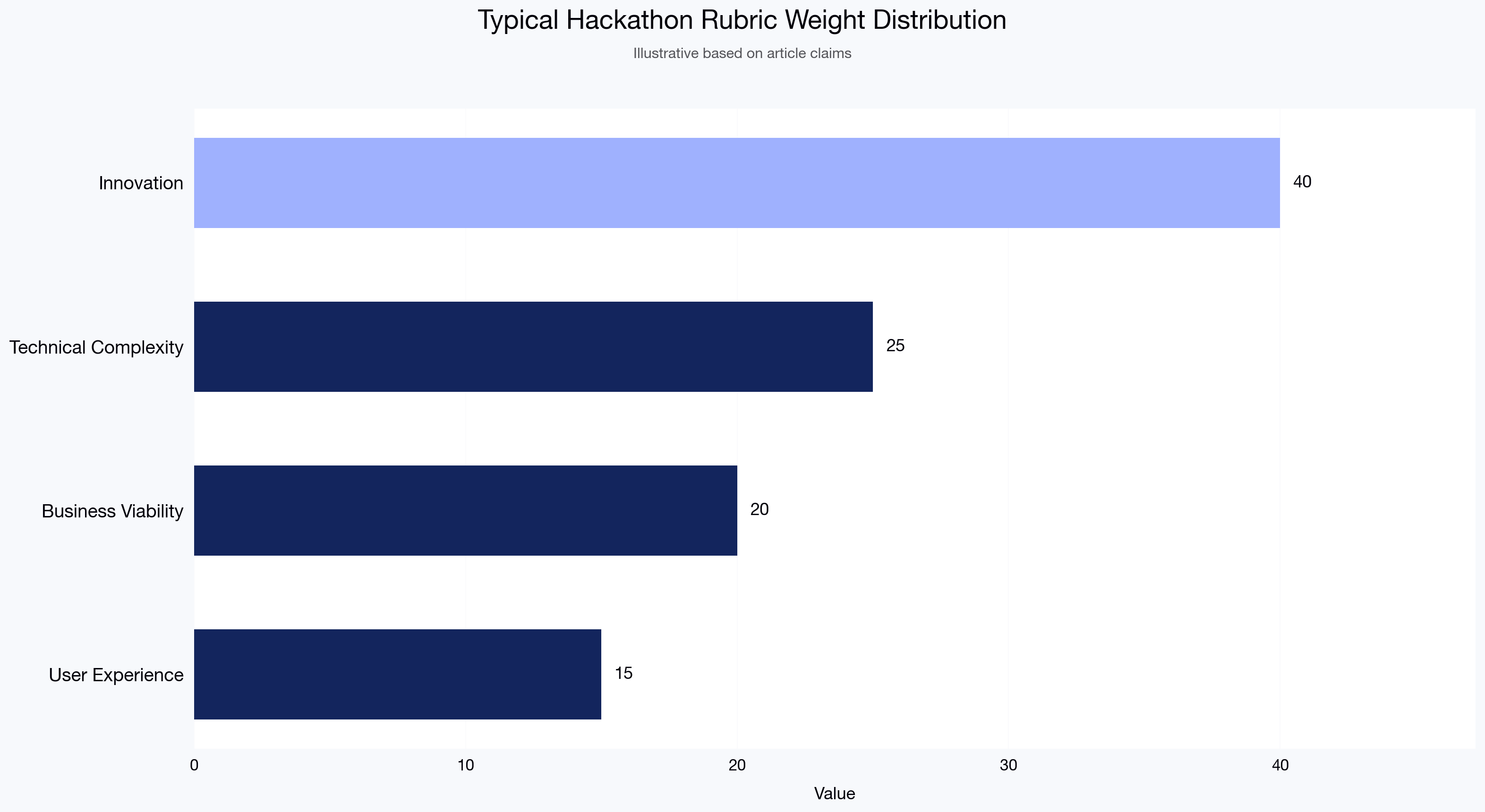
A rubric that weights "innovation" at 40% rewards a clever angle on a boring problem. A rubric that weights "technical complexity" at 40% rewards depth over polish. A rubric heavy on "business viability" wants a pitch deck as much as a demo. Research on hackathon judging from the MLH Organizer Guide confirms that judging criteria — not raw technical merit — drive most outcome variance.
Most teams skim the rubric once and never look at it again. The teams who win re-read it before every major decision — feature scope, demo prep, even slide order. If "user experience" is 25% of the score, your three hours of polish on the landing page is not wasted time.
If the rubric is not published, ask. Organizers will usually share it. If they refuse, assume the judges are scoring on demo quality and storytelling, because that is what unguided judging defaults to.
Source: Illustrative based on article claims
2. Pick a hackathon problem you can finish, not one you want to solve
Ambition kills more hackathon teams than bad code does. The team that wants to "build a generative AI agent that automates legal contract review" at a 36-hour event will spend 30 hours on the agent framework and four hours discovering it doesn't work on real contracts.
The winning move is to scope down hard. A problem you can finish has three properties:
The core demo works without internet, third-party APIs going down, or a specific person being awake
A judge can understand what it does in under 30 seconds
The "wow" moment happens within the first minute of the demo
If your idea fails any of these tests, cut scope until it passes. You can always add stretch features once the core works.
3. Form your hackathon team around skill gaps, not friendships
The four-person team of backend developers is the most common losing configuration at hackathons. They build something technically interesting that demos badly and pitches worse.
A team that wins a 24–48 hour event usually has, at minimum:
One developer who can ship a working frontend fast
One developer comfortable with backend and infrastructure
One person who handles the pitch, slides, and demo script
One generalist who debugs, integrates, and fills gaps
You can compress this into three people if someone doubles up. You cannot compress it into four backend developers, no matter how good they are. The team with weaker individual coding skills and a strong presenter beats the team of brilliant engineers who can't explain what they built.
During the build
4. Build a working hackathon skeleton in the first 25% of the time
This is one of the strongest patterns we observe across the hackathons we run — across formats, prize sizes, and skill levels.
By the end of hour six of a 24-hour hackathon, your team should have:
A deployed or locally-running app that responds to one input and produces one output
The shape of the demo flow even if every screen is placeholder
The integration between frontend and backend working at the most basic level
This skeleton will look embarrassing. It is supposed to. The point is that you now have something to improve rather than something to finish. Teams who spend the first day planning and the second day building lose to teams who spend the first day building something terrible and the second day making it less terrible.
5. Use AI coding tools deliberately, not constantly, during the hackathon
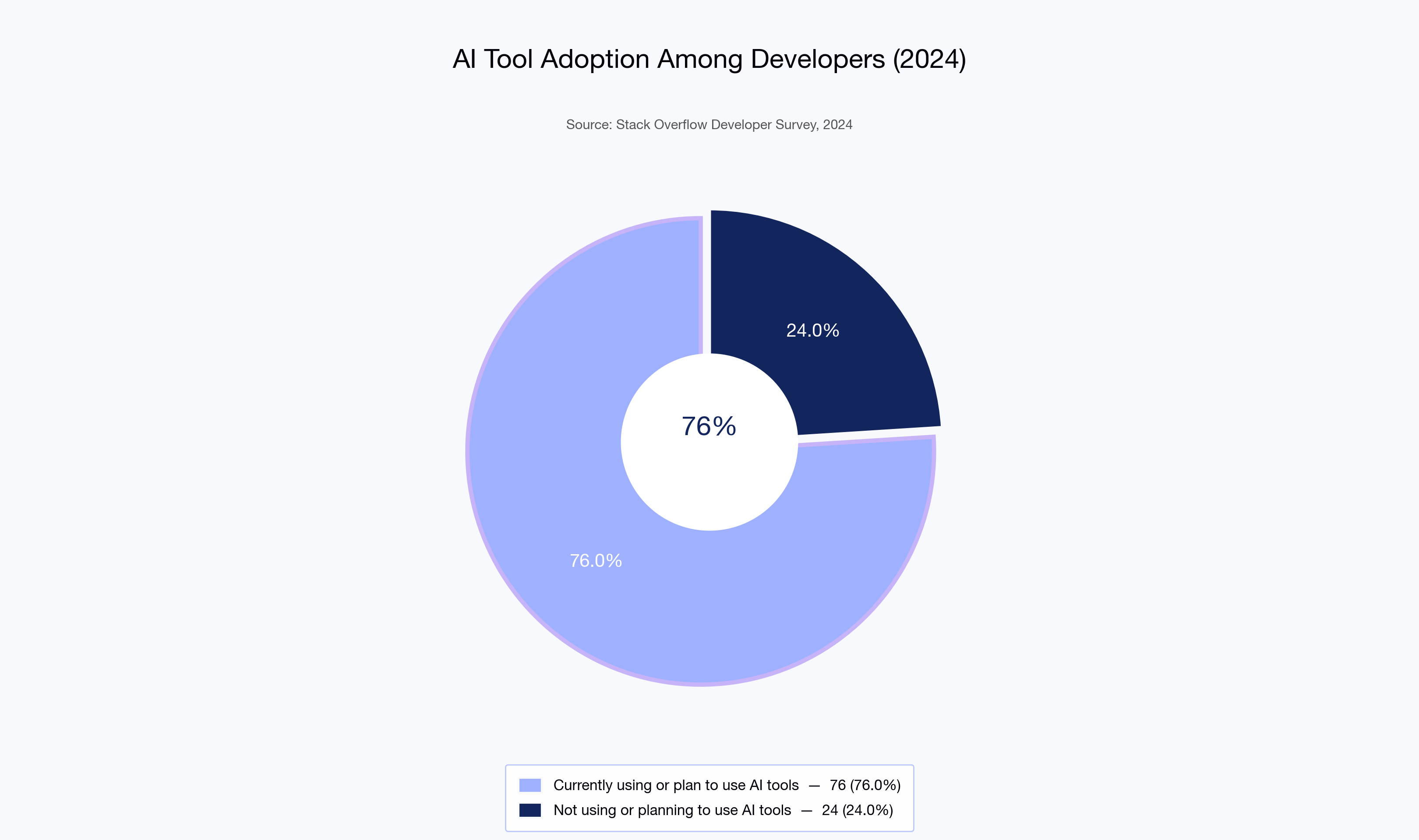
Most developers today use AI coding assistants in normal work. According to the 2024 Stack Overflow Developer Survey, more than 75% of developers report using or planning to use AI tools in their development workflow. At a hackathon, the temptation is to use them for everything. This is a mistake.
AI coding assistants are excellent for boilerplate, API integration code, throwaway UI scaffolding, and converting between formats. They are unreliable for the parts of your project that judges will actually scrutinize: the novel logic, the integration glue between systems, and the parts where your idea is different from every other team's idea.
The teams who win use AI to move fast on the 80% of code that doesn't matter, then write the 20% that does matter themselves, with full understanding. The teams who lose ask the AI to build the differentiated part of their project and then spend the demo Q&A unable to explain how it works.
If you cannot explain a piece of code in your demo, the judges will sense it. They will ask about it specifically.
Source: Stack Overflow Developer Survey, 2024
6. Design the hackathon demo before you write the code
Write the demo script — the actual 90-second walkthrough you will give the judges — before your team writes a meaningful line of code. The script forces clarity about what the project is.
A demo script for a hackathon project should fit on one page and include:
The problem in one sentence, framed around a specific person
The "before" state — what someone does today
The trigger — what action starts the demo
The "aha" moment — the specific thing the judges should remember
The close — why this matters at scale
If you cannot write this script before you start coding, you do not know what you are building yet. Stop and figure it out. Two hours spent on the script saves six hours of building features that don't appear in the final demo.
The final stretch
7. Treat the last four hours of the hackathon as a separate project
The end of a hackathon is not "more building time." It is a different phase entirely, with its own deliverables: a polished demo, a submission video, a deck, written documentation, and submitted code.
In the last four hours of a 24-hour event, do not start new features. Do not refactor. Do not "just fix this one bug." The bug will spawn three more. Lock the code, then:
Record the demo video — twice, so you have a backup
Walk through the live demo five times to find the points where it breaks
Build the slide deck if your event requires one
Write the README so judges who don't see your demo can still evaluate you
Submit everything 30 minutes before the deadline, not 30 seconds
The teams who submit at the deadline buzzer are usually the teams whose demo doesn't quite work. The teams who submit early have time to fix the things they find while testing.
8. Optimize the hackathon demo for the room, not for technical correctness
A demo that runs on localhost with a flaky API call is a demo that will fail in front of judges. The conference Wi-Fi will drop. The third-party service will rate-limit. The laptop will run out of battery at the worst possible moment.
Hardcode your demo path. Mock the external services. Have screenshots ready as a fallback. If your project depends on an LLM call, have a cached response ready for the demo if the live call fails. Judges do not penalize you for "the demo gods being unkind" — they penalize you for not making it to the punchline.
This advice will offend a certain kind of engineer who thinks demos should reflect production reality. They are not wrong about production. They are wrong about hackathons. The judge has six minutes per team and will not see your beautifully resilient retry logic. They will see whether the screen showed the thing or didn't.
9. Pitch the hackathon problem harder than the solution
Most teams demo their solution and assume the problem is obvious. It is not. Judges sit through 30 to 100 demos. The teams whose problem statement lands are the teams who get remembered.
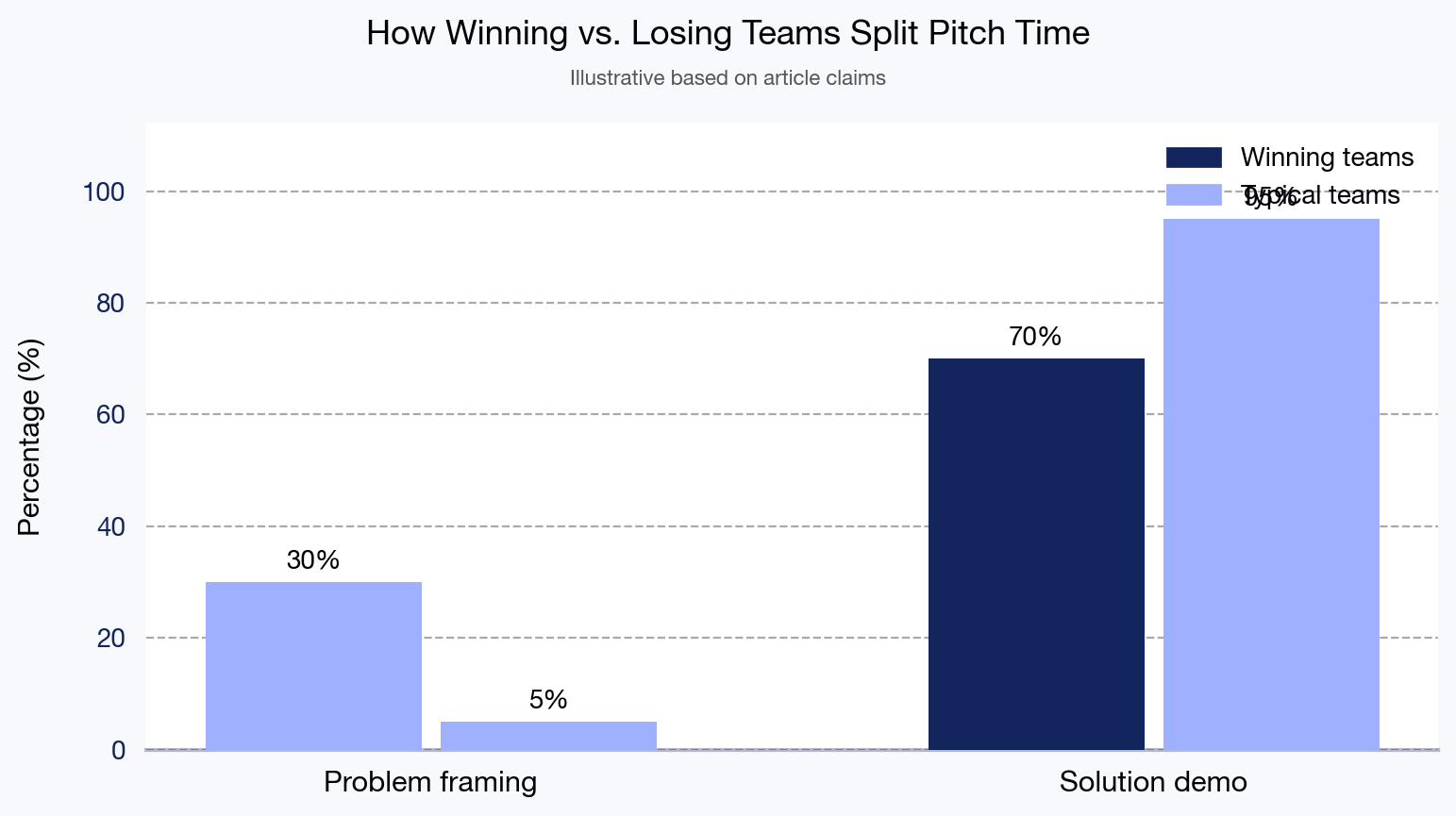
A strong hackathon pitch spends roughly 30% of its time on the problem and 70% on the solution. Most teams do 5% on the problem and 95% on the solution, then are surprised when judges score them low on "impact."
If your problem is "developers spend too much time on X," tell us how much time, in what context, with what consequences. If your problem is "small businesses struggle with Y," tell us about one specific small business. Specificity is the difference between a problem judges remember and a problem they forget by the next team's demo.
Source: Illustrative based on article claims
10. Submit your hackathon project even if you think you lost
Plenty of teams who think they bombed end up placing. Plenty of teams who think they nailed it don't. The judging criteria you assumed were dominant may not have been. The category you didn't realize you qualified for may pay out.
More importantly, the submission itself is valuable independent of the result. Your code goes into your portfolio. The project becomes a conversation piece in interviews. The team you built with may become collaborators on something else.
The developers we see consistently win hackathons over time have lost more hackathons than the developers who give up after one bad result. This is not a motivational point — it is an observation about which demographic shows up in the winners' circle five years in.
What hackathon organizers reward, and why
The 10 tips above optimize for a specific reality: hackathon judging is fast, partial, and demo-dependent. Judges form opinions in the first 30 seconds and spend the rest of the demo looking for evidence to support those opinions. The ACM SIGCHI research on hackathon evaluation backs this up — early impressions dominate scoring decisions.
This is not because judges are lazy. It is because judging 40 demos in a day forces shortcuts. The teams who understand this design their entire approach around the first 30 seconds — the hook, the problem statement, the visible "aha." The teams who don't, build great projects that lose to worse projects with better openings.
For developers reading this who run or sponsor hackathons inside your own company, this asymmetry is worth thinking about. The teams that win your internal events are not necessarily the teams building the most valuable things. They are the teams best at communicating value under time pressure. If you want different outcomes, design different judging — longer evaluations, written submissions, follow-up calls with finalists.
A note on the source of these patterns: Based on our experience designing and running hackathons for 500+ global enterprise customers, organizers who design judging carefully get better projects. Organizers who copy a generic rubric get the same demo-driven optimization every time. To learn more about how structured hackathon programs support innovation discovery, developer engagement, or platform adoption goals, see HackerEarth Hackathons.
Frequently asked questions about winning a hackathon
How do I pick a winning hackathon idea?
Pick a problem you can finish in the allotted time, not one you want to solve. A winning hackathon idea has three traits: the core demo works without external dependencies, a judge can understand it in under 30 seconds, and the "wow" moment lands in the first minute of the demo. Scope down aggressively until your idea passes all three tests.
What makes a good hackathon team?
A good hackathon team is built around skill gaps, not friendships. The minimum effective team has one fast frontend developer, one backend/infrastructure developer, one strong presenter who owns the pitch and demo script, and one generalist who debugs and integrates. A team of four backend engineers, no matter how skilled, almost always loses to a balanced three-person team.
How important is the demo at a hackathon?
The demo is usually the single most important factor in hackathon outcomes. Judges typically see 30–100 demos and form opinions in the first 30 seconds. Optimizing the demo path — hardcoded inputs, cached API responses, screenshots as fallback — matters more than production-quality code. Write the 90-second demo script before you write any code.
Should I use AI coding tools during a hackathon?
Yes, but selectively. Use AI coding assistants for boilerplate, scaffolding, and API integration — the 80% of code that doesn't differentiate your project. Write the novel logic yourself, because judges will ask about it in Q&A and you need to be able to explain it. Teams that AI-generate their differentiated logic tend to lose on technical questioning.
How long before the deadline should I submit?
Submit at least 30 minutes before the deadline, not 30 seconds. Treat the last four hours as a separate phase dedicated to recording the demo video twice, walking the live demo five times, writing the README, and locking the codebase. New features added in the final hours almost always introduce bugs that show up during judging.
What if I think my team lost — should I still submit?
Always submit. Plenty of teams who think they bombed end up placing because their judging category or weighting was different than they assumed. Beyond placement, the submission itself becomes a portfolio piece, an interview talking point, and a foundation for follow-on work with your teammates.
Next steps
If you run hackathons inside your organization — for innovation discovery, developer engagement, or platform adoption goals — the way you structure the event determines what kind of work you get back. Run your next enterprise hackathon with HackerEarth Hackathons to design judging that surfaces the projects you actually want, or launch a HackerEarth Sprint to drive measurable developer engagement beyond participation counts.