Ruehie Jaiya Karri

Author
Ruehie Jaiya Karri

Blogs
Always interested in the “road less traveled”, she went from being a developer to a writer - her dream career. Her writing is simple and uncomplicated, two things she strives to achieve in her life. When not writing, you’ll find her curled up on her couch watching a rom-com or reading a book. A believer of dancing away her blues and a lover of coffee, she is also super passionate about baking.
author’s Articles

Insights & Stories by Ruehie Jaiya Karri

From code to content, Ruehie Jaiya Karri brings a unique perspective to tech and talent assessment. Explore her articles for insightful, easy-to-read takes on hiring trends, recruitment best practices, and the ever-evolving world of technology.
Clear all
Thank you! Your submission has been received!
Oops! Something went wrong while submitting the form.
Filter
Filter

6 Things To Look For In Your Coding Assessment Tool

Two years of the world adapting to new ways of working and the tech industry has pretty much seen it all. From working fully remote to transitioning to hybrid work models, recruiters know what kind of technology they need to streamline their hiring processes. Be it virtual coding assessment tools or online coding interview tools, the recruitment tech stack has vastly been improved to keep up with the ever-changing hiring landscape.

Consequently, there has been an explosion of tech interview tools that claim to help you at every step of the recruiting life cycle. You, as recruiters know what you need but how would you separate the wheat from the chaff—a good marketing pitch versus a functional tool that does what it claims to do?

And this is where we step in! Allow us to point out the most important elements of coding assessment tools that you need to watch out for.

6 things every online coding assessment tool should have

6 things to look for in your coding assessment tool

Choosing the right coding assessment tool may make or break your recruitment process. It is important that whatever tool you decide to run with meets all your requirements and helps simplify finding the best candidate for the job.

We did our research and here are some of the features that constitute a capable and reliable coding interview tool:

Easy integration with your existing ATS

The modern recruiter cannot manage or sift through large volumes of candidate data on a spreadsheet. That’s a recipe for disaster right there.

An applicant tracking system (ATS) is built to solve just that. Work with a tool that offers effortless integration with an ATS, where you can sync all candidate data in one place. It acts as a centralized repository of candidate data—keeps track of resumes and saves all received applications even if they were not hired.

Your ATS helps you effectively screen applications by setting filters instead of doing it manually. It can also ensure that the candidates are all on the same page by sending them real-time updates about their progress at each stage of the interview. Your hiring team can easily check the status of any selected candidate directly from the ATS.

You can create and send assessment invites from the ATS itself and do away with switching between multiple platforms.

Recommended read – Remote Work And Recruitment: An ATS Story

Rich library of questions

Any good online assessment tool will offer a wide array of programming languages, and frameworks as well as tests for both modern and legacy coding skills. You should be able to test for all developer roles whether it is frontend or backend. It should consist of a range of programming languages and frameworks for all coding job roles such as iOS developer, Android developer, web developer, data scientist, and so on.

Automated invigilation with proctor settings

When hiring remotely, it is not possible to closely monitor candidates during the tests. This is where automation takes over. A capable coding assessment tool provides automated invigilation with proctor settings. Proctoring allows you to observe candidates through video during the test and protect the quality of the assessment.

The automated assessment tool should also report tab switching, prevent copy-pasting code, and eliminate candidate impersonation with the help of image processing.

Recommended read: 3 Things To Know About Remote Proctoring

Assessments created for individual roles

What a hiring manager looks for in a candidate varies from role to role. The platform should enable you to build your custom coding assessments as per your requirements. You should have the choice of creating different types of questions like MCQs, project-type, or subjective questions that simulate on-the-job problems with the help of custom data sets and test cases.

Recommended read: 4 Ways To Create Tests With HackerEarth

Grading based on standard evaluation parameters

It’s always advisable to conduct structured interviews to ensure that the hiring process is fair and impartial. One way to do this is by evaluating every candidate against standardized parameters to keep the assessment objective. Scoring reports that are automatically generated at the end of the assessment make it simple and quick for you to identify who goes on to the next round and who doesn’t.

Not only does it cut bias out of the equation but also lets you update the candidate in real-time and ensure that they are kept in the loop at every step of the hiring lifecycle.

Automated performance reports

Any coding test platform supplies in-depth analytics and insights into a candidate’s capabilities with summarized, auto-generated performance reports. You can identify top performers in an instant and screen them further based on work experience and other relevant criteria. This helps you make data-driven decisions in collaboration with your team as all candidate performance data is available on the dashboard.

Top 5 Online Assessment Tool

Choosing the right online assessment tool can streamline your hiring process, ensuring you find the best candidates for your technical roles. Here are the top five coding assessment tools that stand out for their features and effectiveness:

HackerEarth:

HackerEarth combines coding challenges, hackathons, and real-world projects to assess candidates’ skills. It’s known for its user-friendly interface and detailed analytics, making it easy to identify top talent.

HackerRank:

Known for its extensive library of coding challenges and competitive coding environments, HackerRank, the online assessment tool is ideal for assessing a wide range of programming skills and languages. It offers robust reporting and benchmarking capabilities.

Codility:

This online assessment tool excels in evaluating candidates’ coding skills through real-world tasks and coding scenarios. Codility’s automated grading and anti-cheating measures ensure a fair and efficient assessment process.

LeetCode:

Popular among developers, LeetCode provides a vast repository of coding problems that cover various topics and difficulty levels. It’s excellent for both preparing candidates and assessing their problem-solving skills.

CodeSignal:

With a focus on providing a comprehensive evaluation, CodeSignal offers coding tests, technical interviews, and custom assessments. Its advanced coding environment supports a wide range of programming languages and frameworks.

HackerEarth, the best coding assessment tool for your organization

Online Coding assessment toool enable you to assess a candidate’s technical skills objectively. It helps recruiters zero in on the right talent from among a vast talent pool, quickly. Do your research wisely and choose the best coding assessment tool that fits all your needs.

As we discussed before, a good tool is simple to use, has an enormous question bank, uses a combination of knowledge and application-based techniques such as MCQs and simulators to measure job-relevant skills, and provides data-rich insights into a candidate’s performance.

Here’s why we think HackerEarth Assessments is a great option for a coding assessment tool:

  • A rich library of 13,000+ questions across 80+ programming skills helps you to create highly specific coding assessments with zero technical understanding.
  • Creation of your assessment for any job role or expected skill in under 5 minutes or based on job descriptions, with the option to build custom questions.
  • The choice of designing various types of questions like MCQs or project-type questions that simulate real-time problems.
  • Seamless integration with popular ATSs like LinkedIn Talent Hub, Lever, Workable, JazzHR, and more, which means you can sync all your candidate data with your ATS.
  • Instantly invite candidates to take the assessment you created on our platform. See at what stage each candidate is in throughout the hiring lifecycle, and avail performance reports, all from your ATS—without switching between multiple tools.
  • Robust proctoring efforts with the choice to customize the stringency, data-rich insights on each candidate’s performance, and built-in PII (Personal Identifiable Information) feature that mitigates bias in the process to offer an objective, accurate, and impartial screening process.
  • Auto scoring based on standardized evaluation parameters to ensure each candidate is assessed fairly.
  • Provides actionable insights into a candidate’s skills with summarized, automated performance reports.

Go on, take HackerEarth for a spin and see for yourself if everything we claimed checks out! Remember, you only know the difference between a tool that’s good on paper and a tool that can provide good results when you actually test it out.

Keep the top features of a coding assessment tool in mind while making your decision, to find the perfect fit for your recruitment tech stack!

FAQs about Coding Assessment Tools

Q: What are coding assessment tools?
A:
Coding assessment tools are software platforms that help employers evaluate the coding skills of potential hires through various challenges, tasks, and tests.

Q: How do coding assessment tools work?
A:
These tools provide a range of coding challenges and scenarios that candidates must solve. They often include automated grading and performance analytics to streamline the evaluation process.

Q: What should I look for in a coding assessment tool?
A:
Key features to consider include the variety of coding challenges, language support, ease of use, anti-cheating measures, and detailed reporting capabilities.

Q: Can coding assessment tools prevent cheating?
A:
Yes, many tools include anti-cheating measures such as webcam proctoring, plagiarism detection, and controlled coding environments to ensure the integrity of the assessments.

Q: Are coding assessment tools only for recruitment?
A:
No, they can also be used for employee development, training, and identifying areas for improvement within your current team.

The 'Great Resignation' In The Tech Industry - How To Prevent It

Are you worried about the great resignation in tech? This is a problem that is affecting businesses all over the world. But don’t worry, there are things that you can do to prevent it from happening in your organization. In this blog post, we will discuss the great employee resignation and look at some tips on how to avoid it.

First of all, let’s first understand what exactly is the Great Resignation –

The tech industry benefits from an abundance of fresh talent supply annually. However, more than 4 million people in the US alone quit their jobs in 2021- a record number, and this mass exodus isn’t unique to America. One survey found that 41% (or 11 out 15) global workers were considering their exit during 2021 according to Microsoft’s data – which means it could very well continue in 2022 as well. In another study, 39 out of 50 countries surveyed saw higher rates of employee resignations.

So what’s the reason for this Great Resignation?

Well, there isn’t any single particular factor but research shows that it is largely due to “workplace frustration“. This can have a lot of different sources and meanings, but in most cases, it mostly includes workplace culture and environment and being overworked. It could also be due to low compensation or because of negative relationships with co-workers and/or management. And let’s not forget about job dissatisfaction! LinkedIn published a study where they found out that 79% of millennials confessed to being unhappy at their jobs.

What do the statistics say?

A 2021 study by Bankrate showed that 52% of employers noticed a greater number of employee resignations within six months of joining. Moreover, 89% were concerned with how this would impact their business and 28% claimed that they had already lost some clients due to this problem.

When asked which generation is most likely to quit their jobs, more than half (55%) of the respondents said Generation Y or millennials. And if you thought that’s bad enough, more than one-third (35%) believe that employee retention will be even worse in 2022!

How the Great Resignation affected the tech industry

The Great Resignation significantly impacted the tech industry, reshaping how companies approach talent management and acquisition. Tech professionals, enjoying a market flush with opportunities, have become more selective about their employment choices. The reasons for this shift are multifaceted:

  • Seeking Better Work-Life Balance: Many tech professionals have started prioritizing roles that offer flexibility, remote work options, and a better balance between personal life and work.
  • Demand for Higher Compensation: With the tech industry booming, skilled professionals are aware of their market value and are seeking higher compensation and benefits.
  • Career Advancement Opportunities: Tech professionals are looking for roles that offer clear pathways for career advancement and skill development.
  • Cultural Fit and Values: There is an increasing emphasis on finding companies whose values align with their own, especially regarding innovation, diversity, and corporate responsibility.
  • Impact of Pandemic: The COVID-19 pandemic has prompted many to reassess their career goals and seek jobs that provide more security and satisfaction.

This shift requires tech companies to reevaluate their talent acquisition strategies, focusing more on employee engagement, retention programs, and creating an attractive company culture to combat the high turnover rates.

Here is how you can avoid the Great Resignation at your company

The Great Resignation: Are You Worried?

Put an emphasis on employee well being

To combat the high rates of burnout-fueled employee resignations at your company, giving workers time off and expecting them to take it when they need it isn’t enough. Travel options remain limited so people may feel there’s no excuse for using their vacation days while others might believe that the work culture encourages always being present (despite new findings of how this can affect health).

Employees need the time to focus on their mental and emotional well-being. Many workers face a lack of fulfillment regardless of whether they are paid fairly or have tasks to perform. Organizations that provide employees with opportunities to be creative, build social connections at work, or do work on passion projects within the organization will see happier workers who are more committed.

Recommended read: 7 Employee Engagement Strategies For WFH Tech Teams

Hybrid and flexible work options

While many employees prefer being in the office, a lot of them work remotely as a result of personal commitments and circumstances. While remote working allows employees to be productive even when they’re not in the office, some people prefer interacting with their co-workers in person.

The past 16 months are proof that remote (or at least hybrid) working is the future! A recent survey shows 39% of the workers would consider quitting if employers weren’t flexible about remote positions. Among millennials (aged 18–34) this figure sits higher still at 49%. The trend towards virtual teams paired up nicely via technology means less time spent commuting each day which also helps improve company productivity overall.

Retaining talent in roles that can’t be performed from afar is becoming increasingly difficult. Some companies are looking for new amenities to offer their employees, hoping this will help create a sense of balance and preserve stability within the workplace.

The need has become so urgent because workers who spend all day commuting every week may find themselves with little free time when they arrive at home after work – unless there’s another meeting or conference call during what would traditionally qualify as “free” hours.

Recommended read: 4 Things The Pandemic Taught Us About Diverse Tech Teams

Reward loyalty

To attract the best workers, employers should offer competitive compensation packages. You have to pay people enough so they don’t think about money when deciding if working for your company is worth it. Try giving out one-time bonuses as well as student loan repayment assistance and work-from-home options. Employees love to feel appreciated by their bosses, so take the time to show appreciation via bonuses, promotions, or even just a simple email.

Focus on the big picture

While there are endless reasons why people choose to resign, lack of opportunities for growth or advancement is a major one. Make sure you regularly discuss career paths with employees and help them grow within your company. You also need to have a smooth and memorable onboarding process so the new hires feel like they’re part of something great from day one! No matter how many perks you offer, if they don’t feel welcome and a part of the team, your company will almost always have to deal with a high resignation rate.

Recommended read: 7 Ways To Reduce Burnout In Your Tech Teams

Provide opportunities for growth

Employers should create retention strategies to keep top talent around by pretending their best employees just handed in resignations and asking themselves what they could do that would change the person’s mind. Forward-thinking organizations have been doing interviews like this since last month—with each employee advising on where things can be improved or future opportunities offered up.

Care for your employees as well as their families

To retain their employees, employers should make provisions for the physical as well as mental well-being of the employees and their dependents. This can include but is not limited to, medical insurance, discounts on gym memberships, access to a network of mental health resources, maternity and paternity leaves, etc. They can also help parents of small children by providing child care assistance programs or paid time off (PTO).

Be sure to review your company’s policies

Hiring and onboarding processes can make or break your business. It is not only important to go over all of the policies and processes related to hiring and onboarding but also to follow through with them without exception.

You also need to create an environment where these talented individuals feel comfortable speaking up about issues in the workplace. Finally, once the employees are hired, employers need to ensure they have ongoing training programs so that employees can learn and upskill throughout their time at your company.

Recommended read: A Note On Our New Leave Policies

Analyze the blind spots within your system

Look at metrics such as compensation, time spent between promotions (i.e., number of years), location(s) of the company, function/size pay increases over one’s career path, etc. to identify problems that might be causing your employees to quit.

When trying new ideas or programs keep an open mind and remember that there will always come those within our organizations who aren’t happy no matter where they work!

Retain your top talent with HackerEarth

Here is how you can keep your top talent using HackerEarth:

Continuous assessments

  • Skill Evaluation: HackerEarth enables managers to continuously keep assessing employee skills and team members’ skill development. This helps employers address potential problem areas with the help of specific metrics.
  • Learning and Development: Keeping employees up to date with the latest technologies and trends is a must. HackerEarth’s learning and development assessment tool helps employers stay ahead of the curve and improve the overall productivity of their workforce.
  • Employee Engagement: Employee participation is key to overall organizational success. HackerEarth’s gamification tools help employers engage their talent with real-time feedback, on-the-go assessments as well as Hackathons – reducing overall employee resignations.
  • Competency Mapping: Competency mapping is the foundation for any successful organization. HackerEarth’s unique competency mapping tool helps employers in identifying, developing, and retaining talent by optimizing every hiring decision that gives great ROI.

HackerEarth is a platform that connects organizations with skilled developers and helps them participate in major hackathons. This is done by providing access to qualified talent without the need for any bandwidth or environmental drain, as well as hosting challenges specifically designed for a virtual space!

HackerEarth virtual hackathons:

When it comes to assessing employee skills by running a successful hackathon, there is no better place than HackerEarth. HackerEarth has the experience and knowledge needed for all phases of conducting these events at scale across different industries.

  • HackerEarth is the only curated hiring company that guarantees you’ll get all of your engagement needs without any bandwidth drain.
  • With the HackerEarth platform, you can manage your virtual hackathons or hiring challenges from anywhere in the world and even at scale.
  • Working with HackerEarth means working in one of the largest communities for qualified developers.

The great employee resignation in technology is a growing problem that has been affecting businesses all over the world. Luckily, there are things you can do to prevent it from happening in your business. Follow the steps above to stop the Great Resignation from affecting your organization.

How Your Tech Stack Can Help You Hire Top Talent

The great resignation has been on the minds of many IT organizations and their business leaders ever since nearly 4 million people quit their jobs back in November 2021. Consequently, hiring talented tech talent has become a lot harder than before.

Will 2022 break away from this trend wonder recruiters across the globe. Instead of waiting for the tide to turn, why not step up your game—invest in a recruitment tech stack that turns heads and helps you attract the very best talent out there?

The right recruiting software mix will help you streamline your entire recruiting life cycle, create a strong brand recall, and have potential candidates be excited about working with your company! On that note, let’s look at what tech stacks are and how do you choose one that caters to all your needs.

What is a recruitment tech stack?

A tech stack is a collection of technologies that are used to create a product or service. A recruitment tech stack would consist of a set of automated tools and technologies for every step of the hiring process—right from sourcing to onboarding. Your tech stack should have strong built-in analytics, seamless integrations with other apps, and be mobile-friendly.

We are talking sourcing tools, applicant tracking systems, screening and assessment software, engagement tools, coding interview platforms, automated background checks, onboarding software, and so on.

However, your recruitment strategy might not require all of these tools. There is no silver bullet that works best for everyone. The modern recruiter is always trying out new technologies to see what combination of resources suits their ever-changing needs.

Having said that, to stay relevant in this post-pandemic world, you need to prepare your recruitment tech stacks for the new normal, which is mostly remote. Be equipped to conduct fully remote hiring drives and successfully hire candidates without ever meeting them.

Recommended read: Boolean Search Strings – 5 Essential Tips For Recruiters

How tech stacks matter in technical recruiting

There are multiple benefits to having technology be the frontrunner of your recruiting strategies. A tech-enabled recruitment experience goes a long way in attracting and retaining top tech talent.

  • Saves time and improves efficiency in the overall hiring process.
  • Keeps large volumes of candidate data organized and ensures nothing gets lost.
  • Creates a pleasant candidate experience.
  • Keeps your talent pool warm and nurtured.
  • Eliminates bias in hiring decisions.
  • Better communication between candidates and recruiters.

A carefully curated recruitment tech stack can slash your time-to-hire and cost-per-hire metrics by a significant amount. Let’s look at the most important elements of a tech stack next, to better your hiring processes.

Recommended read: 21 Tech Recruiting Tools To Scale Your Hiring

4 must-haves in your tech stack

All About Recruitment Tech Stacks

Here are some technologies to keep in mind when building your tech stack:

#1 Applicant tracking systems

The first thing you need to think about is an applicant tracking system. By investing in the right ATS you’ll be able to reduce your overall time to fill roles. You’ll also be able to create and nurture a pool of passive candidates that you can call upon in the future.

An ATS can go from simple (collating all the candidate information) to quite complex (with various approval levels and AI-enhanced searches). An ATS is also more secure than a spreadsheet or email.

A good ATS has features like:

  • job posting across multiple job boards and websites
  • automated screening of candidates’ resumes, which also lowers human bias and errors
  • database assistance where you can store all applicants’ information
  • view the status of each candidate throughout the interview process
  • send out assessment invites from the ATS itself to the selected candidates and prepare a performance report in real-time
  • initiate offer letters directly from the ATS, get them signed by the candidates, and save the documents digitally on the cloud

#2 Automated employee referral programs

Investing in an ATS has multiple benefits as seen above but the real advantage is you can set up a robust employee referral program with it. Studies show referral hires stay at a company for longer on average with 47% staying longer than 3 years.

Employee referral programs promote company culture and build better-engaged tech teams. Leverage existing data in your ATS to reach a wider audience.

Here’s how:

  • Implement auto-posting where you send job openings to your internal employees on an ongoing basis
  • Automatically use the data in your ATS to suggest the right people to your connections
  • Keep track of where the referred candidate is in the hiring cycle and send updates to the referrer
  • Link your ATS to your payroll system, so any referral bonus can go straight into your employee’s salary
  • Assess the success of your employee referral program and tweak accordingly—number of shares via email or social, number of referred candidates, number of successful hires, and the quality of those hires

#3 Chatbots for better candidate experience

Adding a chatbot to your careers site or investing in an ATS that comes with one takes your candidate experience to the next level. Chatbots can bring your website to life where candidates can strike up a conversation with the bot to clear any basic queries and frequently asked questions.

You can also leverage natural language processing and train your bots to pre-screen candidates, answer candidate queries, and schedule interviews. Some even offer candidates the ability to check the status of their applications.

This vastly decreases the burden on recruiters and frees up time for them to take on other important tasks.

#4 Screening and virtual assessment tools

Virtual assessment tools are how you can better hire candidates for jobs, reduce employee turnover, and improve the quality of hire at your organization. These coding tests are where you get to see if what the candidate mentioned in their resume pans out.

A live coding assessment tool helps you with an objective evaluation of each candidate, provides detailed reports, and instant feedback—all with minimal technical know-how!

HackerEarth Assessments offers plenty of useful features. Here’s how HackerEarth does it:

  • Provides a rich library of 13,000+ questions across 80+ programming skills to create highly accurate assessments
  • Enables you to create your own assessment for any role in under 5 minutes or based on job descriptions, with the option to devise custom questions
  • Gives you the choice of creating different types of questions like MCQs, subjective questions, or project-type questions that simulate on-the-job problems
  • Allows seamless integration with popular ATSs like LinkedIn Talent Hub, Lever, Workable, and more, which means you can sync all your candidate data with your ATS
  • Sends out invitations for candidates to take the assessment you created on our platform. You can also see at what stage each candidate is in throughout the hiring process, and avail performance reports, all from your ATS—without swapping between multiple apps
  • Provides deeper insights into a candidate’s capabilities with summarized, automated performance reports

The use of AI in recruitment continues to spread and it is expected that the modern recruiter is savvy with the latest recruiting technologies and strategies. In 2022, change the way you hire and build great tech teams—and the first step is to start with building your dream recruitment tech stack!

Remote Proctoring for Tech Assessments: A Complete Guide

Online tech assessments are now the default for hiring developers, but they come with a persistent challenge: how do you ensure every candidate completes the test honestly when no one is physically in the room? Remote proctoring solves this problem by using technology — webcams, screen monitoring, browser lockdowns, and AI algorithms — to supervise candidates from any location in the world.

The stakes are high. A 2024 Korn Ferry study estimated the global talent shortage could reach 85 million workers by 2030, making every hiring decision more consequential. As companies scale their technical hiring across time zones, remote proctoring has shifted from a nice-to-have to a critical layer of assessment integrity.

AI-based remote proctoring, in particular, has transformed the landscape. Modern systems go beyond simple webcam recording. They use facial recognition, eye-tracking, and anomaly detection to flag suspicious behavior in real time — without requiring a human proctor for every session.

This guide covers everything you need to evaluate and select the right remote proctoring solution for your tech assessments. You will learn how these systems work, what AI brings to the table, the real benefits and challenges, and how to implement proctoring without degrading the candidate experience.

What Is Remote Proctoring?

Definition of Remote Proctoring

Remote proctoring is a method of supervising online exams using technology instead of an in-person invigilator. Candidates take their assessment from any location — typically their home or office — while software monitors their activity through webcams, microphones, and screen capture.

The remote proctoring meaning extends beyond simple surveillance. It encompasses identity verification, environment scanning, behavior analysis, and post-exam review. Whether used for coding assessments, certification exams, or pre-employment screening, the goal remains the same: maintain exam integrity without requiring physical test centers.

Remote proctoring has applications across education, professional certification, and — increasingly — technical hiring, where companies need to assess thousands of developers across multiple geographies simultaneously.

Key Components of Remote Proctoring Systems

A remote proctoring system typically includes several interconnected components:

  • Webcam monitoring: Captures the candidate's face and surroundings throughout the exam to detect unauthorized persons or materials.
  • Screen capture and recording: Records everything displayed on the candidate's screen, flagging application switches or unauthorized browser tabs.
  • Browser lockdown: Restricts the candidate to the assessment window, preventing access to search engines, messaging apps, or external resources.
  • Identity verification: Uses photo ID matching, facial recognition, or biometric scans to confirm the candidate's identity before the exam begins.
  • Environment scanning: Requires candidates to pan their webcam around the room to verify no prohibited materials are present.

The level of human involvement varies. Live proctoring connects candidates with a trained monitor who watches the session in real time. Automated solutions rely entirely on AI to detect and flag anomalies, with human reviewers stepping in only when needed.

How Remote Proctoring Works in Tech Assessments

For technical assessments specifically, remote proctoring follows a structured workflow:

  1. Pre-exam setup: The candidate installs a secure browser or accesses the assessment platform. They verify their identity via webcam and government-issued ID.
  2. Environment check: The candidate performs a 360-degree room scan to confirm their workspace is free of unauthorized materials.
  3. Active monitoring: During the assessment, the system monitors the candidate's webcam feed, audio input, and screen activity. AI algorithms analyze behavior patterns — such as frequent gaze shifts, background voices, or application switching — in real time.
  4. Post-exam review: Flagged incidents are compiled into a report for the hiring team to review and make final decisions.

This process ensures that results from online coding assessments genuinely reflect a candidate's abilities, not external help.

AI-Based Remote Proctoring for Tech Assessments

How AI Enhances Remote Proctoring Systems

AI has fundamentally changed how remote proctoring works. Traditional proctoring required one human monitor per candidate — an approach that simply does not scale for companies assessing hundreds or thousands of developers at once.

AI-based remote proctoring uses machine learning algorithms to automate monitoring tasks that previously required human attention. Key AI capabilities include:

  • Facial recognition: Continuously verifies that the person taking the exam matches the individual who completed identity verification. This prevents candidate impersonation — a growing concern in remote tech hiring.
  • Eye-tracking algorithms: Monitor gaze patterns to detect when a candidate frequently looks away from the screen, potentially reading from an off-screen source.
  • Audio analysis: Detects background voices, whispered conversations, or other audio anomalies that suggest external assistance.
  • Behavioral pattern recognition: Identifies unusual activity such as rapid copy-paste sequences, extended periods of inactivity followed by sudden bursts of input, or attempts to access restricted applications.

These AI features work in concert to create a comprehensive monitoring layer that operates continuously without fatigue or distraction.

AI in Action: Monitoring and Analytics

During a live assessment, AI remote proctoring systems process multiple data streams simultaneously. The webcam feed is analyzed frame by frame for face detection, head movement, and the presence of additional people. Screen activity is tracked for unauthorized application usage or tab switching.

When the system detects something suspicious, it creates a timestamped flag with a confidence score. Low-confidence flags might include a candidate briefly looking away (which could be reading the question), while high-confidence flags might indicate a second face in the frame or a virtual machine running in the background.

After the assessment, hiring managers receive a detailed analytics report that includes:

  • Total number of flags per candidate with severity ratings
  • Video clips of flagged moments for quick review
  • A summary of browser activity and any lockdown violations
  • Plagiarism analysis comparing code submissions against other candidates

This data-driven approach replaces subjective judgment with verifiable evidence, enabling fair and defensible hiring decisions.

Benefits of AI in Remote Proctoring

The shift to AI-based remote proctoring delivers three core advantages for organizations running tech assessments:

Scalability. AI systems can monitor thousands of concurrent sessions without additional staffing. A company running a global hackathon or high-volume campus recruitment drive can proctor every participant simultaneously — something impossible with live human proctors alone.

Cost-effectiveness. Eliminating or reducing the need for trained human proctors cuts per-session costs significantly. Organizations also save on physical test center expenses, travel coordination, and scheduling overhead.

Consistency. Unlike human proctors who may vary in attentiveness or judgment, AI applies the same detection rules to every candidate. This consistency strengthens the fairness argument, especially important when hiring across diverse global candidate pools. Tools like AI Interview Tool extend this consistency into the interview stage as well.

Benefits of Using Remote Proctoring in Tech Assessments

Maintaining Exam Integrity

The primary benefit of remote proctoring is ensuring that assessment results are trustworthy. When candidates know their session is being monitored — whether by AI, a live proctor, or both — the deterrent effect alone reduces cheating attempts significantly.

For technical roles specifically, integrity measures go beyond webcam monitoring. Features like plagiarism detection that compares code submissions across all candidates, disabled copy-paste functionality in code editors, and IP address restrictions work together to create a secure assessment environment.

Compared to in-person proctoring, remote proctoring actually offers some advantages. Physical test centers cannot easily monitor what is on a candidate's screen in real time. Remote proctoring software captures both the candidate and their screen simultaneously, providing a more complete picture.

Efficiency and Cost-Effectiveness

Remote proctoring eliminates the logistical burden of coordinating physical test centers. There are no venue rental costs, no travel arrangements for proctors, and no geographic limitations on when and where candidates can test.

For companies hiring at scale, this efficiency compounds quickly. A mid-sized tech company that previously spent weeks coordinating assessment logistics across multiple cities can now launch a single online assessment, proctored by AI, that candidates complete within a defined window at their convenience.

Automated proctoring also reduces the time hiring teams spend reviewing results. Instead of watching hours of video footage, reviewers focus only on AI-flagged incidents — cutting review time by up to 80% in many implementations.

Improved Candidate Experience

A well-implemented remote proctoring system improves the candidate experience by offering flexibility without sacrificing security. Candidates appreciate the ability to take assessments from their own environment, on their own schedule, without traveling to a test center.

The key is minimizing disruption. The best remote proctoring software runs quietly in the background, performing its monitoring functions without constant pop-ups or intrusive alerts that break a candidate's focus. When you improve the candidate experience during assessments, you also improve offer acceptance rates and employer brand perception — especially important in competitive tech hiring markets.

Challenges and Considerations of Remote Proctoring for Tech Assessments

Privacy and Data Security Concerns

Remote proctoring collects sensitive video recordings, audio, screen captures, biometric information, and government-issued ID images. Candidates rightfully have concerns about how this data is stored, who can access it, and how long it is retained.

Organizations must ensure their remote proctoring software provider complies with relevant data protection regulations, including GDPR, CCPA, and regional equivalents. Best practices include:

  • Collecting only the data necessary for proctoring purposes
  • Obtaining explicit candidate consent before recording begins
  • Encrypting data in transit and at rest
  • Defining clear data retention and deletion policies
  • Conducting regular security audits and maintaining certifications (ISO 27001, SOC 2)

Transparency matters. Informing candidates upfront about what is being monitored and why builds trust and reduces assessment abandonment rates.

Accessibility for All Candidates

A remote proctoring system must work for all candidates, including those with disabilities. Screen-reader compatibility, adjustable time limits, alternative input methods, and accommodations for candidates who may need to look away from the screen frequently (due to visual impairments, for example) are all essential considerations.

Organizations should also account for varying technical environments. Not every candidate has a high-speed internet connection or a modern laptop with a high-resolution webcam. The proctoring system should define minimum requirements clearly and provide troubleshooting support for candidates who encounter technical issues during their assessment.

AI Accuracy and Bias

AI-based remote proctoring is not perfect. False positives — flagging innocent behavior as suspicious — create a poor candidate experience and waste reviewer time. False negatives — missing actual cheating — undermine the system's purpose.

Bias is a documented concern. Some facial recognition systems have shown lower accuracy rates for candidates with darker skin tones or those wearing head coverings. Eye-tracking algorithms can misinterpret natural gaze patterns in candidates who are neurodivergent.

To mitigate these risks, organizations should:

  • Choose vendors that conduct regular algorithmic bias audits
  • Maintain human review as the final decision layer (never rely solely on AI flags)
  • Track false positive and negative rates across demographic groups
  • Update AI models regularly with diverse training data

How to Choose the Right Remote Proctoring System for Tech Assessments

Key Features to Look for in a Remote Proctoring System

When evaluating a remote proctoring system for technical hiring, prioritize these capabilities:

  • AI-powered monitoring: Facial recognition, eye tracking, audio analysis, and behavioral anomaly detection.
  • Support for technical exam formats: The system should handle coding challenges, system design exercises, and MCQ-based theory tests — not just standard multiple-choice exams.
  • Browser lockdown and secure environment: Full-screen enforcement, disabled copy-paste, restricted application switching.
  • Integration with assessment platforms: Seamless connectivity with your existing tech assessment tools. Platforms like HackerEarth Assessments offer built-in proctoring features that eliminate the need for third-party integration entirely.
  • Reporting and analytics: Detailed, timestamped incident reports with video evidence and severity scoring.
  • Scalability: The ability to handle thousands of concurrent sessions without performance degradation.
  • Compliance certifications: GDPR compliance, SOC 2, ISO 27001, and support for emerging regulations like the EU AI Act.

Comparison of Popular Remote Proctoring Systems

Several platforms serve the remote proctoring market. Here is how some of the well-known options compare for tech assessment use cases:

Platform Best For AI Proctoring Coding Assessment Support Key Differentiator
Mettl (Mercer) Enterprise assessments Yes Limited Strong psychometric testing capabilities
ProctorU (Meazure Learning) Certification exams Yes + live No native coding support Extensive live proctor network
Examity Higher education Yes + live No native coding support Flexible proctoring tiers
Talview High-security hiring Yes (7-layer) Limited Advanced deepfake detection

For organizations specifically hiring developers, a platform that combines proctoring with a native coding environment — like FaceCode for live technical interviews — eliminates friction and reduces the number of tools in your hiring stack.

Implementation Considerations

Integrating remote proctoring into your existing tech assessment framework requires planning:

  1. Define your proctoring requirements. Determine whether you need live proctoring, fully automated AI proctoring, or a hybrid approach based on the role level and assessment stakes.
  2. Test the candidate workflow end-to-end. Before launching, complete the entire assessment as a candidate would — from identity verification through submission — to identify friction points.
  3. Communicate with candidates. Provide clear instructions on system requirements, what will be monitored, and what to do if technical issues arise.
  4. Train your hiring team. Reviewers need to understand how to interpret AI flags, view incident reports, and make fair decisions based on the evidence.
  5. Iterate based on data. Track flag accuracy, candidate completion rates, and feedback to continuously refine your proctoring configuration.

Remote Proctoring Services: What to Expect

Services Provided by Remote Proctoring Companies

Remote proctoring services vary significantly between providers. Core offerings typically include:

  • Automated AI monitoring: Always-on algorithmic surveillance during assessments.
  • Live proctor support: Human monitors available in real time for high-stakes exams.
  • Technical troubleshooting: Help desk support for candidates experiencing connectivity, hardware, or software issues during their session.
  • Custom configuration: The ability to adjust monitoring sensitivity, define which behaviors trigger flags, and customize the candidate-facing interface.
  • Post-assessment analytics: Dashboards and exportable reports summarizing candidate behavior, flag summaries, and integrity scores.

Some providers also offer managed proctoring services where the vendor handles the entire monitoring operation, freeing your internal team to focus on evaluating results rather than managing the proctoring process.

Pricing Models for Remote Proctoring

Remote proctoring pricing is influenced by several factors:

  • Volume: Per-session pricing decreases with higher volumes. Enterprise plans often include unlimited sessions within a fixed subscription.
  • Proctoring type: Fully automated AI proctoring is the most affordable option. Live proctoring costs more due to the human labor involved. Hybrid models fall somewhere in between.
  • Feature set: Advanced AI capabilities (deepfake detection, biometric verification), custom integrations, and premium support tiers increase costs.
  • Contract structure: Annual subscriptions typically offer better per-session rates than pay-as-you-go models.

For organizations evaluating cost, consider the total cost of ownership — not just per-session fees. A platform like HackerEarth that bundles proctoring with online coding assessments can be more cost-effective than purchasing separate assessment and proctoring tools.

The Future of Remote Proctoring for Tech Assessments

Emerging Trends in Remote Proctoring

The remote proctoring landscape continues to evolve rapidly. Key trends shaping the next wave of innovation include:

  • Agentic AI proctoring: AI systems that do not just detect anomalies but autonomously make decisions — pausing a session when fraud is detected, requesting additional identity verification, or adjusting monitoring sensitivity based on real-time risk scoring.
  • Deepfake and proxy detection: As generative AI makes it easier to create convincing video deepfakes, proctoring systems are deploying liveness detection and behavioral biometrics to verify that the person on camera is real and matches their verified identity.
  • Mobile proctoring: With more candidates preferring mobile devices, proctoring systems are expanding to support smartphone-based assessments with camera monitoring and device lockdown.
  • Biometric verification: Beyond facial recognition, voice biometrics and keystroke dynamics are emerging as additional identity verification layers.

Predictions for Remote Proctoring

AI will continue to drive the automation of proctoring workflows, reducing the need for human intervention to only the most complex edge cases. Expect AI accuracy to improve substantially as models are trained on larger, more diverse datasets — reducing both false positives and bias concerns.

The global online proctoring market, valued at approximately $1.2 billion in recent years, is projected to continue strong double-digit growth as remote and hybrid work models become permanent fixtures across industries. Organizations that invest in robust remote proctoring systems now will be better positioned to scale their technical hiring without compromising on assessment integrity.

Standardization is also on the horizon. As more organizations adopt remote proctoring, industry standards for data handling, AI transparency, and candidate rights will emerge — similar to how GDPR standardized data privacy practices.

Conclusion

Remote proctoring has become an essential component of credible, scalable tech assessments. Whether you are hiring a handful of senior engineers or screening thousands of campus candidates, the right remote proctoring system ensures that your assessment results reflect genuine candidate ability — not external help.

The technology has matured significantly. AI-based remote proctoring now offers scalable, cost-effective, and consistent monitoring that outperforms manual alternatives. But technology alone is not enough. The best implementations balance security with candidate experience, automate where possible while keeping human judgment in the loop, and maintain transparency about what is monitored and why.

As you evaluate remote proctoring solutions, prioritize platforms that integrate natively with your technical assessment workflow. A unified platform that combines coding assessments, live interviews, and built-in proctoring — like HackerEarth — reduces tool sprawl, simplifies implementation, and delivers a seamless experience for both hiring teams and candidates.

Start by auditing your current assessment process for integrity gaps, then match those gaps to the proctoring capabilities outlined in this guide. The right system is not the one with the most features — it is the one that fits your hiring volume, technical requirements, and candidate expectations.

Frequently Asked Questions

What is remote proctoring?

Remote proctoring is a technology-enabled method of supervising online exams from a distance. It uses webcams, microphones, screen monitoring, and AI algorithms to observe candidates during assessments, ensuring exam integrity without requiring physical test centers or in-person invigilators.

How does remote proctoring work for tech assessments?

For tech assessments, remote proctoring follows a structured process: the candidate verifies their identity via webcam and ID, performs an environment scan, and then completes the assessment while AI and/or live proctors monitor their webcam feed, audio, and screen activity. Suspicious behavior is flagged and compiled into a report for the hiring team to review.

What is the role of AI in remote proctoring?

AI automates the monitoring process by using facial recognition to verify identity, eye tracking to detect off-screen reading, audio analysis to identify background voices, and behavioral algorithms to flag anomalies like rapid copy-pasting or application switching. AI enables scalable proctoring across thousands of concurrent sessions.

What are the benefits of using remote proctoring?

Key benefits include maintaining assessment integrity at scale, reducing costs by eliminating physical test centers, improving efficiency through automated monitoring and AI-powered analytics, and enhancing the candidate experience by allowing flexible, location-independent testing.

How do I select the best remote proctoring system?

Look for AI-powered monitoring capabilities, support for technical exam formats (coding, system design), browser lockdown features, integration with your existing assessment platform, robust reporting and analytics, compliance certifications (GDPR, SOC 2), and the ability to scale to your candidate volume.

What are the challenges of remote proctoring?

Primary challenges include candidate privacy concerns around data collection, accessibility barriers for candidates with disabilities or limited technology access, and AI accuracy issues such as false positives and potential algorithmic bias. These can be mitigated through transparent data policies, accessibility accommodations, regular bias audits, and maintaining human review as the final decision layer.

7 Tech Recruiting Trends To Watch Out For In 2024

The last couple of years transformed how the world works and the tech industry is no exception. Remote work, a candidate-driven market, and automation are some of the tech recruiting trends born out of the pandemic.

While accepting the new reality and adapting to it is the first step, keeping up with continuously changing hiring trends in technology is the bigger challenge right now.

What does 2024 hold for recruiters across the globe? What hiring practices would work best in this post-pandemic world? How do you stay on top of the changes in this industry?

The answers to these questions will paint a clearer picture of how to set up for success while recruiting tech talent this year.

7 tech recruiting trends for 2024

6 Tech Recruiting Trends To Watch Out For In 2022

Recruiters, we’ve got you covered. Here are the tech recruiting trends that will change the way you build tech teams in 2024.

Trend #1—Leverage data-driven recruiting

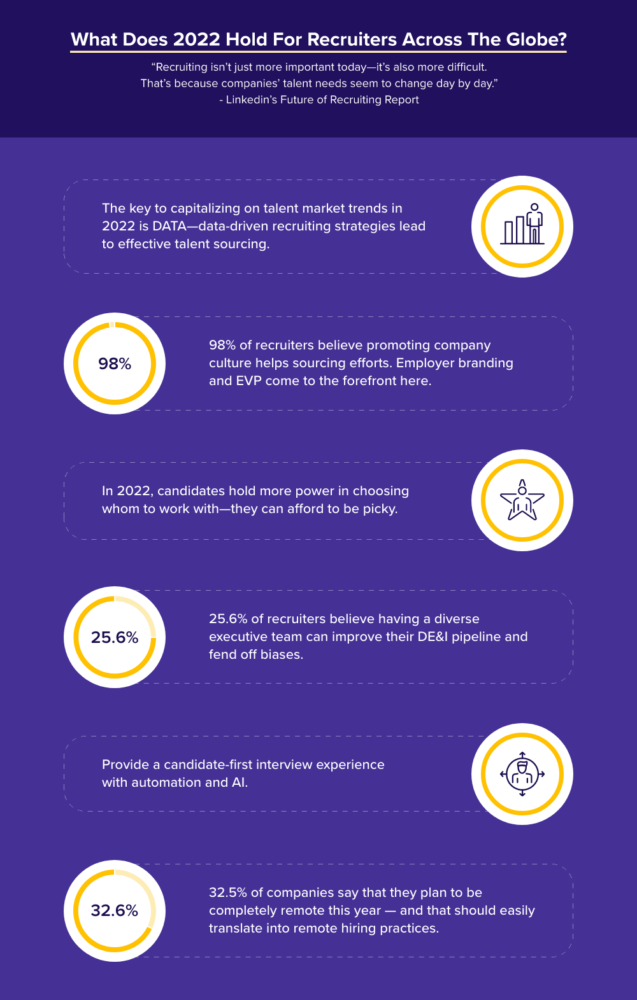
Data-driven recruiting strategies are the answer to effective talent sourcing and a streamlined hiring process.

Talent acquisition leaders need to use real-time analytics like pipeline growth metrics, offer acceptance rates, quality and cost of new hires, and candidate feedback scores to reduce manual work, improve processes, and hire the best talent.

The key to capitalizing on talent market trends in 2024 is data. It enables you to analyze what’s working and what needs refinement, leaving room for experimentation.

Trend #2—Have impactful employer branding

98% of recruiters believe promoting company culture helps sourcing efforts as seen in our 2021 State Of Developer Recruitment report.

Having a strong employer brand that supports a clear Employer Value Proposition (EVP) is crucial to influencing a candidate’s decision to work with your company. Perks like upskilling opportunities, remote work, and flexible hours are top EVPs that attract qualified candidates.

A clear EVP builds a culture of balance, mental health awareness, and flexibility—strengthening your employer brand with candidate-first policies.

Trend #3—Focus on candidate-driven market

The pandemic drastically increased the skills gap, making tech recruitment more challenging. With the severe shortage of tech talent, candidates now hold more power and can afford to be selective.

Competitive pay is no longer enough. Use data to understand what candidates want—work-life balance, remote options, learning opportunities—and adapt accordingly.

Recruiters need to think creatively to attract and retain top talent.


Recommended read: What NOT To Do When Recruiting Fresh Talent


Trend #4—Have a diversity and inclusion oriented company culture

Diversity and inclusion have become central to modern recruitment. While urgent hiring can delay D&I efforts, long-term success depends on inclusive teams. Our survey shows that 25.6% of HR professionals believe a diverse leadership team helps build stronger pipelines and reduces bias.

McKinsey’s Diversity Wins report confirms this: top-quartile gender-diverse companies see 25% higher profitability, and ethnically diverse teams show 36% higher returns.

It's refreshing to see the importance of an inclusive culture increasing across all job-seeking communities, especially in tech. This reiterates that D&I is a must-have, not just a good-to-have.

—Swetha Harikrishnan, Sr. HR Director, HackerEarth

Recommended read: Diversity And Inclusion in 2022 - 5 Essential Rules To Follow


Trend #5—Embed automation and AI into your recruitment systems

With the rise of AI tools like ChatGPT, automation is being adopted across every business function—including recruiting.

Manual communication with large candidate pools is inefficient. In 2024, recruitment automation and AI-powered platforms will automate candidate nurturing and communication, providing a more personalized experience while saving time.

Trend #6—Conduct remote interviews

With 32.5% of companies planning to stay remote, remote interviewing is here to stay.

Remote interviews expand access to global talent, reduce overhead costs, and increase flexibility—making the hiring process more efficient for both recruiters and candidates.

Trend #7—Be proactive in candidate engagement

Delayed responses or lack of updates can frustrate candidates and impact your brand. Proactive communication and engagement with both active and passive candidates are key to successful recruiting.

As recruitment evolves, proactive candidate engagement will become central to attracting and retaining talent. In 2023 and beyond, companies must engage both active and passive candidates through innovative strategies and technologies like chatbots and AI-powered systems. Building pipelines and nurturing relationships will enhance employer branding and ensure long-term hiring success.

—Narayani Gurunathan, CEO, PlaceNet Consultants

Recruiting Tech Talent Just Got Easier With HackerEarth

Recruiting qualified tech talent is tough—but we’re here to help. HackerEarth for Enterprises offers an all-in-one suite that simplifies sourcing, assessing, and interviewing developers.

Our tech recruiting platform enables you to:

  • Tap into a 6 million-strong developer community
  • Host custom hackathons to engage talent and boost your employer brand
  • Create online assessments to evaluate 80+ tech skills
  • Use dev-friendly IDEs and proctoring for reliable evaluations
  • Benchmark candidates against a global community
  • Conduct live coding interviews with FaceCode, our collaborative coding interview tool
  • Guide upskilling journeys via our Learning and Development platform
  • Integrate seamlessly with all leading ATS systems
  • Access 24/7 support with a 95% satisfaction score

Recommended read: The A-Zs Of Tech Recruiting - A Guide


Staying ahead of tech recruiting trends, improving hiring processes, and adapting to change is the way forward in 2024. Take note of the tips in this article and use them to build a future-ready hiring strategy.

Ready to streamline your tech recruiting? Try HackerEarth for Enterprises today.

7 Tech Recruiting Trends To Watch Out

The last couple of years transformed how the world works and the tech industry is no exception. Remote work, candidate-driven market, automation are some of the tech recruiting trends that were born out of the pandemic.

While accepting the new reality and adapting to it is the first step, keeping up with the continuously changing hiring trends in technology is the bigger challenge right now.

What does 2025 hold for recruiters across the globe? What hiring practices would work best in this post-pandemic world? How do you stay on top of the changes in this industry?

The answers to these questions will paint a clearer picture of how to set up for success while recruiting tech talent this year.

7 tech recruiting trends

6 Tech Recruiting Trends To Watch Out For In 2022

Recruiters, we’ve got you covered. Here are the tech recruiting trends that will change the way you build tech teams in 2024.

Trend #1—Leverage data-driven recruiting

Data-driven recruiting strategies are the answer to effective talent sourcing and a streamlined hiring process.

Talent acquisition leaders need to use real-time analytics like pipeline growth metrics, offer acceptance rates (by team, department, and location), quality and cost of new hires, and candidate feedback scores—to help them reduce/eliminate manual work, improve in critical areas and hire the best talent.

Trend #2—Have impactful employer branding

98% of recruiters believe promoting company culture helps sourcing efforts as seen in our 2021 State Of Developer Recruitment report. Having a strong employer brand that supports an equally strong Employer Value Proposition (EVP) is crucial to swaying candidates’ decision to work at your company.

As recruiters, you have to evaluate what your culture stands for and how candidates can be successful at the workplace. You have to be specific about what EVPs you are offering. Perks like upskilling opportunities, remote work processes, flexible working hours are some of the top EVPs that attract qualified candidates.

A clear, well-outlined EVP builds a healthier company culture, which includes better work-life balance, prioritizes mental health, and encourages remote/hybrid work. This in turn strengthens your employer brand as these policies are candidate-friendly and put them first.

Trend #3—Focus on candidate-driven market

Katrina Collier, HR and Recruitment facilitator, said in her newsletter that 2021 was the most candidate-driven market she had ever seen in her 18+ years of career. And she’s got it right.

The pandemic drastically increased the skills gap and recruiting tech talent has become an uphill struggle With the severe shortage of tech talent, candidates hold more power in choosing whom to work with—they can afford to be picky.

Simply dangling a competitive pay package will not cut it anymore. Utilize data-driven recruiting to find out what candidates look for in an ideal job role. Is it work-life balance, a healthy company culture, remote work options, or investment in learning and development?

Recruiters and hiring managers need to get creative to stand out from the crowd and attract the cream of the crop.

Recommended read: What NOT To Do When Recruiting Fresh Talent

Trend #4—Have a diversity and inclusion oriented company culture

Fairer representation and inclusion in the tech industry throughout the world have come to the forefront in the last few years. It has become a key focus of modern recruitment.

While our survey shows us that D&I may have to take a backseat at times to quickly fill open positions—25.6% of our HR respondents believe having a diverse executive team, and improving connections with grassroots student communities can improve their diversity pipeline and fend off biases.

This is further supported by the fact that above-average profitability is 25% higher for companies in the top-quartile for gender diversity in leadership and 36% higher for those with ethnic diversity as seen in McKinsey’s Diversity Wins report.

Recruiters have also experienced candidates turn down job roles due to a lack of DEI representation at the workplace. This is the time to be more intentional about building a diverse tech team to stay relevant and reap the full advantages of D&I in 2024.

It’s refreshing to see the importance of an inclusive culture or to see its popularity as a deal breaker increasing across every job seeking community , including that of the tech community. This reiterates the message of how D&I is not a good-to-have as a culture, but is a must-have that makes absolute people – business sense.
— Swetha Harikrishnan, Sr. HR Director at HackerEarth

Recommended read: Diversity And Inclusion in 2022 – 5 Essential Rules To Follow

Trend #5—Embed automation and AI into your recruitment systems

With the hype that artificial intelligence like ChatGPT, the world of automation has turned the tables. This simply means that the upcoming years are going to see AI fully embedded in every organization’s process—and recruiting is no different!

If, as a recruiter, you have faced enormous challenges in communicating with the candidates: extremely delayed updates, less to no feedback on how the candidate performed in the interviews and

Looking at it from a recruiter’s perspective, regular communication with the candidates is one of the most difficult parts of their job. Manually emailing prospects to nurture them or keeping a large number of candidates in the loop is time-consuming, labor-intensive, and not sustainable.

In 2025 and beyond, recruitment automation trends like automated nurturing and AI for recruiting platforms are what will both eliminate the needless complexity and inefficiency of manual communications and ensure you personalize your team’s candidate outreach. This serves to provide a positive candidate-first experience as well.

Trend #6—Conduct remote interviews

The future of work is mostly remote/hybrid. Remote work has mandated that tech hiring become a more collaborative process, and accelerated the adoption of tech recruiting platforms. What was a forced necessity last year, is here to stay.

32.5% of companies say that they plan to be completely remote this year. And that should translate into remote hiring practices. More and more candidates are expecting remote work and remote hiring processes.

Remote recruitment saves time, expenses and increases efficiency while also opening the doors to a larger talent pool not limited by geography.

Trend #7 — Be proactive in candidate engagement

When recruiters don’t respond to candidates in a timely manner, and update about the screening status—whether they are moving with the candidate to the next round or not—gets the candidiate disappointed.

Candidates expect constant engagement from organizations. That’s what Narayani Gurunathan, the CEO of PlaceNet Consultants emphasizes upon.

As the recruitment landscape continues to evolve, companies are placing increasing emphasis on proactive candidate engagement to attract and retain top talent. In 2023 and beyond, this trend is set to take center stage, with a particular focus on engaging with both active and passive candidates. To stand out in a crowded marketplace, organizations will implement innovative strategies to capture the attention of potential candidates, more so due to the remote hiring environment, Use of technologies such as chatbots and AI-powered feedback systems will play a dominating role here. In addition to technology, building relationships with passive candidates and creating pipelines for future talent needs will also emerge in this new landscape. By investing in the candidate experience and taking a long-term approach, companies will build a strong employer brand and create a competitive advantage. Ultimately, the goal of proactive candidate engagement is to create a positive and personalized experience for candidates, meeting the talent needs of the organization and augmenting employer branding. Thus by prioritizing this trend in 2023 and beyond, companies will not only build a reputation as a desirable employer, but also attract the best talent to achieving long-term success.

Recruiting Tech Talent Just Got Easier With HackerEarth

Recruiting tech talent that is qualified is complicated. It is also competitive, difficult, and long. We, at HackerEarth, aim to make it simple. HackerEarth for Enterprises presents a complete suite of products that unites every step of the employee lifecycle, right from attracting, sourcing to interviewing—making the lives of both developers and recruiters easy!

Effortlessly hire the best developers with our tech recruiting platform that offer features like:

  • With our 6 million strong developer community, we connect organizations with one of the largest talented candidate pools out there.
  • Our customized virtual hackathons are well-suited to engaging the developer community and strengthening your employer brand.
  • We enable you to create online assessments capable of testing 80+ skills, including full-stack assessments, with minimal technical knowledge.
  • Our AI-powered assessment platform comes with dev-friendly IDEs, practice rounds, and support for multiple languages.
  • Our reports and transcripts benchmark the candidate against the entire community or candidate pool.
  • FaceCode, our intelligent remote coding interview tool, allows you to smoothly invite candidates and conduct technical coding interviews, using a real-time, collaborative code editor with a built-in compiler. Bid adieu to whiteboards!
  • HackerEarth’s L&D platform helps employees to evaluate themselves and identify skill gaps. Once these are specified, you can then curate individual learning pathways that will help your team upskill, grow and be ready for future challenges in the ‘present’.
  • Our platform seamlessly integrates with every major ATS provider including Lever, JazzHR, Workable, and Naukri RMS.
  • We offer quick turnaround times and round-the-clock support throughout the process. Our support system has a 95% B2B Customer Satisfaction rating.

Recommended read: The A-Zs Of Tech Recruiting – A Guide

Staying abreast of tech recruiting trends, improving your hiring processes, and adapting to change is the way forward. Take note of the technical recruiting tips and patterns in this article to inform your hiring strategy for the better.

Are you ready to begin streamlining your tech recruiting process? Go on then, take HackerEarth for Enterprises for a quick spin to know more.