Nischal V Chadaga

Author
Nischal V Chadaga

Blogs
Nischal is a former product marketer with a love for growth loops and developer communities. Now, they decode hiring challenges with the same curiosity they brought to GTM plans.
author’s Articles

Insights & Stories by Nischal V Chadaga

Nischal V Chadaga's content is built for talent leaders who want results—fast. Actionable, relevant, and packed with real-world learnings from the frontlines of growth.
Clear all
Thank you! Your submission has been received!
Oops! Something went wrong while submitting the form.
Filter
Filter

How Candidates Use Technology to Cheat in Online Technical Assessments

Impact of Online Assessments in Technical Hiring


In a digitally-native hiring landscape, online assessments have proven to be both a boon and a bane for recruiters and employers.

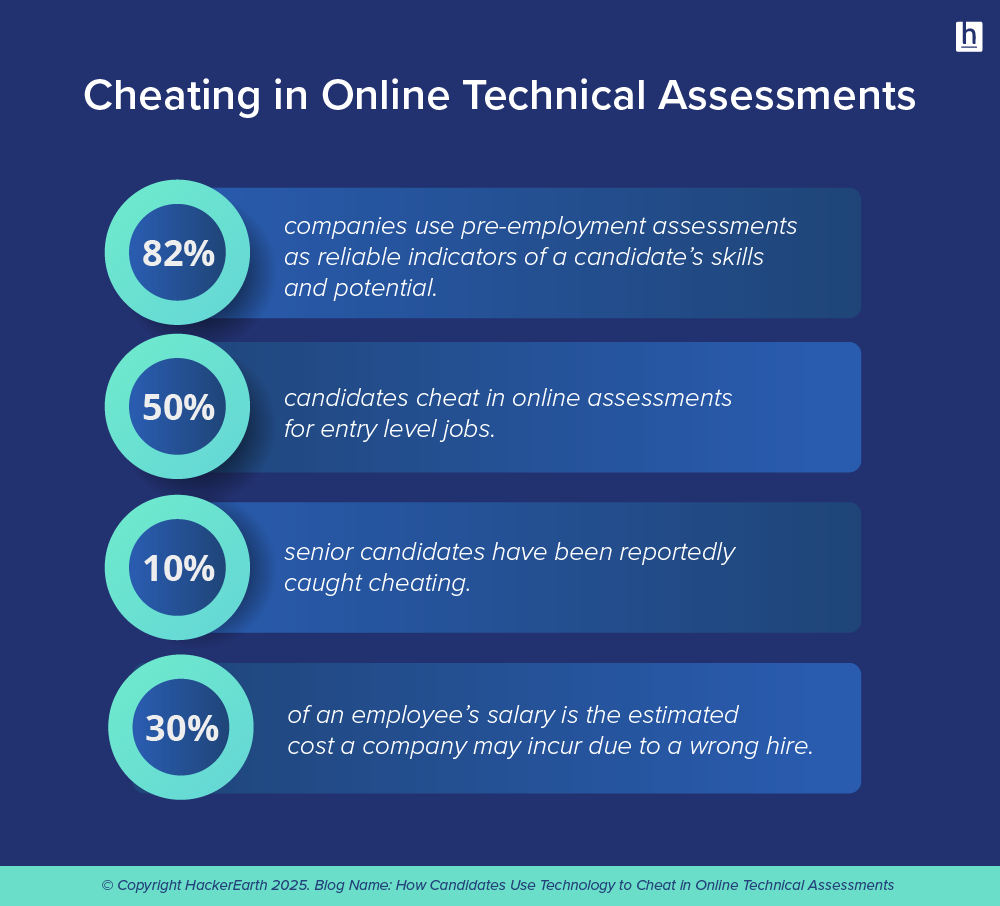
The ease and efficiency of virtual interviews, take home programming tests and remote coding challenges is transformative. Around 82% of companies use pre-employment assessments as reliable indicators of a candidate's skills and potential.

Online skill assessment tests have been proven to streamline technical hiring and enable recruiters to significantly reduce the time and cost to identify and hire top talent.

In the realm of online assessments, remote assessments have transformed the hiring landscape, boosting the speed and efficiency of screening and evaluating talent. On the flip side, candidates have learned how to use creative methods and AI tools to cheat in tests.

As it turns out, technology that makes hiring easier for recruiters and managers - is also their Achilles' heel.

Cheating in Online Assessments is a High Stakes Problem


With the proliferation of AI in recruitment, the conversation around cheating has come to the forefront, putting recruiters and hiring managers in a bit of a flux.


According to research, nearly 30 to 50 percent of candidates cheat in online assessments for entry level jobs. Even 10% of senior candidates have been reportedly caught cheating.

The problem becomes twofold - if finding the right talent can be a competitive advantage, the consequences of hiring the wrong one can be equally damaging and counter-productive.

As per Forbes, a wrong hire can cost a company around 30% of an employee's salary - not to mention, loss of precious productive hours and morale disruption.

The question that arises is - "Can organizations continue to leverage AI-driven tools for online assessments without compromising on the integrity of their hiring process? "

This article will discuss the common methods candidates use to outsmart online assessments. We will also dive deep into actionable steps that you can take to prevent cheating while delivering a positive candidate experience.

Common Cheating Tactics and How You Can Combat Them


  1. Using ChatGPT and other AI tools to write code

    Copy-pasting code using AI-based platforms and online code generators is one of common cheat codes in candidates' books. For tackling technical assessments, candidates conveniently use readily available tools like ChatGPT and GitHub. At the same time, some organizations complement their process with context-aware code security support to ensure AI-generated solutions follow secure development practices. Using these tools, candidates can easily generate solutions to solve common programming challenges such as:
    • Debugging code
    • Optimizing existing code
    • Writing problem-specific code from scratch
    Ways to prevent it
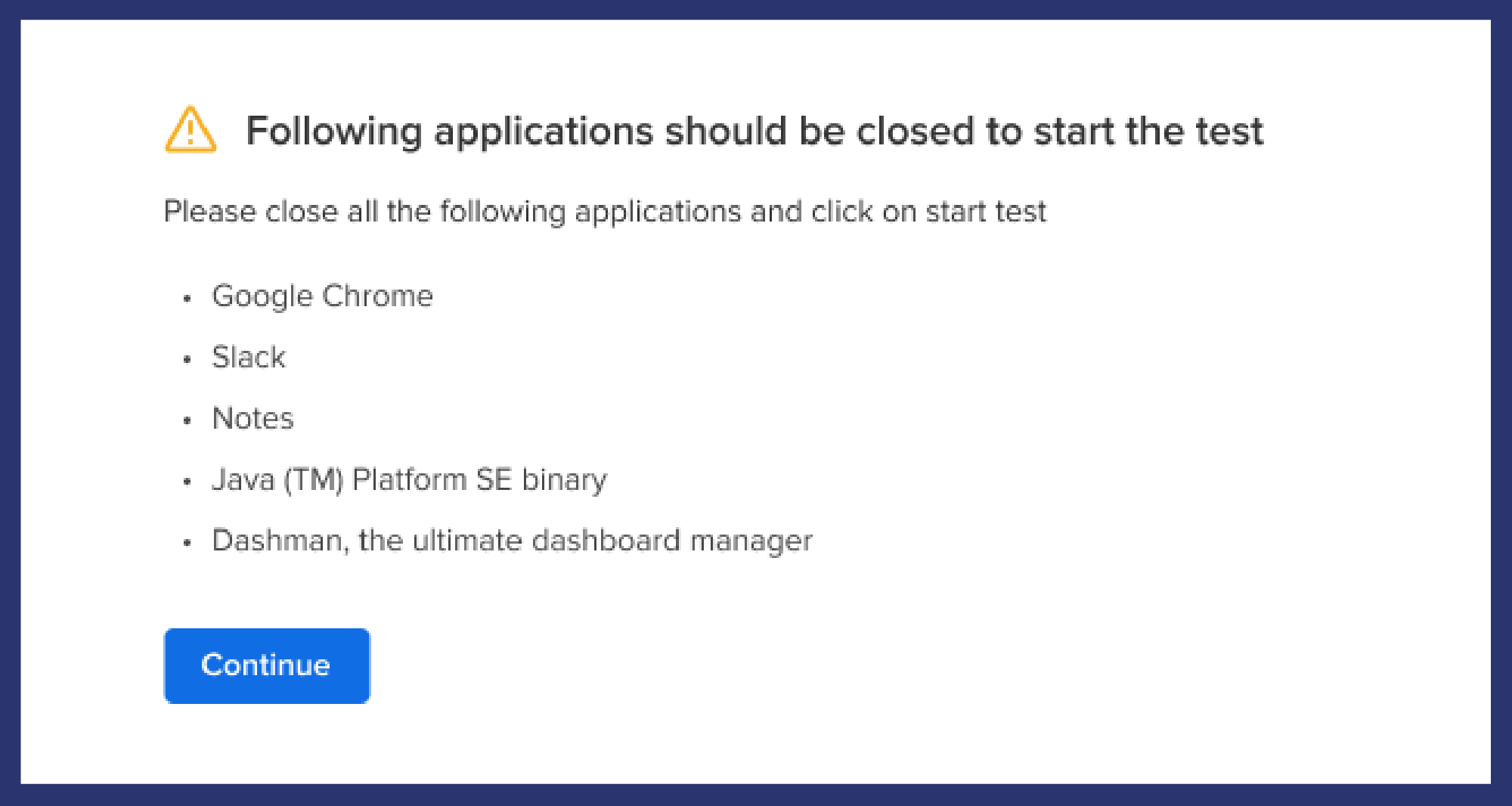
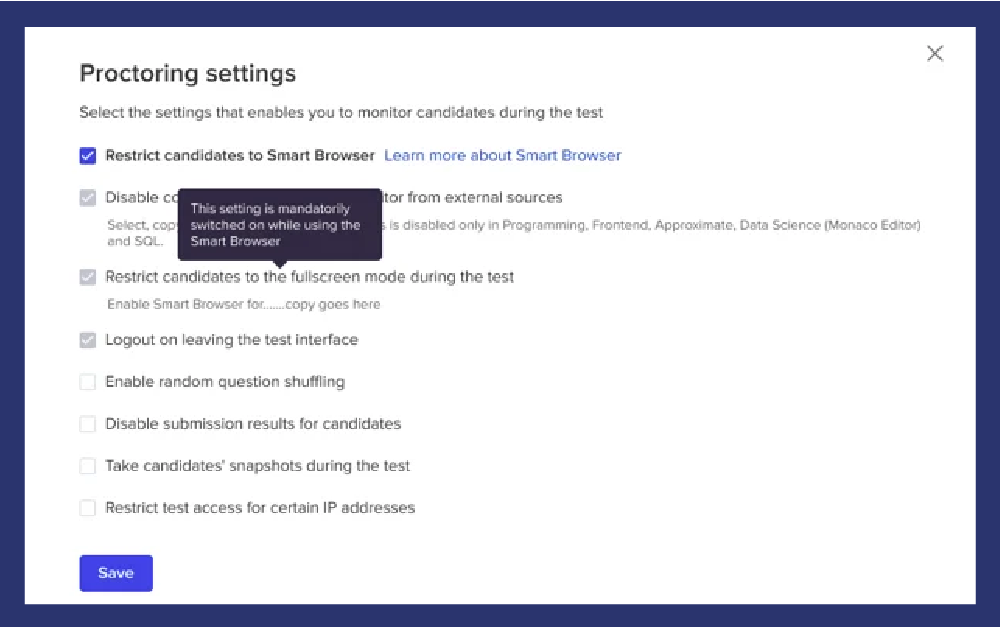
    • Enable full-screen mode
    • Disable copy-and-paste functionality
    • Restrict tab switching outside of code editors
    • Use AI to detect code that has been copied and pasted
  2. Enlist external help to complete the assessment


    Candidates often seek out someone else to take the assessment on their behalf. In many cases, they also use screen sharing and remote collaboration tools for real-time assistance.

    In extreme cases, some candidates might have an off-camera individual present in the same environment for help.

    Ways to prevent it
    • Verify a candidate using video authentication
    • Restrict test access from specific IP addresses
    • Use online proctoring by taking snapshots of the candidate periodically
    • Use a 360 degree environment scan to ensure no unauthorized individual is present
  3. Using multiple devices at the same time


    Candidates attempting to cheat often rely on secondary devices such as a computer, tablet, notebook or a mobile phone hidden from the line of sight of their webcam.

    By using multiple devices, candidates can look up information, search for solutions or simply augment their answers.

    Ways to prevent it
    • Track mouse exit count to detect irregularities
    • Detect when a new device or peripheral is connected
    • Use network monitoring and scanning to detect any smart devices in proximity
    • Conduct a virtual whiteboard interview to monitor movements and gestures
  4. Using remote desktop software and virtual machines


    Tech-savvy candidates go to great lengths to cheat. Using virtual machines, candidates can search for answers using a secondary OS while their primary OS is being monitored.

    Remote desktop software is another cheating technique which lets candidates give access to a third-person, allowing them to control their device.

    With remote desktops, candidates can screen share the test window and use external help.

    Ways to prevent it
    • Restrict access to virtual machines
    • AI-based proctoring for identifying malicious keystrokes
    • Use smart browsers to block candidates from using VMs

Future-proof Your Online Assessments With HackerEarth

HackerEarth's AI-powered online proctoring solution is a tested and proven way to outsmart cheating and take preventive measures at the right stage. With HackerEarth's Smart Browser, recruiters can mitigate the threat of cheating and ensure their online assessments are accurate and trustworthy.
  • Secure, sealed-off testing environment
  • AI-enabled live test monitoring
  • Enterprise-grade, industry leading compliance
  • Built-in features to track, detect and flag cheating attempts
Boost your hiring efficiency and conduct reliable online assessments confidently with HackerEarth's revolutionary Smart Browser.

Talent Acquisition Strategies For Rehiring Former Employees

Former employees who return to work with the same organisation are essential assets. In talent acquisition, such employees are also termed as ‘Boomerang employees’. Former employees are valuable because they require the least training and onboarding because of their familiarity with the organization’s policies. Rehiring former employees by offering them more perks is a mark of a successful hiring process. This article will elaborate on the talent acquisition strategies for rehiring former employees, supported by a few real-life examples and best practices.

Why Should Organizations Consider Rehiring?

One of the best ways of ensuring quality hire with a low candidate turnover is to deploy employee retention programs like rehiring female professionals who wish to return to work after a career break. This gives former employees a chance to prove their expertise while ensuring them the organization’s faith in their skills and abilities. Besides, seeing former employees return to their old organizations encourages newly appointed employees to be more productive and contribute to the overall success of the organization they are working for. A few other benefits of rehiring old employees are listed below.

Reduced Hiring Costs

Hiring new talent incurs a few additional costs. For example, tasks such as sourcing resumes of potential candidates, reaching out to them, conducting interviews and screenings costs money to the HR department. Hiring former employees cuts down these costs and aids a seamless transition process for them.

Faster Onboarding

Since boomerang employees are well acquainted with the company’s onboarding process, they don’t have to undergo the entire exercise. A quick, one-day session informing them of any recent changes in the company’s work policies is sufficient to onboard them.

Retention of Knowledge

As a former employee, rehired executives have knowledge of the previous workflows and insights from working on former projects. This can be valuable in optimizing a current project. They bring immense knowledge and experience with them which can be instrumental in driving new projects to success.Starbucks is a prime example of a company that has successfully leveraged boomerang employees. Howard Schultz, the company's CEO, left in 2000 but returned in 2008 during a critical time for the firm. His leadership was instrumental in revitalizing the brand amid financial challenges.

Best Practices for Rehiring Former Employees

Implementing best practices is the safest way to go about any operation. Hiring former employees can be a daunting task especially if it involves someone who was fired previously. It is important to draft certain policies around rehiring former employees. Here are a few of them that can help you to get started.

1. Create a Clear Rehire Policy

While considering rehiring a former employee, it is essential to go through data indicating the reason why they had to leave in the first place. Any offer being offered must supersede their previous offer while marking clear boundaries to maintain work ethics. Offer a fair compensation that justifies their skills and abilities which can be major contributors to the success of the organization. A well-defined policy not only streamlines the rehiring process but also promotes fairness within the organization.

2. Conduct Thorough Exit Interviews

Exit interviews provide valuable insights into why employees leave and can help maintain relationships for potential future rehires. Key aspects to cover include:
  • Reasons for departure.
  • Conditions under which they might consider returning.
  • Feedback on organizational practices.
Keeping lines of communication open during these discussions can foster goodwill and encourage former employees to consider returning when the time is right.

3. Maintain Connections with Alumni

Creating and maintaining an alumni association must be an integral part of HR strategies. This exercise ensures that the HR department can find former employees in times of dire need and indicates to former employees how the organization is vested in their lives even after they have left them. This gesture fosters a feeling of goodwill and gratitude among former hires. Alumni networks and social media groups help former employees stay in touch with each other, thus improving their interpersonal communication.Research indicates that about 15% of rehired employees return because they maintained connections with their former employers.

4. Assess Current Needs Before Reaching Out

Before reaching out to former employees, assess all viable options and list out the reasons why rehiring is inevitable. Consider:
  • Changes in job responsibilities since their departure.
  • Skills or experiences gained by other team members during their absence.
It is essential to understand how the presence of a boomerang employee can be instrumental in solving professional crises before contacting them. It is also important to consider their present circumstances.

5. Initiate an Honest Conversation

When you get in touch with a former employee, it is important to understand their perspective on the job being offered. Make them feel heard and empathize with any difficult situations they may have had to face during their time in the organization. Understand why they would consider rejoining the company. These steps indicate that you truly care about them and fosters a certain level of trust between them and the organization which can motivate them to rejoin with a positive attitude.

6. Implement a Reboarding Program

When a former employee rejoins, HR departments must ensure a robust reboarding exercise is conducted to update them about any changes within the organization regarding the work policies and culture changes, training them about any new tools or systems that were deployed during their absence and allowing them time to reconnect with old team members or acquaint with new ones.

7. Make Them Feel Welcome

Creating a welcoming environment is essential for helping returning employees adjust smoothly. Consider:
  • Organizing team lunches or social events during their first week.
  • Assigning a mentor or buddy from their previous team to help them reacclimate.
  • Providing resources that facilitate learning about any organizational changes.
A positive onboarding experience reinforces their decision to return and fosters loyalty.

Real-Life Examples of Successful Rehiring

Several companies have successfully implemented these strategies:

IBM: The tech giant has embraced boomerang hiring by actively reaching out to former employees who possess critical skills in emerging technologies. IBM has found that these individuals often bring fresh perspectives that contribute significantly to innovation7.

Zappos: Known for its strong company culture, Zappos maintains an alumni network that keeps former employees engaged with the brand. This connection has led to numerous successful rehiring instances, enhancing both morale and productivity within teams6.

Conclusion

Rehiring former employees can provide organizations with unique advantages, including reduced costs, quicker onboarding, and retained knowledge. By implementing strategic practices—such as creating clear policies, maintaining connections, assessing current needs, and fostering welcoming environments—companies can effectively tap into this valuable talent pool.

As organizations continue navigating an ever-changing workforce landscape, embracing boomerang employees may be key to building resilient teams equipped for future challenges. By recognizing the potential benefits and following best practices outlined above, businesses can create a robust strategy for rehiring that enhances both employee satisfaction and organizational performance.

Automation in Talent Acquisition: A Comprehensive Guide

Automation has become a major element in the modern-day hiring process. The automated hiring process gained momentum since the advent of remote work culture in the pandemic era. It has greatly improved hire quality, streamlined the talent pipeline creation process and given birth to the use of technology in talent acquisition. This article will explore how automated hiring processes help organizations streamline their hiring process while maintaining cost efficiency and the key tools that help in doing so.

How Does Automation Help in Talent Acquisition?

Automation has been one of the most beneficial offerings of the modern-day technological advancement. It helps enhance hiring efficiency, reduce costs and improve candidate experience. In talent acquisition, automation involves the use of tools and technology to expedite tasks such as candidate sourcing, screening and interviewing, to onboarding new hires. The underlying goal is to use technology where possible and reducing the need for human intervention when possible, thus allowing HR professionals to focus on designing employee-friendly strategies and finding better ways to improve candidate engagement.

Key Benefits of Automation in Talent Acquisition

Apart from helping expedite key HR tasks, automation in recruitment has opened new avenues for the use of AI in talent acquisition and management, workforce planning, succession planning, and devising employee retention programs with the help of predictive analytics. In addition to this, automating HR processes is beneficial in the following ways.

Increased Efficiency

Automating several mundane tasks such as resume screening and interview scheduling using tools and technologies like HackerEarth has greatly reduced the workload for HR professionals. According to a study by PwC, 39% of organizations cited recruiting as their biggest human capital challenge, highlighting the need for efficient solutions. The use of applicant tracking systems to track a candidate’s application status has greatly contributed in improving the quality of human capital management.

Enhanced Candidate Experience

Setting up automated communication informing candidates about their application status has led to increased candidate satisfaction. This improves candidate engagement and creates a positive impression about the organization’s HR practices.

Data-Driven Decision Making

AI recruitment tools use machine learning to create predictive analysis algorithms that collect valuable data based on recruitment metrics like Time-to-Fill and Cost-per-Hire, allowing HR teams to make data-driven decisions and refine their recruitment strategies over time.

Reduced Bias

By standardizing the evaluation process through automated screening tools, organizations can minimize unconscious bias in hiring decisions, promoting diversity and inclusion.

Key Stages of Automation in Talent Acquisition

Resume Screening & Application Management

An Applicant Tracking System (ATS) allows HR teams to level up their recruitment game. The system helps companies set up automated screening of applications, analyse and store candidate information and shortlist candidates based on certain pre-defined criteria. It facilitates seamless communication from companies to candidates, thus improving the candidate experience. Having an ATS in place also lets HR managers formulate onboarding strategies for the incoming candidates, thus aiding a smooth transition into the company.

Candidate Sourcing & Outreach

Candidate sourcing takes up a significant amount of time in the recruitment process. Automation uses AI-powered tools to collate and identify candidate profiles that fit the job descriptions and are aligned with the organization’s culture. AI recruitment tools like HackerEarth employ the latest technologies to source, interview and assess potential candidates in a streamlined manner. For tech companies, HackerEarth offers tailored hackathon events to scout talented candidates which substantially reduces the workload for HR professionals. Additionally, chatbots can engage candidates in initial conversations and pre-screen them efficiently.

Interview Scheduling & Management

Automated scheduling tools like HackerEarth streamline virtual interview process by allowing recruiters to send invites, manage interview slots, and receive confirmations all within a centralized platform. This reduces back-and-forth communication and ensures a smoother experience for both recruiters and candidates.

Assessment & Testing

Many talent acquisition systems integrate with pre-employment testing platforms that enable recruiters to administer assessments and analyze results efficiently. This helps in evaluating candidates’ skills and suitability for the role without manual intervention.

Offer Letters & Onboarding

Automation can expedite the final stages of hiring by generating offer letters and contracts automatically. Onboarding software facilitates document submission, compliance checks, and online training modules for new hires. This ensures that new employees are integrated into the organization seamlessly.

Tools for Automating Talent Acquisition

Several tools are available that cater specifically to different aspects of the talent acquisition process:

Applicant Tracking Systems (ATS): Centralizes candidate information and streamlines application processes.

Candidate Relationship Management (CRM): Helps maintain relationships with potential candidates through automated communication.

Interview Scheduling Software: Automates the scheduling of interviews based on availability.

Assessment Tools: Allows for skills testing and evaluation before interviews.

Onboarding Platforms: Facilitates the onboarding process for new hires with automated workflows.

Best Practices for Implementing Automation

Assess Your Current Recruitment Process

Taking an account of the current recruitment process helps one understand the loopholes and devise strategies to overcome them. For example, Recruiters often spend an excessive amount of time manually reviewing resumes, leading to delays in the hiring process and potential oversight of qualified candidates.

Choose the Right Tools

Conduct a thorough study of the automated recruitment solutions available in the market to ensure that the right system is being leveraged for automated recruitment. For example, deploying recruitment chatbots can be instrumental in helping potential candidates understand their application status or clear doubts regarding the future steps. Select automation tools that align with your specific recruitment needs. Consider factors such as ease of use, integration capabilities with existing systems, and scalability.

Maintain a Human Touch

Automation does expedite crucial hiring processes, however, human intervention is essential in ensuring that interactions with highly qualified candidates are maintained in a clear and engaging manner.

Monitor Performance Metrics

Use analytics tools to track key performance indicators (KPIs) related to your recruitment efforts. Regularly review these metrics to assess the effectiveness of your automated processes and make necessary adjustments.

Train Your Team

Ensure that your HR team is well-trained in using automation tools effectively. Provide ongoing support and resources to help them adapt to new technologies.

Future Trends in Talent Acquisition Automation

As technology continues to evolve, several trends are shaping the future of talent acquisition automation:

Artificial Intelligence (AI) AI will play an increasingly significant role in automating candidate screening processes by analyzing vast amounts of data to identify top candidates more accurately.

Predictive Analytics: Organizations will leverage predictive analytics to forecast hiring needs based on historical data and market trends, enabling proactive recruitment strategies.

Enhanced Candidate Engagement Tools: The use of chatbots and AI-driven communication tools will become more prevalent, providing candidates with instant responses and personalized experiences throughout their journey.

Conclusion

Recruitment automation is a novel idea in the hiring industry. However, automation is increasingly becoming an indispensable part of the recruitment process, revolutionizing the conventional hiring tasks and enhancing candidate experience, reducing bias and helping hirers make informed, data-driven decisions. Going forward, it is inevitable that AI-based technologies will slowly dominate the industry. The next big task for HR managers will be striking the right balance between human intervention and dispensing artificial intelligence to attract top talent effectively. Incorporating these practices into your talent acquisition strategy will not only streamline your hiring processes but also position your organization as a forward-thinking employer in a competitive job market.

Predictive Analytics for Talent Management

The job landscape in today’s age is highly competitive for both job seekers and hiring managers. Finding the right talent under such conditions can be daunting without a little help from technology. Data analytics has been a game-changer in the hiring process. Several tools leverage historical data and statistical algorithms to forecast future workforce needs and conduct workforce planning. This article will explain how predictive analytics plays an important role in effective hiring and talent management.

Understanding Predictive Analytics in Talent Management

In HR, Predictive analytics uses data mining techniques, machine learning and statistical techniques to forecast talent requirements and for workforce optimization. Data-driven decision-making helps companies make accurate predictions. Predictive analytics is used to transform raw data into actionable insights. For instance, by analyzing past hiring data, companies can predict which candidates are likely to succeed in specific roles. Predictive models help HR professionals identify trends in employee performance by providing a skill gap analysis, enabling them to address potential employee issues before they escalate.

Benefits of Using Predictive Analytics in Talent Management

One of the biggest takeaways of using predictive analytics in talent management is getting to identify major workforce issues and make provisions for them to ensure employee retention and succession planning. The other benefits of using recruitment analytics for talent management are listed below.

Enhanced Recruitment Processes

In predictive modelling, hiring teams can make candidate success forecasts by carrying out a detailed analysis of historical data. This helps them streamline the hiring process. This reduces bias and ensures equality, diversity and inclusion in hiring. Companies get to hire candidates who fit into their culture and job requirements, thus maintaining quality of hire.

Anticipating Workforce Needs

An HR department’s scope of work does not just include hiring new talent. It involves workforce planning and succession planning, human capital management and workforce management. Predictive analytics allows them to make data-driven HR decisions which are more accurate than the traditional methods. With the help of HR analytics, managers get to conduct an in-depth skill-gap analysis which helps identify the possible need for training and updation, thus improving the overall performance of employees and the organization as a whole. Conducting occasional training and skill development workshops enables better employee retention and engagement. For example, predictive models can identify employees at risk of leaving and suggest interventions to enhance job satisfaction.

Improved Employee Retention

Employee retention is a major concern for most organizations in this era where skilled employees are in high demand. In order to ensure that they remain loyal to the organization, it is imperative that companies make use of people analytics to improve employee retention rates. Businesses implementing predictive analytics for employee retention have experienced up to a 25% decrease in turnover rates.

Optimized Training and Development

Predictive analytics helps in identifying skill gaps within the workforce. By understanding these gaps, organizations can tailor training programs that align with both employee aspirations and organizational goals.

Increased Productivity

By utilizing data-driven insights to optimize team compositions and work processes, organizations can enhance overall productivity. Predictive analytics allows HR to identify high-performing teams and replicate their success across the organization.

Implementing Predictive Analytics in Talent Management

To effectively implement predictive analytics in talent management, organizations should consider the following steps:

Data Collection: Gather comprehensive data from various sources such as employee performance reviews, engagement surveys, and recruitment processes. The quality of predictions relies heavily on the quality of the input data.

Choosing the Right Tools: Invest in advanced analytical tools that can process large datasets and provide real-time insights. Many software solutions are available that specialize in HR analytics.

Building Predictive Models: Develop models that can analyze historical data to forecast future outcomes. This may involve statistical analysis or machine learning techniques depending on the complexity of the predictions required.

Continuous Monitoring: Once predictive models are implemented, it is crucial to continuously monitor their effectiveness. Adjustments may be necessary based on changing business environments or workforce dynamics.

Challenges in Using Predictive Analytics

While predictive analytics offers numerous advantages for talent management, organizations may face several challenges:

Data Privacy Concerns: Handling employee data raises ethical considerations regarding privacy and consent. Organizations must ensure compliance with relevant regulations while using employee data for analysis.

Data Quality Issues: Inaccurate or incomplete data can lead to misleading predictions. Organizations must prioritize data integrity by implementing robust data collection and management practices.

Resistance to Change: Employees may be hesitant to adopt new technologies or methodologies. Effective change management strategies are essential to facilitate a smooth transition toward data-driven decision-making.

Future Trends in Predictive Analytics for Talent Management

As technology continues to evolve, several trends are expected to shape the future of predictive analytics in talent management:

Integration with Artificial Intelligence (AI): AI will play a crucial role in enhancing predictive analytics capabilities by automating data analysis processes and providing deeper insights into workforce dynamics.

Real-Time Analytics: The demand for real-time insights will grow as organizations seek immediate responses to workforce challenges. This shift will necessitate advancements in analytical tools capable of processing live data streams.

Use of Technology for Virtual Recruitment: Using tools like HackerEarth to streamline hiring processes ensures a hassle-free hiring process while ensuring a positive candidate experience.

Focus on Employee Experience: Organizations will increasingly use predictive analytics not only for operational efficiency but also for enhancing employee experience. Understanding factors that contribute to job satisfaction will become a priority.

Collaboration Across Departments: Successful predictive analytics initiatives will require collaboration between HR, IT, and other departments. A unified approach will ensure that insights derived from analytics are effectively integrated into broader business strategies.

Conclusion

Predictive analytics is a major gamechanger in the hiring industry. It has great potential in helping organizations realize their HR objectives in an optimized and streamlined manner.

Predictive analytics is revolutionizing talent management by enabling organizations to make informed decisions based on data-driven insights. From optimizing recruitment processes to enhancing employee retention strategies, the benefits of predictive analytics are vast and impactful. As businesses continue to embrace this technology, they will gain a competitive edge by aligning their workforce with strategic objectives while fostering a culture of continuous improvement.

By investing in predictive analytics tools and practices, organizations can not only anticipate future workforce needs but also create an environment where employees thrive—ultimately driving organizational success in an ever-evolving marketplace.

In conclusion, integrating predictive analytics into talent management is not just an option; it is becoming a necessity for organizations aiming to stay ahead in today's dynamic business landscape.

How To Create A Positive Virtual Onboarding Experience?

The advent of the pandemic changed the hiring industry in many ways. One of the biggest outcomes of this global phenomenon was that many companies adopted and adapted to remote work, including hiring. Remote hiring strategies are designed to provide a positive candidate experience to new employees as they directly reflect a company’s attitude towards their staff. In virtual hiring, a positive virtual onboarding experience guarantees better employee retention and inspires new hires to be productive and contribute positively towards a company’s business and financial goals. This article will help you understand what virtual onboarding encompasses, and how it differs from the traditional method and mention virtual onboarding best practices to ensure a hassle-free transition for new hires through effective virtual onboarding strategies.

What is Virtual Onboarding?

Once a candidate has been hired, the next step is to onboard them. Onboarding involves training new hires for their new role, teaching them about the company values and business goals, and giving them the time to familiarize themselves with the workplace. Virtual onboarding is carried out online as opposed to the traditional onboarding process. All the different tasks are conducted with the help of online digital onboarding tools. This includes using video conferencing tools, online training modules, and other digital resources to welcome, train, and socialize new hires. The goal is to ensure that employees feel connected to their roles and the company culture from day one.

Why Does Candidate Experience Matter?

Candidate experience refers to how candidates find a company’s hiring process. This can be a good point to collect feedback from candidates regarding the hiring process. A positive candidate experience leads to:

Employee Retention: Companies with effective onboarding processes can improve new hire retention by upto 82%. Effective virtual onboarding strategies must be implemented to ensure that newly hired employees stay with the company for a substantial period.

Engagement: Effective virtual onboarding enhances employee engagement; organizations with robust onboarding strategies see a 54% increase in engagement levels.

Brand Reputation: A positive candidate experience can enhance a company's reputation, making it more attractive to future talent.

These factors highlight the importance of creating a seamless and supportive onboarding process that fosters a sense of belonging among new hires.

Tips To Improve Candidate Experience During Virtual Onboarding

To enhance the candidate experience during virtual onboarding, consider implementing the following strategies:

Start Early

Communication is key to a successful employee-employer interaction. Early communication is a crucial part of any effective virtual onboarding program. Initiate communication before the employee's first day by sending them essential information such as schedules and resources. This allows them to familiarize themselves with the company’s tools and processes.

Provide Clear Instructions

Ensure that all instructions are straightforward to follow. This clarity helps new hires feel confident in their ability to complete tasks and reduces misunderstandings.

Foster Social Connections

Encourage team introductions through virtual meetings or social platforms. This helps new employees build relationships with colleagues and feel part of the team from day one.

Utilize Interactive Tools: Incorporate gamified elements or interactive training modules that engage new hires actively rather than passively consuming information.

How To Create a Positive Virtual Onboarding Experience?

Creating a positive virtual onboarding experience involves several key steps:

Structured Program: Develop a comprehensive onboarding program that outlines each step of the process. This should include orientation sessions, training schedules, and check-ins with managers.

Feedback Mechanisms

Implement regular feedback loops where new hires can share their experiences and suggestions for improvement. This not only helps refine the onboarding process but also makes employees feel valued.

Access to Resources

Ensure that new employees have easy access to necessary resources such as training materials, company policies, and support contacts. A centralized online platform can facilitate this accessibility, and many companies even create dedicated onboarding portals using affordable hosting solutions. Using a Hostinger coupon can help reduce costs when setting up such resource hubs.

Celebrate Milestones

Recognize achievements during the onboarding phase, such as completing training modules or reaching 30 days in their role. Celebrating these milestones fosters motivation and engagement.

What Technologies Help Facilitate Virtual Onboarding of Candidates Seamlessly?

Several technologies can enhance the virtual onboarding experience:

Video Conferencing Tools

Platforms like Zoom or Microsoft Teams allow for face-to-face interactions, essential for building rapport between new hires and their teams.

Learning Management Systems (LMS)

Tools like Moodle or TalentLMS enable organizations to deliver structured training programs that new hires can complete at their own pace.

Document Signing Software:

Solutions such as DocuSign streamline paperwork by allowing new hires to sign documents electronically, reducing delays in compliance processes.

Collaboration Platforms

Tools like Slack or Trello facilitate ongoing communication and project management among team members, helping new hires stay connected and informed about team activities.

Conclusion

In conclusion, creating a positive virtual onboarding experience is essential for organizations looking to thrive in today's remote work landscape. By understanding what virtual onboarding entails, recognizing its historical significance, prioritizing candidate experience, and implementing effective strategies and technologies, companies can foster an engaging environment for new hires. As demonstrated by successful real-life examples and supported by industry statistics, investing in a robust virtual onboarding program not only enhances employee satisfaction but also contributes significantly to retention and productivity. By adopting these practices, organizations can ensure they attract top talent while nurturing a productive workforce from day one.

How to Conduct a Recruitment SWOT Analysis (With Template)

A SWOT analysis is one of the most practical strategic frameworks in business — and it works just as powerfully when applied to recruitment. SWOT stands for Strengths, Weaknesses, Opportunities, and Threats. By mapping these four factors against your hiring process, you gain a clear picture of what is working, what is not, and where your biggest talent acquisition risks and advantages lie.

Whether you are scaling a technical team, reducing time-to-hire, or rethinking your employer brand, a recruitment SWOT analysis gives you a structured way to evaluate internal capabilities and external conditions before making critical workforce decisions. According to SHRM's 2024 Talent Trends report, organizations that conduct regular strategic assessments of their hiring processes are 2.5x more likely to meet their workforce planning goals.

This guide walks you through the full process — from defining your recruitment goals to building a visual SWOT matrix — and includes a ready-to-use template and real-world examples you can adapt immediately.

What Is a SWOT Analysis? (Definition & Meaning)

SWOT Analysis Meaning

A SWOT analysis is a strategic planning framework that organizes information into four categories: Strengths, Weaknesses, Opportunities, and Threats. The first two — strengths and weaknesses — are internal factors that your organization controls. The second two — opportunities and threats — are external factors shaped by the market, competitors, and broader industry trends.

Here is how each component breaks down:

  • Strengths: Internal attributes that give you a competitive advantage. Examples include a strong employer brand, experienced recruiters, or advanced hiring technology.
  • Weaknesses: Internal limitations that hold your hiring process back. Examples include long time-to-fill, outdated job descriptions, or limited candidate pipelines.
  • Opportunities: External conditions you can leverage to improve outcomes. Examples include emerging sourcing channels, remote work expansion, or growing talent pools in new geographies.
  • Threats: External challenges that could negatively impact your ability to hire. Examples include competitor hiring surges, economic downturns, or tightening labor markets.

The framework was first introduced in the 1960s by Albert Humphrey at the Stanford Research Institute. It has since become one of the most widely adopted tools in business strategy, used across industries from product development to human resources.

Why SWOT Analysis Matters

The power of a SWOT analysis lies in its simplicity. It forces structured thinking about both internal realities and external forces, which is exactly what most hiring teams skip when troubleshooting recruitment problems.

In a general business context, SWOT analysis helps organizations make informed decisions about product launches, market entry, or competitive positioning. In HR and recruitment, the same logic applies. You are assessing your talent acquisition function as a system — one that has strengths to leverage, weaknesses to fix, opportunities to seize, and threats to mitigate.

Without this structured evaluation, recruitment decisions tend to be reactive. A SWOT analysis shifts your approach from putting out fires to building a proactive hiring strategy.

Why Use SWOT Analysis for Recruitment?

Recruitment is not just about posting jobs and screening resumes. It is a complex workflow involving employer branding, sourcing, assessments, interviews, offer management, and onboarding. A SWOT analysis for recruitment and selection helps you evaluate each of these components systematically.

Here is why it matters for hiring teams specifically:

  • Identifies bottlenecks before they become crises. If your average time-to-fill is 45 days but the industry benchmark is 30, a SWOT analysis surfaces this weakness alongside its root causes.
  • Reveals untapped sourcing opportunities. You might discover that competitors are not yet tapping into hackathon-based hiring or niche developer communities — an opportunity you can capitalize on.
  • Aligns recruitment with business goals. When leadership plans to expand into a new market, a SWOT analysis helps your hiring team prepare by mapping available talent pools against projected headcount needs.
  • Creates a shared language for hiring stakeholders. A visual SWOT matrix gives recruiters, hiring managers, and executives a common framework to discuss priorities and tradeoffs.

A recruitment SWOT analysis is particularly useful in these scenarios:

  • You are experiencing a hiring surge and need to scale fast without sacrificing quality.
  • Candidate drop-off rates are high and you need to diagnose why.
  • You are entering a new market or hiring for roles you have not recruited for before.
  • Leadership is asking for a strategic assessment of your talent acquisition function.
  • You are evaluating whether to invest in new assessment tools or sourcing platforms.

Step-by-Step Guide to Conducting a Recruitment SWOT Analysis

Step 1 — Define Recruitment Goals

Every SWOT analysis starts with a clear objective. Without one, you end up with a generic list of observations that do not lead anywhere actionable.

Ask yourself: What specific recruitment outcome are you trying to improve? Common goals include:

  • Reducing time-to-hire by 20% over the next two quarters
  • Improving quality of hire for engineering roles
  • Increasing offer acceptance rates from 65% to 80%
  • Expanding the candidate pipeline for underrepresented talent

Define the scope as well. Are you analyzing your entire recruitment function, a single department's hiring process, or a specific role family? The tighter your scope, the more actionable your findings will be.

Step 2 — Gather Data

A SWOT analysis based on assumptions is worse than no analysis at all. Ground every quadrant in real data.

Internal data to collect:

  • Time-to-fill and time-to-hire by role and department
  • Quality-of-hire metrics (performance ratings, retention at 6 and 12 months)
  • Source-of-hire data (which channels produce the best candidates)
  • Candidate experience survey scores
  • Offer acceptance and rejection rates
  • Recruiter workload and capacity metrics

External data to collect:

  • Industry benchmarking reports (LinkedIn Talent Insights, SHRM, Glassdoor)
  • Competitor hiring activity (job postings, Glassdoor reviews, LinkedIn growth)
  • Labor market data for target roles and geographies
  • Emerging technology and sourcing channel trends

If you use coding assessments or technical screening platforms, pull data on candidate pass rates, assessment completion rates, and score distributions. This quantitative evidence strengthens your SWOT matrix significantly.

Step 3 — Identify Strengths

List the internal factors that give your recruitment function an advantage. Be specific and evidence-based.

Examples of recruitment strengths:

  • Strong employer brand with a 4.2+ Glassdoor rating
  • Dedicated technical recruiting team with domain expertise
  • Structured interview process with validated scorecards
  • Advanced hiring technology stack (ATS, AI-powered assessments, video interviews)
  • Fast offer turnaround — average of 3 days from final interview to offer
  • Active talent community or developer engagement programs

Ask your recruiters, hiring managers, and recent hires what they think works best about your process. Their input often reveals strengths that data alone misses.

Step 4 — Identify Weaknesses

This is where honesty matters most. Weaknesses are the internal gaps and limitations that slow your hiring down or reduce its quality.

Examples of recruitment weaknesses:

  • Average time-to-fill exceeding 40 days for technical roles
  • Limited candidate pipeline — over-reliance on one or two sourcing channels
  • High candidate drop-off during assessments or interviews
  • Inconsistent interview practices across teams
  • Lack of structured onboarding reducing new hire retention
  • Manual processes that create administrative bottlenecks

Building a strong candidate pipeline is one of the most common weaknesses organizations uncover during this step. If your pipeline is shallow or stale, it directly impacts every other metric.

Step 5 — Spot Opportunities

Look outward. What external trends, technologies, or market shifts can you use to strengthen your recruiting?

Examples of recruitment opportunities:

  • Growing remote-first talent pools in lower-cost geographies
  • AI-powered sourcing and screening tools that reduce manual effort
  • Hackathons and coding competitions as employer branding and sourcing channels
  • Skills-based hiring trends that broaden candidate pools beyond traditional credentials
  • Partnerships with universities, bootcamps, or professional communities
  • New candidate sourcing strategies enabled by social media and niche platforms

The key is to identify opportunities that directly address one or more of the weaknesses you listed in Step 4. This connection becomes critical when you translate your SWOT into action.

Step 6 — Recognize Threats

Threats are external factors you cannot control but must plan for. Ignoring them is how organizations get blindsided by hiring crunches.

Examples of recruitment threats:

  • Competitors offering 15–25% higher base salaries for the same roles
  • Talent shortages in specialized fields (machine learning, cybersecurity, DevOps)
  • Economic uncertainty causing hiring freezes or budget cuts
  • Negative employer brand perception from public reviews or layoff news
  • Regulatory changes affecting hiring practices (pay transparency laws, AI audit requirements)
  • Candidate use of generative AI making resume screening less reliable

Document threats alongside their potential severity and likelihood. Not all threats deserve the same level of attention, so prioritize the ones with the highest combined impact.

Step 7 — Build & Interpret the Matrix

Organize your findings into a 2x2 SWOT matrix. This visual structure makes it easy to share with stakeholders and identify patterns.

Strengths
Internal · Positive
List your top 4–6 strengths here
Weaknesses
Internal · Negative
List your top 4–6 weaknesses here
Opportunities
External · Positive
List your top 4–6 opportunities here
Threats
External · Negative
List your top 4–6 threats here

Once the matrix is complete, look for connections:

  • Strength + Opportunity: Where can you double down? (e.g., strong tech brand + growing remote talent pool = expand global sourcing)
  • Weakness + Threat: Where are you most vulnerable? (e.g., slow hiring process + aggressive competitor recruiting = losing top candidates)
  • Strength + Threat: How can strengths buffer threats? (e.g., advanced assessments + AI-generated resumes = reliable skill verification)
  • Weakness + Opportunity: What investments would close the gap? (e.g., limited pipeline + new sourcing channels = diversify sourcing strategy)

Recruitment SWOT Analysis Template (Visual + Download)

Blank Template You Can Use

Copy the template below and fill it in with your hiring team. Each quadrant should contain 4–6 specific, evidence-based factors.

STRENGTHS
Internal · Positive
WEAKNESSES
Internal · Negative
OPPORTUNITIES
External · Positive
THREATS
External · Negative

Instructions: How to Fill Each Section

  1. Start with strengths. It is easier to begin with positives. Ask: "What do candidates and hiring managers consistently praise about our process?"
  2. Move to weaknesses. Ask: "Where do we lose candidates? What do exit interviews and hiring manager feedback tell us?"
  3. Map opportunities. Research external trends and ask: "What new channels, tools, or market shifts could we leverage?"
  4. Document threats. Analyze competitor activity and market conditions. Ask: "What external forces could make hiring harder in the next 6–12 months?"
  5. Prioritize each quadrant. Rank factors by impact. Not everything deserves equal attention.
  6. Validate with data. Every factor should be backed by a metric, survey result, or documented trend — not gut feeling.

Printable / Copyable Version

The text-based template above is designed to be copied directly into any document, spreadsheet, or presentation. For a more visual version, use a tool like Miro, Lucidchart, or Canva — each offers free SWOT analysis templates you can customize with your recruitment data.

Examples: SWOT Analysis for Recruitment & Selection

Example 1 — Tech Startup Hiring Surge

A Series B startup needs to grow its engineering team from 15 to 50 developers within six months.

Strengths
Internal · Positive
  • Exciting product and mission attract developers
  • Competitive equity packages
  • Agile, fast-moving culture
Weaknesses
Internal · Negative
  • No dedicated recruiting team — founders handle hiring
  • No structured interview process or standardized assessments
  • Employer brand unknown outside local market
Opportunities
External · Positive
Threats
External · Negative
  • FAANG companies hiring aggressively for the same skill sets
  • Burnout risk if hiring delays overload current team
  • Runway pressure — each month of delay costs $80K+ in lost productivity

Example 2 — Campus Recruitment Challenge

A mid-size enterprise wants to improve its campus hiring program to build a stronger junior developer pipeline.

Strengths
Internal · Positive
  • Established relationships with 5 target universities
  • Strong L&D program for graduates
  • Brand recognition in the region
Weaknesses
Internal · Negative
  • Campus events generate applications but few quality hires
  • Assessment process is resume-based, missing actual coding skills
  • No year-round engagement — only visits during placement season
Opportunities
External · Positive
  • Run online coding challenges to engage students year-round
  • Partner with bootcamps to diversify the talent pool
  • Use skills-based assessments to improve quality of campus hires
Threats
External · Negative
  • Competitors are running branded hackathons and online events
  • Top students accepting offers earlier in the cycle from faster-moving firms
  • Declining enrollment in CS programs at target universities

Example 3 — High-Volume Hiring Needs

A BPO firm needs to hire 500 customer support agents quarterly while maintaining quality and improving candidate experience.

Strengths
Internal · Positive
  • Efficient ATS with automated workflows
  • Large recruiter team experienced in volume hiring
  • Competitive pay for the market
Weaknesses
Internal · Negative
  • 38% candidate drop-off during application process
  • High first-year attrition (42%) suggesting poor job fit
  • Generic job descriptions attracting unqualified applicants
Opportunities
External · Positive
  • AI-powered screening to pre-qualify candidates faster
  • Employee referral program expansion
  • Video interview tools to reduce scheduling bottlenecks
Threats
External · Negative
  • Gig economy pulling potential applicants away
  • Seasonal hiring spikes from competitors in the same market
  • Minimum wage increases squeezing hiring budgets

Interpreting Your SWOT Analysis for Action

How to Convert Insights into Strategy

A SWOT matrix is only valuable if it leads to concrete action. Use the TOWS strategy matrix to translate your four quadrants into specific initiatives:

  • SO Strategies (Strengths + Opportunities): Use your advantages to seize opportunities. Example: Leverage your strong employer brand (strength) to launch a remote hiring campaign targeting new geographies (opportunity).
  • WO Strategies (Weaknesses + Opportunities): Use opportunities to address weaknesses. Example: Implement AI-powered assessments (opportunity) to replace your slow manual screening process (weakness).
  • ST Strategies (Strengths + Threats): Use strengths to defend against threats. Example: Use your advanced technical assessment platform (strength) to maintain hiring quality even as candidates use AI to inflate resumes (threat).
  • WT Strategies (Weaknesses + Threats): Minimize weaknesses to reduce exposure to threats. Example: Build a proactive talent pipeline (fix weakness) to reduce dependence on reactive hiring when competitors surge (threat).

Assign each strategy an owner, a timeline, and a measurable KPI. Without accountability, even the best SWOT analysis ends up as a forgotten whiteboard exercise.

Common Pitfalls to Avoid

  • Confirmation bias. Teams tend to overweight strengths and undercount weaknesses. Use anonymous surveys and external benchmarks to keep assessments honest.
  • Listing too many factors. A quadrant with 15 items is overwhelming and unactionable. Limit each to 4–6 prioritized factors.
  • Treating SWOT as a one-time exercise. The talent market shifts constantly. Revisit your recruitment SWOT quarterly or whenever a major business change occurs.
  • Confusing internal and external factors. A common mistake is listing "talent shortage" as a weakness. It is a threat — you cannot control it internally.
  • Skipping the action plan. The matrix itself does not create change. Strategy and execution do.

How to Integrate with Other HR Frameworks

A SWOT analysis works best when combined with other strategic tools:

  • PESTLE Analysis: Expands the "Threats" and "Opportunities" quadrants by systematically examining Political, Economic, Social, Technological, Legal, and Environmental factors affecting hiring.
  • KPI Dashboards: Use recruitment KPIs (time-to-fill, cost-per-hire, quality-of-hire) to quantify each SWOT factor. Data-backed matrices are far more persuasive than qualitative-only assessments.
  • ATS and Assessment Data: Pull reporting from your applicant tracking system and technical assessment platform to validate strengths and weaknesses with real numbers.

Tools to Help with Recruitment SWOT Analysis

HR Analytics Tools (ATS, BI Tools)

Your applicant tracking system is the richest source of internal data for a recruitment SWOT. Platforms like Greenhouse, Lever, and Workday provide dashboards showing time-to-fill, source effectiveness, and pipeline conversion rates. Pair ATS data with technical assessment platforms to add candidate quality metrics — pass rates, score distributions, and assessment completion rates — directly into your SWOT.

Business intelligence tools like Tableau, Power BI, or Looker can aggregate data across systems to give you a unified view of recruitment performance.

Collaboration Tools for Team Input

A SWOT analysis should never be a solo exercise. Use collaborative tools to gather input from recruiters, hiring managers, HR leadership, and even recent hires:

  • Miro or MURAL for real-time brainstorming sessions with sticky notes mapped to each quadrant
  • Google Forms or Typeform for anonymous input collection
  • Slack or Teams for asynchronous feedback on draft matrices
  • Notion or Confluence for documenting and sharing the final analysis with stakeholders

SWOT Diagram Creators & Template Libraries

If you need a polished visual beyond the text template provided above, these tools offer free SWOT analysis templates:

  • Canva — Drag-and-drop SWOT templates with customizable colors and branding
  • Lucidchart — Diagramming tool with collaborative SWOT matrix templates
  • Creately — Offers SWOT templates with real-time co-editing
  • Miro — Whiteboard-style SWOT templates ideal for remote team workshops
  • Google Slides / PowerPoint — Simple 2x2 grid templates for quick presentations

Conclusion

A recruitment SWOT analysis gives your hiring team a structured, evidence-based way to evaluate what is working, what needs fixing, and where the biggest risks and opportunities lie. It transforms vague concerns about "hiring problems" into a prioritized, actionable strategy.

The process does not need to be complicated. Define your goals, gather real data, fill in the four quadrants, and — most importantly — convert your findings into concrete initiatives with owners and deadlines. Revisit the analysis quarterly to keep it relevant as market conditions and business priorities evolve.

Start with the template in this guide. Gather your hiring stakeholders for a 60-minute SWOT workshop. The insights you uncover will directly shape a stronger, faster, and more competitive talent acquisition strategy.

Frequently Asked Questions

What is a recruitment SWOT analysis?

A recruitment SWOT analysis applies the classic SWOT framework — Strengths, Weaknesses, Opportunities, and Threats — specifically to an organization's hiring process. It evaluates internal factors like employer brand and interview quality alongside external factors like competitor hiring activity and talent market conditions.

Why is SWOT analysis useful in recruitment?

SWOT analysis helps hiring teams identify bottlenecks, uncover untapped sourcing channels, and prepare for competitive threats. It provides a structured way to assess your recruitment function holistically rather than reacting to individual problems as they arise.

How do you conduct a SWOT analysis step by step?

Follow seven steps: (1) Define clear recruitment goals. (2) Gather internal and external data. (3) Identify strengths. (4) Identify weaknesses. (5) Spot external opportunities. (6) Recognize external threats. (7) Build the SWOT matrix and interpret connections between quadrants.

What are some examples of recruitment SWOT analysis?

A tech startup might list "exciting product mission" as a strength and "no dedicated recruiter" as a weakness. A campus recruiter might identify "year-round coding competitions" as an opportunity and "competitors offering earlier offers" as a threat. The examples section above includes three detailed, filled-in matrices.

How does recruitment SWOT help improve hiring?

It forces data-driven evaluation of your entire hiring workflow, highlights where resources are best allocated, and creates alignment between recruiters, hiring managers, and leadership. When paired with a TOWS strategy matrix, it directly translates into prioritized action plans with measurable outcomes.

How often should you update a recruitment SWOT analysis?

Review your recruitment SWOT at least quarterly, or whenever a significant change occurs — such as a new business unit launch, a major competitor entering your talent market, or a shift in hiring volume. The talent market evolves quickly, and a stale SWOT can lead to outdated strategies.