The global talent crisis and the economic cost of unfilled roles
There is a growing gap between the skills employers need and what job seekers offer, putting both economies and companies at risk. As technology evolves quickly, relying solely on education and work history is not enough. Employers struggle to find qualified people, and many job seekers cannot find roles that recognize their true skills.
Research from Korn Ferry shows that by 2030, there could be a shortage of over 85 million workers worldwide. If this continues, the global economy could lose about $8.5 trillion each year. The problem is especially serious in fields like cybersecurity, which already needs 4 million more professionals, and the semiconductor industry, which will need another million skilled workers by the end of the decade.
Several factors are causing this talent shortage. As Baby Boomers retire, the workforce loses years of experience, and the rapid growth of artificial intelligence is changing the skills needed for many jobs. LinkedIn data shows that the skills required for a typical job have changed by about 25% since 2015, and this pace is expected to double by 2027. In this situation, a degree is no longer a reliable sign of current skills. Organizations need to shift to a more flexible, skills-based hiring approach.
Defining skills-based hiring and the transition from traditional proxies
Skills-based hiring, also called "skills-first" hiring, means selecting candidates based on their specific hard and soft skills rather than their education or past job titles. Traditionally, employers used a four-year degree as a shortcut to judge ability and knowledge. But now, people can gain valuable skills through boot camps, community colleges, military service, or work experience, making the old approach less reliable.
The old way of hiring assumes that having a degree or a job at a well-known company means someone will perform well. This "pedigree bias" has led many jobs, such as administrative support or entry-level IT roles, to require degrees even when they are not needed. A skills-based approach breaks down each job into the exact skills needed. It asks, "What does this person need to do from day one?" and "How can we measure that skill fairly?"
This shift requires a fundamental re-engineering of the recruitment funnel. Instead of a resume acting as the primary gatekeeper, objective assessments and technical evaluations take center stage. Platforms like HackerEarth allow candidates to demonstrate their proficiency in real-world coding environments, regardless of whether they have a computer science degree.
.webp)
Switching to this model is not just a trend; it is needed. Research shows that hiring for skills predicts job success five times better than hiring for education and 2.5 times better than hiring for work experience alone. By focusing on skills rather than degrees, companies can find better candidates and reduce biases that have excluded many skilled workers.
The rhetoric versus reality gap in 2025 and 2026
A key issue with skills-based hiring is the gap between what companies say and what they do. By 2025, 85% of employers say they use skills-based hiring, a much higher rate than before. But a 2024 study by Harvard Business School and The Burning Glass Institute found that dropping degree requirements has had little real effect. Less than 1 in 700 hires (0.14%) changed because of these new rules. This shows that even when HR updates job postings, hiring managers still mostly pick candidates with traditional credentials, especially in final interviews. This often happens because managers are unsure about new ways to measure skills or prefer what they already know.
This shows that real change is harder than just removing a checkbox on a job application. True skills-based hiring means using clear ways to assess skills, such as the HackerEarth assessment library and the FaceCode interview tool. These give hiring managers the data they need to trust candidates with non-traditional backgrounds. Without these tools, skills-based hiring could become just another buzzword instead of a real strategy.
Expanding the talent pool: reaching the STARs
The main benefit of skills-based hiring is that it quickly expands the pool of people companies can hire. Dropping the bachelor’s degree requirement gives access to about 70 million U.S. workers who are "Skilled Through Alternative Routes" (STARs). These workers are already active in many fields, from retail to healthcare, and have valuable skills from military service, certificate programs, or years of work experience.
Economic efficiencies: time and cost savings
In today’s competitive economy, hiring faster and smarter gives companies an edge. Traditional hiring takes a long time because recruiters have to review hundreds of resumes, many of which are made by AI tools. Skills-based hiring uses automation and AI to speed up the hiring process and reduce time-to-hire.
Reports show that 91% of companies using skills-based hiring have made their hiring process faster. Almost 20% have cut their hiring time in half. For non-senior roles, companies can save 339-660 hours of recruiter and manager time per hire with a skills-first approach.
The cost savings are also strong. Replacing an employee usually costs about 33% of their yearly salary. By hiring better from the start and using fewer expensive headhunters, companies can save between $7,800 and $22,500 for each role. In total, 74% of employers say skills-based hiring has lowered their recruitment costs.
These time and cost savings are even bigger with tools like HackerEarth. Its automated grading and leaderboards let recruiters review thousands of candidates at once and quickly find the best people, using data rather than reading every resume. This makes it easier to fill many jobs and keeps hiring fast and affordable.
The retention advantage: building long-term workforce stability
Retention is now the main challenge for 66% of HR leaders. High turnover, especially among younger workers like Gen Z, disrupts operations and causes knowledge loss. Skills-based hiring is proving to be one of the best ways to retain employees.
LinkedIn and McKinsey data show that employees without four-year degrees stay in their jobs 34% longer than those with degrees. In companies that use skills-based hiring, 89% report a significant increase in employee retention.
This loyalty is built on trust. When companies value skills and offer "career-changing opportunities" to people without traditional backgrounds, those employees are more likely to stay and stay engaged. Skills-based hiring also shows employees what skills they need to advance, turning retention problems into growth opportunities. Companies that use these methods are 98% more likely to retain their best workers.
Fostering diversity, equity, and inclusion (DEI)
Using college degrees as the main hiring filter has acted as a "paper ceiling," keeping out many people from marginalized backgrounds who did not have access to top schools. For example, 62% of Black workers, 54% of Hispanic workers, and 70% of Native American workers in the U.S. are STARs—Skilled Through Alternative Routes.
Skills-based hiring is a powerful way to support diversity, equity, and inclusion. Deloitte research shows that 80% of business leaders think it reduces bias and makes hiring fairer. By looking at real skills instead of where someone went to school or who they know, companies give more people a fair chance.
A four-step implementation guide for skills-first hiring
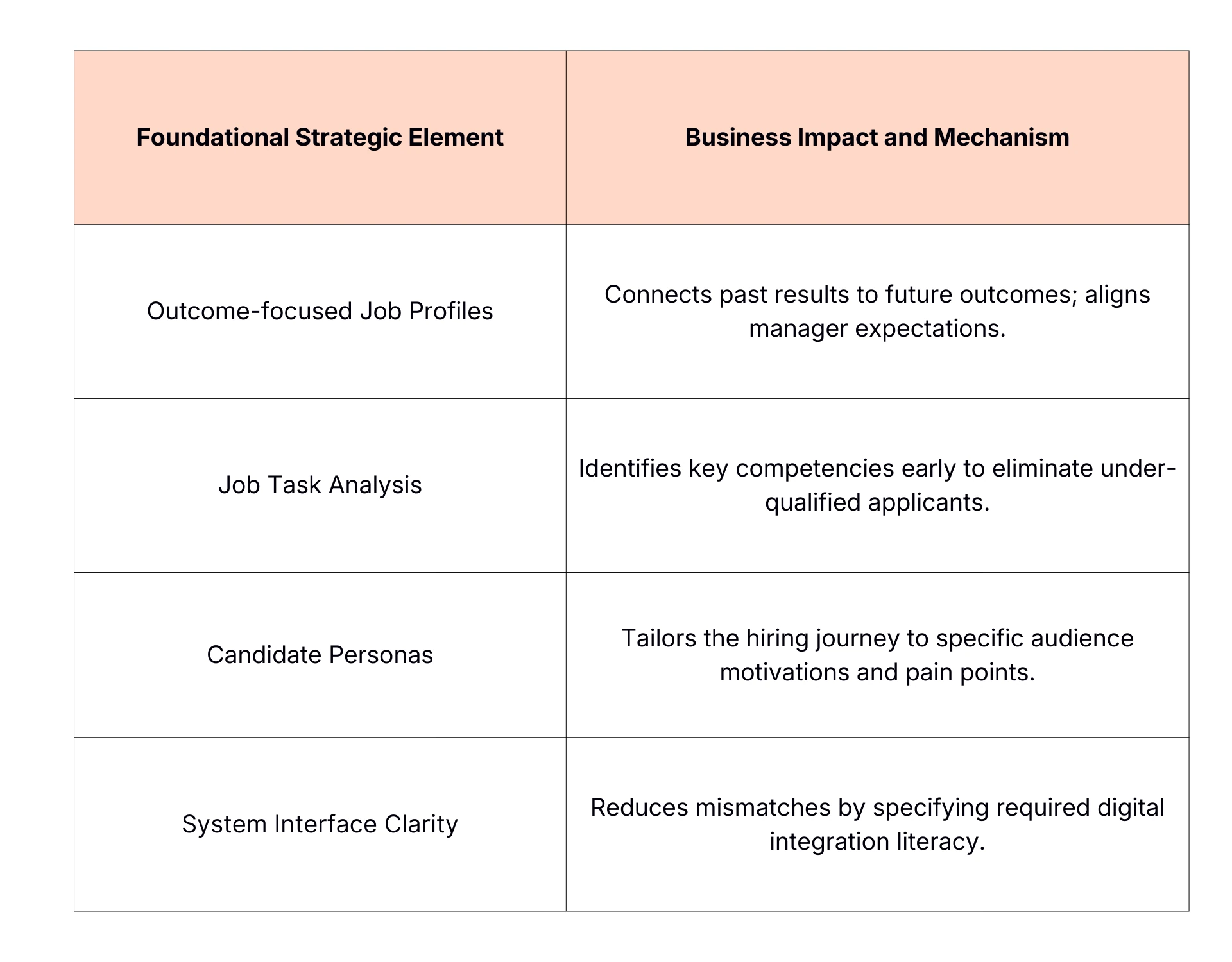
Moving from traditional hiring to a skills-first approach is a major change and means companies need to update their recruiting methods. The four steps below give a guide for organizations that want to modernize how they find talent.
Step 1: Identify and deconstruct role-specific skills
The first step is to go beyond general job descriptions and list the exact, proven skills needed for a role. This means working with hiring managers to separate "must-have" skills needed right away from "preferred" skills that can be learned later. Companies should consider both technical and soft skills, such as communication and teamwork.
Step 2: Redefine job postings to focus on capabilities
After identifying the required skills, companies should rewrite job descriptions to focus on skills rather than credentials. Research shows that skills-based job postings attract more applicants and get 42% more responses. Companies should clearly say that a college degree is not required and that they will consider other work, life, or educational experiences.
Step 3: Implement objective, data-driven assessments
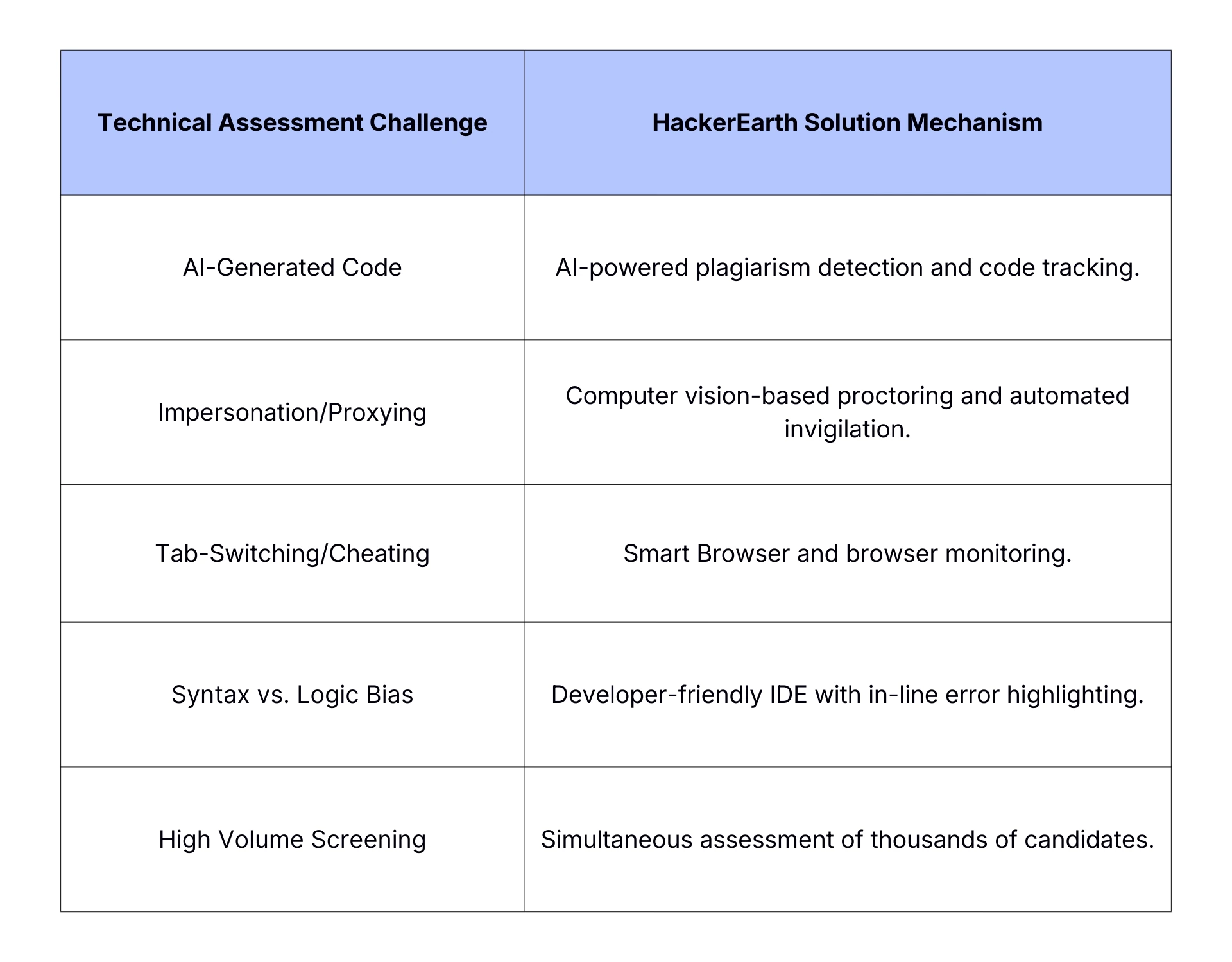
To ensure candidates have the right skills, companies should use practical tests rather than just reviewing resumes. Technical platforms like HackerEarth are key for this. With a library of over 40,000 questions, companies can build coding tests that mimic real job tasks. For interviews, tools like FaceCode let candidates pair-program in real time, demonstrating their logic and problem-solving skills more effectively than a traditional interview.
Step 4: Train hiring teams and align organizational culture
The last step is to train hiring managers and interviewers on why skills-based hiring matters and how to assess candidates with non-traditional backgrounds. Without this support, managers might still rely on first impressions or prefer candidates with elite degrees. Companies need to build a culture that values learning, potential, and adaptability as much as current expertise.
Step 5: Measuring success: the skills-based organization framework
A skills-based strategy is most effective when companies measure it with solid data. They should set up key performance indicators (KPIs) to track how well their new hiring methods are working.
.webp)
By tracking these numbers, HR teams can show the value of skills-based hiring and help the company keep investing in better ways to find and keep talent.
Conclusion
The global talent market is changing for good. Relying on educational pedigree is now outdated. Today, successful organizations are those that recognize talent in all forms, whether it comes from an Ivy League classroom or a self-taught project on GitHub.
By using skills-based hiring, companies can fix talent shortages, hire better people, lower recruitment costs, and build a more loyal and diverse workforce. This is not just an HR strategy; it is a key part of modern organizational strength. As the job market gets tighter, the ability to spot "STARs" in the talent pool will set the best leaders apart.
Frequently asked questions regarding skills-based hiring
Does skills-based hiring mean we are ignoring education?
No. It means education is no longer used as an exclusive filter. Degree holders are still considered, but they must demonstrate their skills alongside non-degreed candidates.
How do we verify soft skills through this method?
Soft skills like resilience, collaboration, and communication are assessed through structured behavioral interviews and collaborative coding sessions like HackerEarth FaceCode.
What if a job legally requires a degree?
In roles where a degree is "legally mandated" (e.g., certain healthcare or legal positions), the requirement remains. However, for most corporate and technical roles, skills-based evaluation is the priority.
Is skills-based hiring only for technical roles?
While it is common in tech, it is rapidly expanding to healthcare, financial services, retail, and government administration.
How long does it take to implement?
A pilot program in one department can be launched in a few weeks, with full organizational adoption taking several months as cultures and tools are updated.
Are there tools for non-technical skills-based hiring?
Yes, there are platforms for behavioral assessments, language proficiency, and soft skills evaluation that follow similar skills-first principles.
Why do hiring managers often resist this change?
Resistance often stems from a lack of confidence in alternative signals. Providing managers with objective data from tools like HackerEarth helps build that confidence.
.webp)
.webp)
.webp)



.webp)
.webp)